
The Benefits of Owning a Pashmina Shawl
Beyond the scarf — why a true pashmina shawl is not an accessory, but a generational asset.
A cashmere scarf is a luxury. A pashmina shawl is something else entirely. While both originate from the same high-altitude world of Capra hircus, the shawl exists in a different category of possession — one that borders on the sacred.
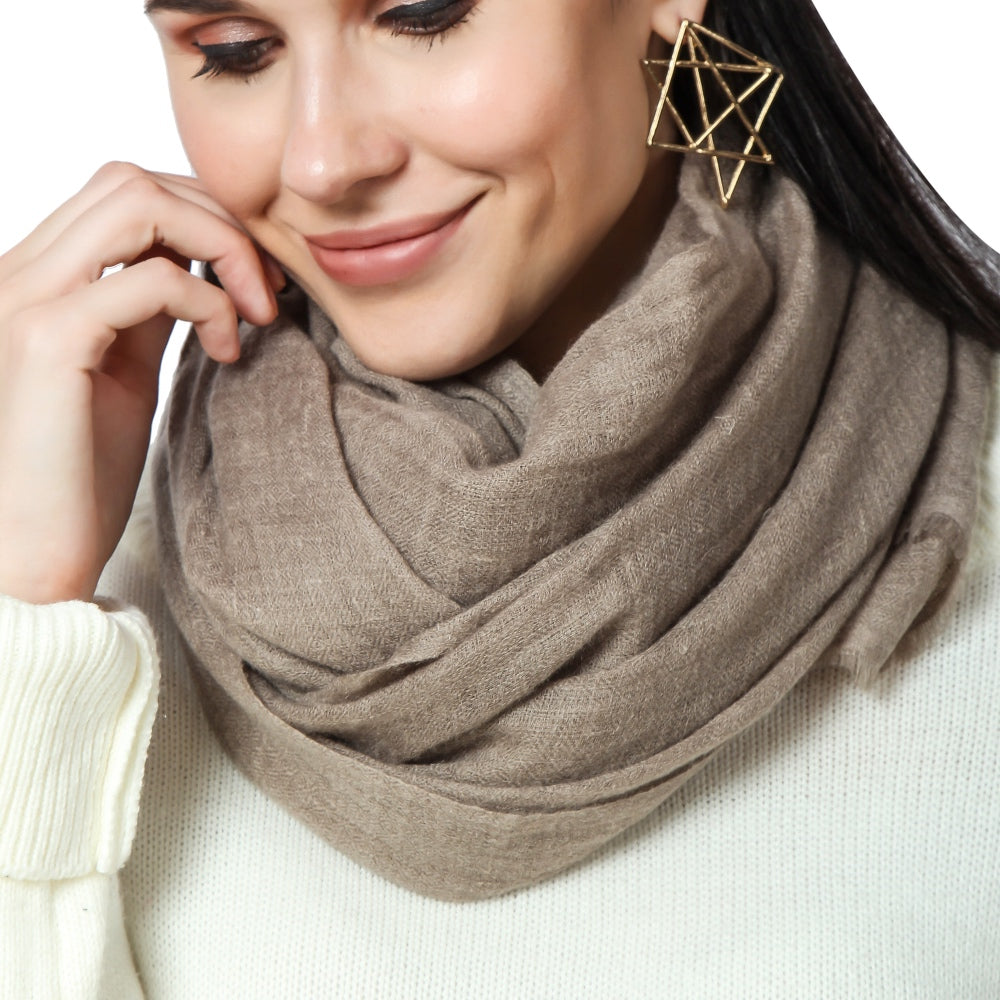
A scarf is tied around the neck. A shawl is draped across the shoulders, wrapped around the body, or laid over an evening dress. A scarf is worn. A shawl is inhabited. The shift in format, size, and cultural weight transforms it from a cold-weather accessory into a statement of discernment, a wearable work of art, and, ultimately, an heirloom.
The benefits of owning a pure pashmina shawl extend far beyond the considerable benefits of cashmere. They encompass art history, textile physics, generational legacy, and a rare kind of sartorial sovereignty that no other garment can provide.
1. The Apex of the Textile Hierarchy
Textiles have a hierarchy. At the base lies cotton — democratic, serviceable, ubiquitous. Above it sits linen, then silk, then standard wool, then merino, then grade-A cashmere. At the very summit, occupying a space so refined it is almost unreachable by mass production, sits the Kashmiri pashmina shawl.
The difference between cashmere and pashmina is not a matter of degree but of kind. Pashmina fibre — harvested from the Changthangi goat at 12,000 feet in Ladakh — measures just 12 to 14 microns in diameter. This is not merely "softer" than standard cashmere (14–19 microns); it crosses a perceptual threshold. Your skin cannot detect individual pashmina fibres. The fabric ceases to feel like a fabric at all.
When you own a pashmina shawl, you own the finest wearable textile that human hands can produce. There is no upgrade path beyond it. This is the ceiling. Owning it means your collection is complete.
The science behind this softness lies in the fibre's cuticle structure and extreme fineness. Below 15 microns, fibres fail to trigger the mechanoreceptors in human skin responsible for detecting texture. You do not feel softness. You feel nothing — which, in textiles, is the ultimate sensation.
2. The Drape Deficit: What Scarves Cannot Do
A scarf, by virtue of its size (typically 180cm × 70cm), is structurally constrained. It can be wrapped, knotted, or looped. Its relationship with your body is limited to the neck and upper chest. It is fundamentally a linear garment.
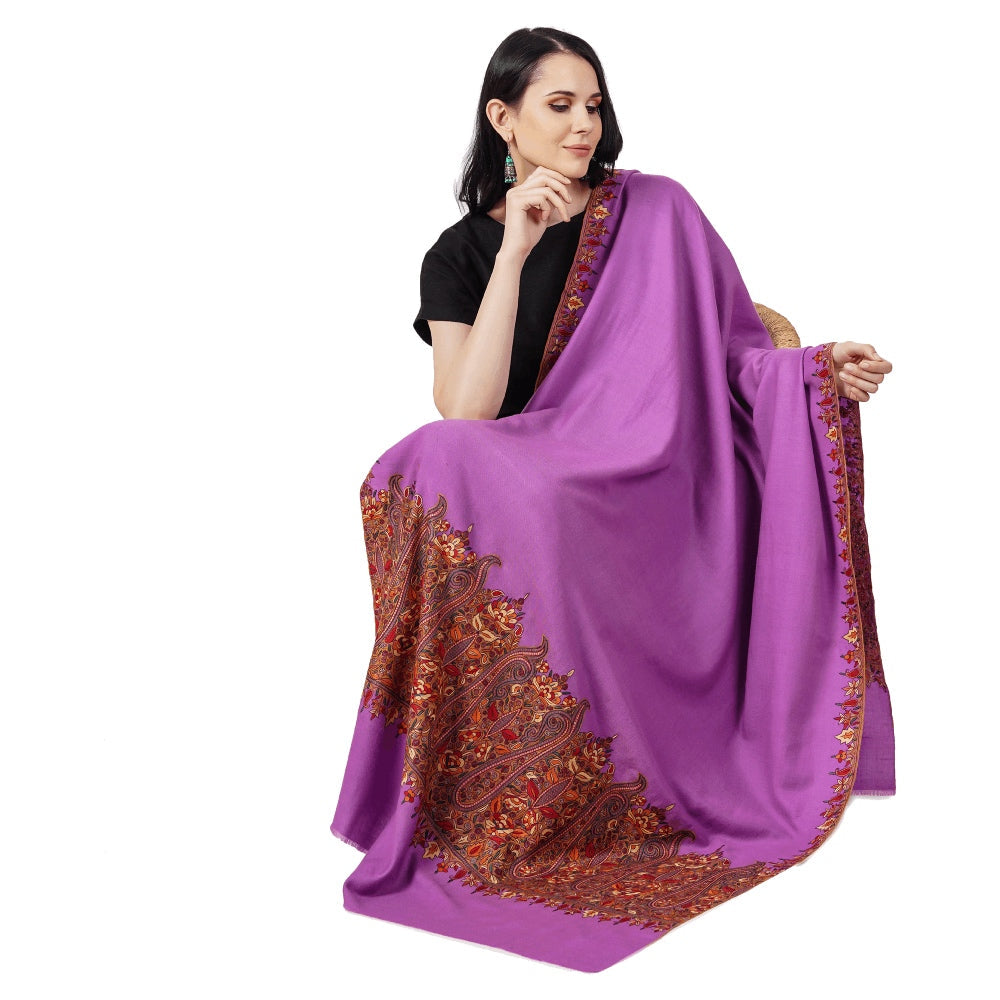
A pashmina shawl (typically 200cm × 100cm or larger) exists in two dimensions. It can do everything a scarf can do, but it can also do what no scarf can: it can drape. And drape is the single most important quality in luxury textiles.
Drape is the way fabric falls under its own weight. It is the cascade of folds when a shawl is placed over the shoulders. Machine-spun cashmere, regardless of fibre quality, has a slightly stiff drape — the high-speed spinning process twists the yarn tightly, reducing its natural flow. Hand-spun Kashmiri pashmina, processed on a traditional yander, preserves the fibre's natural waviness, producing a drape that is often described as "liquid."
When you drape a handmade pashmina over an evening dress or a tailored suit, it does not sit on your shoulders — it collaborates with your body. It follows your movements with a lag that suggests weightlessness. It creates folds that catch light differently with every shift in posture. No other garment format can replicate this effect.
3. A Canvas for Master Artisans
A cashmere scarf is usually plain. A pashmina shawl, by contrast, has historically been treated as a canvas. And the artists who work on this canvas are among the most skilled textile artisans on earth.
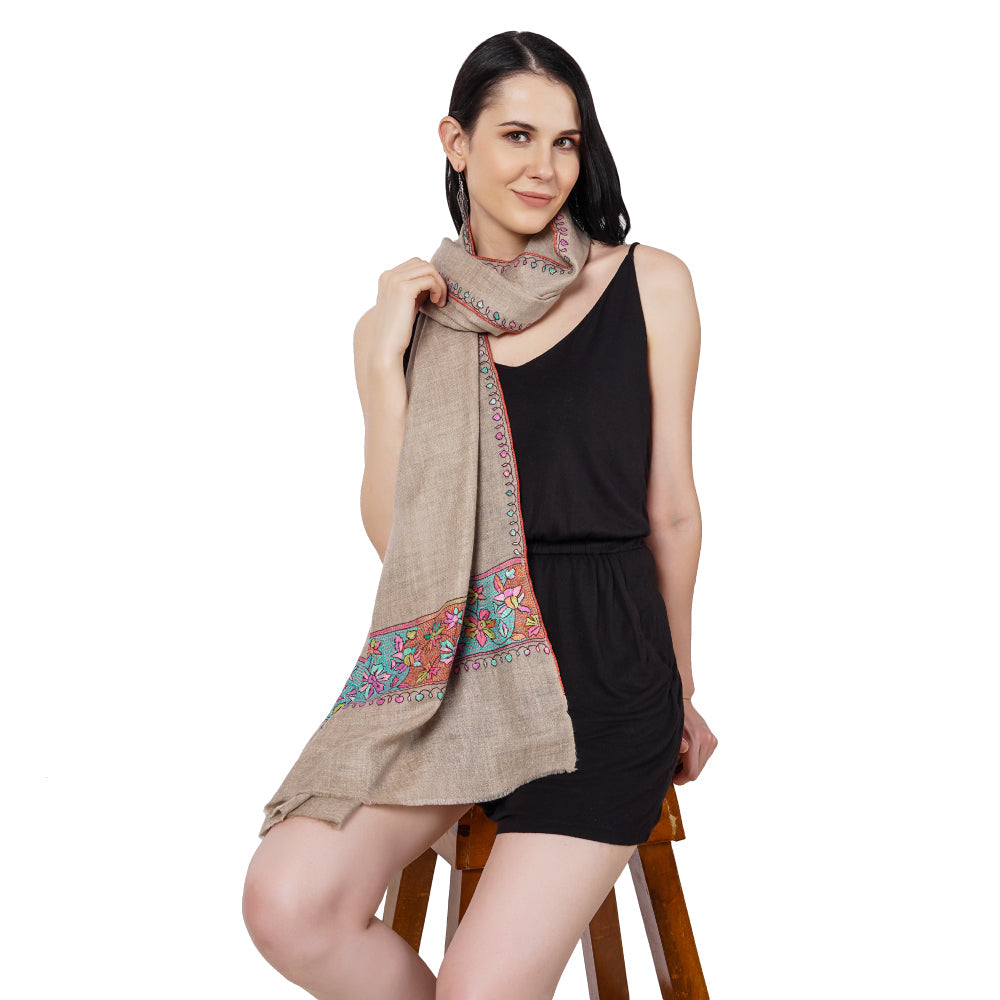
Needlework so fine that the embroidery appears woven into the fabric rather than sitting on top. A master artisan works with a single hair of pashmina yarn, creating patterns of extraordinary intricacy. A single shawl can take three to six months to complete.
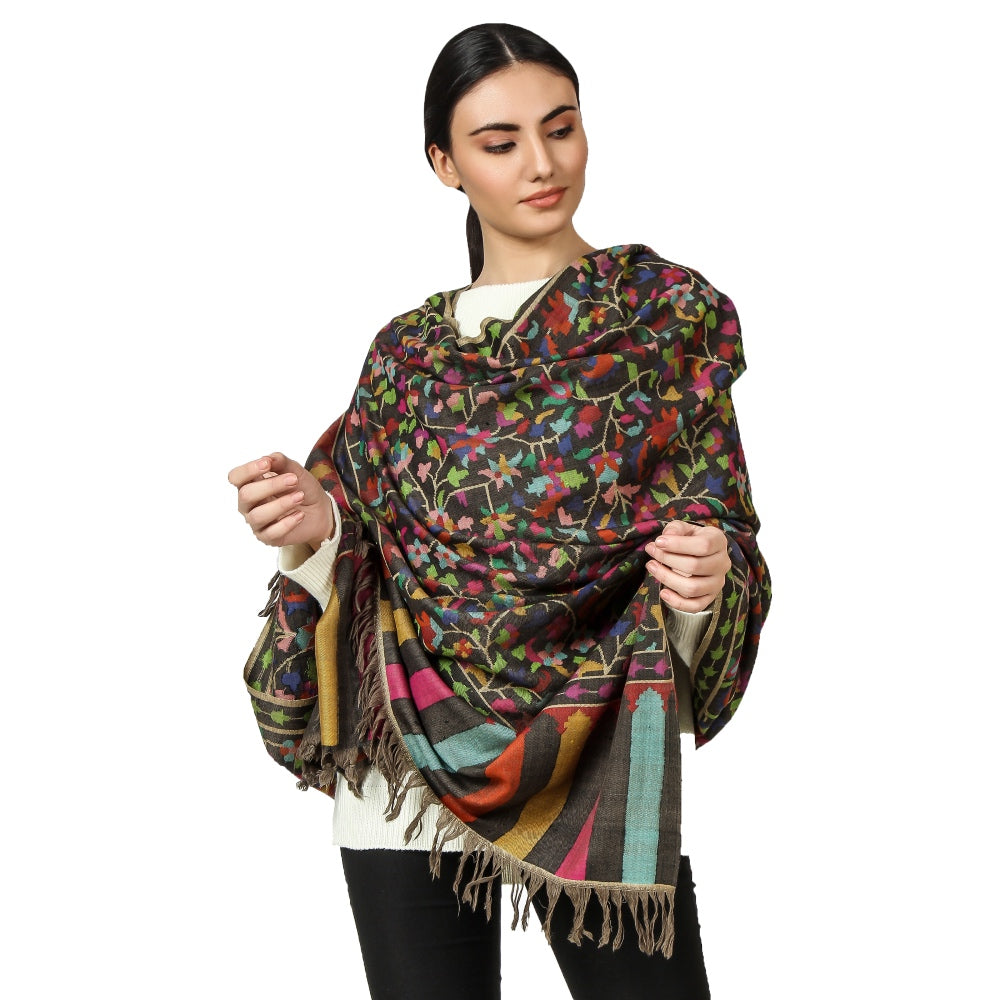
A weaving technique where patterns are created by the loom itself, using hundreds of wooden bobbins (kanis) each carrying a different coloured thread. A single Kani shawl can require over a thousand bobbins and take up to eighteen months — among the most complex textile techniques ever devised.
Large-scale, Mughal-inspired patterns that cover the entire surface. Jamawar shawls carry the visual density of a Persian miniature painting translated into textile form — the pinnacle of Kashmir's artistic heritage.
The process of making these shawls is closer to fine art than garment manufacture. When you own an embroidered pashmina, you are wearing a specific artist's vision, executed over months, that can never be exactly replicated.
Explore our collection of hand-embroidered and plain Kashmiri pashmina shawls — each one a unique creation.
Explore Pashmina Shawls4. Generational Anchoring: The Heirloom Factor
Very few modern possessions are designed to outlast their owner. A car depreciates to zero. Electronics become obsolete within a decade. Even fine clothing eventually shows its age. We live in a culture of consumption, not accumulation.
A pashmina shawl is a deliberate exception. The history of cashmere in Kashmir includes shawls from the 18th and 19th centuries that remain structurally sound and visually stunning today — over two hundred years after they were woven. These pieces now sell at international auction for extraordinary sums.
A genuine Kashmiri pashmina, properly cared for, will last not years but generations. It will soften with age. It will develop a patina unique to your wearing patterns. It will become a personal artefact that carries your history — your travels, your occasions, your quiet evenings — woven into its fibres.
"There is a specific kind of satisfaction — deeper than novelty, more enduring than pleasure — that comes from owning something you will never need to replace. It is the satisfaction of permanence in a world of disposables."
Whether a pashmina is worth it depends on the timeframe. Measured against a single season, the price is high. Measured against a lifetime — or your children's lifetime — the price is almost absurdly low.
5. Weightless Insulation: The Science of Warmth Without Mass
A shawl provides more coverage than a scarf — it encompasses the shoulders, upper back, and arms. With standard textiles, this additional coverage comes with proportional weight and bulk. Pashmere defies this relationship.
A full-size pashmina shawl typically weighs between 200 and 400 grams — less than a small bottle of water. Yet it provides insulation that surpasses woollen shawls weighing two to three times as much. The larger surface area means more microscopic air pockets, more trapped still air, and more consistent insulation across your upper body.
For those seeking the best cashmere for winter warmth, a pashmina shawl worn over a coat provides formidable thermal performance that is effectively imperceptible in terms of weight.
6. Cultural Authority: The Weight of Heritage
Certain objects carry cultural authority. A Patek Philippe tells time, but it is not about time. A first edition tells a story, but it is not about the story. A Kashmiri pashmina shawl provides warmth, but its significance extends far beyond thermoregulation.
For six centuries, the pashmina shawl has been one of the world's most recognised symbols of refinement. Mughal emperors wore them as badges of sovereignty. French Empress Joséphine owned hundreds. The shawl appeared in European portraiture and Persian miniature painting as a consistent marker of the highest social standing.
When you wear a pashmina shawl to a formal event, a gallery opening, or a fine restaurant, you are tapping into a six-hundred-year vocabulary of elegance. It signals, without a word, that you understand the difference between price and value, between fashion and style, between acquisition and curation.
Many wonder why Kashmiri pashmina commands such prices. The answer is not the raw material alone — it is the 600-year cultural lineage embedded in every piece. You are purchasing textile sovereignty.
7. The Ethical Equation: Preservation Through Purchase
The Kashmiri pashmina industry is in crisis. Machine-made imitations — often labelled "pashmina" despite containing no pashmina fibre — have flooded the market, destroying the economic viability of handcraft. The number of active master weavers in Kashmir has declined dramatically. Techniques that took centuries to perfect are at risk of extinction within a generation.
When you purchase a genuine Kashmiri pashmina shawl, you are directly funding the survival of one of humanity's most extraordinary textile traditions. Your purchase pays a hand-spinner (almost always a woman working from her home). It pays a weaver. It pays a master embroiderer. It sustains communities whose entire livelihood depends on this craft.
The question of whether cashmere is sustainable and ethical has a uniquely clear answer in Kashmir: a production system using minimal energy, zero chemical runoff, no harm to animals, and dignified human labour. The benefit is twofold — extraordinary quality and ethical integrity.
Our luxury cashmere and pashmina collection is sourced directly from artisan families in Kashmir.
Shop Pure Pashmina ShawlsThe Shift from Consumer to Custodian
There is a moment, usually after the first or second wearing, when the owner of a genuine pashmina shawl undergoes a subtle shift in perception. They stop thinking of it as something they bought and start thinking of it as something they hold — temporarily, on behalf of the next generation.
This shift — from consumer to custodian — is the defining benefit of owning a pashmina shawl. It introduces the concept of stewardship into your wardrobe. It asks you to consider not just "Does this look good on me?" but "Will this outlast me?"
Very few modern purchases prompt this question. A pashmina shawl does, because it was built to survive the asking. It was hand-spun by a woman who learned from her mother, who learned from hers, in an unbroken chain reaching back centuries. It carries a weight of human effort and cultural memory that no factory can replicate.
This only applies to genuine Kashmiri pashmina. The market is saturated with machine-made approximations. Testing cashmere quality at home is essential. Understanding what real pashmina should cost is equally important — because a £50 "pashmina shawl" online is a different object entirely.
Choose the real thing. Choose the cashmere and pashmina that justifies the word "heirloom." Choose the piece that changes not just how you look, but how you think about what you own.
Frequently Asked Questions
Size, format, and cultural weight. A scarf is typically 180×70cm for the neck. A shawl is 200×100cm or larger, designed to be draped over the shoulders or wrapped around the body. Shawls are also the traditional canvas for Kashmiri embroidery (Sozni, Kani, Jamawar), which scarves rarely feature.
In experiential terms, absolutely — it delivers increasing satisfaction over 15–20+ years. In financial terms, antique Kashmiri shawls consistently appreciate at auction. While a modern shawl is not primarily a financial instrument, its residual value remains significant as global supply of authentic handcrafted pashmina shrinks.
Yes. A plain shawl in charcoal, camel, or navy over a simple jumper transforms casual attire without looking ostentatious. Reserve heavily embroidered pieces for occasions where they can be properly appreciated.
The most elegant method is the simple shoulder drape: unfold fully, place across your shoulders from back to front, and let it fall naturally. For a secured fit, fold diagonally into a triangle and drape over one shoulder. The fabric's natural drape does most of the work — avoid forcing folds.
Fold in tissue paper (never plastic) and store flat in a breathable cotton bag. Add natural cedar or lavender to deter moths. Store cool and dry, away from sunlight. Never hang — gravity will distort its shape over time.
Because the embroidery is executed entirely by hand, often taking months. A master Sozni artisan may work on a single shawl for six months using a single pashmina thread as a "needle." Kani shawls require over a thousand bobbins and up to eighteen months of loom work. You are paying for human time at the highest level of textile artistry.
Choose a piece that will define your collection — and outlast it.
PASHWRAP — Authentic Kashmiri Pashmina & Cashmere
Handcrafted in the Valley. Delivered to Your Door.