

Our Mission
Pashwrap exists to preserve the integrity of Himalayan cashmere — from its source in Changthang to its weaving in Kashmir — by working slowly, honestly, and entirely by hand.
About Pashwrap
A Geography, Not a Product
Pashwrap was founded to preserve the integrity of one of the world’s rarest textile traditions — Himalayan Pashmina. Not as an interpretation, not as a modern substitute, but as it has existed for centuries.
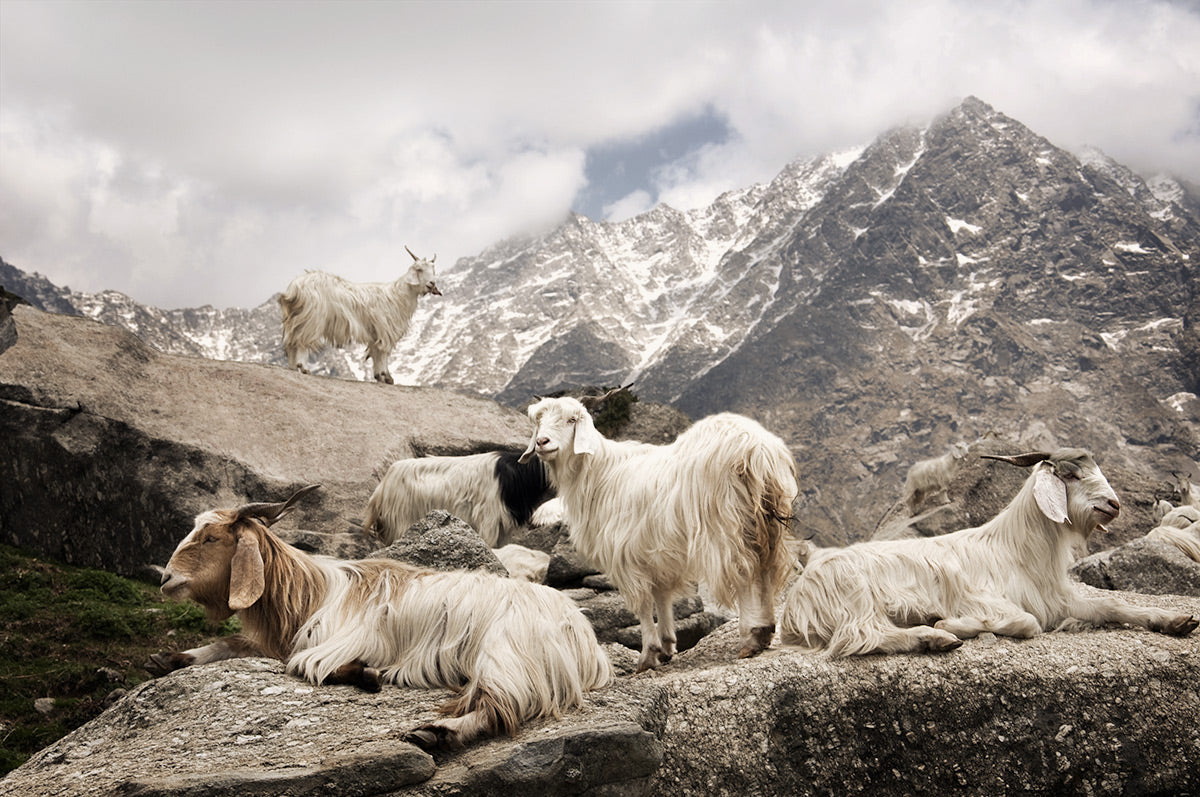
True Pashmina begins far from fashion capitals. On the high-altitude Changthang plateau, where winters are unforgiving and survival depends on adaptation, Changthangi goats develop an exceptionally fine underfleece. This fibre, collected once a year during the natural molting season, is the origin of everything we create.
From Changthang to Kashmir
At Pashwrap, our work follows a single, uninterrupted path.
The fibre is hand-combed in Changthang, then transported to Kashmir, where it is hand-spun and woven by skilled artisans using traditional wooden looms. No stage of the process is industrialised. No step is rushed.
This continuity — from source to finished piece — is what defines authenticity. It is also what limits scale. We accept these limits as part of the craft, not constraints to overcome.
Craft Over Scale
Every Pashwrap piece is created slowly. The spinning, weaving, and finishing of a single scarf can take weeks, shaped by human hands rather than machines.
Subtle variations in texture and weave are not corrected or concealed. They are the natural result of handwork and serve as a quiet record of the people who made the piece.
We work directly with artisan families in Kashmir, supporting the continuity of knowledge that has been passed down through generations.
Why We Exist
In a world driven by speed and volume, true Pashmina is increasingly rare. The fibre cannot be farmed intensively. The craft cannot be automated. The process does not scale without losing its essence.
Pashwrap exists to protect this balance — between material, maker, and time.
We produce only what the season and the craft allow, creating objects meant to be worn, kept, and valued over decades.
A Quiet Commitment
We do not follow trends, seasonal colour cycles, or mass production calendars. Each piece is released when it is ready, not when the market demands it.
This restraint is intentional. It allows us to remain faithful to the material, respectful to the artisans, and honest with those who choose to wear Pashwrap.
Handwoven in Kashmir
Every Pashwrap is accompanied by a provenance record detailing its origin and weave. This is not a mark of reassurance, but a continuation of transparency — a way of documenting a journey that begins in the Himalayas and ends with the wearer.
Pashwrap creates cashmere without excess, without shortcuts, and without compromise.
The PASHWRAP difference
Cashmere from Ladakh (Himalayas)
Cashmere from Ladakhi Chaganthari goats who live in conditions where the temperature goes down to -50°C, is superior to the Cashmere produced anywhere else in the world and accounts only for 0.5% - 1% of the total cashmere production annually.
Ethical Cashmere
PASHWRAP sources authentic high quality Cashmere from Himalayan region of Ladakh. We support the local herder community by sourcing exclusively Hand-combed Cashmere which is cruelty free Cashmere as no Goats are harmed while harvesting of Cashmere.
Sustainable Fashion
When we think of cashmere’s sustainability, it’s important for us to realise that it is a natural fabric that is biodegradable and often doesn’t require toxic chemicals to process it (both of which make it attractive option for sustainable shoppers.
100% Handmade
For centuries, the region of Kashmir has acquired unparalleled expertise in weaving Cashmere. The resulting natural yarn post spinning is then hand woven on traditional wooden looms using ancestral techniques. One of the most popular woven patterns, and for making the finest Cashmere, is bird's eye (Bulbul) or the diamond pattern.
History of Heritage
European first experienced this material in Kashmir, they coined the word Cashmere from there only. The Cashmere Industry which was built in fifteenth century by then ruler Zayn-ul-Abidin after he brought Persian weavers to Kashmir. Indeed, even the word Pashmina came from the Persian word Pashm that implies fleece.
Traditional Sozni Needle Work
The hand embroidery is an Art mastered by only few skilled traditional Kashmiri artisans. Kashmiri Artisans are inspired from Natural beauty of Kashmir and it reflects in their art work as the most recognized motif is of Paisley. Unlike factory produced wraps, Our products are one of a Kind as no design of embroidery is replicated.
We Pay it Forward
Herders, weavers, and artisans play an essential role in our society. Their skills and dedication are invaluable to us, and this is why we strive to pay them well. We understand the hard work they put into their craft, and we want to make sure they are rewarded for it. We believe that by paying them well, we are not only showing our appreciation but also encouraging them to continue doing what they do best. We also want to ensure that our herders, weavers, and artisans can live comfortably and enjoy the fruits of their labor. That's why we make sure that everyone in our team is paid fairly for the work they do.