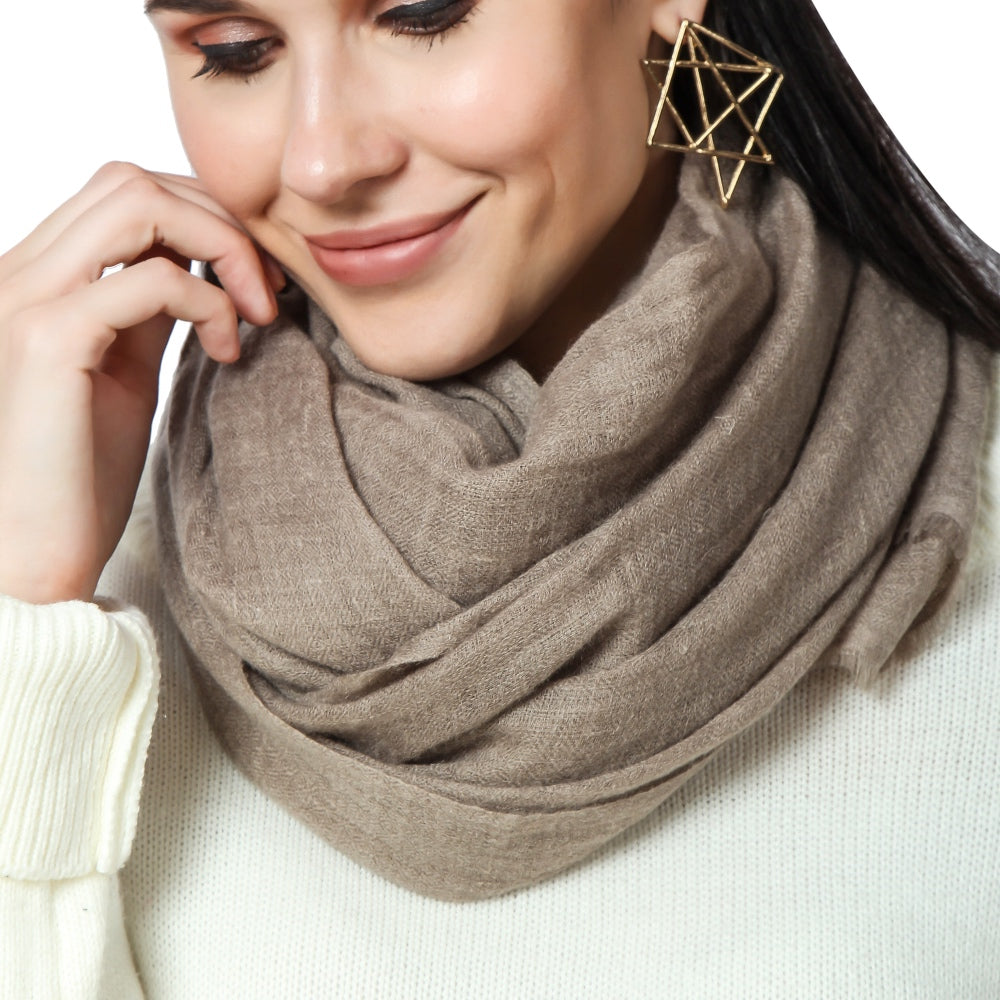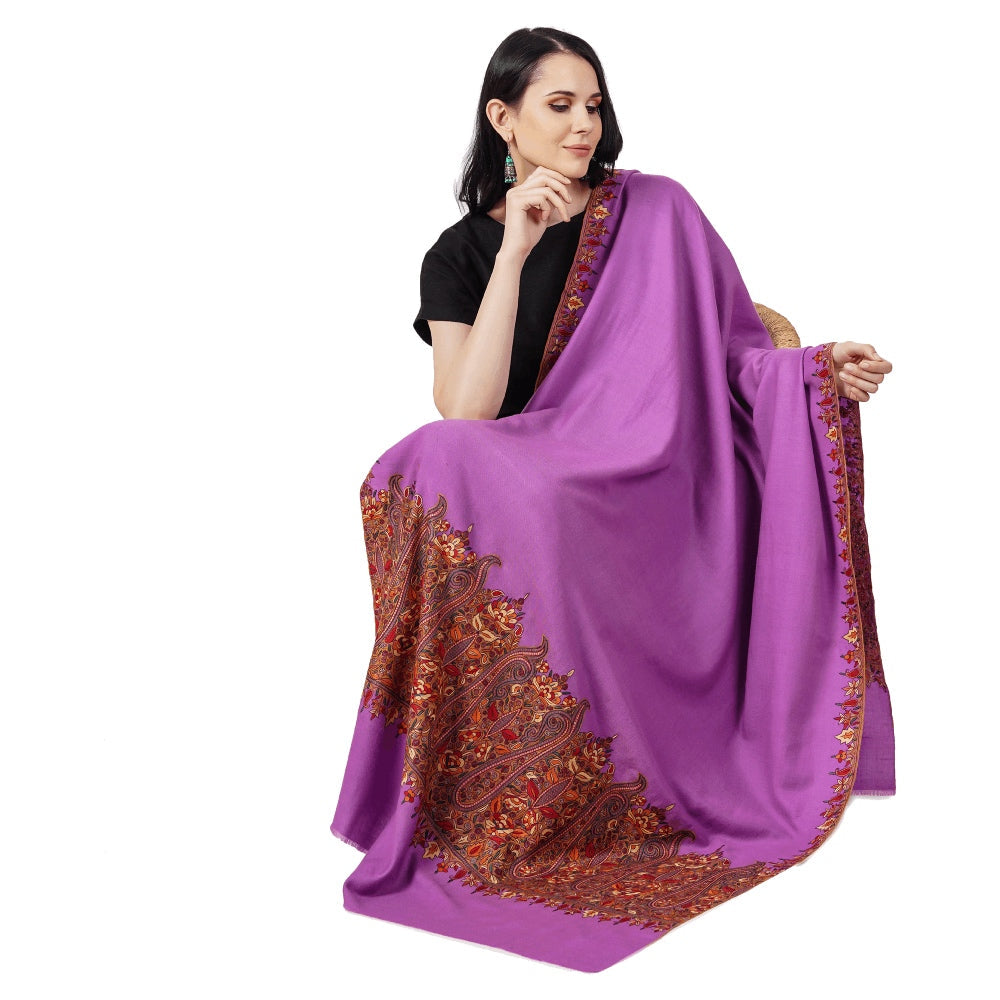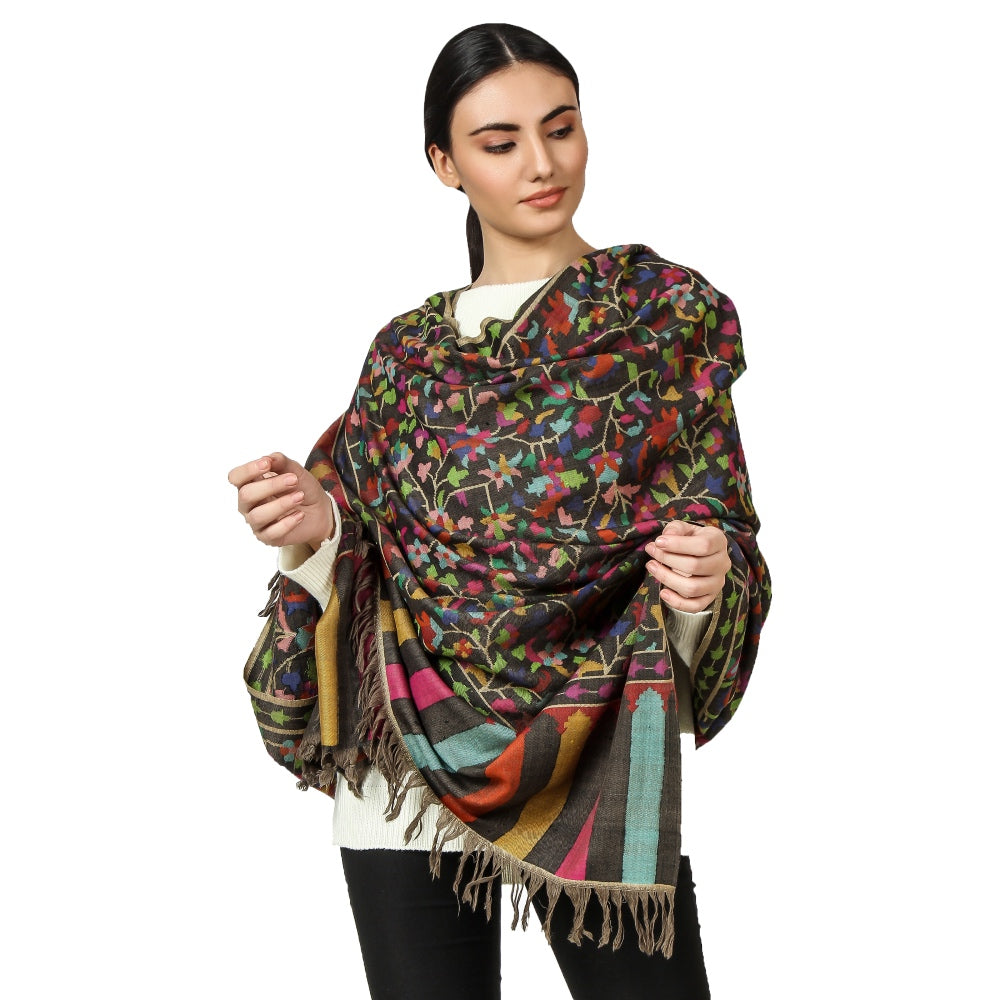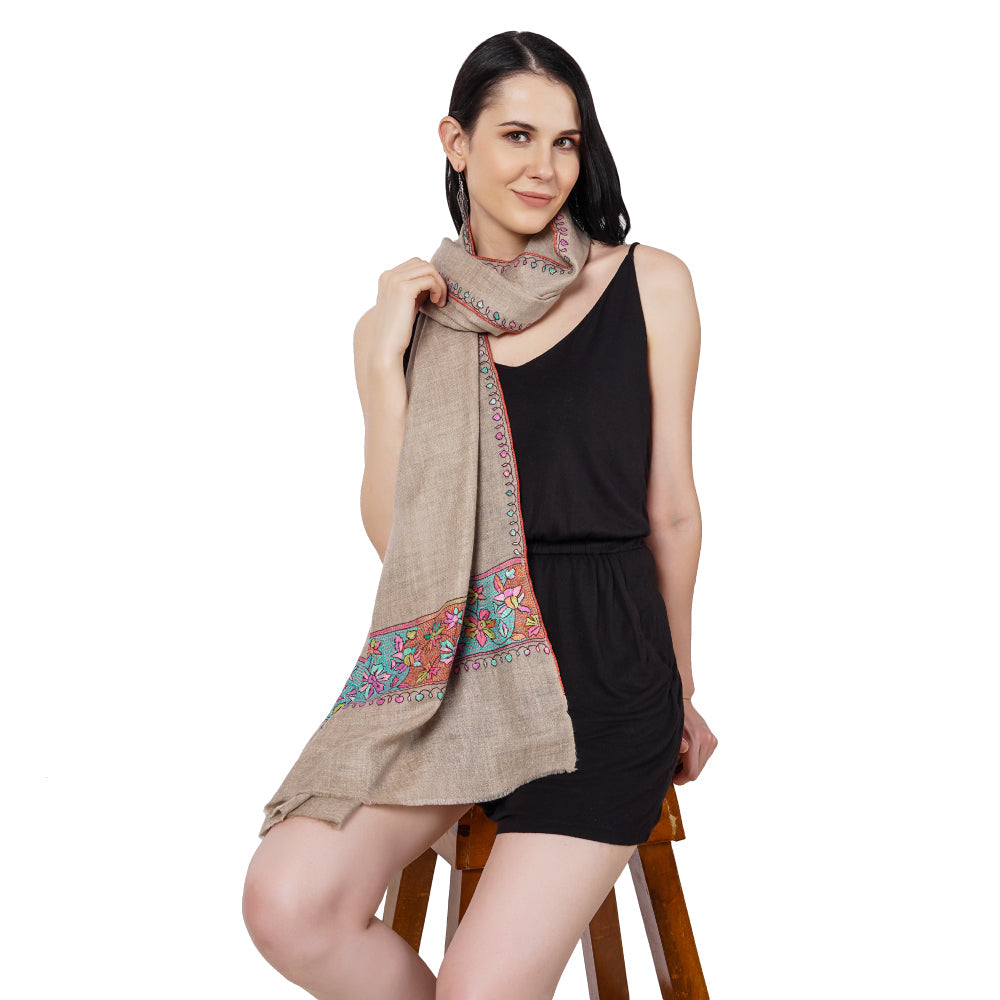

Why You Should Invest in a Cashmere Scarf?
The definitive case for owning one exceptional piece — instead of a dozen forgettable ones.
Walk into any department store this winter and you will find racks of scarves — acrylic, polyester, wool blends, "cashmere-mix" — priced between £15 and £40. They look acceptable. They serve a function. And by February, most of them will be languishing at the back of a drawer, pilling, fading, already forgotten.
Now consider a different scenario. You purchase a single luxury cashmere scarf — pure, handcrafted, from Kashmir. You wear it not just this winter, but the next ten. It drapes better each year. It softens with age. It becomes, in a very real sense, yours.
Which was the better purchase?
The answer feels intuitive, yet most buyers never make the calculation explicitly. This article does. What follows is the complete, unvarnished case for investing in a cashmere scarf — built not on aspiration alone but on economics, material science, sustainability, and the quiet power of owning something genuinely excellent.
The Cost-Per-Wear Reality: A Simple Calculation
Luxury purchases feel expensive at the moment of transaction. This is by design — the price tag creates friction, and friction creates doubt. But the relevant metric is not total cost. It is cost per wear.
Consider the arithmetic:
The question of whether a cashmere scarf is worth it resolves itself with basic arithmetic. The Kashmiri cashmere scarf is not more expensive — it is 37% less expensive per wear. And this calculation does not account for the immeasurable cost of wearing something inferior: the discomfort, the aesthetic compromise, the quiet dissatisfaction of wrapping yourself in something that feels ordinary.
The math only improves over time. A well-maintained Kashmiri pashmina can last beyond fifteen years. At that point, the cost per wear drops below £0.28 — making it cheaper than virtually any alternative on the market.
Decades, Not Seasons: The Longevity of Real Cashmere
Fast fashion has trained us to think of accessories as disposable. A scarf is something you buy in October and donate by March. This cycle is not inevitable — it is a consequence of using inferior materials.
Real cashmere, specifically cashmere scarves made from grade-A fibre with proper craftsmanship, operates on an entirely different timeline. The reasons are rooted in the material itself:
Despite its ethereal softness, cashmere fibre is remarkably strong. The science behind cashmere softness lies in the fibre's internal structure — the medulla (core) and cuticle (outer scale layer) create a material that is simultaneously fine and resilient. Unlike merino wool, which can become brittle over time, quality cashmere maintains its structural integrity for decades.
Cashmere fibres can stretch up to 30% of their length and return to their original shape. This means a well-made cashmere scarf does not sag, bag, or lose its form — even after years of being knotted, wrapped, and stored. Machine-spun cashmere loses much of this elasticity during high-speed processing. Hand-spun Kashmiri cashmere retains it.
Unlike synthetic fibres, which degrade with each wash, and unlike most wools, which stiffen, genuine cashmere actually becomes softer with proper care. The fibres smooth and settle over time, developing a patina — a unique texture that is specific to you and your wearing habits. A ten-year-old cashmere scarf feels better than a new one. This is virtually unheard of in textiles.
"A cashmere scarf is one of the few possessions that improves with time — like a well-seasoned cast iron pan, like a leather bag that has moulded to your body, like a marriage that has been tested and deepened. It becomes more yours with every wearing."
Our cashmere scarves are crafted to be worn for a decade or more — not discarded after a season.
Explore Cashmere ScarvesVersatility Redefined: One Scarf, Infinite Expressions
Most accessories are constrained by context. A statement necklace belongs at evening events. A woollen beanie belongs on ski slopes. A silk pocket square belongs in a suit jacket. A cashmere scarf belongs everywhere.
This is not hyperbole. Consider the range:
No other accessory at any price point offers this breadth of application. A pure pashmina shawl in a neutral tone — ivory, charcoal, camel — can be worn with virtually everything in your wardrobe, from denim to black tie. This is not versatility in the marketing sense. It is versatility born from the material's inherent qualities: its drape, its weightlessness, its ability to complement rather than compete with whatever it is paired with.
Comfort That Has No Equal
We have become accustomed to a very specific kind of winter discomfort: the woollen scarf that feels fine for the first five minutes but begins to prickle at the neck as the fibres rub against sensitive skin. The polyester blend that traps heat but never quite feels warm — because warmth is not just about temperature retention, it is about how a material interacts with your body.
Cashmere eliminates this entirely. And the reason is not marketing — it is physics.
The Warmth-to-Weight Ratio
Cashmere fibres are extraordinarily fine — as low as 12 microns for the finest Kashmiri pashm. This fineness means the fibres can be spun into a yarn that traps a remarkable volume of still air within its structure. Still air is the world's best insulator (this is why double-glazing works). A cashmere scarf weighing just 150 grams can outperform a merino wool scarf weighing 300 grams. You feel wrapped in warmth without feeling weighted down.
This is particularly relevant for the best cashmere scarf for winter — the season when you are layering heavily and do not want additional bulk around your neck. Cashmere provides maximum insulation with minimum weight. It is the textile equivalent of high-performance aerogel insulation used in aerospace — except it has been around for six hundred years and feels impossibly soft against your skin.
The Absence of Irritation
Wool fibres above 25 microns are perceptible to human nerve endings — this is why coarse wool itches. Cashmere, at 12–15 microns, falls below this threshold. Your skin literally cannot detect individual cashmere fibres. The sensation is not "soft" in the way that a cotton t-shirt is soft. It is absent — the fabric disappears, leaving only warmth. This is why people who cannot tolerate any wool can wear cashmere against bare skin without discomfort.
Thermoregulation
Unlike synthetic materials, which either trap heat excessively (causing perspiration) or fail to insulate at all, cashmere is naturally thermoregulating. It breathes. It adapts. When you step from a heated building into a cold street, a cashmere scarf adjusts its insulation properties within minutes. When you return indoors, it releases excess warmth rather than suffocating you. This is not a feature added through technology — it is inherent to the fibre's structure, evolved over millennia in goats surviving extreme temperature swings on the Tibetan plateau.
The Sustainability Argument: Buying Less, But Better
The fashion industry produces approximately 100 billion garments per year. The average garment is worn fewer than seven times before disposal. Scarves and accessories follow a similar pattern — particularly at the lower end of the market, where low prices encourage volume purchasing and rapid replacement.
Investing in a single cashmere scarf directly contradicts this cycle. And in doing so, it becomes — perhaps counterintuitively — one of the most sustainable choices you can make in fashion.
One cashmere scarf worn 600 times over fifteen years replaces approximately ten synthetic or low-quality wool scarves. That is ten fewer items manufactured, dyed, packaged, shipped, and eventually landfilled. The environmental footprint of a single well-made cashmere scarf — even accounting for goat farming and water usage in processing — is dramatically lower than the cumulative footprint of the disposable alternatives it displaces.
But sustainability in cashmere is not only about longevity. It is also about how the fibre is sourced. And here, the origin of your cashmere becomes critical.
Industrial cashmere farming — particularly in parts of China and Mongolia where herding has been intensified to meet global demand — has caused genuine environmental damage: overgrazing, desertification, and the degradation of fragile grassland ecosystems. When you buy cheap cashmere, you are indirectly funding this degradation.
Kashmiri cashmere, by contrast, operates on an entirely different model. The Changthangi goat is herded by nomadic Changpa communities at extremely low density across the vast Changthang plateau. The goats are not farmed intensively — they roam freely, grazing on naturally occurring vegetation. The question of sustainable cashmere has a clear answer when applied to the Kashmiri supply chain: it is one of the most ecologically balanced fibre production systems in the world, precisely because it has not been industrialised.
Buying one Kashmiri cashmere scarf instead of ten factory-made alternatives is not a small gesture. It is a deliberate rejection of the disposable fashion economy — and a direct investment in a production system that has sustained communities and ecosystems for centuries.
Every PASHWRAP scarf supports artisan families in Kashmir and sustains a centuries-old craft — while replacing a dozen disposable alternatives in your wardrobe.
Shop Kashmiri CashmereWhat Makes a Cashmere Scarf a Genuine Investment
The word "investment" is overused in fashion marketing. A £90 jumper from a high-street brand is not an investment. A "limited edition" sneaker produced in the thousands is not an investment. These are purchases — some better than others, but purchases nonetheless.
A genuine investment in fashion meets specific criteria. A Kashmiri cashmere scarf meets all of them:
A cashmere scarf becomes softer, more personal, and more comfortable with each wearing. Unlike a car that depreciates the moment you drive it off the lot, a cashmere scarf improves. The tenth year of ownership delivers a better experience than the first.
A well-chosen cashmere scarf in a timeless colour — ivory, charcoal, navy, camel — is immune to trends. It looked elegant in 1920, it looks elegant today, and it will look elegant in 2060. Fashion moves; style endures. Cashmere is style.
A Kashmiri pashmina is not a factory product. It carries the skill of a specific spinner, the vision of a specific weaver, the heritage of a community that has practised this craft for over six centuries. This cultural provenance does not depreciate — if anything, it becomes more significant as artisanal traditions become rarer.
A genuine Kashmiri pashmina in good condition retains significant resale value — particularly as global supply of authentic handcrafted cashmere shrinks. Antique Kashmiri shawls from the 18th and 19th centuries now sell for tens of thousands at auction. While a modern scarf will not reach those figures, it will not be worthless either — unlike a synthetic alternative that has zero secondary market.
Understanding what a real cashmere scarf should cost is the first step to recognising it as an investment rather than an expense. The price reflects not markup but the genuine cost of exceptional raw material and extraordinary human skill.
How to Choose a Cashmere Scarf That Deserves Your Investment
Not all cashmere scarves are created equal. The gap between the best and the worst is vast — and the price tag alone will not always tell you which is which. Here is what to evaluate:
Fibre Origin
As we have explored in our guide to the difference between cashmere and pashmina, origin is the single strongest predictor of quality. Kashmiri cashmere from the Changthangi goat offers the finest fibre diameter and the most skilled handcraft tradition. Mongolian cashmere is excellent but typically machine-processed. Chinese cashmere varies enormously and requires careful vetting.
Spinning Method
Hand-spun cashmere is qualitatively different from machine-spun cashmere. The gentler twist preserves fibre loft and produces a softer, more breathable fabric. If the brand does not specify spinning method, assume it is machine-spun — because any brand that has invested in hand-spinning will say so prominently.
Ply and Weight
For scarves, a 2-ply construction offers the ideal balance of warmth, drape, and durability. Single-ply is too fragile for frequent wearing. 3-ply or higher provides extra warmth but may sacrifice some drape. Weight should typically fall between 150 and 250 grams for a standard scarf — lighter indicates possible blending, heavier may indicate lower-grade fibre being used to compensate for lack of fineness.
Colour
For a first investment piece, choose a neutral: ivory, cream, charcoal, camel, or navy. These colours maximise versatility and will never look dated. Reserve deeper or more unusual tones — burgundy, forest green, saffron — for subsequent purchases once you have experienced the daily pleasure of wearing real cashmere.
The Seller's Transparency
A trustworthy seller will tell you where the fibre comes from, how it was processed, and who made the finished piece. They will welcome questions rather than deflect them. At PASHWRAP, every scarf comes with full provenance — from the plateau where the fibre was combed to the name of the weaving family. If a brand cannot provide this level of detail, you can verify cashmere quality at home through touch, burn, and drape tests — but the absence of transparency from the seller is itself telling.
For a first investment, we recommend our Luxury Cashmere Scarves in charcoal or ivory — 2-ply, hand-spun, hand-woven. These are the pieces our customers return to purchase in additional colours, year after year.
The Emotional Case: Why It Feels Different
There is a dimension to owning real cashmere that no cost-per-wear calculation can capture. It is the moment on a cold morning when you reach for your scarf and feel that specific softness — not the generic softness of a new garment, but the familiar softness of something that has been yours for years. It has your scent. It holds the shape of your knots. It has travelled with you.
This is not sentimentality manufactured by marketing. It is a genuine psychological response to owning something of enduring quality — something that rewards your attention, that improves with your care, that exists on a timeline measured in decades rather than seasons.
In a culture that encourages constant acquisition — new collections every week, new trends every month, new purchases to fill every perceived gap — there is a quiet power in owning something complete. Something that needs nothing added. Something that, when you reach for it, always delivers.
The history of cashmere in Kashmir stretches back over six hundred years. Mughal emperors wore it. French aristocrats coveted it. British colonial officers brought it home as the ultimate trophy of the East. Through all of this, the essential experience of wrapping yourself in genuine pashmina has remained unchanged — because the material is that good, and the craftsmanship is that refined.
When you invest in a cashmere scarf, you are not buying a trend. You are entering a continuum that spans centuries. That is worth something — something that no £30 high-street scarf can offer, no matter how clever the branding.
Frequently Asked Questions
Yes — when it is genuine, well-made, and properly cared for. The cost-per-wear analysis consistently favours quality cashmere over cheaper alternatives, and the experiential gap widens with each year of ownership. We have written a detailed examination of whether a cashmere scarf is worth it that breaks this down further.
A genuine Kashmiri cashmere scarf, stored properly and hand-washed with appropriate care, should last 10 to 15 years at minimum. Many last significantly longer. The critical factors are fibre quality (hand-spun Kashmiri pashm outlasts machine-spun alternatives) and care (no machine washing, no tumble drying, proper storage folded — never hung).
Absolutely. Cashmere is remarkably resilient for such a fine fibre. Daily wearing actually helps the fibres settle and soften. The key is to allow the scarf to rest between wears — do not wear the same scarf seven days consecutively. Having two quality scarves in rotation is ideal.
Charcoal or ivory. These two colours offer maximum versatility — charcoal pairs with virtually everything and adds sophistication to casual outfits, while ivory provides elegant contrast against dark coats and suits. Once you have experienced daily cashmere wearing, expand into camel, navy, and deeper tones.
Touch it — genuine cashmere is immediately soft, not gradually soft after washing. Check the seller's transparency — can they tell you the fibre origin and processing method? Testing cashmere quality at home includes the burn test (pure cashmere burns like hair and crumbles to ash) and the drape test (quality cashmere flows, not stiffens). If the price seems too good to be true — a "cashmere scarf" for £40 — it almost certainly is.
Gram for gram, yes — significantly. Cashmere's finer fibres trap more air per unit of weight than wool, providing superior insulation. However, a thin single-ply cashmere scarf may not be warmer than a thick chunky wool scarf. The relevant comparison is warmth-to-weight ratio, and here cashmere is unmatched. For winter specifically, a 2-ply Kashmiri pashmina offers an extraordinary balance of warmth and lightness.
Three reasons: fibre fineness (Changthangi pashm is among the finest in the world at 12–14 microns), processing method (hand-spinning and hand-weaving takes weeks versus machine processing that takes minutes), and supply constraints (Kashmir produces less than 1% of global cashmere output). The reasons Kashmiri pashmina is expensive are the same reasons it is superior — you are paying for what makes it exceptional, not for markup.
Handcrafted Kashmiri cashmere — certified pure, traceable to source, and made to outlast every scarf you have ever owned.
PASHWRAP — Authentic Kashmiri Pashmina & Cashmere
Handcrafted in the Valley. Delivered to Your Door.