
Best Cashmere Scarf for Winter
The best winter cashmere scarf is not the heaviest one. It is the one with the finest hollow-core fiber — a biological adaptation that makes genuine Pashmina the most thermally efficient natural insulator in fashion. Here is the science, the buying framework, and the one answer the evidence points to.
Most people approach the question of a winter cashmere scarf the same way they approach a winter coat — looking for weight, density, and thickness as proxies for warmth. The heavier it feels, the warmer it must be. This is the right instinct for most textiles. For Pashmina, it produces exactly the wrong conclusion.
Genuine Pashmina from the Changthangi goat of the Changthang Plateau is not warm because it is thick. It is warm because of a microscopic biological fact — the hollow core at the centre of each individual fiber — that gives it a thermal resistance per gram that no other natural fiber and no synthetic material in mainstream fashion can match. Understanding this one fact reframes the entire question of what makes the best winter cashmere scarf.
The hollow core of the Pashmina fiber is the undisputed MVP of winter warmth. Without it, a genuine Pashmina scarf would be a very expensive, very thin piece of fabric. With it, it is the most efficient natural insulator known to fashion.
Every Pashmina fiber — at 12–14 microns in diameter — contains a partially hollow medullary channel running along its length. This is not a manufacturing property. It is a biological adaptation. The Changthangi goat evolved this fiber structure over generations of surviving winters at 4,000–5,000 metres altitude on the Changthang Plateau, where temperatures drop to −40°C. The hollow core is not incidental to the fiber's warmth. It is the reason the goat survives.
The physics of why this matters for a winter scarf is straightforward. Warmth in any insulating material comes from trapped air — still air is an exceptionally poor conductor of heat, which means any material that traps air between its fibers creates a barrier that slows the transfer of body heat to the cold environment outside. The hollow core of Pashmina fiber adds an additional layer of trapped air inside each fiber itself, not just between fibers. This is what gives Pashmina its extraordinary warmth-to-weight ratio — what textile engineers measure as thermal resistance, or R-value.
🌡️ Thermal Efficiency Comparison — Warmth Per Gram of Fiber
The hollow core of Pashmina fiber traps air both between fibers and within each fiber — doubling the insulation mechanism relative to solid-core fibers of equivalent weight. This is why a 100g Pashmina scarf outperforms a 250g merino scarf for warmth at the neck, while folding to a fraction of the bulk.
The R-Value Advantage — Warmth Without Weight
Thermal resistance — the R-value of a material — measures how effectively a given thickness of material resists heat flow. High R-value materials are used in building insulation, sleeping bag fill, and high-performance outdoor gear. Genuine Pashmina achieves an exceptionally high R-value per gram relative to its weight — a property that makes it categorically different from every other fashion-grade fiber.
What this means in practice is that a Pashmina scarf provides more warmth per gram of fabric than a wool scarf, a synthetic scarf, or a commercial cashmere scarf at any grade. It warms the moment it is placed around the neck — not gradually as body heat builds up inside a dense fabric, but immediately, because the hollow-core structure begins trapping and reflecting body heat on contact. The warmth is fast, efficient, and sustained without the bulk that heavier alternatives require to achieve a comparable effect.
The "weight" of a genuine Pashmina is its secret weapon. High thermal resistance without bulk makes it the most efficient natural insulator in fashion — not in spite of being light, but because of it.
The hollow core is the foundation — but several other factors determine whether a specific cashmere scarf is genuinely the best choice for winter wear. Here is every criterion that matters, in order of importance.
Fiber Grade — 12–14 Microns Is the Only Answer
The hollow core is most developed and most thermally effective in the finest grades of Pashmina fiber — 12–14 microns from the Changthangi goat. As fiber diameter increases toward commercial cashmere (17–19 microns), the hollow core becomes less pronounced, the warmth-to-weight advantage narrows, and the fiber transitions toward a solid-core structure that insulates conventionally — through mass — rather than structurally. For winter warmth, the finest fiber is not just the softest choice. It is the warmest choice per gram.
Size and Coverage — 70×200cm Minimum
The hollow core provides the thermal efficiency. Coverage provides the thermal seal. A scarf that sits loosely at the neck with gaps where cold air can enter does not allow the trapped-air insulation to work. For genuine winter use, a scarf of at least 70×200cm — long enough to wrap twice around the neck, or drape over the shoulders and cross over the chest — provides the coverage needed for the fiber's thermal properties to perform. A smaller scarf made from the same fiber will feel warmer than wool, but will not reach the full potential of the material.
Weight — 95–120g for a Scarf, 150–200g for a Shawl
This is the counterintuitive one. More weight in genuine Pashmina does not mean more warmth — it means more fiber, more coverage, and more structural presence. A 100g Pashmina scarf is genuinely warm because the hollow-core structure at 12–14 microns is doing the thermal work. A 300g commercial cashmere scarf achieves comparable warmth through sheer fiber mass — and is bulkier, heavier, and less versatile as a result. For winter, 95–120g in a 70×200cm scarf is the optimal range: enough fiber density for structural warmth, light enough to wear all day without fatigue.
Weave — Plain Weave for Warmth, Kani for Coverage
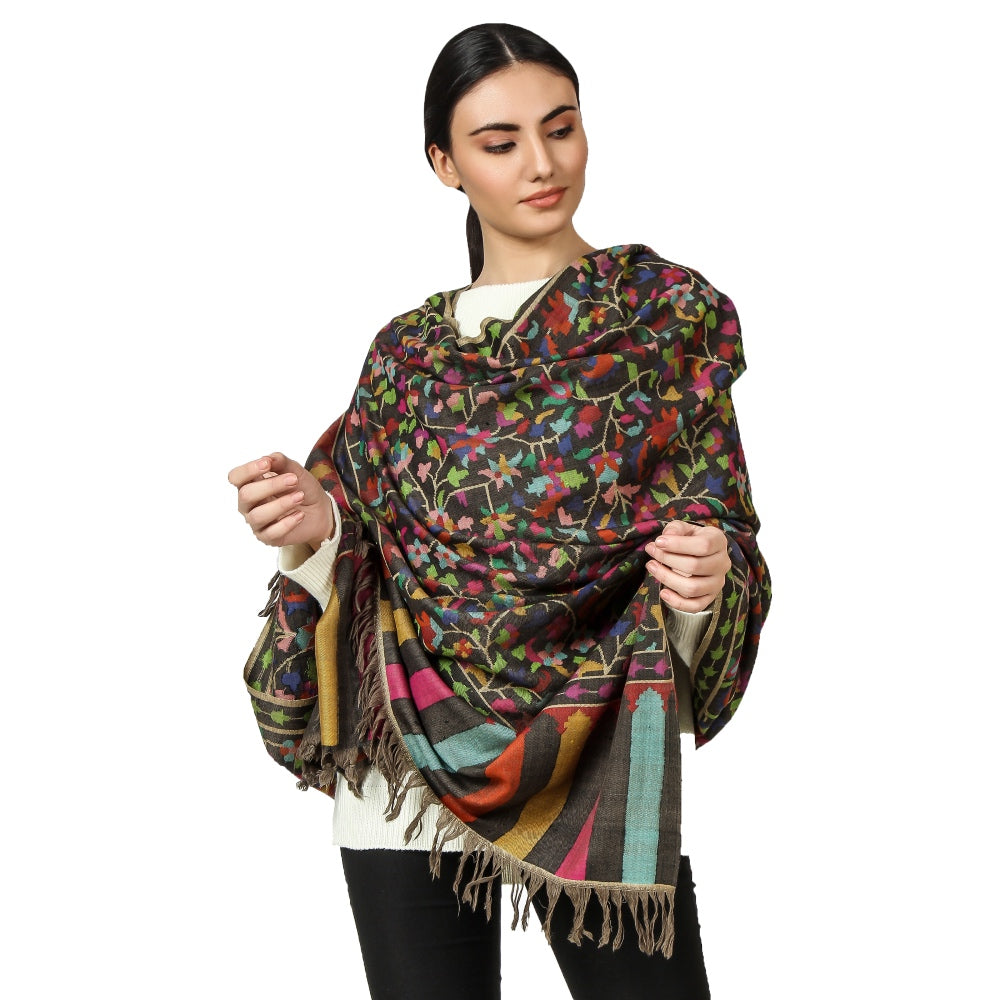
The weave structure affects how the fiber's air-trapping properties are expressed in the finished fabric. A plain handwoven Pashmina scarf — warp and weft evenly interlaced — creates a fabric with consistent fiber density and an even distribution of the hollow-core air-trap effect. Kani-woven pieces, with their denser interlocked structure, provide more fabric mass per square centimetre and more coverage at the edges and embroidered sections. Both are excellent winter choices. Plain weave is lighter and more fluid. Kani weave is warmer and more structured.
Hand-Spun Yarn — Not Optional for Winter Performance
Hand-spun Pashmina yarn preserves the full length and natural crimp of the fiber, which determines how effectively it creates the air pockets responsible for insulation. Machine-spun cashmere yarn — even when made from genuine cashmere fiber — compresses and partially damages the fiber structure, reducing the hollow-core effect and the resulting warmth-to-weight advantage. For winter warmth, hand-spun is not a heritage preference. It is the specification that allows the fiber's thermal properties to be fully expressed in the finished piece.
The hollow-core fiber provides the thermal efficiency. How you wear the scarf determines how much of that efficiency reaches you. These four methods, from lightest to most insulating, work with the fiber's air-trapping properties to maximise warmth at different temperature ranges.
The Parisian Drape
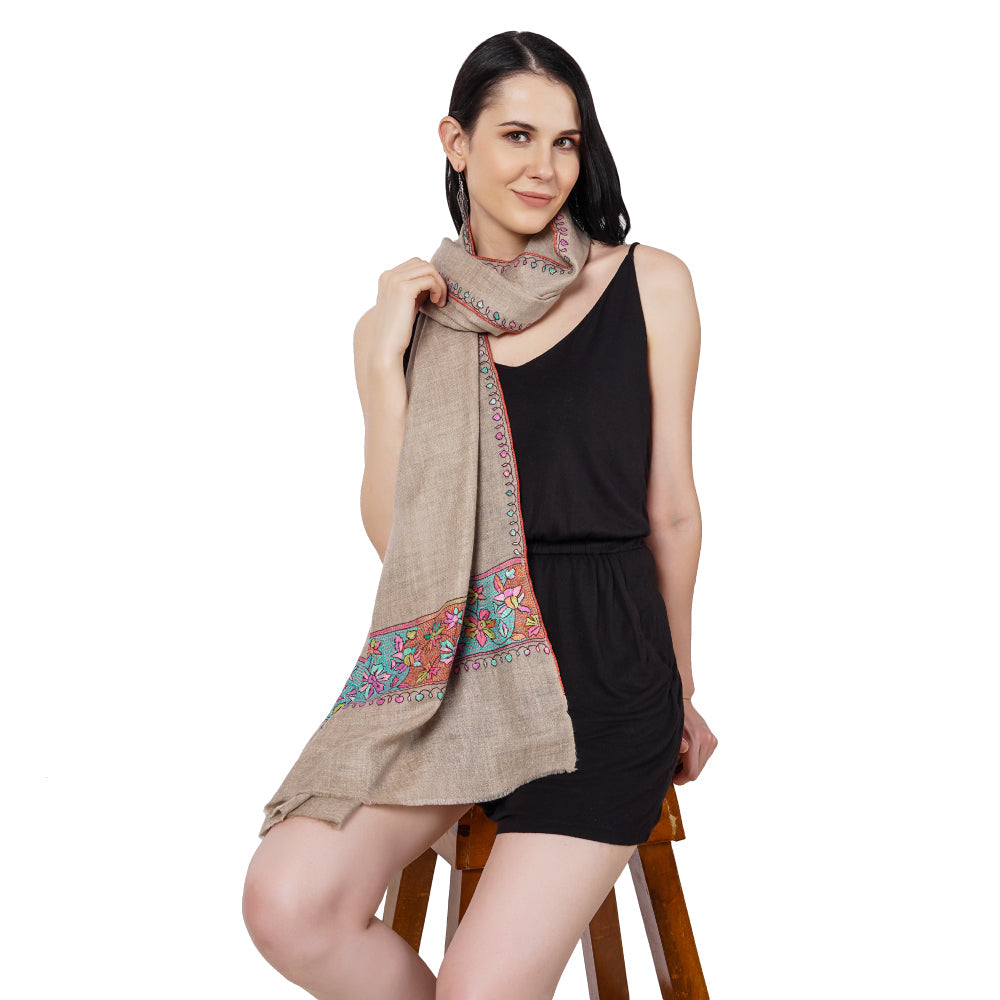
Fold the scarf in half lengthwise, drape around the neck with the loop on one side, and pull both ends through the loop. Sits flat against the chest. One layer of Pashmina at the neck.
Best for: 10°C to 15°CThe Double Wrap
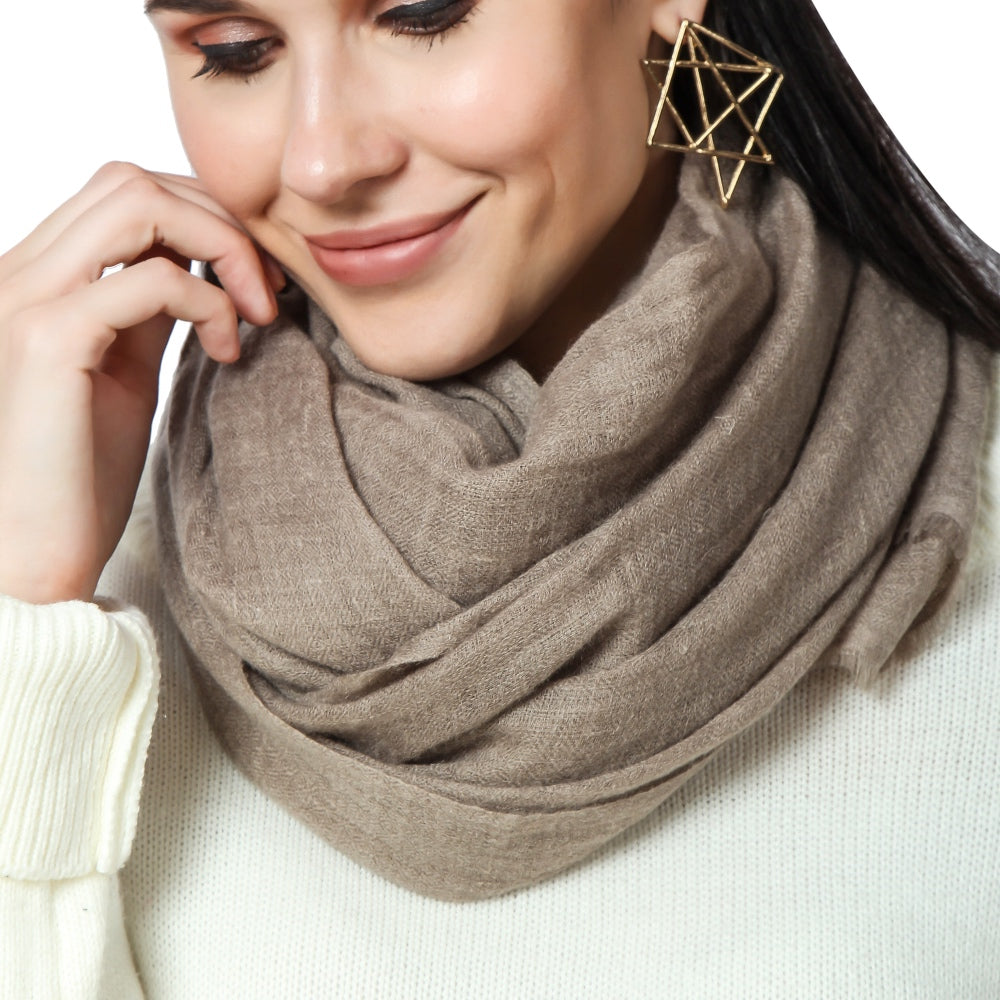
Wrap the full length around the neck twice, leaving both ends hanging. Creates two layers of hollow-core insulation at the neck and traps a layer of warmed air between them — the most efficient use of the fiber's R-value.
Best for: 0°C to 10°CThe Shoulder Shawl
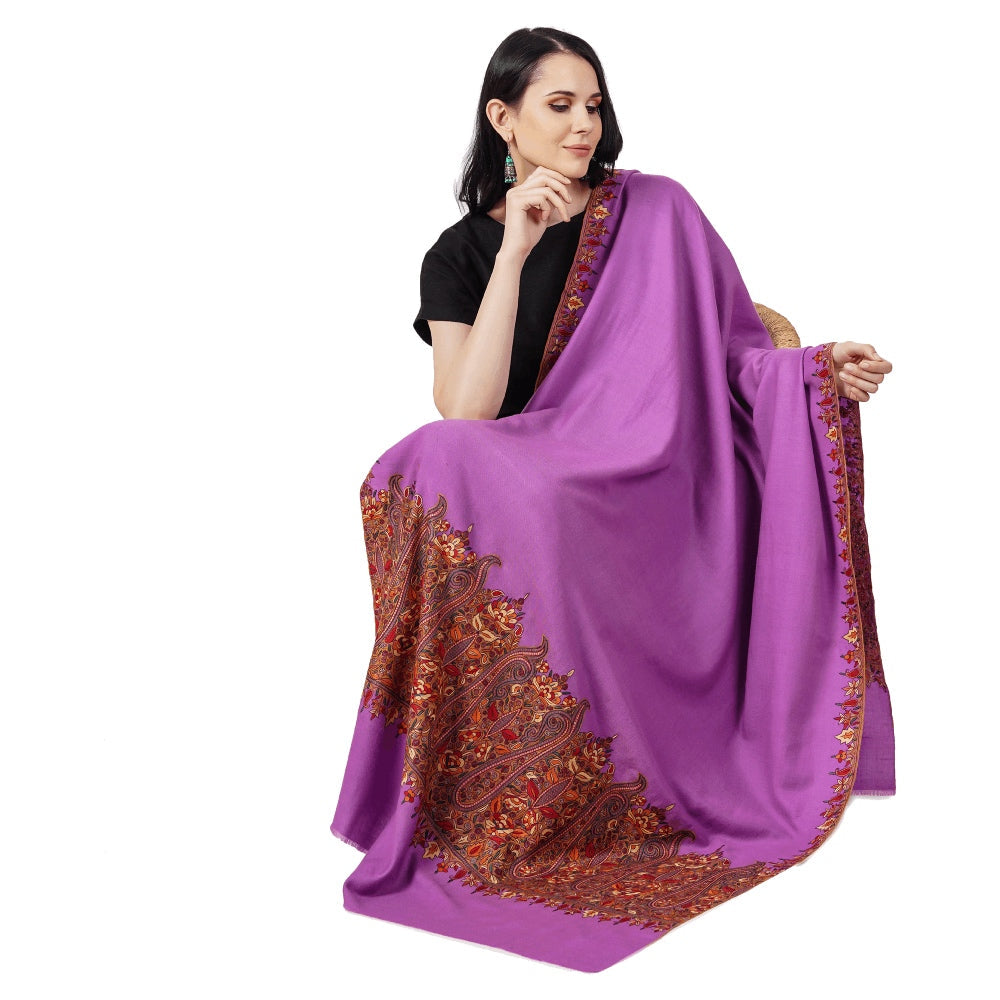
Drape across both shoulders and cross the ends over the chest. Creates a full upper-body coverage layer that protects the neck, chest, and shoulders simultaneously — the coverage that makes a Pashmina shawl a genuine coat substitute in mild-to-cool conditions.
Best for: 5°C to 15°CThe Full Wrap
Cross the shawl over the chest, wrap both ends behind the back, and bring them forward to cross at the front again. For a full shawl (100×200cm), this creates three layers of Pashmina at the core. Used in the Kashmir Valley for outdoor winter wear at altitude.
Best for: −10°C to 5°C🧣 The Layering Principle
The double wrap and full wrap methods work with the hollow-core fiber's air-trapping mechanism by creating multiple layers that each capture and hold a film of warmed air. The warmth compounds with each layer — not linearly, but exponentially — because each trapped air layer reduces the temperature gradient across the next one. This is the same principle used in high-performance outdoor insulation layers, applied at the neck and chest where heat loss is greatest.
| Material | Warmth per Gram | Bulk | Softness | Lifespan | Winter Verdict |
|---|---|---|---|---|---|
|
Pashwrap Pashmina 12–14µm · Hand-spun |
Exceptional | Minimal | Unmatched | 20+ years | Best in class |
|
Grade A Cashmere 15–16µm · Hand-spun |
Very Good | Low | Excellent | 10–15 years | Excellent |
|
Commercial Cashmere 17–19µm · Machine-spun |
Good | Moderate | Good | 3–5 years | Acceptable |
|
Fine Merino Wool 18–22µm |
Good | Moderate | Good | 5–8 years | Acceptable |
|
Lambswool Often sold as "cashmere" |
Moderate | High | Prickles | 5–8 years | Poor value |
|
Acrylic / Synthetic Often sold as "Pashmina" |
Poor | High | Degrades fast | Under 1 year | Avoid |
Everything in this article points to a single specification. Here it is without qualification.
Two tests confirm whether a cashmere scarf will perform in winter — both available before purchase, both taking under sixty seconds.
The Warmth Speed Test
Hold the fabric completely still against the inner wrist for fifteen seconds without rubbing. Genuine Pashmina with an active hollow core begins to reflect body heat almost immediately — you feel warmth within seconds. Synthetic, acrylic, and low-grade cashmere warm slowly through conduction, not reflection. The speed of warmth onset is a direct indicator of hollow-core thermal activity.
The Weight-to-Coverage Test
Hold the scarf at one corner and assess the ratio of how much fabric is there relative to how little it weighs. Genuine Pashmina at 95–120g in a 70×200cm size feels almost weightless for its coverage. A scarf that feels heavy for its size is achieving warmth through mass rather than hollow-core efficiency — the wrong mechanism, and a reliable indicator of lower-grade fiber.
The Answer the Science Gives
The best cashmere scarf for winter is a genuine Pashmina piece — Changthangi fiber, 12–14 microns, hand-spun, handwoven — in a size large enough to wrap and a weight optimised for thermal efficiency over bulk. Not because it is the most expensive option, but because it is the only option built around the specific biological property — the hollow core — that makes cashmere worth wearing in winter in the first place.
Every other scarf in the market achieves winter warmth through mass, through chemistry, or through neither. A genuine Pashmina achieves it through physics — the same physics that allowed the Changthangi goat to survive at −40°C on the Changthang Plateau, expressed in the finest fiber the natural world produces.
To understand the complete science behind Pashmina's softness and fiber structure, read our article The Science Behind Cashmere Softness. To understand exactly what distinguishes genuine Pashmina from commercial cashmere, read What Is the Difference Between Cashmere and Pashmina? To understand how to verify any cashmere piece before buying, read How to Check Cashmere Quality at Home. To understand the honest pricing of genuine Pashmina, read How Much Should a Real Cashmere Scarf Cost?
To find the winter scarf the science recommends, visit the Pashwrap collection.