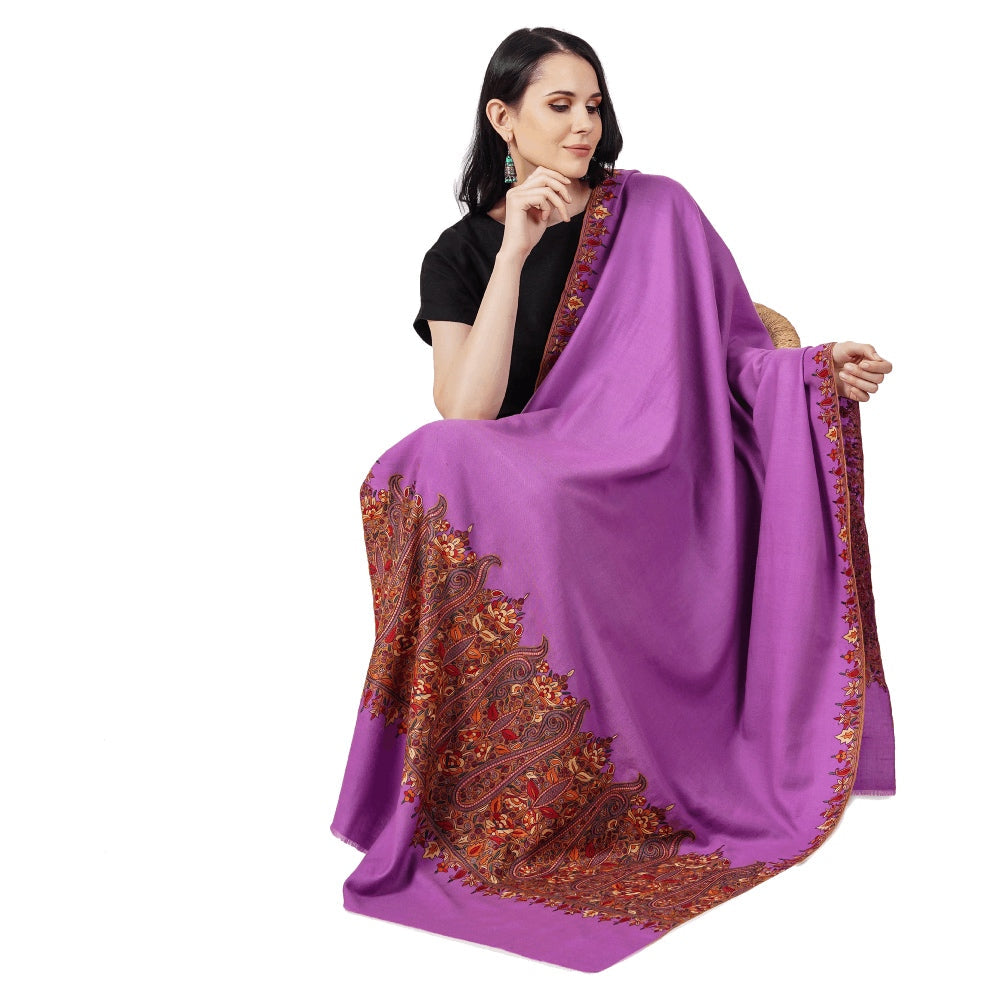

Shahtoosh and the Himalayan Ecosystem: Why the Chiru Matters Beyond the Shawl
The chiru is not simply the animal killed to make Shahtoosh. It is a keystone herbivore in one of Earth's most fragile and poorly understood ecosystems — the Tibetan Plateau. Its near-extinction at the hands of the Shahtoosh trade did not only reduce a population number. It disrupted an entire trophic web: predator populations, grassland structure, scavenger access, and the slow decomposition cycles that keep high-altitude soil fertile across the Changthangi range. This is what Shahtoosh really cost.
Most conversations about the environmental cost of Shahtoosh focus on a single number: 3–5 chiru killed per shawl. That number is accurate and important. At peak trade — estimated at 15,000–20,000 shawls per year through the 1980s and 1990s — it implies 45,000–100,000 chiru deaths per year, from a population that had already declined from a pre-trade baseline of roughly one million animals to a mid-1990s nadir of approximately 65,000–75,000. The arithmetic alone describes a crisis.
But the number of animals killed tells only part of the story. The chiru is not a passive grazer whose absence leaves a simple gap. It is an animal whose behavioral ecology, migration patterns, and herd structure shape the grassland ecosystem of the Chang Tang — the vast high-altitude plateau of Tibet — in ways that are still being understood by researchers who have only had consistent field access to the plateau since the late 1990s. What those researchers found, in the partial recovery period after international protection began to take effect, is that the damage went far deeper than a population reduction. It reshaped the plateau ecosystem in ways that cannot be fully reversed simply by allowing numbers to recover.
A shawl worn once for a season. An ecosystem disrupted for decades. The cost of Shahtoosh was never just counted in animals.
The chiru's near-extinction altered predator populations, grassland structure, scavenger food chains, and the migration corridors that have shaped the Tibetan Plateau for ten thousand years.
The Chang Tang — "northern plateau" in Tibetan — covers approximately 500,000 square kilometres at altitudes between 4,500 and 5,500 metres. It is the highest, largest, and most biologically isolated plateau grassland system on Earth. Its climate is extreme: temperatures range from −40°C in winter to +15°C in summer, oxygen levels run at roughly 60% of sea level, and rainfall averages 150–300mm per year — less than many deserts. Most plant life is restricted to low-growing grasses, sedges, and cushion plants that have adapted over millions of years to the specific combination of cold, dryness, intense UV radiation, and short growing seasons the plateau imposes.
The ecosystem that evolved in these conditions is simpler in structure than temperate grasslands, but the simplicity is deceptive. In a system with fewer species and slower reproduction cycles, each species plays a proportionally larger role. Lose one large herbivore — the chiru, the Tibetan gazelle, the kiang — and the effect on grassland structure, predator food availability, and nutrient cycling is not merely proportional to the animal's population. It cascades.
The chiru is, by biomass, the dominant large herbivore of the eastern Chang Tang. At historical population levels of approximately one million animals, it processed enormous quantities of plateau grasses — creating the grazing pressure that kept grassland structure open and diverse, depositing the organic nitrogen that drives slow-cycle soil fertility, and maintaining the herd migration routes that shaped grassland composition across the plateau for thousands of years.
The foundation that chiru grazing maintains
- — Stipa and Poa grasses: 70–80% of chiru diet
- — Sedges and forbs in riparian zones
- — Cushion plants in wind-exposed ridges
- — Cryptogamic soil crust binding plateau soils
- — Soil fertility: driven by large herbivore dung nitrogen
The species whose loss restructured the entire web
- ✦ Population: ~1M historically → ~70K nadir → ~100K today
- ✦ Seasonal migrations: 300–500km calving migrations, annual
- ✦ Grazing: keystone grassland structure maintenance
- ✦ Nitrogen deposition: primary driver of plateau soil fertility
- ✦ Prey base: snow leopard, wolf, golden eagle all dependent
Species whose populations track chiru abundance
- → Snow leopard: chiru is primary summer prey
- → Tibetan wolf: pack size tracks chiru density
- → Golden eagle: nesting success linked to prey density
- → Himalayan griffon: scavenges chiru winter kills
- → Brown bear: opportunistic on weakened herds
The chiru is not one species among many on the plateau.
It is the species that everything else is calibrated to.
The international Shahtoosh trade developed through the 1970s and accelerated sharply through the 1980s. The trigger was partly demand — Kashmir's luxury textile industry, responding to growing Western appetite for premium natural fibers — and partly the structural opening of poaching networks as wildlife enforcement across the Tibet-India border remained fragmented between jurisdictions that did not coordinate. CITES listed the chiru under Appendix I in 1979, making international trade illegal. India had already included the chiru in Schedule I of the Wildlife Protection Act in 1972. But listing and enforcement are different things, and for most of the 1980s and early 1990s, enforcement was minimal.
The mid-1990s nadir — approximately 65,000–75,000 animals from a historical baseline of one million — represented a 93–94% population collapse over roughly one hundred years, with the steepest decline occurring in the two decades of peak Shahtoosh trade. TRAFFIC estimated 15,000–20,000 Shahtoosh shawls were produced annually at peak, requiring 3–5 chiru per shawl: 45,000–100,000 animals killed per year. At the nadir population, that rate of offtake would have driven the species to functional extinction within a decade even without any additional pressure.
What saved the chiru from that outcome was not one event but a convergence: India's high-profile enforcement campaign beginning in the mid-1990s, the UK's Control of Trade in Endangered Species (COTES) regulations bringing substantial seizures of shawls in the European market in 1994–97, and — critically — the creation of the Changtang Wildlife Reserve in Tibet (1993) and the Arjin Mountain Nature Reserve expansion, which together gave plateau rangers a legal basis and political mandate for anti-poaching patrol that had not previously existed at meaningful scale.
✦ The Recovery — and Its Limits
Current chiru population: approximately 100,000, earning an IUCN downgrade from Endangered to Near Threatened in 2016. This is real recovery — a 40–50% increase from the nadir population. But 100,000 animals from a historical baseline of one million is not conservation success. It is stabilisation after near-collapse. The ecosystem functions that depended on one million chiru — grassland structure maintenance, soil nitrogen cycling, predator food base — are not restored by 100,000.
A keystone herbivore collapse does not affect only the herbivore. It removes the food base on which entire predator guilds depend. On the Tibetan Plateau, the chiru was the primary large prey species for three of the ecosystem's apex and meso-predators: the snow leopard, the Tibetan wolf, and the golden eagle. Each responded differently to the collapse — and the cumulative effect was a restructuring of predator ecology that persists decades after enforcement improved.
Snow Leopard (Panthera uncia)
Apex predator · Chiru-dependent
Snow leopards in the Chang Tang shifted prey focus toward the kiang (Tibetan wild ass) and Tibetan gazelle as chiru density collapsed. But these are not equivalent substitutes: kiang are larger and more dangerous prey, and snow leopards suffered elevated injury rates and lower hunting success. Simultaneously, as wild prey became scarce, snow leopard livestock predation increased substantially, accelerating retaliatory killing by plateau herders — compressing the species from both ends.
Current IUCN status: Vulnerable. Population ~4,000–6,500. Direct connection to chiru density decline well documented in field studies from 2003 onward.
Tibetan Wolf (Canis lupus chanco)
Pack predator · Herd-dependent
Tibetan wolf pack territories on the plateau are sized around prey density. As chiru populations collapsed, pack territories expanded dramatically — requiring more travel, more energy, and more territory overlap with human herding communities. Pack sizes contracted as prey became insufficient to sustain large groups. Livestock predation increased proportionally, and anti-wolf poisoning campaigns intensified as herders experienced heavier losses.
Wolf population on the plateau: poorly documented. Field surveys suggest substantial decline from pre-Shahtoosh trade baselines. Livestock conflict is now the primary driver of wolf mortality across Tibet.
Himalayan Griffon (Gyps himalayensis)
Obligate scavenger · Winter-kill dependent
The Himalayan griffon is a specialist scavenger that depends on large ungulate winter kills as its primary winter food source. In plateau winters, chiru mortality from cold, starvation, and predation provided a reliable biomass pulse to scavenger species. As chiru populations collapsed, winter-kill carcass availability fell sharply. Griffon population trends across the Tibet plateau declined through the 1980s–1990s, with partial recovery lagging the chiru rebound by roughly ten years.
Himalayan griffon: listed Least Concern but with declining population trend. Reduced winter prey base and increasing human disturbance both noted as drivers.
Kiang (Equus kiang)
Secondary herbivore · Indirect beneficiary
The kiang — Tibetan wild ass — experienced a paradoxical dynamic during the chiru collapse. With reduced chiru grazing pressure, some grassland areas initially showed higher forage availability for kiang. But the simultaneous increase in predator pressure from snow leopards and wolves redirected toward kiang as chiru became scarce created offsetting mortality. The plateau predator recalibration after chiru collapse affected kiang significantly across high-density predator zones.
Kiang: listed Least Concern. One of the few large plateau mammals with a stable-to-recovering population trend, but the predator recalibration after chiru collapse left a mark.
Plateau Grassland (Stipa and Poa communities)
Ecosystem base · Chiru-structured
The grassland structure of the Chang Tang is actively shaped by grazing pressure, nitrogen deposition, and the disturbance created by large migrating herds. At one million animals, chiru grazing maintained a diverse, mixed-height grassland. With the collapse, reduced grazing in some areas drove secondary succession toward denser sedge communities that support fewer species. Reduced nitrogen deposition from fewer animals slowed soil fertility cycles measurably.
Plateau grassland degradation is multi-causal. But the chiru's role as a grassland structuring agent is well-established in ecological literature from the 2000s onward.
Tibetan Antelope / Chiru (Pantholops hodgsonii)
Keystone herbivore · Recovering
9–12 micron fiber, hollow-core insulation evolved for −40°C plateau winters, calving migration of 300–500km annually to birthing grounds at 5,000m altitude. The species whose fiber drove the Shahtoosh trade. Population now approximately 100,000 — real recovery, real protection — but still 90% below historical levels. The ecosystem it shaped is not restored by this number. The recovery is genuine and worth acknowledging. It is also partial.
IUCN: Near Threatened (2016, downgraded from Endangered). One of the most visible conservation success stories of the Tibetan Plateau. The success is real and incomplete in equal measure.
One of the most ecologically significant behaviors of the chiru is its annual calving migration — one of the longest remaining large mammal migrations on Earth. Female chiru travel 300–500 kilometres from their winter ranges in the central and western Chang Tang to traditional calving grounds in the northeastern plateau, typically in June. They give birth, remain with their calves for several weeks, then migrate back. The route is ancient — the same corridors have been used for thousands of years, and the calving grounds are fixed locations to which females return annually regardless of current conditions elsewhere.
At the population nadir, this migration was disrupted in ways that went beyond simple numerical reduction. Hunters specifically targeted the calving migration, when female chiru concentrated at predictable locations, making mass hunting far more efficient than pursuing dispersed animals year-round. The disruption of the migration had compounding effects: not only were females killed during calving, but the calving concentration itself — the evolutionary strategy that made the migration efficient — made it catastrophically vulnerable to organized poaching. Hunters who knew the calving ground locations could harvest hundreds of animals in days.
"The calving grounds are the most important real estate in the Chang Tang. They are the places that determine whether the next generation survives. The Shahtoosh hunters knew this. They hunted there specifically, at the moment of maximum concentration, maximum vulnerability."
The survival of the calving migration as a behavior — even after population recovery — is one of the reasons conservationists view the chiru's partial recovery with cautious optimism. The migration itself is an information-rich behavior encoded in female memory and passed to calves: the routes, the calving grounds, the timing. Species that lose this behavioral transmission lose something that population numbers alone cannot recover. The chiru retained it, barely. The migration corridors still exist. The calving grounds are still used. This is not guaranteed — some species that recover numerically lose the behavioral ecology that makes them ecologically functional.
India WPA Schedule I
Chiru listed as protected in India. Shahtoosh trade continues — enforcement is minimal and the trade operates primarily through networks that cross the Tibet–Ladakh border outside formal checkpoints.
CITES Appendix I
International trade in chiru products banned. Demand for Shahtoosh in Western luxury markets is growing, not shrinking. The listing creates legal risk for importers but does not suppress demand for another decade.
Peak Trade / Peak Killing
TRAFFIC estimates 15,000–20,000 shawls per year. Chiru population falls from ~250,000 to nadir of ~65,000–75,000. Snow leopard, wolf, griffon all show concurrent population stress. Migration corridors are disrupted by organized calving-ground hunting.
Protection Infrastructure Begins
Changtang Wildlife Reserve (Tibet, 1993) and Arjin Mountain Nature Reserve expansions create patrol mandate. UK COTES enforcement 1994–97 creates high-profile seizures in European markets. India's Wildlife Crime Control Bureau launches dedicated operations.
India WPA Amendment
Possession of Shahtoosh criminalized in India — not just trade. The amendment specifically addresses the defence that items were acquired before the ban. Possession becomes a primary offence. Enforcement raids on Srinagar dealers intensify significantly.
IUCN Downgrade to Near Threatened
Chiru population at approximately 100,000. IUCN downgrades from Endangered to Near Threatened. Conservation community acknowledges the progress while noting the species remains at 90% below historical baseline. Ecosystem functions not yet restored.
The legal argument against Shahtoosh — that it is internationally banned, that possession can result in criminal prosecution, that the animal must be killed to produce the fiber — is sufficient on its own to make the transaction unconscionable. But the ecosystem argument adds a dimension that the legal argument cannot. Legal frameworks protect individual species. They do not protect the ecological relationships that define the species' role in its environment.
When a shawl was purchased in a London boutique or at a Srinagar dealer in 1987, the buyer understood, at most, that a rare animal had been killed to produce it. The buyer did not understand — could not have understood without access to the ecological literature that did not yet fully exist — that the purchase was also contributing to the disruption of predator populations across 500,000 square kilometres of the world's highest plateau; to the modification of grassland structures that had been stable for thousands of years; to the near-loss of a 500-kilometre annual migration that now exists only because enforcement happened to become effective before the behavioral transmission chain broke entirely.
✦ The One Fiber That Could Have Been Different
The Pashmina — produced from the Changthangi goat of Ladakh's high plateau, combed alive in spring, yielding 80–170 grams per animal per year — solves the Shahtoosh fiber problem entirely. At 12–16 microns, genuine Pashmina is the finest legal fiber in commercial production. It shares the hollow-core structure of chiru fiber. It is produced by living animals in a herding tradition that has sustained plateau ecosystems rather than destroyed them. The Changthangi goat and the herders who tend them are part of the Ladakh plateau's ecological fabric — not a disruption of it. This is not a compromise alternative. It is a better answer to the same need.
The Pashmina Alternative — From the Same Plateau
Genuine Kashmiri Pashmina comes from the Changthangi goat of the same high-altitude plateau world as the chiru — the same climate, the same hollow-core fiber physics, the same commitment to the finest natural insulation on Earth. The animal lives. The herder thrives. The ecosystem is maintained. At Pashwrap, we have worked with Changthangi herders and Kashmir Valley weavers for three generations. This is what the craft looks like when it does not require killing.
The IUCN downgraded the chiru from Endangered to Near Threatened in 2016, reflecting real population recovery from approximately 65,000–75,000 animals at the mid-1990s nadir to approximately 100,000 animals today. That is genuine progress and deserves acknowledgment. However, "Near Threatened" is not "secure" — it means the species remains at elevated extinction risk under a change in conditions. More importantly, 100,000 animals is approximately 10% of the historical baseline of one million. The ecosystem functions that depended on one million chiru — grassland structure, predator food base, soil nitrogen cycling — are not functioning at historical capacity. Recovery and restoration are different things.
Three factors make Shahtoosh uniquely destructive compared to most luxury fiber trades. First, the fiber cannot be collected from a living animal: the chiru's undercoat is bound too tightly to comb or shear, and the animal must be killed to extract it. Second, the calving migration concentrates female chiru at predictable locations annually, making targeted mass hunting far more efficient than pursuing dispersed animals — hunters could take hundreds of animals in days at the calving grounds. Third, the ecosystem in which the chiru lives — the Tibetan Plateau — is exceptionally vulnerable to keystone species loss because its biological simplicity means each species plays a proportionally larger role in the system's function.
This is a common defence of secondary market Shahtoosh purchases: the argument that a shawl already produced does not cause additional harm to the chiru. The argument is legally incorrect — possession and trade in Shahtoosh remain criminal offences in India, the UK, the US, and many other jurisdictions regardless of when the item was produced. But it is also ecologically incomplete. Secondary market demand — the existence of a trading price — sustains the illegal market's commercial logic by establishing that Shahtoosh has a resale value. Enforcement agencies and conservation economists have both noted that the vintage market and the active poaching market are not cleanly separated. A functioning secondary market for Shahtoosh supports the overall trade ecosystem within which new killing occurs.
Snow leopards are apex predators on the Tibetan Plateau and in the adjacent Himalayan range. Their primary large prey in the Chang Tang is the chiru — in some study areas, chiru represent 50–70% of summer snow leopard diet. As chiru populations collapsed through the Shahtoosh trade decades, snow leopards in the plateau zone experienced reduced prey availability, shifted toward more dangerous prey (kiang), and increased livestock predation — which in turn drove elevated retaliatory killing by herding communities. Field researchers studying snow leopard populations in the early 2000s found clear correlations between chiru density and snow leopard body condition, reproductive success, and territory size. The Shahtoosh trade effectively applied pressure to snow leopard populations indirectly through the prey base collapse.
Genuine Pashmina is produced from the Changthangi goat — a domesticated animal herded in the Changthang plateau of Indian Ladakh at altitudes of 4,000–5,000 metres. The fiber is combed from the goat's undercoat in spring, when the animal naturally sheds its winter coat. The animal is not killed. The herding system has existed in the Changthang for centuries and is integrated into the plateau ecosystem rather than extractive from it — the goats contribute nitrogen, the herders maintain traditional land management practices, and the GI certification system established since 2008 creates accountability for fiber provenance. Genuine Pashmina is not an approximation of Shahtoosh. At 12–16 microns, with a hollow-core fiber structure, it is the finest natural fiber that can be produced from a living animal at commercial scale.
This question has been raised repeatedly since the Shahtoosh trade was banned, and it is worth answering carefully. The chiru has never been successfully domesticated. Every attempt to maintain chiru in captivity has resulted in rapid decline and high mortality — the animals appear to require the open plateau environment, the long migrations, and the specific cold and altitude conditions they evolved for. They do not adapt to enclosed conditions. They cannot be bred in captivity at meaningful scale. Additionally, even if captive farming were possible, it would not solve the fiber extraction problem: the chiru's undercoat is structurally inseparable from the animal's skin in a way that makes shearing or combing unworkable without killing. There is no viable Shahtoosh farming scenario.
The Plateau's Accounting
There is a logic to luxury markets that is difficult to examine from inside them. The Shahtoosh shawl was, by every conventional measure of luxury, a genuinely extraordinary object: the finest natural fiber ever produced by an animal, woven by skilled artisans in a craft tradition going back centuries, so fine and light that it could pass through a finger ring while keeping a person warm in Himalayan winter. The desire to own it was not irrational. The fiber was not fraudulently described. The quality was real.
What was not understood — what the market did not make legible to buyers — was the complete accounting of what the production cost. Not three to five animals per shawl in the abstract. Three to five breeding females killed at the calving ground during the migration that maintains the species' behavioral ecology. A predator guild calibrated over thousands of years to a population of one million, forced to recalibrate to 70,000. A grassland ecosystem losing the grazing pressure, nitrogen cycling, and structural maintenance that one million animals had provided. A 500,000 square kilometre plateau ecosystem restructured by the demand of a luxury market that operated at the opposite end of the Earth from the consequences it created.
The chiru is recovering. The ecosystem is not restored. The accounting runs across centuries. The shawl lasted a season.
Genuine Kashmiri Pashmina is not a consolation prize. It is a different answer to a different question: not how to obtain the rarest possible fiber, but how to wear the finest one that does not extract its cost from something that cannot recover the loss. To understand the full fiber comparison, read What Genuine Pashmina Feels Like Compared to Shahtoosh. To understand how genuine Pashmina is verified, read How Kashmir's GI Certification Protects Buyers. To understand the legal status of any Shahtoosh in your possession, read Why Any Shahtoosh Shawl for Sale Is Illegal.