
What Happens to Confiscated Shahtoosh Shawls?
Customs, Courts, and Destruction — the precise bureaucratic and legal journey from the moment a shawl is seized to its final, irreversible disposal.
The Moment of Seizure: What Triggers Confiscation
A Shahtoosh seizure rarely happens by accident. Wildlife crime units and customs agencies conduct intelligence-led operations — often acting on tips from TRAFFIC (the Wildlife Trade Monitoring Network) or Interpol's Environmental Crime unit — targeting specific shipments, dealers, or private collections suspected to contain chiru fiber goods.
Seizure can occur at multiple points: at a port of entry when a shipment is flagged, during a raid on a boutique or warehouse, or — increasingly — as part of estate and insurance audits when a collection changes hands. The legal threshold for confiscation differs by jurisdiction, but in most CITES signatory states, a single confirmed Shahtoosh shawl is sufficient for immediate seizure and criminal referral.
In many countries — including the United Kingdom, the United States, and India — possession alone is a criminal offence. You do not need to be selling a Shahtoosh shawl to face confiscation and prosecution. Inheriting one, buying one at auction, or receiving one as a gift carries the same legal exposure.
Once an officer identifies a suspected Shahtoosh item, a chain of custody begins immediately. The item is tagged, logged, and placed into controlled storage. At this point it legally ceases to be the owner's property.
Initial Seizure & Chain of Custody
Item is seized, tagged with evidence reference, photographed, and entered into an evidence log. A receipt is issued to the owner if present. Items are sealed in tamper-evident packaging and transported under controlled conditions.
Species Identification Testing
Fiber samples are removed and submitted for laboratory analysis. Primary methods include scanning electron microscopy (SEM) to measure scale morphology, micro-spectroscopy, and DNA analysis of the keratin protein. Results determine whether the item is chiru (Pantholops hodgsonii) fiber — and are admissible as court evidence.
Criminal Referral & Court Proceedings
A confirmed result triggers referral to the relevant prosecution authority. In wildlife crime cases, this typically involves both national wildlife law (India's Wildlife Protection Act, the UK's Control of Trade in Endangered Species regulations, the US Lacey Act) and international CITES provisions. Cases can take 1–4 years to resolve.
Post-Conviction Transfer
After conviction or a guilty plea, the court issues a forfeiture order. The shawl is formally transferred to the relevant wildlife authority — in India this is the Wildlife Crime Control Bureau (WCCB); in the UK, APHA (Animal and Plant Health Agency); in the US, the US Fish & Wildlife Service (USFWS).
Destruction, Preservation, or Museum Transfer
The wildlife authority makes a disposal decision based on evidentiary value, cultural significance, and policy directives. The three possible outcomes — and what drives each — are detailed in the section below.
How Authorities Prove It Is Shahtoosh: The Forensic Science
The identification of Shahtoosh fiber is not a matter of visual inspection. To obtain a conviction — and to prevent false positives that could implicate legitimate Pashmina or fine Merino — enforcement agencies rely on peer-reviewed laboratory techniques.
The most widely used method is scanning electron microscopy (SEM). Chiru (Pantholops hodgsonii) fiber has a characteristic scale morphology: scale height averages 0.7–0.9 µm, with an irregular wave pattern that is distinct from both Cashmere (Capra hircus, ~0.5–0.7 µm scale height) and common wool. Because the scales are the physical property being measured — not a chemical marker that could be faked — SEM results are extremely difficult to challenge in court.
The popular claim that Shahtoosh can be identified by passing an entire shawl through a ring has no forensic basis. Ring size varies; shawl construction varies. Courts require SEM analysis or DNA testing. The ring test cannot distinguish Shahtoosh from ultra-fine Pashmina or mixed-fiber blends, and no prosecution has been built on it.
For cases where fiber morphology is ambiguous — particularly for blended fabrics — mitochondrial DNA analysis of keratin protein fragments provides species-level confirmation. The chiru's DNA sequence is unique enough that even fiber that has been processed, dyed, and woven into a finished shawl retains identifiable markers. Research published in the journal Forensic Science International has confirmed viable chiru DNA in shawls seized more than two decades after manufacture.
The forensic chain matters legally: samples must be handled under documented custody protocols from the moment of seizure to the moment of lab analysis. Any gap in documentation can — and has — resulted in evidence being ruled inadmissible.
The Legal Framework: Penalties Across Key Jurisdictions
Shahtoosh is protected under Appendix I of CITES (the Convention on International Trade in Endangered Species), the most restrictive tier — the same category as elephant ivory and tiger products. Each signatory country gives effect to this through domestic legislation, with penalties that vary considerably.
| Country | Governing Law | Max Imprisonment | Max Fine | Notes |
|---|---|---|---|---|
| India | Wildlife Protection Act 1972, Schedule I | 7 years | ₹25,000+ (enhanced) | Origin country of most Shahtoosh production; WCCB coordinates enforcement |
| United Kingdom | COTES 2018 (Control of Trade in Endangered Species) | 5 years | Unlimited | Post-Brexit retained CITES framework; APHA enforces; prosecution rate high for confirmed cases |
| United States | Lacey Act; Endangered Species Act | 5 years (Lacey) | $250,000+ | USFWS investigates; civil forfeiture applies even without criminal conviction |
| European Union | EU Wildlife Trade Regulation 338/97 | Varies by member state | Varies by member state | France and Germany have active enforcement records; Italy has prosecuted auction houses |
| China | Wildlife Protection Law 2016 (amended 2022) | 10 years+ | 15–20× item value | Tibet is primary chiru habitat; enforcement has intensified since 2016 law amendments |
| UAE | Federal Law No. 24 on Environment | 3 years | AED 200,000+ | Dubai was historically a transshipment hub; enforcement has tightened since 2015 |
A shawl purchased before a country's domestic ban does not carry automatic legal immunity. CITES Appendix I listing applies to existing items as well as new trade. Vintage Shahtoosh at estate auctions and antique dealers continues to be seized. The age of the shawl is a mitigating factor in sentencing, not a defence to the charge of possession.
What Actually Happens to the Shawl: The Three Disposal Paths
Once a forfeiture order is issued, the relevant wildlife authority faces a disposal decision that is neither simple nor automatic. Three distinct outcomes are possible, each governed by different policy considerations.
"Destruction is not punitive — it is prophylactic. The shawl that is not incinerated is the shawl that might, one day, reach the market again."
— TRAFFIC India, internal enforcement guidance noteCritically, destruction is irreversible by design. CITES reporting requirements mean that every destroyed item must be accounted for, so there is no quiet re-entry. The weight of fiber destroyed in each calendar year is reported to CITES headquarters in Geneva and published in national annual reports. Between 1995 and 2020, India alone reported the destruction of goods containing an estimated equivalent of tens of thousands of chiru pelts.
Scale of Enforcement: What the Data Shows
Tracking Shahtoosh seizures globally is difficult — reporting obligations under CITES exist, but implementation quality varies by country. The most reliable data comes from TRAFFIC reports, India's WCCB annual reports, and the CITES Trade Database. The picture they reveal is one of sustained, large-scale enforcement activity across three decades.
Key Enforcement Milestones
CITES Appendix I Listing
The chiru (Pantholops hodgsonii) is listed on CITES Appendix I at the convention's founding conference. International commercial trade is immediately prohibited for all signatory states.
London and New York Dealer Raids
UK Customs and USFWS conduct coordinated raids on luxury textile dealers in Knightsbridge and Manhattan. Dozens of shawls are seized; several dealers receive criminal convictions. The operations establish the enforcement template still used today.
Operation Boot (India–Nepal Corridor)
Joint India-Nepal operation dismantles the primary post-slaughter processing corridor. Hundreds of kg of raw chiru fiber and finished shawls confiscated. Several key brokers sentenced under India's Wildlife Protection Act.
Kashmir Mass Seizure Operations
Indian WCCB conducts a series of operations targeting Srinagar workshops. Total seizures across this period included several thousand finished shawls and significant quantities of raw fiber. Multiple weavers and traders prosecuted under amended WPA provisions.
Auction House Prosecutions (Europe)
Several European auction houses face regulatory action for knowingly selling Shahtoosh shawls as antiques without confirming legal provenance. Items are seized from buyers post-sale; a French auction house is fined under EU Wildlife Trade Regulation.
Digital Trade Enforcement
TRAFFIC and Interpol begin systematic monitoring of online luxury platforms. Multiple seizures initiated from intelligence gathered on social media and encrypted messaging group sales. Enforcement has expanded to include estate sales and private collection transfers.
Case Studies: What Happened in Practice
The enforcement record is extensive. The following cases illustrate how the seizure-to-disposal pipeline has functioned across different jurisdictions and item types.
The Knightsbridge Boutique Seizures
During a coordinated intelligence operation, HMCE (now HMRC) seized 36 Shahtoosh shawls from two high-end London dealers. SEM testing confirmed all items. Both dealers were prosecuted under the Control of Trade in Endangered Species (Enforcement) Regulations 1997.
Operation Salaud (USFWS / TRAFFIC)
US Fish & Wildlife Service undercover operation targeting Shahtoosh importers shipping through New York and Los Angeles. DNA testing introduced as evidence for the first time in a US Shahtoosh prosecution. Defendants argued items were Pashmina — DNA results rebutted this conclusively.
Srinagar Workshop Raids
WCCB acting on informant intelligence raided five Srinagar workshops in a single operation. Approximately 800 unfinished shawls and 12 kg of raw chiru fiber confiscated. Several master weavers among those charged — raising complex questions about artisanal complicity under economic duress.
Paris Auction House Action
French customs seized 14 Shahtoosh shawls consigned to a Parisian auction house by an anonymous private seller. The auction house had listed them as "antique Kashmir shawls" without testing. Post-seizure SEM confirmed chiru fiber. The consignor was never identified.
Tibet Plateau Source Seizures
Following 2016 Wildlife Protection Law amendments, Chinese enforcement conducted a series of operations targeting raw fiber collected near chiru migration routes in the Changtang Nature Reserve. These were source-level seizures, targeting poachers and raw fiber traders rather than finished shawl dealers.
Estate and Inheritance Cases
At each CITES Conference of the Parties, member states report a consistent pattern: Shahtoosh shawls discovered in the estates of elderly collectors, inherited unknowingly by family members, or consigned to auction by executors unaware of the items' legal status. These cases account for a meaningful share of Western seizures.
What to Do If You Own a Shahtoosh Shawl
If you have inherited, purchased, or received as a gift what may be a Shahtoosh shawl, the legal situation is serious but not necessarily catastrophic — the approach you take matters significantly.
Selling — or even attempting to sell — a Shahtoosh shawl is an aggravated offence in most jurisdictions, carrying substantially higher penalties than mere possession. This includes selling through auction houses, private dealers, online platforms, or even to a family member. The act of transfer is itself a criminal offence under CITES-implementing legislation.
Get Legal Advice First
If you believe you own Shahtoosh, consult a solicitor or attorney with wildlife law experience before taking any action. The law varies significantly by country, and how you handle the situation affects your legal exposure. In many jurisdictions, voluntary surrender — before an investigation begins — is treated very differently from a confiscation.
Consider Voluntary Testing
You may not actually own Shahtoosh. Ultra-fine Pashmina, Vicuña, and certain blended fabrics are frequently misidentified. Independent SEM testing through a textile laboratory can confirm species before you make any report. Knowing what you have changes your options.
Voluntary Surrender
Most jurisdictions allow voluntary surrender to wildlife authorities or customs, particularly for inherited items. In the UK, items surrendered voluntarily under COTES are not automatically subject to criminal prosecution. In the US, USFWS has an informal voluntary surrender program for wildlife goods held in good faith. Always use a solicitor to negotiate terms.
Do Not Store Internationally
Moving a Shahtoosh shawl across an international border — even between countries where possession penalties are mild — triggers import and export offences under CITES. Do not take it on holiday, send it abroad as a gift, or place it in international storage without legal clearance.
If you love the aesthetic of a heritage Kashmiri shawl — the weight, the drape, the hand-weaving tradition — authentic Pashmina from the Kashmir Valley delivers that experience without legal jeopardy, without wildlife crime, and with a provenance that can be documented and passed on. The shawl itself can become a legitimate heirloom. A Shahtoosh cannot.
In rare circumstances — primarily where testing proves an item is not chiru fiber (i.e., it turns out to be Pashmina or another legal fiber) — items may be returned. This requires a formal re-testing process and a written determination by the wildlife authority. Once a forfeiture order has been issued following a conviction, return is not possible under any circumstances. The item has been legally transferred to the state.
In cases of clearly innocent possession (such as an uninformed inheritance), some jurisdictions allow the owner to keep a photographed record of the item before destruction, but the physical object is not returned.
Age is a mitigating factor at sentencing, but not a defence to the charge. There is no grandfather clause in CITES law. A shawl manufactured in 1960 is subject to the same forfeiture rules as one made last year — both contain fiber from a protected species. What changes is how harshly a court may treat the owner: inherited or antique items typically result in civil forfeiture without criminal conviction where good faith can be demonstrated.
Some jurisdictions (notably the US under ESA) have antique exemptions, but these require documentation showing the item is genuinely antique (over 100 years old) and was not part of commercial trade. Very few Shahtoosh shawls qualify.
Items that have been transferred to museum collections under CITES-compliant conditions may be available for academic study — fiber analysis, historical documentation, conservation research. Museum loans between institutions are governed by separate CITES permit requirements and are not straightforward. The V&A Museum in London, for example, holds historic Shahtoosh specimens from its 19th-century collections that pre-date the legal prohibition, and these are available to registered researchers under controlled conditions.
No museum may lend or transfer a Shahtoosh item in circumstances that could result in its commercial use or re-entry into trade.
Frontline customs officers typically act on intelligence rather than random inspection — they are not equipped to make on-the-spot species identification. When a shipment is flagged (through manifests, country of origin, or informant intelligence), it is directed to a controlled examination area. Officers may take fiber samples using a standardized protocol, which are then sent to a partner laboratory. In the UK, APHA provides laboratory services; in the US, the USFWS National Forensics Laboratory in Ashland, Oregon, conducts the analysis.
Airports and ports also work with TRAFFIC's intelligence unit, which maintains active watch lists of traders, shipment routes, and known Shahtoosh networks.
The large-scale enforcement operations of the 1990s and 2000s dramatically disrupted the high-volume commercial trade. Open retail of Shahtoosh in Western luxury markets essentially ended by the mid-2000s. What remained shifted to three channels: private sales within closed social networks (particularly in South Asia and the Gulf); the antique and estate auction market (where mis-labeling as "vintage Kashmiri shawl" was common); and online platforms in the 2010s.
The chiru population recovery — from a nadir of approximately 65,000–75,000 in the late 1990s to over 200,000 today — directly tracks the impact of this enforcement pressure. Poaching has not ended, but the scale has been substantially reduced.
No. Pashmina is made from the fiber of the domesticated Cashmere goat (Capra hircus), which is not a protected or endangered species. Genuine Pashmina is entirely legal to buy, sell, own, inherit, and transport internationally. There are no CITES restrictions, no WCCB enforcement actions, and no forensic testing requirements for Pashmina.
The enforcement challenge runs in the other direction: Pashmina is sometimes adulterated with cheaper fibers (fine wool, acrylic) and mis-sold at inflated prices. This is a consumer protection issue, not a wildlife crime. Authentic Pashmina from Kashmir — particularly from established producers with traceable supply chains — carries none of the legal or ethical baggage of Shahtoosh.
Since Shahtoosh is Illegal, Here Is the Best Alternative
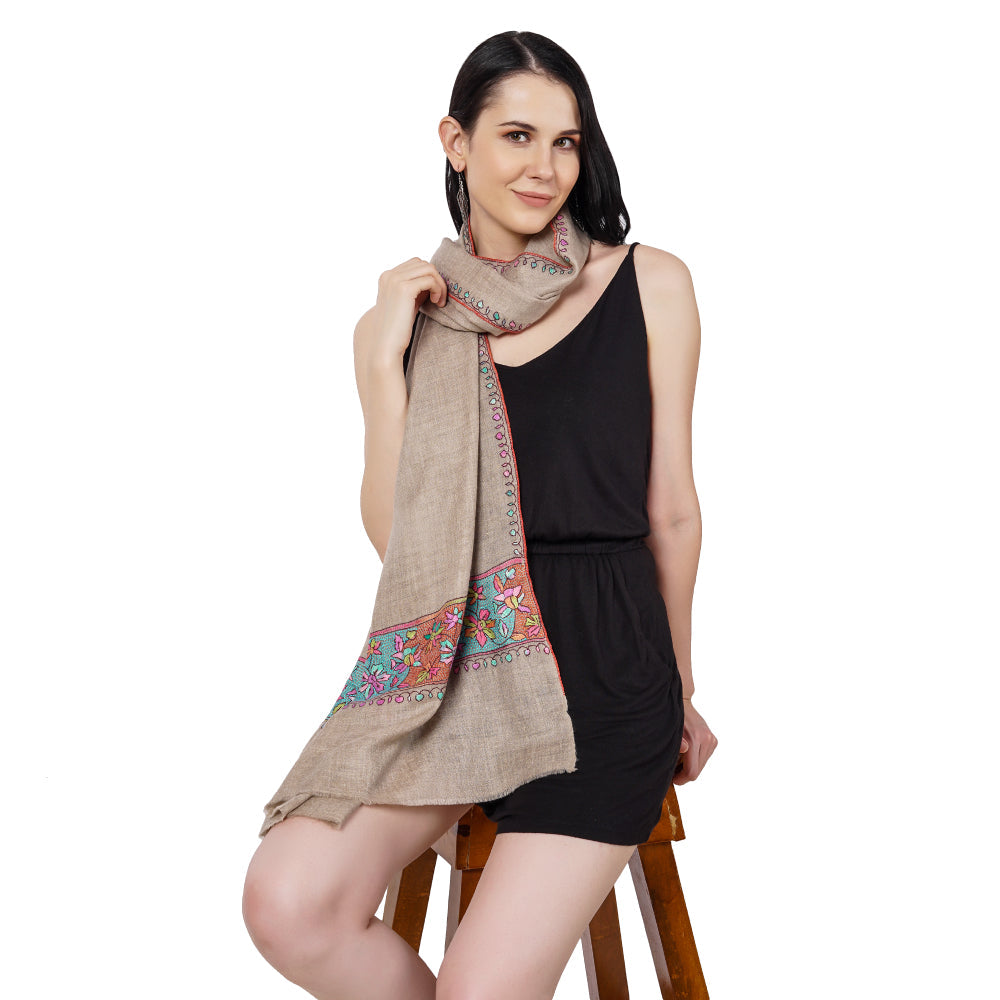
Authentic Kashmiri Pashmina — hand-spun, hand-woven, legally provenance-traced — offers everything a connoisseur of fine textiles values: extraordinary fineness, warmth-to-weight ratio, and a centuries-deep craft tradition. With none of the legal jeopardy.
Explore Pashwrap Pashmina Shawls