
How Is a Cashmere Scarf Made?
Every stage — from a goat on the Changthang plateau to a finished scarf in your hands. Specific tools, specific times, specific sensory details at each step. Including the three stages most brands never tell you about: dyeing, quality inspection, and finishing.
Most brands tell you that their cashmere is "handmade in Kashmir." Almost none of them tell you what that actually means — what happens at each stage, how long each stage takes, which tools are used, what the artisan is looking for, what can go wrong, and what separates a scarf that passes quality inspection from one that does not.
This is the complete account. Eleven stages, every one of them specific. By the end you will understand not just what a genuine Pashmina-grade cashmere scarf is, but what it took to make the one in your hands.
Total human labour in a single plain Pashmina-grade cashmere scarf: 70 to 80 hours across five or more skilled artisans. For a diamond weave Cheshme Bulbul scarf — the pattern used by Pashwrap — the weaving alone adds 10 to 15 hours to that total. No electric machinery is used at any stage.
Each spring as temperatures on the Changthang plateau begin to rise, the Changthangi goat sheds its winter undercoat naturally. The Changpa herder works through the herd one animal at a time, using a wide-toothed comb — traditionally made from bone or hardwood — to gather the loosening pashm before the wind takes it. The combing is gentle and unhurried. The goat is not sheared and not harmed. The herder is collecting what the animal is already releasing.
What comes away on the comb is a soft, pale cloud of mixed fibre — fine pashm undercoat tangled with coarser guard hairs, carrying the dust of the plateau and the natural lanolin of the animal. One goat yields approximately 240 grams of raw fibre. Of that, 80 to 100 grams will be usable after the next stage. The rest — the guard hair — will be separated and discarded or used in lower-grade products.
The raw fibre arrives in the Kashmir Valley — approximately 400 kilometres south and west of the Changthang plateau — and enters the dehairing process. This is where the fine pashm undercoat is separated from the coarser outer guard hairs. It is done through a combination of mechanical combing — using fine-toothed combs pulled through the fibre repeatedly in one direction — and hand-sorting, where the artisan feels through the fibre removing any remaining coarse strands by touch.
The dehairing artisan can feel the difference between pashm and guard hair immediately — the guard hair is coarser and stiffer, the pashm almost weightless by comparison. Any guard hair remaining in the finished product causes prickle and roughness, so this stage is not rushed. A skilled dehairer works slowly and methodically, passing the fibre through the combs multiple times until only the finest down remains.
After dehairing, the usable pashm is washed lightly in clean water to remove dust and surface oils, combed again to align the fibres in a consistent direction, and left to dry before spinning. At this stage the fibre is ready for the spinner — a clean, aligned, pale-coloured cloud of the finest naturally occurring cashmere on earth.
The dehaired pashm is distributed to the spinning community — traditionally women working from their homes in villages across the Kashmir Valley. The spinner sits at a yindeer — a wooden, foot-operated spinning wheel that has been used in Kashmir for centuries. The wheel is driven by a foot pedal, leaving both hands free to draft the fibre into yarn.
The spinner draws a small amount of pashm from the prepared fibre bundle with one hand, attenuating it into a thin ribbon before the wheel twists it into single-ply yarn. The tension she applies — the speed of drafting against the speed of the wheel — determines the diameter and consistency of the yarn. Too fast and the yarn breaks. Too slow and it is uneven. The right tension is a physical knowledge that lives in the hands, not in any instruction that can be written down. It takes years to develop and cannot be transferred to a machine.
At 12 to 14 microns, the pashm fibre breaks under the mechanical tension of industrial spinning equipment. This is not a process choice — it is a physical constraint. The hand is the only tool that works at this fineness. Twenty-four hours of continuous spinning produces 100 grams of yarn — enough for one scarf.
For coloured scarves, dyeing happens at the yarn stage — before warping and weaving. Dyeing at yarn stage (rather than piece-dyeing the finished fabric) produces more even, deep colour penetration and allows the weaver to work with coloured yarn from the start, maintaining colour accuracy across the full fabric. The dyed yarn is what the weaver sees and works with throughout the entire weaving process.
Pashmina-grade cashmere requires particular care during dyeing. At 12 to 14 microns, the protein structure of the fibre is exceptionally fine and sensitive to temperature, pH, and chemical stress. Too high a temperature during the dye bath damages the protein bonds — the fibre loses softness, lustre, and tensile strength. Genuine Pashmina dyers work at controlled low temperatures, with pH-buffered dye baths, and with contact times calibrated to the specific dye type and colour depth required.
Sources: Indigo (blue), madder root (red-orange), pomegranate rind (yellow), walnut husk (brown-black), lac insect (deep red), turmeric (gold). Traditional Kashmiri dyeing has used these sources for centuries.
Process: Yarn is first treated with a mordant — typically alum, iron, or tannin — which bonds to the fibre protein and creates attachment sites for the dye molecule. The mordanted yarn is then immersed in the dye bath at controlled temperature for several hours, removed, rinsed, and dried.
Character: Natural dyes produce colours with a specific depth and warmth — slightly muted, complex, and variable in a way that gives each piece a unique quality. They do not fade to white over time — they patinate, mellowing to softer versions of themselves.
What AZO-free means: AZO dyes are a class of synthetic dyes that can break down under certain conditions to release aromatic amines — compounds that are carcinogenic and prohibited in textiles worn against skin in the EU and many other markets. AZO-free synthetic dyes achieve the same colour range without these compounds.
Process: Acid dyes for protein fibres — including cashmere — bond directly to the amino groups in the keratin protein chain. Applied at controlled low pH and temperature, they produce exceptionally colour-fast results across the full colour spectrum, including the vivid, saturated colours that natural dyes cannot achieve.
Pashwrap standard: All Pashwrap scarves use either natural dyes or AZO-free synthetic acid dyes. No harmful AZO compounds. No heavy metal mordants. Safe for direct skin contact at the neck and face.
Before the yarn can be warped onto the loom, it must be strengthened. Pashmina yarn at 12 to 14 microns is exceptionally fine and fragile — it cannot withstand the mechanical tension of warping and weaving without some temporary structural support. The traditional solution is a light application of rice starch — called maya in Kashmiri — which coats the individual yarn fibres and gives the yarn the stiffness and tensile strength needed to survive the weaving process.
The starch treatment is applied by drawing skeins of yarn through a warm rice starch bath, then stretching them on wooden frames to dry under tension. The dried yarn has a slightly stiff, papery hand — nothing like the softness of the finished scarf. The starch is scaffolding, not fabric. Its entire purpose is to be removed at the washing stage, after weaving is complete.
Warping — called yarun in Kashmiri — is the process of setting up the vertical threads of the loom before weaving begins. Each of these vertical threads is a warp thread. For a standard cashmere scarf, 1,200 or more individual warp threads must be wound from wooden spools called prech, measured to the correct length, and set onto the loom frame at perfectly consistent tension.
The warp threads determine the width of the finished scarf and the structural backbone of the fabric. If warp tension is uneven — some threads tighter, some looser — the finished fabric will show streaks, distortion, and uneven density. Getting every one of 1,200 threads at identical tension by hand, without mechanical assistance, is painstaking work that takes three to five hours. An experienced warper moves with practiced rhythm — thread by thread, spool by spool — checking tension by feel along the warp frame before the first weft thread is ever passed.
The weaver sits at ground level at the khaddi — a traditional pit loom sunk partially into the floor, so the weaver's feet can operate the foot pedals at ground level. The foot pedals control the heddles — the frames that raise and lower alternating groups of warp threads to create the shed, the opening through which the weft thread passes. One foot press raises half the warp. The shuttle carrying the weft thread passes through the opening. The other foot press raises the alternate group. The shuttle passes back. The weft is beaten down with the beater — a wooden comb that consolidates each new weft pass against the previous one.
This action — shed open, pass, shed reverse, pass, beat — repeats more than 100,000 times to complete a plain weave scarf. The weaver's hands and feet work in constant, coordinated rhythm. The sound of the khaddi in operation is distinctive: the thump of the heddles, the slide of the shuttle, the rhythmic knock of the beater. It fills the workshop the way a metronome fills a room — unhurried, consistent, present.
For the Cheshme Bulbul diamond weave pattern used by Pashwrap, every weft pass requires the weaver to adjust the threading sequence to maintain the repeating diamond structure across the full 70-centimetre width of the scarf. The pattern demands sustained attention across 40 to 45 hours of weaving — there is no mechanical system holding the pattern. It exists in the weaver's hands and eyes.
When weaving is complete, the scarf is cut from the loom — a careful cut that leaves the correct length of warp thread exposed at each end to form the fringe. These exposed warp threads are the structural threads of the scarf itself — not decorative additions, not separate fringe material. They are the actual warp, revealed at the cut ends.
The fringe artisan works through these exposed threads, tying them into small groups — typically three to four threads per knot — at consistent intervals along both ends of the scarf. Each knot is tied by hand, positioned at a consistent distance from the fabric edge, and pulled to a consistent tension. The result is the characteristic natural fringe of a hand-woven Kashmiri scarf — slightly variable in exactly the way that human handwork always is, completely unlike the machine-uniform fringe of a mass-produced product.
This is the stage that transforms the stiff, starched woven cloth into the scarf the buyer will receive. The scarf is immersed in cold, clean water with a mild natural washing agent — no harsh detergents, no chemical softeners, no bleaches. It is gently worked by hand to ensure even penetration of the water, then allowed to soak as the rice starch dissolves out of the fibre.
As the starch washes away, something visible happens: the fabric relaxes. The slight rigidity of the starch-treated weave softens and opens. The individual fibres, freed from their temporary structural constraint, find their natural arrangement. The drape of the fabric — that characteristic fluid fall that defines cashmere — appears for the first time. The scarf that was stiff and papery becomes light, fluid, and soft.
The washed scarf is removed from the water, gently pressed — never wrung — and laid flat on a clean drying surface in shade. Drying flat is essential: a wet Pashmina scarf hung vertically will stretch under its own weight. Dried flat, it returns to its woven dimensions. After several hours, when fully dry, the scarf is brushed lightly to raise the nap and achieve an even surface texture.
Every finished scarf passes through a quality inspection before it is labelled and packaged. This is not a perfunctory check — it is a systematic examination carried out by an experienced artisan in good natural light, using both eyes and hands. The inspection has specific criteria that a scarf must meet to pass. A scarf that fails any of them goes back for correction or is set aside.
What the inspector checks — in order:
Automatic reject criteria — a scarf fails inspection if any of these are present:
A scarf that passes inspection is labelled. The label is attached by hand — stating "100% Cashmere, Handmade in Kashmir" and the wash care instructions. At Pashwrap, no label is attached until the scarf has passed all inspection criteria. The label is a statement of what the product is, not a sales tool applied before quality is confirmed.
The scarf is then folded along specific lines — lengthwise, then across — to a compact rectangular form that will hold its shape without creasing the fabric significantly. Cashmere folds well and can be unfolded without lasting crease marks, but consistent folding at the same points avoids any sharp fold lines from forming across the weave.
It is placed in tissue and packaging designed to protect it during transit without trapping moisture. No plastic wrap directly against the cashmere — cashmere needs to breathe, and sealed plastic creates conditions for mildew over extended storage or transit periods. A care card is included with every Pashwrap scarf — specifying hand-wash cold, press gently and never wring, dry flat in shade, store folded not hung, and how to use a cashmere comb if surface pilling appears.
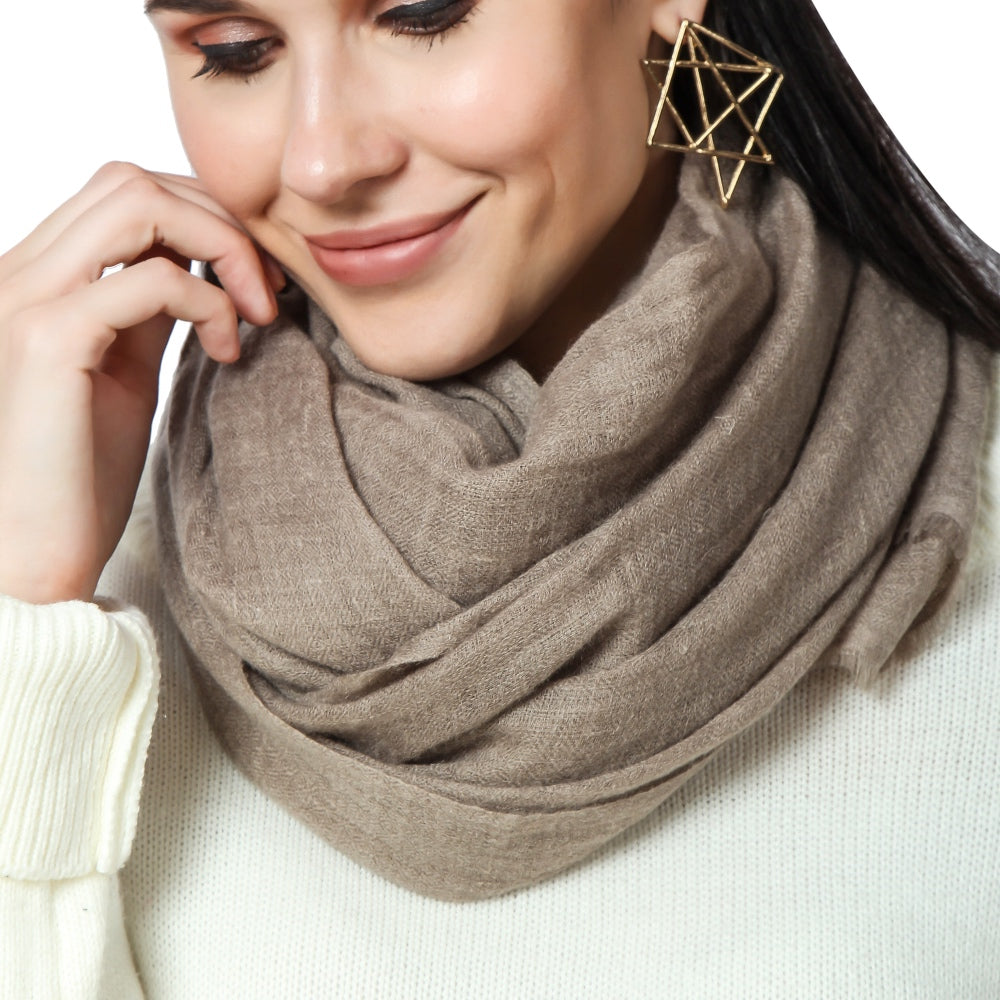
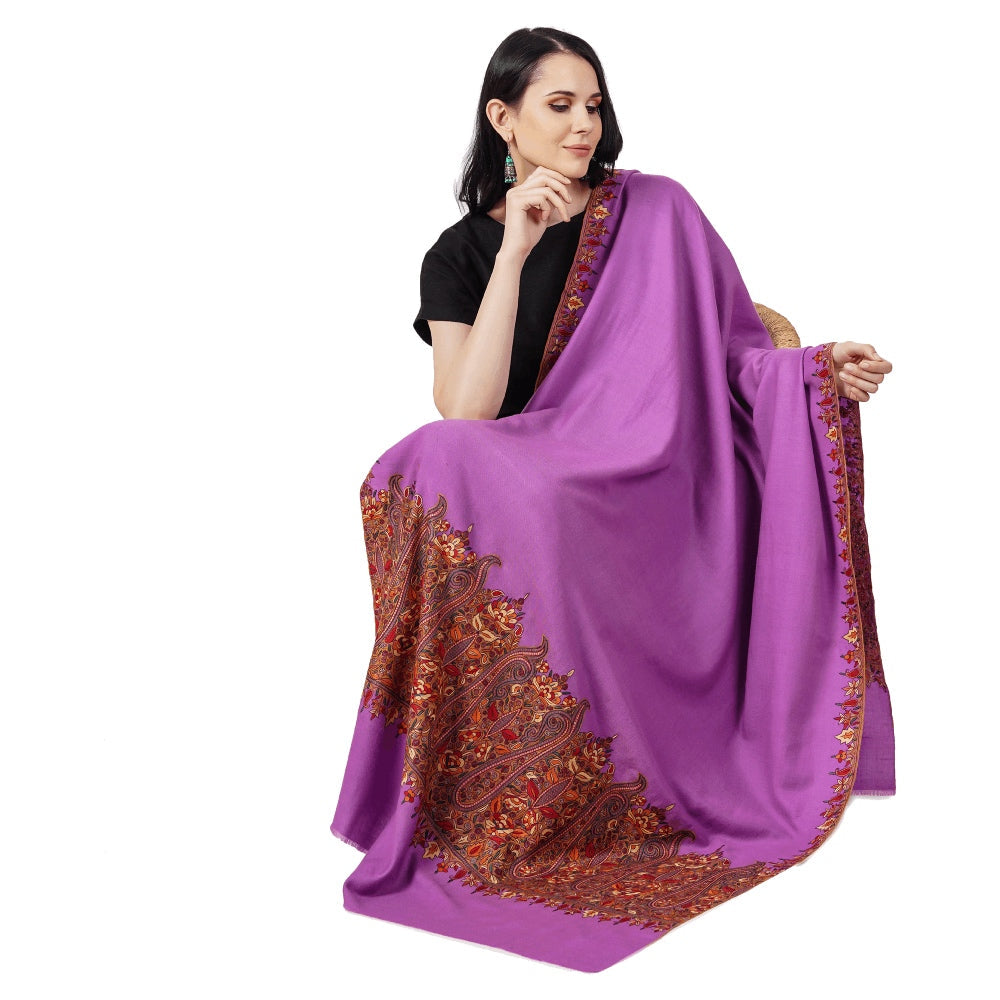
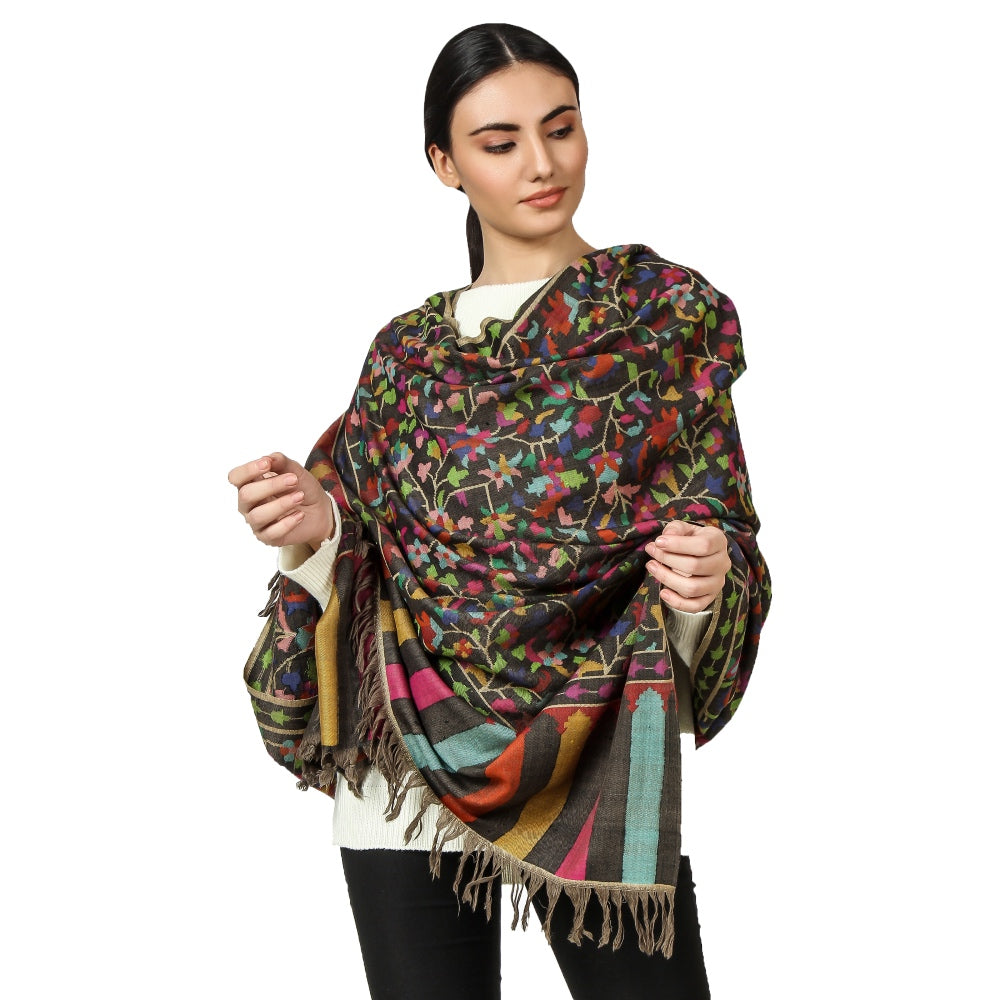
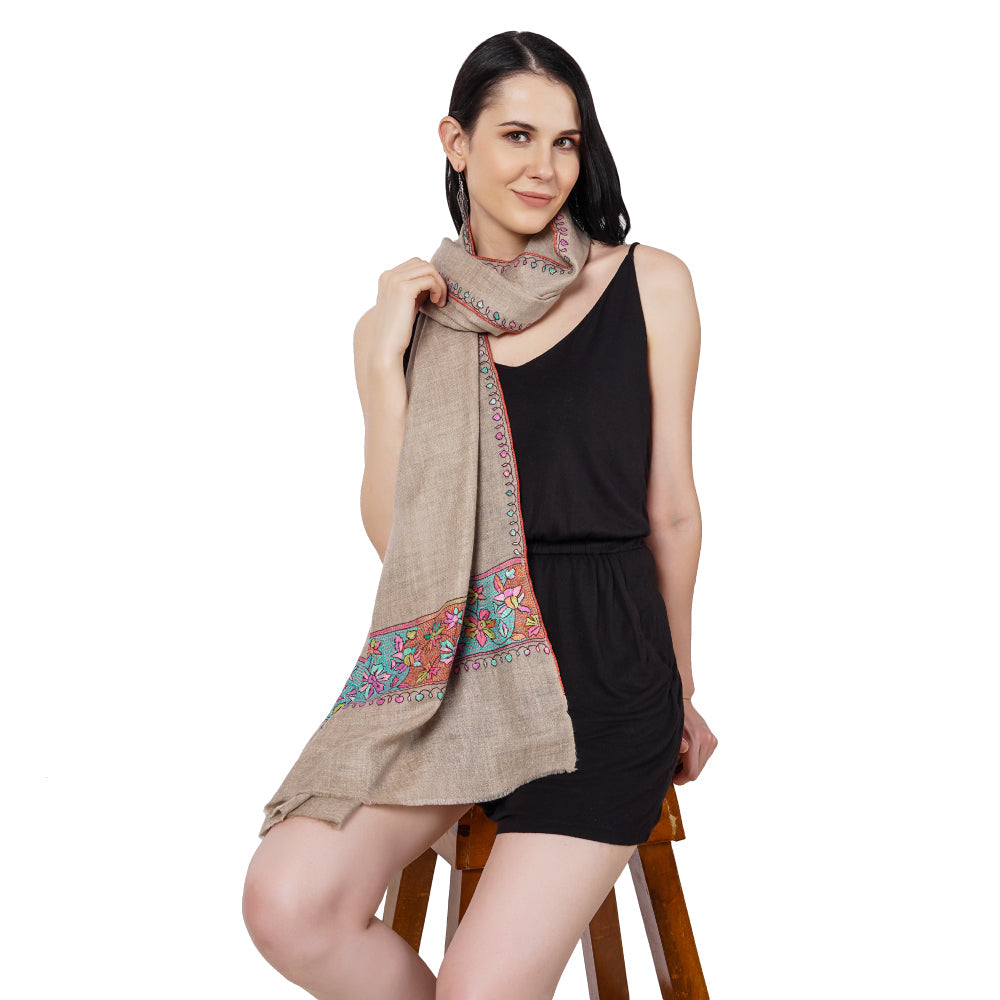
At this point the scarf is ready. Seventy to eighty hours of human skill across five or more artisans, 400 kilometres of mountain geography, one goat's entire annual contribution — compressed into a 95-gram object that will outlast almost anything else its owner buys this year.
Seventy to eighty hours of human skill.
Five artisans. One goat. Four hundred kilometres.
95 grams. Decades of use.
To understand the dyeing and fibre science behind what gives Pashmina its softness, read Why Is Cashmere Softer Than Wool? To understand the full quality grading system and micron count that underpins everything in this process, read What Is the Micron Count of Cashmere Fiber? To explore Pashwrap's collection — every scarf made by this exact process, no shortcuts — visit Cashmere Scarves.