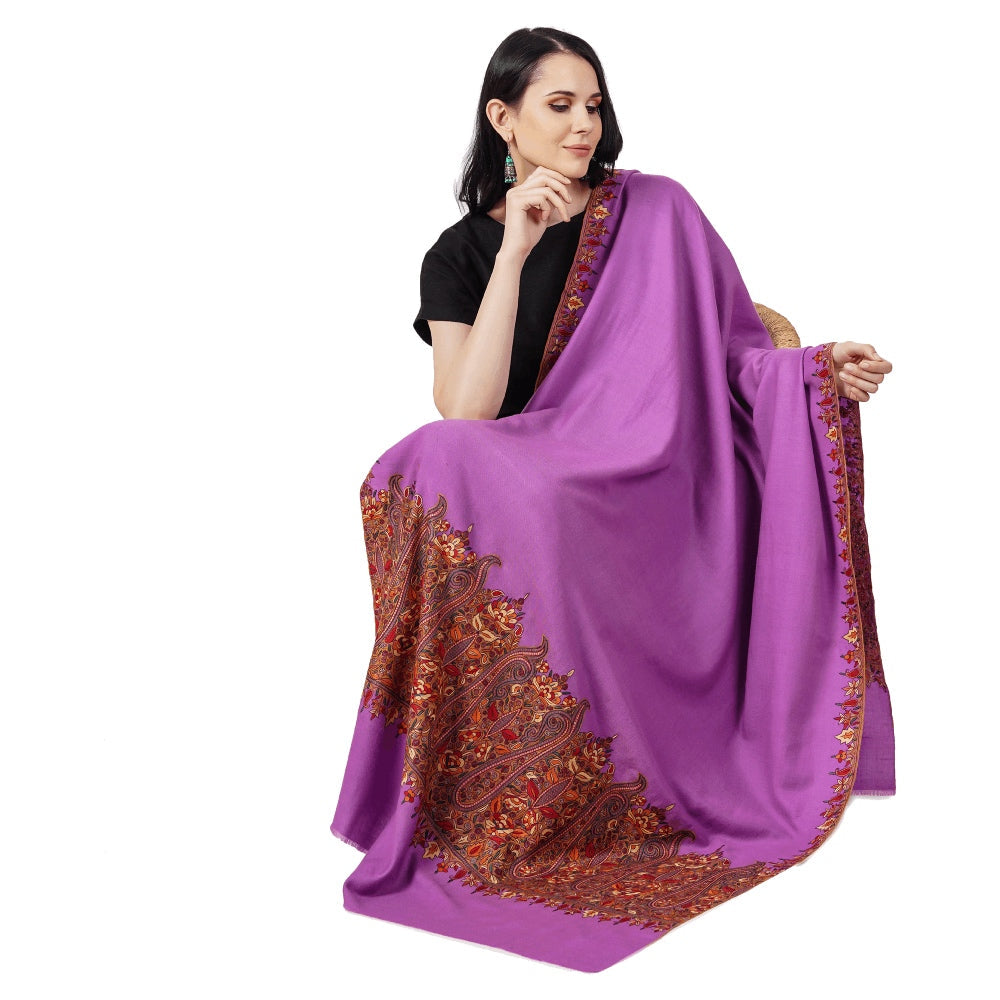

How Many Chiru Are Killed for One Shahtoosh Shawl?
This is the number that matters most in the entire Shahtoosh story. Not the price, not the fineness, not the mystique — the body count. Here is where the number comes from, what it means in context, and why no honest defence of Shahtoosh can survive it.
In This Article
- 01 The Number — Three to Five Chiru Per Shawl
- 02 The Fiber Yield Mathematics — Step by Step
- 03 How the Animals Were Actually Killed
- 04 Why Combing Was Never Possible
- 05 The Pashmina Comparison — How Many Goats Per Shawl
- 06 Peak Production — The Annual Kill Estimate
- 07 What Those Numbers Did to the Chiru Population
- 08 Frequently Asked Questions
The question "how many animals are killed for one Shahtoosh shawl?" is asked in every serious discussion about Shahtoosh — by journalists, by researchers, by people who have inherited a shawl and are trying to understand what they own. The answer is specific, verifiable, and devastating. Here is the calculation, the evidence behind it, and the context that makes the number meaningful.
The Number — Three to Five Chiru Per Shawl
This is not an estimate. It is a calculation derived from well-documented fiber yield data. The logic is straightforward and verifiable. Here is exactly where the number comes from.
The Fiber Yield Mathematics — Step by Step
Every calculation of chiru kill numbers rests on three data points. Each one has been documented by wildlife researchers, textile scientists, and conservation organisations over decades. Each one is independently verifiable.
The Tibetan antelope produces approximately 125–150 grams of usable under-fleece. This is the fiber that can be separated from the guard hair and spun after the animal is killed. The range accounts for variation in animal size, age, health, and seasonal condition. A large adult male at the height of the trade may yield slightly more; a smaller female slightly less.
A standard full-size Shahtoosh shawl measuring 200cm × 100cm requires approximately 350–500 grams of spun yarn. This range accounts for variation in weave density (Shahtoosh was woven at extraordinarily high thread counts), shawl dimensions, and the processing waste that occurs during spinning and weaving. At 9–12 microns, the fiber is so delicate that 20–30% of the raw fleece is lost during processing.
350g ÷ 125g = 2.8 chiru. 500g ÷ 150g = 3.3 chiru. The real-world number falls between 3 and 5 because yarn requirements vary by shawl type, some processing waste is higher than 20–30%, and individual chiru yields vary. No documented Shahtoosh production method has required fewer than three animals per shawl.
That is the arithmetic. It is not contested by any serious source — not by wildlife researchers, not by conservation organisations, not by the courts that have prosecuted Shahtoosh cases, not by the traders who handled the raw material. Anyone who claims a lower number is either misinformed or deliberately minimising the cost.
How the Animals Were Actually Killed
The method did not vary significantly across the history of the trade. The process was consistent for decades:
- Hunting on the Tibetan Plateau. Professional poachers hunted chiru on the Tibetan Plateau during the winter, when the under-fleece was at its thickest. Methods included high-powered rifles and sometimes nets. The animals were killed in remote areas at elevations of 4,000–5,000 metres, far from any enforcement presence.
- Removal of the skin. The entire hide was typically removed — not just the fleece — because separating under-fleece from guard hair on a carcass is more efficient than attempting it on a living animal. The skins were then transported to processing centres, primarily in Kashmir.
- Fibre separation in Kashmir. In Kashmir, specialised artisans separated the under-fleece from the guard hair by hand — a labour-intensive process because the fiber at 9–12 microns is too fine for mechanical separation. The separated Shahtoosh fiber was then cleaned, dehaired, sorted by quality, and prepared for spinning.
- Hand-spinning and weaving. The fibre was hand-spun on a traditional yinder wheel and hand-woven on a wooden khaddi loom by a small number of specialist Kashmiri artisans. At 9–12 microns, machine spinning was impossible — the fibre broke under tension. This labour intensity contributed to the high price but did not change the kill count.
⚠ Why "Collecting From Vegetation" Is False
The claim that Shahtoosh can be collected from the vegetation or fences the chiru brushes against is the most widely circulated falsehood in the trade. The chiru does shed its winter under-fleece seasonally — but the shed fibre is distributed across 2.5 million square kilometres of remote plateau in quantities far too small for commercial collection. No commercial-scale shedding operation has ever been documented. Every documented Shahtoosh production method involved killing the animals. This is not a scientific debate — it is settled fact, confirmed by TRAFFIC investigators and accepted by every court that has considered it.
Why Combing Was Never Possible
The comparison most often made by sellers attempting to legitimise Shahtoosh is to Pashmina: "Both fibers are combed from living animals, so Shahtoosh could be too." This comparison is false — and the biological reason is directly relevant to the kill count.
The comparison explains why the kill count for Shahtoosh is inevitably higher per shawl than the yield-per-goat ratio for genuine Kashmiri Pashmina. A standard pure Pashmina shawl requires the annual yield of 3–4 Changthangi goats — all alive, all returning to their herds. A Shahtoosh shawl requires 3–5 chiru — all dead, none returning.
The Pashmina Comparison — How Many Goats Per Shawl
The numbers are remarkably similar — but the outcomes could not be more different. The comparison is not between two luxury products. It is between an illegal wildlife product and a legal one. The fibre is in the same broad family — both are hollow-core, both from high-altitude caprine species, both spun and woven in Kashmir — but one requires killing and the other does not.
Peak Production — The Annual Kill Estimate
⚠ These Are Estimates, Not Precise Counts
No one counted every chiru killed for Shahtoosh. The trade was illegal, the killing occurred in remote areas, and much of it went unrecorded. The estimates above are derived from production data (shawls produced) worked backwards through yield data (fibre per animal) and cross-referenced with chiru population surveys. The true total number of chiru killed for the Shahtoosh trade from the 1970s to the 2000s is unknown — but the range of 1–2 million animals over three decades is broadly accepted by conservation organisations including TRAFFIC, the IUCN, and the CITES Secretariat. The precise number does not matter for understanding the scale. The order of magnitude does.
What Those Numbers Did to the Chiru Population
The Tibetan antelope population crash caused by the Shahtoosh trade is one of the most documented wildlife population declines of the 20th century — and one of the most consequential. The trajectory is clear from multiple independent data sources:
✦ The Conservation Perspective
The partial recovery of the chiru population to approximately 100,000 animals is a conservation success — but it should be understood in context. The species has not recovered to a level where its pre-trade population of over one million is remotely achievable within the foreseeable future. The habitat remains threatened by climate change, infrastructure development, and the persistent underground demand for Shahtoosh that continues to drive poaching. Every Shahtoosh shawl still sold — whether genuinely old stock or newly poached — represents demand that threatens that recovery. The chiru's partial recovery is not evidence that the problem is solved. It is evidence that enforcement has slowed the decline — not that the cause of the decline has been removed.
Three to five animals died for every shawl. Over a million were killed for decades. No legal supply chain can ever exist because no harvesting method exists that doesn't end in a carcass.
The mathematics are not complex. The moral weight of each shawl is.
Frequently Asked Questions
Is the "3–5 chiru per shawl" figure universally accepted? +
Yes, with a qualifier. The 3–5 range is widely cited by TRAFFIC, the IUCN, CITES enforcement agencies, USFWS, and academic researchers. The range exists because individual chiru yield varies (125–150g), shawl specifications vary (size, weave density), and processing waste varies (20–30%). The range is not a margin of error — it reflects real production conditions. No credible source has published a lower figure that has survived scrutiny.
Does the 3–5 figure include animals that died from natural causes? +
No. The 3–5 figure refers specifically to animals killed for their under-fleece for Shahtoosh production — not natural mortality. The chiru faces natural threats including predation by wolves, snow leopards, and harsh winter conditions. Natural mortality exists and is accounted for in population estimates. The 3–5 figure is the deliberate kill count for textile production — the number of animals that would not have died if Shahtoosh did not exist as a commercial product.
Were female chiru also killed? +
Yes. Female chiru produce less under-fleece than males (they are smaller), so the kill count per shawl skews toward the higher end of the range. This is one reason the "5 chiru" figure exists. In some documented enforcement cases, specimens seized and tested included fetal chiru — indicating that pregnant females were among the animals killed. The trade did not discriminate by sex. It killed whatever chiru the poacher encountered.
Has the chiru population recovered since the trade ended? +
Partially. The population has recovered from a low of approximately 65,000–75,000 in the late 1990s to approximately 100,000 currently. This is a significant conservation achievement — but it remains classified as Near Threatened by the IUCN. The pre-trade population was over one million. Full recovery to historic levels is not considered achievable because the habitat has been permanently altered by climate change, infrastructure, and the residual illegal trade. The recovery is real but fragile, and continued demand for Shahtoosh — even as an illegal product — creates ongoing poaching pressure that could reverse the recovery.
What if someone claims their Shahtoosh was made from "shed fibre" — does that change the number? +
No. The shedding claim has been examined by multiple conservation organisations and rejected in every serious investigation. No commercial-scale shedding collection operation has ever been documented. Even if a small quantity of shed fibre could theoretically be collected (which is itself disputed), it could not support commercial Shahtoosh production. The number does not change. A shawl made from shed fibre would still be a CITES Appendix I specimen — and trading it would still be illegal in every country where the term has legal meaning. The shedding claim is a sales tactic, not a scientific finding.
Continue Reading — The Shahtoosh Series
M1·04 · The Animal
The Tibetan Antelope (Chiru): The Animal Behind Shahtoosh and Its Near-Extinction
M1·16 · Biology & Ethics
Why Shahtoosh Requires Killing the Animal
M1·02 · Full Legal Guide
Is Shahtoosh Illegal? A Country-by-Country Legal Guide for 2026
M3·06 · Shedding Myth
The Shahtoosh Shedding Myth: Why Chiru Fibers Cannot Be Collected Humanely
Three to five animals died for each one
The only honest next step is Pashmina — where zero animals die.
Genuine Kashmiri Pashmina requires 3–4 Changthangi goats to produce a comparable shawl. All alive. All returning to their herds. The warmth-to-weight physics is 85–90% of Shahtoosh. The cost is in fibre, not in blood. Available legally, ethically, and sustainably to anyone in the world.