
Kani Weave Pashmina: The Craft That Outlived Shahtoosh
Kani weaving is the most labour-intensive textile technique practised in Kashmir — a process that builds colour thread by thread using tiny wooden bobbins, with no shuttle. It predates Shahtoosh's rise to global infamy, and it survived Shahtoosh's legal collapse.
What Kani Weaving Is — And Why It Is Unlike Any Other Technique
Most woven fabric is made with a shuttle: a single carrier that passes the weft thread from one selvedge to the other across the full width of the cloth, then returns. The pattern is produced by which warp threads are raised or lowered before each pass. This is fast, predictable, and mechanisable. It is not how Kani works.
In Kani weaving, there is no shuttle. Instead, the weaver uses a set of tiny wooden sticks — the kanis, typically 6–10 cm long — each wound with a different coloured yarn. Each kani carries only as much thread as is needed for its particular patch of colour within one row. A complex Kani shawl may require 300 to 1,500 individual bobbins working simultaneously across a single row, each one handled by the weaver's fingers to build up the pattern cell by cell.
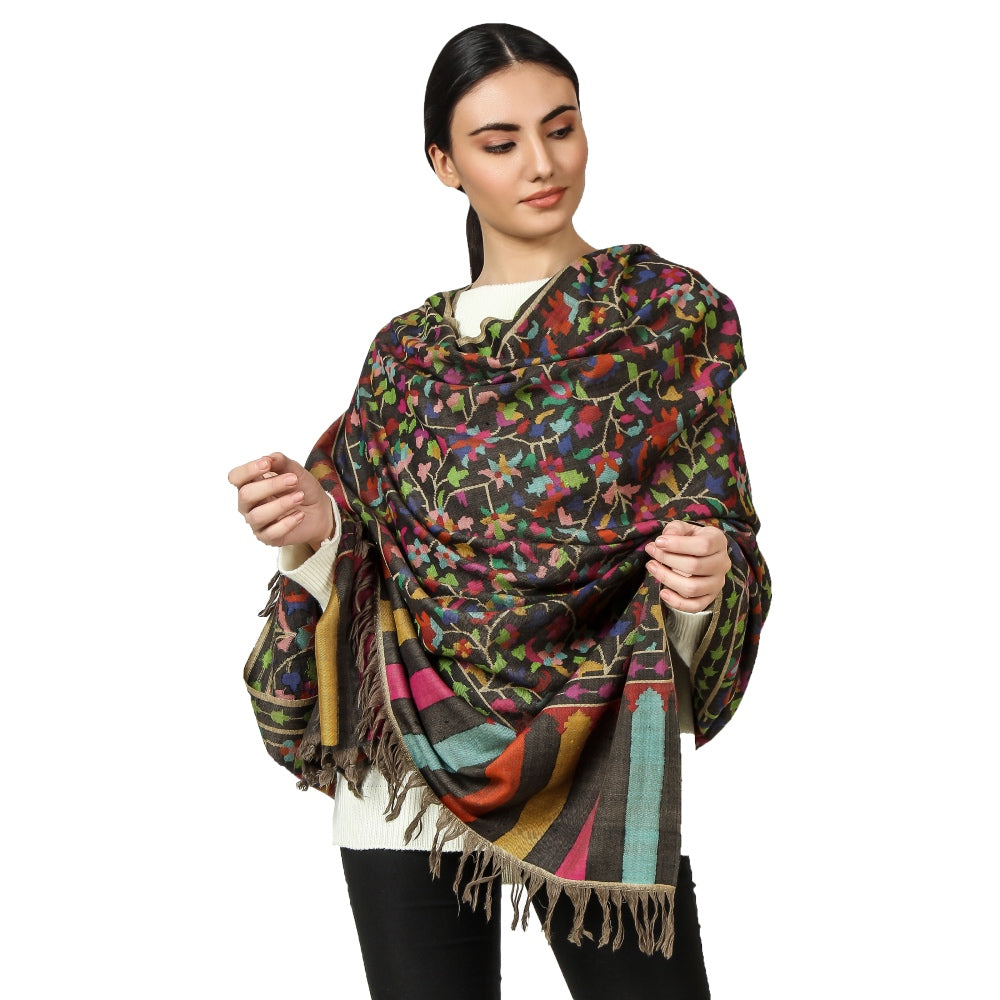
Kani is technically a twill tapestry weave: the weft threads interlock at colour boundaries rather than running selvedge to selvedge, and the pattern is woven into the fabric structure rather than applied to its surface. There is no embroidery, no printing, no dyeing of finished cloth. Every colour exists because a kani bobbin of that colour was passed through that exact shed at that exact point in the weaving sequence. The back of a finished Kani shawl shows the same image as the front — reversed, but equally precise — because the threads have no free ends; they are interlocked within the weave.
This produces a fabric that is simultaneously a textile and a woven painting. The motifs — traditionally derived from the Kashmiri garden, the cypress tree, the paisley (originally the buta, a stylised flower bud), and abstract floral arabesques — are not representations of the weave structure. They are the weave structure, indivisible from the fabric itself.
↑ Kani bobbins — each carries one colour thread, passed by hand through the shed
The Taleem: A Written Score for the Loom
Kani weaving is too complex to hold in working memory. A single moon shawl — the most elaborate Kani format, with a large central medallion surrounded by an intricate field and multiple borders — may require six months to a year of weaving time and involve thousands of colour decisions per row. The system that makes this possible is the taleem.
A taleem is a hand-written (historically) or now sometimes digitally produced notation document that encodes the weaving pattern row by row in a compressed symbolic language specific to Kashmiri weaving. The notation specifies which warp threads to raise for each colour passage, how many threads each colour segment spans, and in what sequence the kani bobbins are to be passed. It is, functionally, sheet music for the loom.
Taleems are professional documents — produced by specialist designers called naqshband — and are sold or licensed to workshop owners. A single taleem for a complex moon shawl may take a naqshband months to compose. Historically, taleems were family heirlooms, kept secret from competing workshops, and passed from master to apprentice as part of trade succession. The naqshband profession and the kani weaving profession are distinct; neither can exist without the other.
A Kani taleem uses a system of abbreviated Kashmiri notation that specifies both thread count and colour simultaneously. A line of taleem notation might encode "pass blue bobbin over 4 threads, red over 7, gold over 3, blue return over 4" in a compressed shorthand that an experienced weaver can read rhythmically, almost like spoken metre. Learning to read taleem is itself a multi-year apprenticeship, separate from learning to weave.
The Making of a Kani Shawl: Step by Step
Sorting, Combing, and Spinning
Raw Pashmina fiber is hand-sorted by quality and fineness, then combed to align the staple. The combed fiber is spun — traditionally on a simple wooden spinning wheel (yinder) — into warp-weight yarn (stronger, tightly spun) and weft-weight yarn (softer, loosely spun). Kani weft yarn is deliberately kept at a finer, softer twist than the warp to allow maximum colour saturation and a softer hand in the finished fabric.
Pre-Dyeing the Kani Yarns
Unlike plain weave, where a finished shawl might be dyed as a single piece, Kani requires all colour decisions to be made before weaving begins. The kani threads are dyed in their individual colours — using traditional plant-based dyes or modern certified acid dyes — wound onto their tiny bobbin sticks, and sorted by the colour map of the taleem. A complex shawl may use 50 to 300 distinct shades of thread, each pre-dyed and pre-wound.
Setting the Loom
The warp is dressed on a traditional low horizontal loom — not a high vertical tapestry loom. The Kashmiri kani loom has the weaver working in a reclined position with the warp extending away horizontally, maintained under tension by a system of beams and heddles. Dressing the loom for a full shawl — threading 600 to 1,200 warp ends through the heddles in the correct order — takes several days and is typically done by a specialist warper, not the weaver.
Row by Row, Bobbin by Bobbin
The weaver reads the taleem line by line and places each kani bobbin through the raised warp shed in sequence. A single row of a complex shawl — perhaps 3–4mm of finished fabric — may require an hour or more to complete. The bobbins hang on the near side of the warp when not in use, and the weaver must return each to its correct position at the end of each row. This is the stage that accounts for most of a Kani shawl's time cost.
Multi-Piece Construction (Moon Shawls)
Large Kani pieces — particularly moon shawls with central medallions — are often woven in multiple panels that are later joined by hand. The joining seam, when done by a skilled craftsperson, is invisible. Identifying a join requires examining the back of the shawl, where the interlocking thread structure reveals the seam point. This multi-panel approach allows work to proceed on different sections simultaneously, cutting overall production time for the most complex designs.
Washing, Blocking, and Inspection
The finished shawl is washed in cool water with natural soap to remove loom tension and allow the fiber to bloom and relax. It is then blocked flat on a frame to its correct dimensions and dried under tension. Final inspection includes checking for missed taleem rows (a single error can introduce a colour fault visible to a trained eye), thread tension consistency, and selvedge straightness. A shawl that fails inspection is either repaired (minor faults) or re-woven from that point.
Kani Weaving and Shahtoosh: A Shared History, a Divergent Fate
Kani weaving and Shahtoosh are entangled in the historical record — but less tightly than is commonly assumed. The finest Kani pieces were overwhelmingly woven in Pashmina, not Shahtoosh. The reasons are technical: Shahtoosh fiber, with its extreme fineness and structural fragility, was poorly suited to the tension and abrasion demands of kani bobbin weaving. The standard technique of passing bobbins repeatedly through the shed would damage ultra-fine chiru fiber in ways that more robust Pashmina tolerates without difficulty.
When Shahtoosh was effectively removed from the trade by law enforcement operations in the 1990s and 2000s, Kani weaving was not materially affected. The fiber that Kani weaving actually depended upon — Pashmina — remained entirely legal. The craft lost a marketing association and a prestige narrative; it did not lose its raw material.
"People say Kani died with Shahtoosh. This is wrong. Kani was never Shahtoosh. Kani was always Pashmina dressed in borrowed prestige."
— Master Kani weaver, Kanihama village, KashmirKani Weaving Through History
Origins Under the Sultanate
Kani weaving traditions are documented in Kashmir under Sultan Zain-ul-Abidin's reign, who reportedly brought weavers from Central Asia. The technique likely drew on Persian flatweave traditions applied to the locally available Pashmina fiber.
Mughal Court Patronage
Akbar, Jahangir, and Shah Jahan are all documented as enthusiastic patrons of Kashmiri woven shawls. The Mughal court's aesthetic — garden motifs, arabesques, cypress trees — directly shaped the Kani vocabulary still used today. Akbar reportedly owned hundreds of fine shawls.
European Export Boom and the "Paisley" Misunderstanding
Kani shawls began entering European markets in large quantities through the East India Companies. The buta motif — a stylised flower bud — was reproduced by European manufacturers in Paisley (Scotland) and Norwich (England) using Jacquard looms, giving the shape a Western name it has kept ever since. The machine-made "Paisley" was a pale imitation of Kani; the confusion persists.
Decline and Near-Extinction
The combination of European machine competition, the collapse of colonial luxury markets after the 1857 uprising, and later the political disruption of Partition drove Kani weaving to the edge of extinction. By the mid-20th century, only a handful of master weavers in villages like Kanihama and Sheikhpora preserved the tradition.
Revival Through Tourism and Export
Growing Western interest in Indian craft traditions, combined with the Kashmir tourism boom of the 1970s, created renewed demand for authentic Kani pieces. Government craft development schemes and export promotion gave the tradition commercial viability for the first time in over a century.
Shahtoosh Trade Collapses — Kani Continues
Major enforcement operations effectively ended large-scale Shahtoosh commerce. Kani weaving — dependent on Pashmina, not chiru fiber — was untouched. The craft's artisanal workforce, already small, continued uninterrupted.
UNESCO Recognition
Kani (Kani Shawl Weaving) was included on the UNESCO Representative List of Intangible Cultural Heritage of Humanity as part of the broader nomination of Kashmiri crafts. The recognition formalised what craft preservationists had long argued: Kani is not a product category, it is a living knowledge system.
GI Tag and Modern Authentication
The Geographical Indication (GI) tag for Kashmir Kani Shawl provides legal protection against machine-made imitations labelled as Kani. QR-coded authentication tags attached to certified pieces allow buyers to verify the maker, the loom, and the production date — bringing traceability to a tradition that previously relied entirely on reputation.
The Kani Motif Vocabulary: What the Patterns Mean
Kani patterns are not arbitrary decoration. Each principal motif carries a documented genealogy traceable through centuries of workshop practice, taleem notation, and court inventory. The major motif families:
Buta (Boteh / Paisley)
The signature Kani motif — a stylised flower bud, possibly derived from a cypress tree bent by wind. The form that Europe called "Paisley" and that Persia called "boteh." Its orientation (upright, tilted, mirrored) carries distinct meanings within workshop tradition.
Chinar Leaf
The oriental plane tree (Platanus orientalis) — "chinar" — is Kashmir's iconic tree. Its distinctive lobed leaf appears throughout Kani work as a border element and field filler. The chinar leaf motif is relatively simpler to weave than the buta, and often appears in student work as an early exercise in taleem reading.
Gulbadan (Flower Body)
A stylised rose or generic flower form that appears most commonly in the field of a moon shawl. Gulbadan designs are typically woven on a plain or softly coloured ground, allowing the flower forms to carry the visual weight. The term is also used loosely for any floral all-over field.
Hashia (Border)
The hashia is the multi-band border that frames a Kani shawl. Its complexity is one of the primary indicators of a shawl's overall quality and production time. A simple hashia may have two or three bands; a grand moon shawl may have eight or more, each woven in a distinct pattern vocabulary with its own taleem section.
Amlikar (Moon / Medallion)
The central circular or oval medallion that defines the "moon shawl" format. The amlikar is the most demanding element of a Kani composition — its circular geometry requires the weaver to constantly adjust bobbin counts and colour boundaries to maintain the curve. A large amlikar may itself require a separate taleem document.
Cypress (Sarv)
The tall, upright cypress — a Central Asian garden symbol of constancy and eternity — appears throughout Kani borders and fields. Persian influence on Kashmiri court aesthetics introduced the cypress; it has remained in the Kani vocabulary for five centuries. The cypress motif is typically woven in a single saturated colour against a contrasting ground.
Several reliable indicators distinguish handwoven Kani from machine-made copies. First, examine the back: a genuine Kani shawl has a back that mirrors the front pattern in interlocked weft threads — tidy, but showing the colour floats and interlocking joins of the bobbin structure. A machine-made Jacquard imitation has a back covered in floating threads (weft floats running selvedge to selvedge) that look messier and structurally different.
Second, look at the selvedges: handwoven Kani has selvedges that are slightly irregular, built up row by row. Machine selvedges are perfectly regular and mechanically uniform.
Third, look for the GI authentication tag (for pieces sold through registered channels) or a government craft certification mark. Since 2020, certified Kani shawls from registered producers carry QR-coded authentication.
A full moon shawl with a complex central medallion, intricate field pattern, and multi-band hashia border takes between ten months and eighteen months for a single master weaver working six to ten hours per day. This does not include the taleem composition (months for the naqshband), fiber preparation, dyeing, warping, and finishing. The total production time from raw fiber to finished shawl often exceeds two years.
Simpler Kani pieces — a shawl with border-only pattern and plain field, or a smaller stole — may be completed in four to eight weeks. Even these represent a labour investment far beyond any machine alternative.
No. Shahtoosh (chiru fiber) has been illegal to trade or possess in most countries since the 1970s under CITES, and domestic bans in India under the Wildlife Protection Act have been in force since 1972. Legitimate Kani production uses Pashmina — the fiber of the domestic Cashmere goat — throughout. Silk is occasionally used for fine weft threads in premium pieces.
Any seller claiming to offer "Kani Shahtoosh" is describing something either illegal or fictitious. Genuine Kani production has no need for chiru fiber — Pashmina's properties are well-suited to the technical demands of the kani bobbin technique.
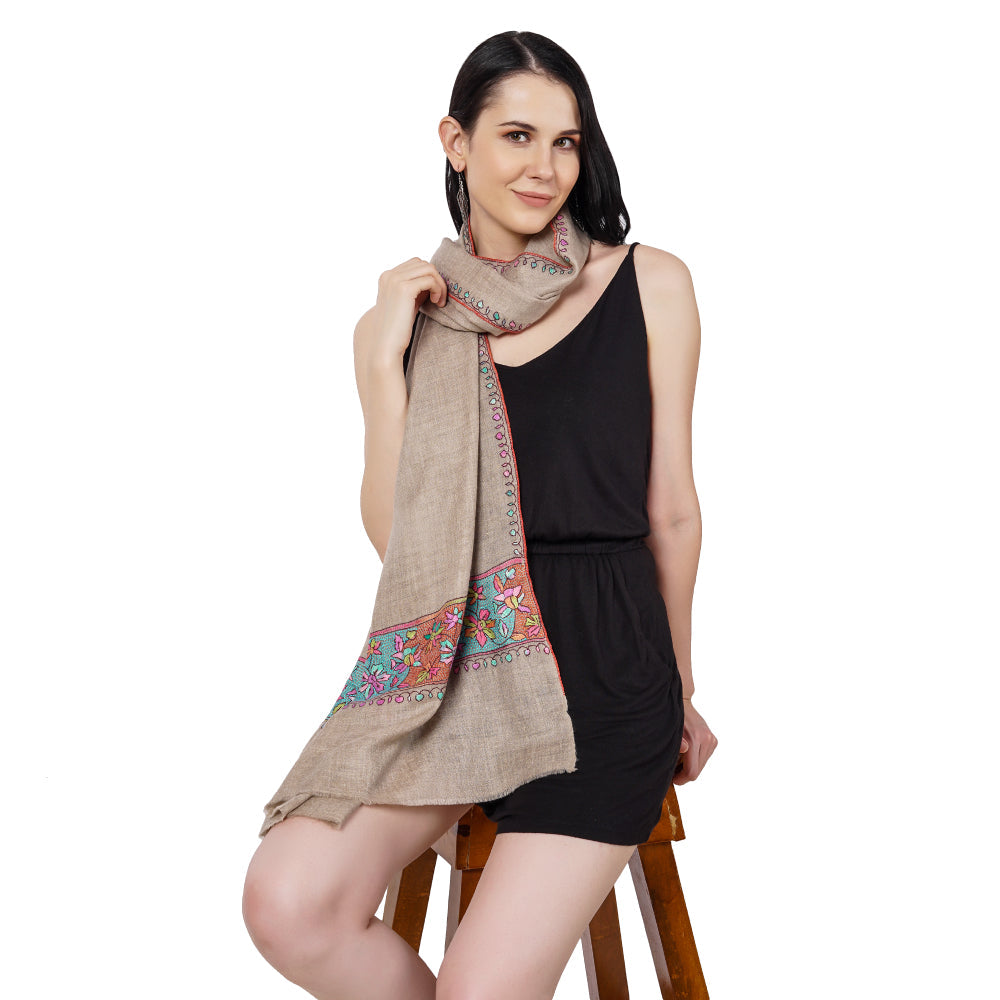
These are two entirely different techniques applied to Kashmiri shawls, often confused. Kani weave builds the pattern into the fabric structure during weaving — using pre-dyed bobbins passed through the warp. The colour is structural, not applied. Sozni is needle embroidery applied to a finished plain-woven Pashmina ground — a craftsperson (soznikar) embroiders the pattern in fine thread using a needle after the base fabric is complete.
A sozni shawl typically takes less time than a complex Kani piece but can still represent months of embroidery work. Some shawls combine both techniques: a Kani-woven ground with sozni embroidery applied to the borders or field. These combined pieces are among the most expensive in the market.
The community of active Kani weavers is small — estimates range from a few hundred to perhaps two thousand individuals who work in the traditional technique regularly — concentrated in villages in the Kanihama area of Kashmir and in Srinagar's old craft quarters. Apprenticeship typically requires three to five years before a weaver can work from taleem independently, and the economic returns in the early years are modest.
The UNESCO recognition in 2014 and the GI tag have helped establish price premiums that make the craft more economically viable. Growing international interest in certified handcraft, and the traceability that QR authentication provides, has brought new buyers who are willing to pay prices commensurate with the labour involved. The craft is fragile but not in immediate crisis — and brands like Pashwrap that source authentic Kani directly from artisan families provide the consistent commercial demand that sustains workshops between heritage-market sales.
The primary cost driver is time — specifically, the complexity of the taleem and the number of bobbins required per row. A shawl with a plain field and a simple single-band border might use 80–100 bobbins and take four to six weeks. A moon shawl with a densely patterned field, large central medallion, and eight-band hashia border might use 800–1,500 bobbins and take twelve to eighteen months. The price difference between these pieces reflects real labour inputs, not arbitrary luxury pricing.
Secondary factors include fiber quality (finer Pashmina adds cost), number of colours (more distinct dye lots, more pre-preparation), and naqshband design complexity (elaborate original taleems command a premium over standard repeat patterns). A certified Pashwrap Kani piece carries documentation of which artisan wove it — the attribution that allows genuine collector pricing.
Since Shahtoosh Is Illegal, Here Is the Best Alternative
Kani Pashmina — woven on traditional looms, from ethically sourced Kashmiri fiber, by named artisans — is the living form of the craft that Shahtoosh was only ever marketed alongside. It needs no association with wildlife crime to justify its price or its beauty.
Explore Pashwrap Kani Shawls