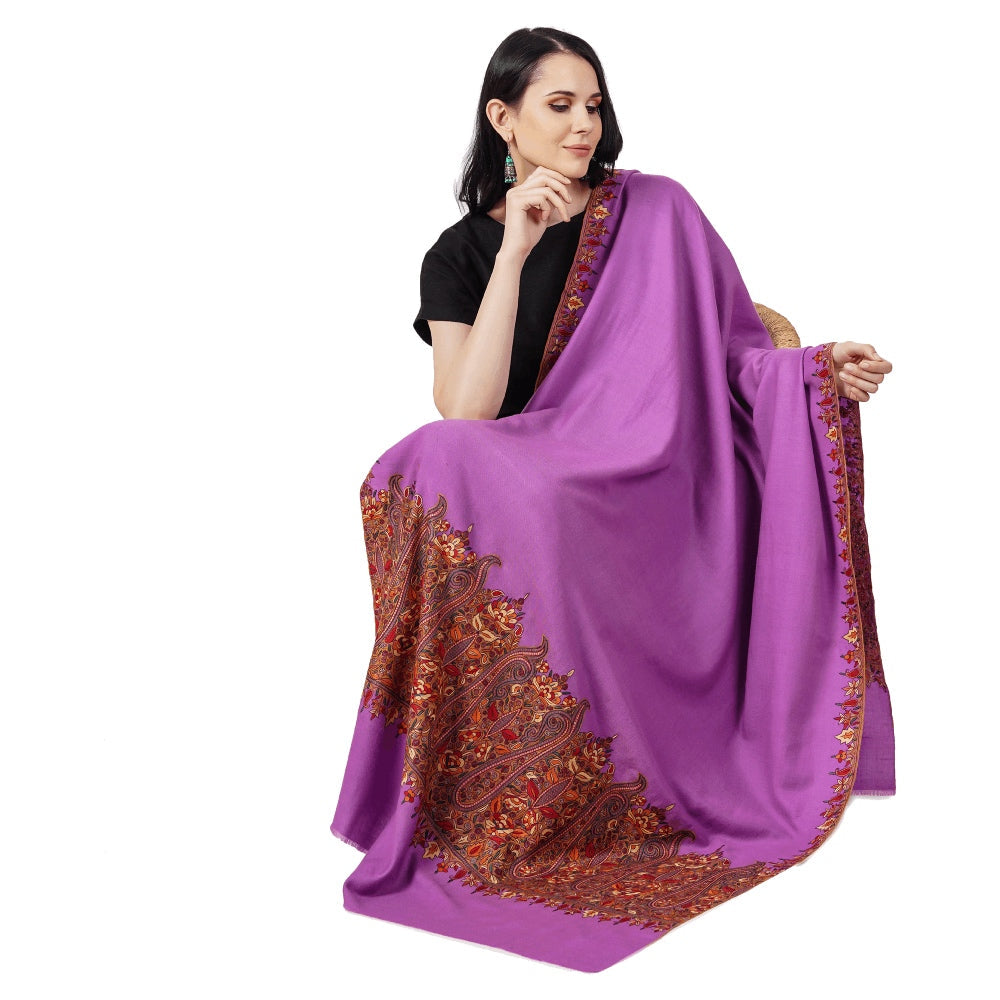

What Happened to the Kashmir Shahtoosh Trade After 2002?
We watched it happen in real time. The raids, the closed shops, the weavers who suddenly had nothing to weave. The year 2002 did not just ban a fibre — it dismantled an entire segment of Kashmir's economy overnight. This is what that looked like from the inside, and what came after.
What This Article Covers
If you walked through the textile markets of Srinagar in 1998, you could buy Shahtoosh. Not in secret. Not through a coded conversation or a whispered arrangement in a back room. You could walk into shops on Residency Road, on the bund near Dal Lake, in the lanes off Lal Chowk, and find Shahtoosh shawls displayed openly — sometimes not even locked in a cabinet, just draped over a chair or folded on a shelf between Pashmina pieces. The price was high, but the transaction was ordinary. You paid in rupees or dollars. You got a receipt, sometimes. You walked out with a shawl in a bag.
If you walked through the same markets in 2004, that world was gone. Not diminished. Not pushed underground in a way that a determined buyer could still navigate. Gone. The shops that had sold Shahtoosh were either closed or had stripped every trace of the word from their premises. The weavers who had spent their lives working with the fibre were suddenly unemployed or in hiding. The looms that had woven it sat idle, and in some cases were confiscated by the police as evidence. The transformation took less than two years, and it permanently altered the economic geography of Kashmir's textile trade.
We were there for all of it. Our family's workshop was operating throughout this period, manufacturing Pashmina while watching the Shahtoosh trade collapse around us. What follows is not a legal analysis or a conservation report. It is a ground-level account of what [the legal status of Shahtoosh](/blogs/news/is-shahtoosh-illegal-country-legal-guide) actually looked like when it arrived in Srinagar — and what happened to the people, the skills, and the market in the years that followed.
The 2002 Amendment: What the Law Actually Changed
The legal history of Shahtoosh in India is not a single event. It is a sequence of escalating restrictions, each one closing a loophole that the previous restriction had left open. [The complete history of Shahtoosh](/blogs/news/shahtoosh-history-mughal-courts-ban) traces this sequence in full, but the critical moment for the Kashmir trade was 2002.
Prior to 2002, the Wildlife Protection Act of 1972 already prohibited the hunting of the chiru and the trade in its derivatives. But the enforcement was weak, the penalties were relatively light, and — most importantly — the law was interpreted in Kashmir as prohibiting the trade in Shahtoosh (buying and selling) but not necessarily the possession of existing stock. This distinction mattered enormously. Dealers in Srinagar argued that shawls they had woven before the trade restrictions tightened were legally held inventory. Weavers argued that they were simply working with raw material they had purchased years earlier. The legal ambiguity created enough cover for the market to continue operating, albeit nervously, throughout the 1990s.
⚠ The 2002 Change
In 2002, the Indian government amended the Wildlife Protection Act to move the chiru from Schedule I Part II to Schedule I Part I, and simultaneously increased the penalties for offences involving Schedule I species. The amendment explicitly criminalised possession of Shahtoosh — not just trading, not just hunting, but having it in your shop, in your home, or on your loom. The penalty for possession became imprisonment of up to seven years and a fine of up to 25,000 rupees.
This single change — from prohibiting trade to prohibiting possession — eliminated the legal grey zone that the Srinagar market had been operating in. A dealer could no longer claim that old stock was exempt. A weaver could no longer claim that the yarn on her loom was pre-ban. If it was in your shop, you were committing a criminal offence punishable by prison. The theoretical distinction between old stock and new stock ceased to exist in practical terms.
The timing was not coincidental. International pressure on India to enforce CITES had been building throughout the late 1990s, driven by TRAFFIC reports, conservation campaigns in Europe and North America, and embarrassment over the continued open sale of Shahtoosh in Kashmir despite India's CITES obligations. The 2002 amendment was the central government's response to that pressure — and it was designed to be unambiguous enough that local enforcement in Kashmir could no longer look the other way.
The Srinagar Market Before the Crackdown

To understand what 2002 destroyed, you need to understand what existed before it. The Shahtoosh market in Srinagar was not a shadowy underworld. It was an integrated part of the mainstream Kashmir textile industry. The same shops that sold Pashmina sold Shahtoosh. The same dealers who sourced Pashmina from the countryside sourced Shahtoosh raw material through Ladakhi intermediaries. The same artisans who wove Pashmina on their looms wove Shahtoosh when the raw material was available. The two fibres existed in a shared ecosystem — not legally, but practically.
The market operated on a hierarchy of discretion. At the bottom were the open-air tourist shops near Dal Lake, where Shahtoosh might be offered to a foreign visitor who asked the right questions in the right way — usually after establishing that they were not an enforcement officer. At the top were the established dealers on Residency Road and in the upscale showrooms, who kept Shahtoosh in locked cabinets or back rooms and only brought it out for known clients. In between was a vast grey zone of shops where Shahtoosh was not openly displayed but was available to anyone who used the word.
Pricing reflected the risk and the rarity. In the late 1990s, a standard Shahtoosh shawl — plain weave, no embroidery — sold in Srinagar for roughly 15,000 to 40,000 rupees (roughly $350 to $900 at exchange rates of the period). An exceptionally fine piece could command significantly more. For context, a high-quality Pashmina shawl at the same time sold for 3,000 to 10,000 rupees. The Shahtoosh premium was roughly four to six times the Pashmina price — a markup that reflected the fibre's fineness, the longer production time, and the growing legal risk that sellers were beginning to factor into their pricing.
What is important to understand is that many of the people involved in this market did not consider themselves criminals. The weavers certainly did not. They were craftspeople working with whatever fibre their employer provided. The spinners did not. They were women drawing thread for a wage, no more responsible for the legal status of the raw material than a factory worker is responsible for the patent status of a product design. Even some of the dealers — particularly the older generation — had entered the trade when Shahtoosh was legal or ambiguously regulated, and they viewed the subsequent restrictions as an arbitrary government intervention in a legitimate business they had operated for decades. This was not a defence that held up in court. But it is essential context for understanding why the 2002 crackdown was experienced in Kashmir not as law enforcement but as an economic catastrophe visited on ordinary working people.
The Raids, Seizures, and the Climate of Fear
The enforcement did not begin gradually. It arrived as a series of high-profile raids in late 2002 and early 2003, conducted jointly by the Jammu and Kashmir Wildlife Protection Department and the police. The raids were designed for visibility — not just to seize contraband, but to send a message that the legal landscape had fundamentally changed.
Shops were raided during business hours. Stock was seized from display cases and back rooms. Looms were confiscated from workshops — in some cases, the looms themselves were taken as evidence, which meant the weaver lost not only their Shahtoosh work but the equipment they used for Pashmina as well. Raw fibre was seized from godowns. Dealers were arrested. The local newspapers covered the raids extensively, which was precisely the point: the publicity was part of the enforcement strategy, intended to convince the broader market that the 2002 law was not a paper tiger.
The message was received. Within months, the open market for Shahtoosh in Srinagar effectively ceased to exist. Shops removed anything that could be connected to the fibre. Dealers who had built their businesses on Shahtoosh quietly redirected their inventories toward Pashmina. The word itself — which had been a selling point, a status marker, a shorthand for the finest product available — became something people stopped saying in public. We watched this shift happen in real time. In 2001, a dealer might mention Shahtoosh casually to a trusted client. By 2004, even mentioning the word in a business context was considered reckless. The climate of fear was not limited to people who were actually breaking the law. It extended to anyone whose business was adjacent to the fibre — which, in the Kashmir textile trade, meant almost everyone.
The Human Cost: Artisans Caught in the Middle
The conservation narrative around Shahtoosh is clear and correct: the trade was driving the chiru toward extinction, and ending it was necessary. We do not dispute this. But the conservation narrative rarely addresses what happened to the human beings who were economically dependent on the trade when it was shut down — and addressing that gap is important, not as an argument against the ban, but as a factual account of its consequences.
The weavers and spinners of Shahtoosh were not wealthy. The profits of the trade accrued primarily to the dealers and middlemen who controlled the raw material supply and the export channels. The artisans — the women who spun the fibre and the men who wove it — were wage workers. They were paid per piece or per gram of spun yarn, at rates that were higher than Pashmina wages but not dramatically so. When the raids came, the dealers had the resources to absorb the shock: diversified inventories, cash reserves, connections in other markets, the ability to pivot. The artisans had none of these things. They had one skill — spinning or weaving ultra-fine fibre — and one source of income. When the looms stopped, the income stopped.
The transition to Pashmina was not immediate for these artisans. Despite the similarities between the two fibres, the shift was not seamless. Shahtoosh spinners had to recalibrate their technique for a slightly thicker, slightly more robust fibre — a transition that sounds trivial but took weeks or months to execute consistently. Shahtoosh weavers had to adjust loom tension, pick density, and beat patterns. More significantly, the Pashmina market could not immediately absorb all the artisans displaced from Shahtoosh. The Pashmina market was large, but it was already staffed. Suddenly adding dozens of highly specialised Shahtoosh weavers to the labor pool created a temporary oversupply that depressed wages for everyone.
"We knew a weaver in our locality who had woven Shahtoosh for twenty years. After the raids, his loom was taken by the authorities — not because they found Shahtoosh on it, but because it was a loom known to have been used for Shahtoosh and they seized it as evidence. He lost his loom, his income, and two months of work that was on the loom when they took it. He spent the next year doing manual labour before he could afford to buy a new loom for Pashmina work. He was not a criminal. He was a craftsman who had been abandoned by the transition."
We are not recounting this to argue that the ban was wrong. It was not. But any honest account of [what Shahtoosh is](/blogs/news/what-is-shahtoosh) must include the fact that ending the trade had human costs that were borne almost entirely by the people with the least power in the supply chain. The dealers adapted. The smugglers found other products. The international buyers moved on to other luxuries. The artisans in Srinagar bore the economic brunt of a decision made in Delhi, enforced by police, and celebrated by conservation organisations that had no presence in the valley and no program to assist the displaced workers.
The Underground Years: 2002 to 2012
The 2002 amendment did not eliminate the Shahtoosh trade overnight. What it eliminated was the open retail market. What remained — for roughly a decade — was a closed, word-of-mouth network that operated at a fraction of its former scale, serving a shrinking pool of buyers who were willing to accept the increased risk and price.
During this period, Shahtoosh was not available in shops. It was available through personal contacts. A wealthy buyer — typically an Indian business family, a Middle Eastern collector, or occasionally a foreign diplomat — would express interest through an intermediary. The intermediary would approach a former Shahtoosh dealer who still had hidden stock or access to hidden stock. A meeting would be arranged, often not in a shop at all but in a private home or a hotel room. The shawl would be brought out, inspected, and if the transaction proceeded, it would happen in cash with no documentation. The price during this underground period was significantly higher than the pre-ban retail price — often double or triple — reflecting both the scarcity of remaining stock and the risk premium that sellers now demanded.
This underground market was small, paranoid, and declining. The raw material supply from Tibet had been severely disrupted by Chinese enforcement on the plateau. Indian enforcement in Kashmir was making the logistics of holding stock increasingly dangerous. Each raid, each arrest, each seizure reduced the remaining inventory of finished shawls and raw fibre. And unlike Pashmina, there was no way to replenish the stock — the supply chain from the plateau was effectively dead.
The underground market's death knell came around 2010 to 2012, when a second wave of enforcement — driven by both state and central wildlife agencies — specifically targeted the remaining network of dealers and intermediaries. Several high-profile arrests and prosecutions in this period demonstrated that the legal system was willing to pursue not just possession cases but the conspiracy and supply-chain cases that underpinned the underground trade. After 2012, the Shahtoosh trade in Kashmir ceased to exist in any meaningful form. What remained was [the shahtoosh black market](/blogs/news/shahtoosh-black-market-2026) in its absolute final stages — a handful of aging stockholders sitting on pieces they could no longer sell, and a trickle of fake Shahtoosh being peddled to gullible tourists who did not understand that the real thing was gone.
How Pashmina Absorbed the Shock
The most underreported consequence of the Shahtoosh ban is the one that matters most for understanding the Kashmir textile industry today: Pashmina absorbed the displaced economic energy of the Shahtoosh trade and became stronger as a result.
This was not automatic. In the immediate aftermath of 2002, the Pashmina market was disrupted along with everything else — the shared infrastructure, the overlapping dealer networks, the artisan labor pool that had moved between both fibres. But within three to five years, a structural shift became visible. The dealers who had previously diversified across Shahtoosh and Pashmina now concentrated entirely on Pashmina. The capital that had been tied up in Shahtoosh inventory was redirected into Pashmina raw material, artisan wages, and marketing. The artisans who had been spinning and weaving Shahtoosh transitioned fully to Pashmina, bringing with them the extraordinary skill levels that ultra-fine fibre work had demanded.
The quality of Kashmiri Pashmina improved in the decade after 2002. This sounds counterintuitive — how does losing the finest fibre improve the quality of the remaining one? The answer is artisan skill. The women who could spin Shahtoosh at 9 to 11 microns were, by definition, the most skilled spinners in the valley. When they redirected that skill to Pashmina at 12 to 14 microns, they produced Pashmina yarn of exceptional fineness and consistency — better than the Pashmina yarn being produced before the ban, when the most skilled spinners were occupied with Shahtoosh. The ban inadvertently concentrated the valley's highest skill level onto a single fibre, and Pashmina was the beneficiary.
✦ The Unintended Consequence
The post-2002 period produced what many in the trade consider the finest era of Kashmiri Pashmina spinning. With Shahtoosh gone, the finest spinners in the valley had no choice but to apply their abilities to Pashmina. The resulting yarn — hand-spun at 12 to 13 microns by women who had previously spun at 10 microns — set a quality standard that the Pashmina industry had rarely achieved when Shahtoosh was still available to distract the top talent.
This is the irony of the Shahtoosh ban for the Pashmina industry: the elimination of a rival fibre concentrated artisan skill onto Pashmina and produced a level of quality that the market had not previously seen. The [handmade Pashmina](/pages/handmade-pashmina) being produced in Srinagar in the late 2000s and early 2010s — by former Shahtoosh spinners working with Changthangi goat fibre — was some of the finest Pashmina ever made.
The market also shifted in how it positioned Pashmina. Before 2002, Pashmina was often described in the trade as "the poor man's Shahtoosh" — a phrase that makes us wince now but that was genuinely used by dealers to create a frame of reference for buyers. After 2002, that framing disappeared. Pashmina could no longer be defined by what it was not. It had to be defined by what it was — and the industry gradually developed the vocabulary to do that: GI certification, hand-spinning provenance, Changthangi goat fibre specifications, artisan identification. The ban forced Pashmina to stand on its own identity, and it was strong enough to do so.
Today, when a customer asks us about Shahtoosh — which happens regularly — we tell them the truth about what it is, why it is banned, and what happened to the trade. And then we explain that the craft infrastructure that produced Shahtoosh did not disappear. It shifted to [genuine Kashmiri Pashmina](/pages/kashmiri-pashmina). Same spinners. Same weavers. Same looms. Different fibre — a fibre that does not require killing anything, that is legal in every country on earth, and that carries a five-hundred-year craft heritage of its own. The story of Kashmiri textiles after 2002 is not a story of loss. It is a story of a craft tradition that proved resilient enough to survive the elimination of its most famous product — and emerge stronger.
Frequently Asked Questions
Were any of the arrested weavers or dealers actually sent to prison? +
Yes. While many early cases resulted in fines or seizures without custodial sentences, several high-profile prosecutions in the mid-to-late 2000s did result in prison terms — typically ranging from one to three years, well below the theoretical maximum of seven. The dealers who were prosecuted were generally those found with significant quantities of finished shawls or raw fibre, or those identified as organisers of supply chains rather than individual artisans. The weavers and spinners — the wage workers — were less frequently prosecuted, though some were detained during raids and questioned. The legal system's approach evolved over time, with earlier enforcement focusing more on seizures and later enforcement focusing more on prosecuting the supply chain.
Is there still any genuine Shahtoosh hidden in Kashmir? +
Almost certainly, yes — in very small quantities. Individual pieces held by families who inherited them, or by former dealers who kept a few shawls hidden rather than destroying or surrendering them. But these pieces are not traded. They cannot be sold legally, and attempting to sell them risks imprisonment. They exist as hidden objects, not as market inventory. The practical reality is that the trade in genuine Shahtoosh in Kashmir is functionally dead. What is sold as "Shahtoosh" in Kashmir today — in the rare instances where the word is still used — is fake. The real thing is in private collections, evidence rooms, or museum storage, not in shops.
Did the Pashmina industry support the ban or oppose it? +
The response was divided, and it shifted over time. In the 1990s, many Pashmina dealers were quietly opposed to strict enforcement because the Shahtoosh trade brought high-spending international buyers to Kashmir, and some of that spending spilled over into Pashmina. After 2002, as it became clear that the ban was permanent and that opposing it was legally and reputationally dangerous, the Pashmina industry's public position shifted to support for the law. Privately, many older dealers still express ambivalence — not because they want to trade Shahtoosh again, but because they remember the era when the Kashmir textile market was larger, more diverse, and more internationally prominent than it became after the ban. The honest answer is that the Pashmina industry adapted to the ban rather than championed it.
Could the Shahtoosh trade ever return to Kashmir if the chiru population recovered? +
No, for three independent reasons. First, even if the chiru population recovered — which is happening slowly, from a low of roughly 75,000 to an estimated 100,000 to 150,000 today — the fibre cannot be collected without killing the animal, which makes any harvest inherently illegal under Indian and international law. Second, the artisan skill base has been lost. The spinners who could process Shahtoosh are ageing, and the skill is not being passed on because there is no fibre to practice on. Third, the legal framework has hardened since 2002, not softened. Reopening the trade would require reversing CITES Appendix I listing, amending the Wildlife Protection Act, and overcoming decades of conservation enforcement — none of which is politically or practically realistic. The Shahtoosh trade in Kashmir is permanently closed.
What happened to the raw Shahtoosh fibre that was already in Kashmir when the ban hit? +
Some was seized during raids. Some was reportedly destroyed by dealers who feared raids and wanted to eliminate the evidence from their premises. Some was hidden — and a small quantity of this hidden raw fibre likely still exists in storage, though it degrades over time and may no longer be usable for spinning after two decades. The raw fibre was more dangerous to hold than finished shawls because larger quantities of it implied involvement in the supply chain rather than simple possession, which attracted harsher prosecution. Most of what survived the raids did so in the form of finished shawls rather than raw material.
Continue Reading — The Shahtoosh Series
M1·02 · Legal Guide
Is Shahtoosh Illegal? A Country-by-Country Legal Guide for 2026
M2·01 · Full History
The Complete History of Shahtoosh: From Mughal Courts to Modern Ban
M4·10 · Underground Trade
Shahtoosh Black Market in 2026: What the Underground Trade Looks Like Now
M2·28 · Economic Impact
Shahtoosh and the Kashmir Economy: What the Ban Cost Local Artisans
The craft that survived the ban
Kashmiri Pashmina, post-2002.
Stronger, finer, and entirely its own.
The artisans who once wove Shahtoosh wove Pashmina afterward — and they wove it better than anyone had before, because the skill that Shahtoosh demanded was now fully concentrated on a single legal fibre. When you buy genuine Kashmiri Pashmina from a house that has been in this trade since the 1960s, you are buying the direct beneficiary of that transition.