
Protein Fiber Physics: Why Animal Fibers Insulate Differently From Synthetics
A 100g Pashmina shawl in its fifth winter is warmer than a 300g polyester fleece in its first. This is not marketing — it is physics. The hollow-core protein fiber, the keratin scale structure, the hygroscopic moisture chemistry: these are engineering solutions that three hundred million years of mammalian evolution produced, and that no petrochemical process has yet replicated. Here is the full explanation.
The question of why natural animal fiber outperforms synthetic insulation — weight for weight, across decades of use — is one of the most practically significant questions in textile science, and one of the least well answered by the popular press. Answers tend to be gestural: "natural is better," "protein fibers breathe," "Pashmina is alive." None of these is wrong, exactly, but none explains the mechanism. The mechanism matters because understanding it is the only way to evaluate the claims made about luxury fiber — including the claims made about Shahtoosh and Pashmina — with any precision.
The physical difference between protein fiber insulation and synthetic insulation operates at three distinct scales: the molecular structure of the fiber itself (keratin vs polyester), the microscopic architecture of the individual fiber strand (hollow core vs solid core), and the macroscopic behavior of fiber assemblies in fabric (moisture management, dead-air trapping, compressive resilience). At each scale, the protein fiber does something that synthetic fiber cannot. Understanding all three is understanding why a Pashmina shawl is warmer than it has any right to be.
The insulating advantage of protein fiber is not one property. It is four separate physical mechanisms operating simultaneously — and they interact in ways that compound the advantage.
No synthetic has yet replicated all four in a single fiber. Most replicate none of them well.
The most structurally significant feature of high-performance animal fiber — including the Changthangi goat fiber that produces genuine Pashmina, and the Tibetan Chiru fiber that produced Shahtoosh — is the hollow medullary canal at the center of the fiber cross-section. This is not a manufacturing artifact or a processing choice: it is a biological structure present in the fiber as it grows from the follicle.
Hollow-Core Architecture
Changthangi Pashmina 12–16µm · Chiru 9–12µm
The fiber cross-section shows a cortex of tightly wound keratin protein surrounding a hollow medullary canal. The canal is not empty in the biological sense — in the living fiber it contains air and cellular debris — but functionally it traps a column of dead air along the fiber's entire length. Dead air is among the most effective insulating materials known: it has a thermal conductivity of approximately 0.025 W/m·K, lower than most solid materials. The hollow core means that a fiber strand at 12µm contains proportionally far more insulating dead-air volume than a solid synthetic fiber at the same diameter.
Dead-air fraction: 15–30% of fiber volume
Solid-Core Architecture
Standard polyester 10–20µm · Microfiber 5–10µm
Standard synthetic fibers are solid throughout their cross-section. Some engineered synthetics (hollow-fill polyester used in pillows and duvets, for example) do incorporate a hollow core, but these are manufactured at diameters of 20–40µm — too thick for next-to-skin use — and the hollow fraction is typically only 5–10% of fiber volume. At the fine diameters required for luxury fabric (under 20µm), the engineering challenges of maintaining hollow-core structure make genuine hollow-core synthetics essentially non-existent in commercial woven textile production. The thermal contribution of the fiber itself is therefore limited to the conductivity of the solid polymer — typically 0.2–0.4 W/m·K for polyester, eight to sixteen times higher than still air.
Dead-air fraction: 0–5% of fiber volume (woven)
The practical consequence of the hollow-core differential is substantial. A fabric woven from hollow-core protein fiber at 100 GSM contains — per unit area — a significantly higher volume of trapped dead air than a fabric woven from solid synthetic at the same weight. The protein fabric insulates better at the same weight, or achieves equivalent insulation at lower weight. The weight-to-warmth advantage of Pashmina over synthetic at matched weight is largely explained by this mechanism alone.
The surface of a protein fiber is not smooth. Under electron microscopy, the outer surface of a wool or Pashmina fiber shows a pattern of overlapping scales — the cuticular scales of the keratin cortex — oriented like fish scales along the fiber's length, pointing toward the tip. This scale structure is not decorative: it has profound consequences for how fibers behave when assembled into a fabric.
Crimp and Natural Loft
Protein fibers grow with an intrinsic crimp — a waviness along their length — produced by the asymmetric distribution of chemical bonds in the keratin protein chain. This crimp causes individual fiber strands to spring away from each other when assembled, creating a three-dimensional fiber array with substantial air volume between strands. This is "loft" — the property that makes a handful of Pashmina feel voluminous for its weight. Loft is a direct contributor to insulation: a fabric with high loft contains more trapped air per gram of fiber than a flat, uncrimped fabric of the same weight.
Scale Interlocking and Resilience
The cuticular scales on adjacent fiber strands interlock when the fabric is compressed. This interlocking provides two functions: it gives the fabric structural resilience (it springs back after compression, recovering its loft), and it creates micro-pockets of trapped air at every scale-contact point. Synthetic fibers, which have smooth surfaces, do not interlock in this way: they slide past each other under compression, losing loft permanently with each compression cycle. A protein fabric recovers its insulating loft after being compressed in storage or wearing; a synthetic fabric gradually flatlines.
The Keratin Protein Chain
Keratin is a structural protein with a specific helical configuration (the alpha-helix and beta-sheet secondary structures). This configuration gives the fiber strand mechanical elasticity: it can stretch under load and recover its original length when the load is released. Synthetic polymers like polyester are viscoelastic — they recover slowly and imperfectly from stretch, and they undergo irreversible elongation under sustained load. The keratin elastic recovery means that the crimp, loft, and scale structure of a protein fiber survive repeated use in ways that equivalent synthetic properties do not.
The Fiber Scale — Insulation at the Micron Level
The scale of protein fiber insulation mechanisms is worth appreciating precisely. A single Pashmina fiber at 14µm is approximately one-fifth the diameter of a human hair (70µm average). At this scale, the hollow core contains a column of dead air approximately 4–5µm in diameter. Across a square centimeter of woven Pashmina fabric — containing hundreds of fiber crossings — the aggregate dead-air volume is substantial relative to the total fabric volume. This is the scale at which the insulation advantage operates: not at the level of the shawl, but at the level of each individual fiber, repeated millions of times across the fabric area.
The table above makes visible something that is rarely stated explicitly in luxury fiber marketing: the hollow-core advantage that produces the warmth-to-weight superiority of fine animal fiber is present across the entire 9–20µm range of high-performance animal fiber — from Shahtoosh through Pashmina through Vicuña through fine Merino. What distinguishes these fibers from each other in insulating performance is not primarily the presence or absence of the hollow core, but the diameter at which that core operates and the specific structural characteristics of the keratin in each case.
The third and most underappreciated insulating mechanism of protein fiber is its hygroscopic behavior — the way it manages moisture. This is the property that most clearly distinguishes protein fiber from synthetic in actual-use conditions, where body moisture (sweat and ambient humidity) is a constant variable that dramatically affects thermal performance.
Hygroscopic — absorbs, manages, and releases moisture
- — Absorbs up to 30–35% of its own weight in moisture vapor without feeling wet
- — Moisture is absorbed into the fiber cortex, not held on the surface: the surface remains tactilely dry
- — The absorption process is exothermic (releases heat): moisture uptake generates warmth in the fabric
- — The desorption process is slow: moisture releases gradually over hours as conditions change, avoiding rapid evaporative cooling
- — Insulating performance at 20% moisture content: approximately 80% of dry performance
- — Does not support bacterial growth readily at moderate moisture levels: odor resistance sustained across multiple wearings
Hydrophobic — repels moisture to the surface
- — Absorbs less than 0.5% of its own weight in moisture vapor
- — Moisture sits on fiber surfaces, not in the cortex: creates a wet, clammy surface feel at low moisture levels
- — The hydrophobic surface offers no moisture-absorption warmth: no exothermic uptake
- — Rapid evaporation at the surface: fast desorption creates evaporative cooling effect, reducing apparent warmth
- — Insulating performance at 20% moisture content: approximately 40–55% of dry performance
- — Supports bacterial growth on moisture-saturated surfaces: characteristic synthetic odor develops rapidly in active use
The exothermic absorption mechanism deserves particular attention because it is counterintuitive: absorbing moisture makes a protein fabric warmer, not cooler. When keratin protein absorbs water vapor, the water molecules form hydrogen bonds with the protein chain, releasing energy as heat. The magnitude of this effect — sometimes called the "heat of sorption" — is measurable at the garment level: a Pashmina shawl worn in rising humidity will maintain its surface temperature more effectively than a synthetic of equivalent weight, not because of passive insulation but because of active heat generation from moisture uptake.
Level 1
Primary structure
The amino acid sequence of the keratin polypeptide chain. High in cysteine — the amino acid whose sulfur-sulfur disulfide bonds provide the protein's structural cross-linking and chemical resilience.
Level 2
Secondary structure
The alpha-helical coiling of the polypeptide chain. The helix provides the mechanical elasticity of the fiber: it stretches under load and recovers, functioning as a molecular spring across millions of use cycles.
Level 3
Tertiary & coiled-coil
Two alpha-helices wind around each other to form a coiled-coil heterodimer. Multiple dimers bundle into protofibrils, which bundle into microfibrils. This hierarchical bundling distributes mechanical stress across many protein chains simultaneously.
Level 4
Macrofibril and cortex
Microfibrils are embedded in an amorphous protein matrix to form macrofibrils, which are bundled into cortical cells that make up the fiber cortex. The cortex is where moisture absorption occurs and where the mechanical properties of the fiber are primarily determined.
The keratin hierarchy produces a fiber with a combination of properties that no synthetic polymer has replicated in a single material: high tensile strength relative to diameter, elastic recovery across thousands of strain cycles, moisture absorption capacity of up to 35% by weight, and thermal insulation from both the hollow core and the moisture management chemistry. Polyester achieves some of these properties individually — high tensile strength, reasonable moisture resistance — but not in combination, and not with the hollow-core architecture at fine diameters.
Where Shahtoosh Sits in This Physics
The four mechanisms described above apply to Shahtoosh fiber as they do to Pashmina, with the modifications that follow from its extreme fineness (9–12µm vs 12–16µm for Pashmina). The hollow-core void fraction may be slightly lower at 9–12µm due to the physical limits of wall-to-diameter ratio, but the core is confirmed present in Chiru fiber. The moisture management properties are equivalent. The keratin structure is broadly the same as other fine Himalayan fiber.
The insulating performance difference between Shahtoosh and fine Pashmina is real but modest — in the range of 10–15% warmth advantage at matched weight, attributable primarily to the finer fiber producing a slightly higher fiber count per unit area. This is not the performance gulf that luxury marketing implies. The extraordinary sensory quality of Shahtoosh — the extreme softness, the translucency, the ring-test drape — is the genuine distinction. But a genuine Pashmina at 12–14µm, correctly sourced and woven, is thermally extraordinary by any reasonable standard, and legal by every one.
The Physics Made into a Shawl
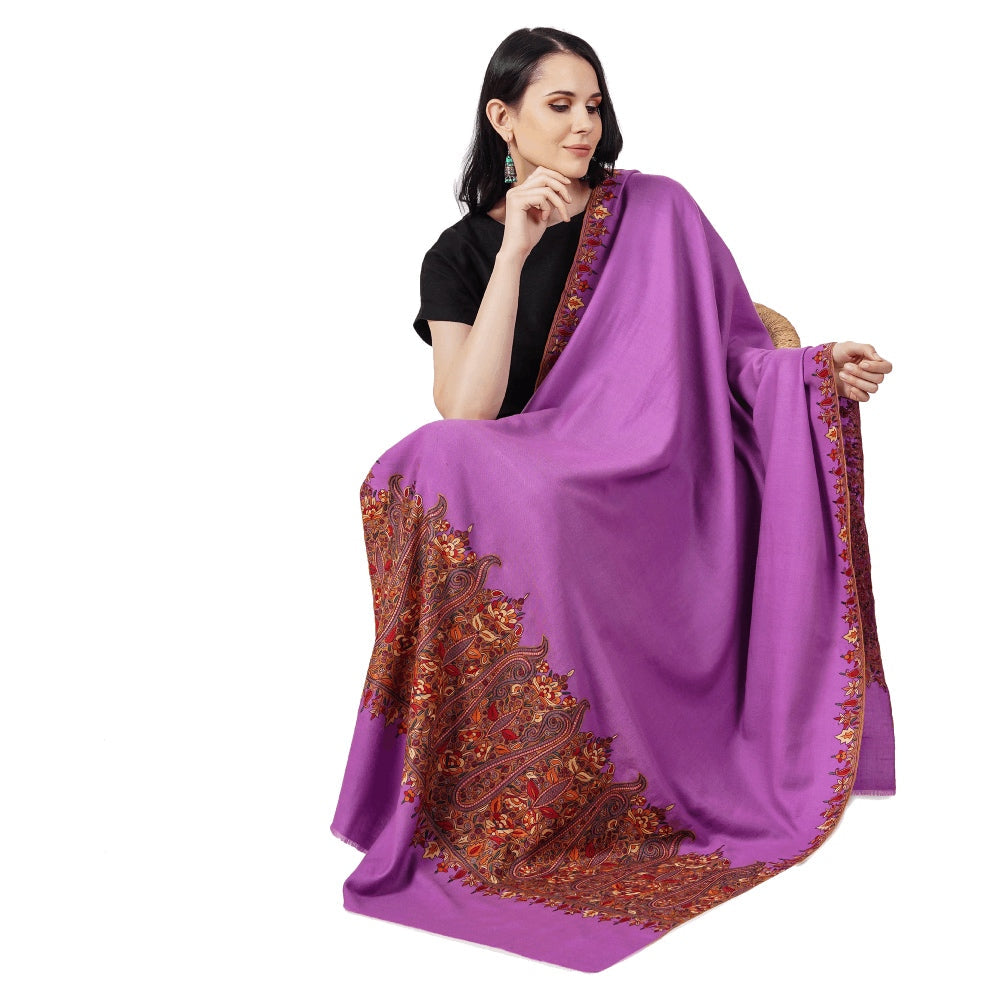
Genuine Kashmiri Pashmina at 12–16µm is the practical realisation of the four insulating mechanisms described above — hollow core, keratin crimp and loft, hygroscopic moisture management, and protein elastic recovery. Pashwrap sources from Changthangi herders with three-generation relationships, hand-spun and hand-woven in the Kashmir Valley. The physics has not changed in ten thousand years. The ethics of how you get it have.
They try — but the engineering challenge at fine diameters (under 20µm) is substantial. Hollow-fill polyester exists for pillow and duvet fills, but these fibers are manufactured at 20–50µm — too coarse and stiff for next-to-skin woven fabric. The challenge is maintaining the hollow-core structure through the fiber-drawing process at fine diameters: the thinner the fiber wall, the more likely the hollow core is to collapse or become eccentric during manufacturing. The biological solution — growing the fiber from a follicle with a hollow medullary canal already formed — avoids this manufacturing problem entirely. Several materials science research programs are investigating electrospun hollow polymer nanofibers that could replicate the hollow-core architecture at fine diameters, but as of the mid-2020s, none have achieved commercial production for woven textile use. The hollow-core protein fiber advantage remains intact against available synthetics.
The hollow core of a protein fiber is a structural feature of the fiber cross-section, not a surface coating or treatment — it cannot be washed away. The core's survival under long-term use depends on the fiber diameter. At 12–16µm (genuine Pashmina), the fiber wall is robust enough to withstand the mechanical stresses of washing and wearing across decades, as described in the M4·04 aging comparison. The hollow core remains intact through the positive aging trajectory of correctly cared-for Pashmina. At 9–12µm (Shahtoosh), the thinner fiber wall makes the core more vulnerable to compressive collapse under mechanical stress — one of the factors driving Shahtoosh's less positive aging trajectory. Correct care — hand washing, no wring, flat dry — is essential for maintaining hollow-core integrity at both diameters. Machine washing, which subjects fine fiber to high-speed rotational mechanical stress, can collapse hollow cores even in Pashmina if repeated.
The terms overlap in commercial use, which creates confusion. "Cashmere" in international trade refers to fiber from any cashmere goat (genus Capra hircus) graded below 19µm. "Pashmina" specifically refers to fiber from the Changthangi breed of Kashmir goat, which produces fiber at 12–16µm — consistently finer than the 14–19µm range of general commercial cashmere. At matched weight, genuine Pashmina at 12–14µm is warmer than standard commercial cashmere at 16–19µm, for the reasons described in this article: the finer fiber produces higher fiber count per unit area, a higher hollow-core dead-air density, and slightly better loft performance. The difference is real but not dramatic — perhaps 10–20% in warmth-to-weight — and both are extraordinary relative to synthetic alternatives. The softness difference (Pashmina vs standard cashmere) is more perceptible than the warmth difference to most wearers.
Yes, and it is one of the most practically significant properties of protein fiber in real wearing conditions, though it operates at a scale too small to perceive as "the fabric warming up." The exothermic heat of sorption released when keratin absorbs moisture vapor from skin or air is measured in the range of 2–5 watts per square meter of fabric at typical absorption rates — a small but real contribution to thermal comfort, especially in the transition conditions (morning, evening, entering a heated building from cold) where the ambient humidity is changing rapidly. The more perceptible practical benefit is the converse: when you move from a warm, humid interior to cold, dry air, a synthetic fabric dumps its surface moisture rapidly, creating immediate evaporative cooling against the skin. A protein fabric releases its absorbed moisture slowly over hours, avoiding the evaporative cooling entirely. The warmth advantage of protein fiber in changing conditions is largely this mechanism.
The practical thermal performance difference between a Shahtoosh shawl and a genuine Pashmina shawl at matched weight is modest — in the range of 10–15% in favor of Shahtoosh, attributable primarily to the slightly higher fiber count per unit area that the finer diameter (9–12µm vs 12–16µm) permits at the same fabric weight. Both fibers have the hollow core, both have the hygroscopic moisture management, both have the keratin crimp and elastic recovery. The insulating advantage of Shahtoosh over Pashmina is real but subtle — perceptible to a careful wearer in controlled conditions, but not the dramatic superiority that luxury marketing historically suggested. The genuine and extraordinary distinction between Shahtoosh and Pashmina is sensory — the extreme softness, the translucency, the extraordinary drape of the finer fiber — not primarily thermal. A genuine Pashmina is thermally excellent by any measure. The additional warmth of Shahtoosh does not justify the death of the Chiru in any reasonable calculation.
The "warmer with age" perception reported by experienced Pashmina owners is real and has a physical explanation. The primary mechanism is fiber crimp relaxation — the gradual settling of the keratin alpha-helix from its initial manufactured crimp toward a more relaxed equilibrium configuration. As the crimp relaxes over years of careful use, the fiber strands in the fabric redistribute slightly, producing a fabric with marginally higher loft and better dead-air trapping per unit area. This is a small effect — perhaps 5–10% in thermal performance — but it is real and measurable. A secondary mechanism is the gradual compaction of the fabric's outer surface, which reduces convective heat loss (wind chill effect through the fabric) without meaningfully reducing the bulk insulation properties. Together, these produce the genuine perception that a well-maintained Pashmina performs better in its fifth year than its first — a property that is the opposite of what happens to a synthetic fabric across the same period.
The Physics in Plain Summary
A Pashmina shawl outperforms a synthetic of equivalent weight because it operates four insulating mechanisms simultaneously: the hollow-core dead-air column that runs the length of each fiber; the keratin crimp and scale structure that creates loft and recovers from compression; the hygroscopic moisture chemistry that absorbs water vapor internally, maintains dry-feeling surfaces, and generates warmth on absorption; and the protein elastic structure that maintains all three of these properties across decades of use.
No current commercial synthetic replicates all four mechanisms at the fine diameters needed for luxury woven fabric. The warmth-to-weight advantage of genuine Kashmiri Pashmina over synthetic alternatives is not marketing: it is biology and physics, accumulated over millions of years of animal adaptation to cold, and sustained through centuries of craft tradition in the Kashmir Valley.
To understand how the two finest animal fibers compare against each other — Pashmina at 12–16µm vs Shahtoosh at 9–12µm — in both performance and legal status, read Shahtoosh vs Pashmina: The Fiber Difference Explained. To understand how these physical properties translate into aging behavior across twenty years of ownership, read Which Ages Better Over 20 Years.