
Shahtoosh Colour: Why the Fiber Was Almost Always Left Natural or Lightly Dyed
A color palette is not merely an aesthetic choice — it is a structural constraint. The extreme fineness of chiru fiber made deep dyeing chemically damaging. Here's what that meant in practice, and why Pashmina handled colour so differently.
The Palette That Survived: What Colours Shahtoosh Actually Came In
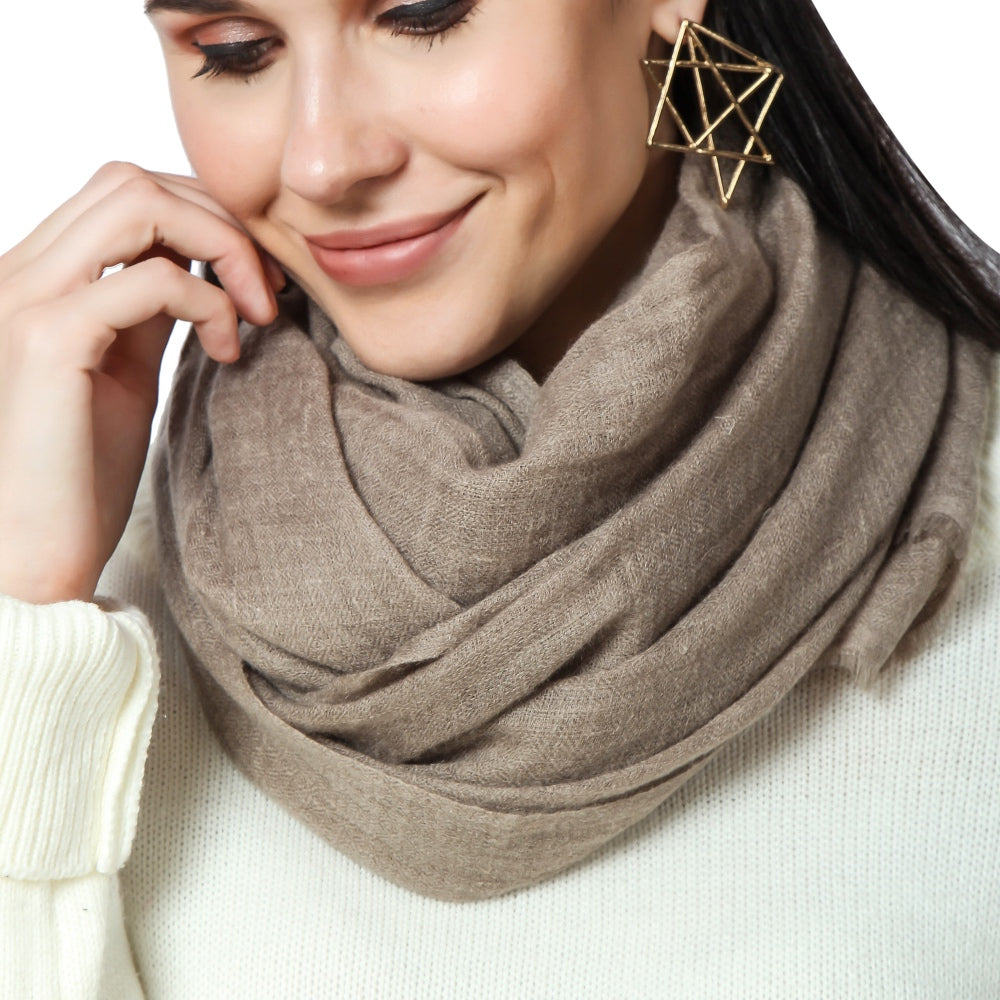
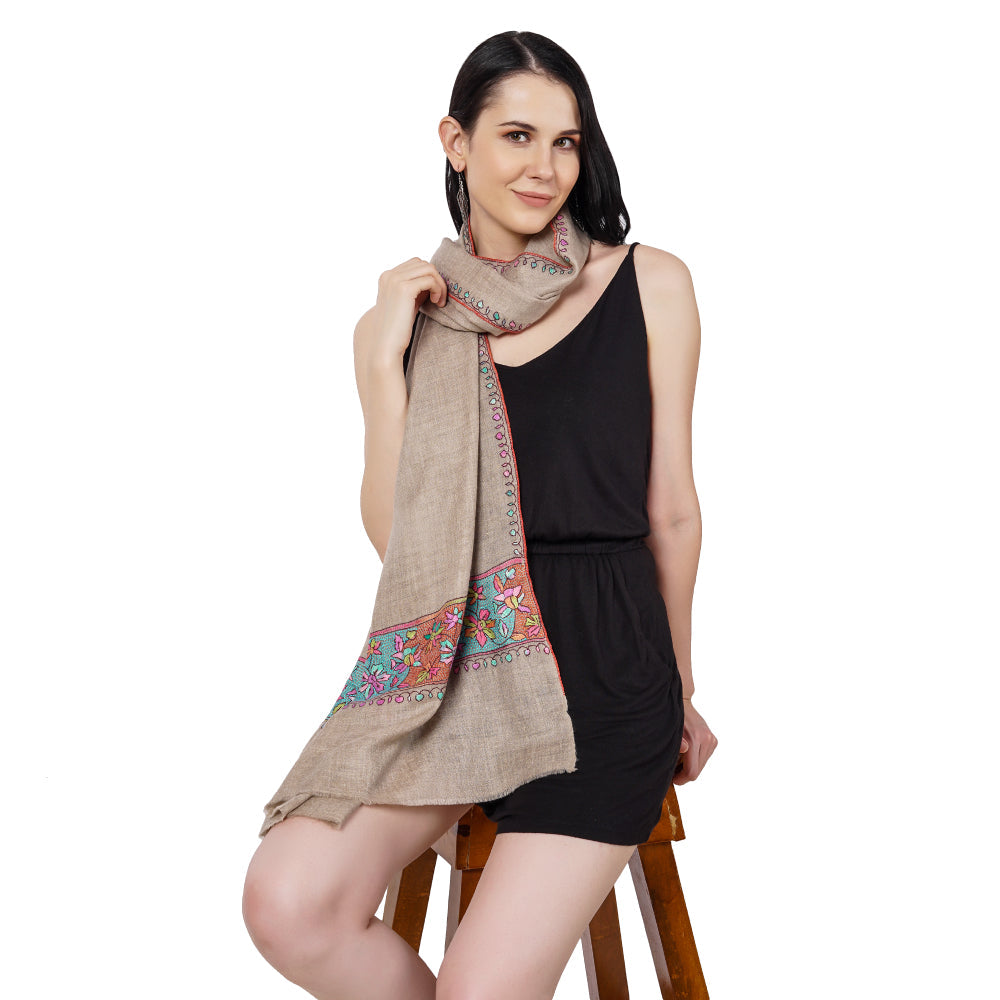
Authentic historical Shahtoosh shawls occupy a very narrow register of colour. Museum collections — the V&A in London, the Musée des Arts Décoratifs in Paris, the Calico Museum in Ahmedabad — tell the same story. The shawls are overwhelmingly ivory, ecru, warm fawn, or soft mocha. When colour appears, it is typically as embroidered or woven border work rather than overall dye. A fully and deeply dyed Shahtoosh shawl is historically almost unknown.
This was not a stylistic convention imposed by taste. It was a physical constraint imposed by fiber structure.
Note: Swatches represent approximate historic hue range. Exact museum-piece colours vary with age, mordant, and fiber oxidation.
"The paleness of these shawls was not poverty of colour — it was the fiber asserting its own nature. You could not force the chiru's wool to be something it wasn't."
— Textiles historian, Calico Museum of Textiles, AhmedabadWhy Extreme Fineness Resists Deep Dyeing: The Physics
To understand why Shahtoosh resisted deep colour, you need to understand how natural dyes bond to protein fiber. In brief: dye molecules enter the fiber cortex through the cuticle scale layer. The fineness of the fiber determines how much cortex is available, how the scales open under heat and pH change, and how structurally resilient the cortex is to the chemical stress of the dye bath.
The Three Physical Constraints
Three interacting properties of chiru fiber conspired against deep dyeing:
1. Fineness. At 9–12 microns in diameter, chiru underwool is among the finest animal fiber known. This means the surface-area-to-volume ratio of each fiber is exceptionally high — the cuticle scales occupy a proportionally larger fraction of the fiber's cross-section relative to the cortex beneath. Dye molecules that bond to the keratin in the cortex have less material to bond to. The result is a structural ceiling on colour saturation that cannot be overcome by simply using more dye or a longer dye bath.
2. Hollow core sensitivity. Chiru fiber, like many cold-climate animal fibers, has a partially hollow medullary core. This is the structural feature that gives Shahtoosh its legendary warmth-to-weight ratio. It is also the feature that makes dye baths hazardous. High temperatures in the dye bath cause the hollow fiber to expand and then contract unevenly, stressing the cuticle. The result — at temperatures that Pashmina tolerates easily — is felting, matting, or fiber breakdown. Dyers historically kept Shahtoosh baths cool and brief, sacrificing colour depth for structural safety.
3. Scale morphology and felting risk. The cuticle scales of ultra-fine fiber are proportionally larger relative to the fiber diameter than on coarser fiber. In alkaline or high-temperature conditions — both common in traditional dye processes — these scales open and interlock with neighbouring fibers, causing irreversible felting. The same fineness that makes Shahtoosh feel like spun air also makes it structurally fragile in the dye pot.
Low-concentration, cool-bath, alum-mordanted natural dyes — saffron, turmeric, light madder, weak walnut — achieve their hues through surface bonding to the cuticle scale rather than deep cortex penetration. This is why pale yellows and warm fawns survived on Shahtoosh where deep blues and saturated reds did not. Surface bonding requires less heat, lower pH disruption, and shorter bath times. The colour sits on the fiber rather than through it — which is also why these historic hues fade more readily than deeply mordanted Pashmina dyes.
Dye Class Compatibility: What Could and Couldn't Penetrate Chiru Fiber
Different categories of dye interact with protein fiber differently. The table below maps how each dye class performed on Shahtoosh versus Pashmina — and explains why the historical record looks the way it does.
| Dye Class | Bonding Mechanism | On Shahtoosh | On Pashmina |
|---|---|---|---|
| Alum-mordanted natural (saffron, turmeric, weld) |
Metal-salt mordant creates ionic link; surface and shallow cortex bonding | Workable — pale to mid-depth achieved safely at 60°C; most common historical method | Excellent — full depth achievable; durable |
| Tannin-based natural (walnut, oak gall, tea) |
Tannin binds directly to keratin via hydrogen bonds; no metal mordant required | Usable — produces warm browns and tans; gentle enough at low temps; some historic examples | Good — produces rich dark browns; very durable |
| Madder / alizarin | Aluminium mordant + high-temperature bath; deep cortex penetration | Marginal — pale pinks achievable; full red requires dangerous bath temperatures; fibers mat | Excellent — Kashmir's signature jewel reds achieved with madder |
| Indigo (vat dye) | Reduction-oxidation cycle; alkaline bath at sustained temperature | Problematic — alkaline conditions open scales; felting risk very high; historically avoided for overall dye | Very good — Pashmina accepts indigo well; Kashmir blue-ground shawls common |
| Lac / cochineal (insect dyes) |
Carminic acid bonds to protein; requires acid and heat | Problematic for deep application — acid bath alone tolerable but heat + acid combination damages fine scales | Good — vibrant crimsons and pinks achievable on Pashmina |
| Synthetic acid dyes (20th century) |
Sulphonic acid groups bond ionically to protonated amino groups in keratin | High risk — requires 70–80°C acidified bath; fiber damage significant at dye depths above pale; some adulterated trade items show this damage | Excellent — full colour range achievable; standard for modern Pashmina |
| Reactive / fibre-reactive (cellulose-type) |
Covalent bond to fiber; designed for cotton and plant fibers | Incompatible — protein fiber incompatible chemistry; structurally harmful | Incompatible — likewise not suitable for protein fiber |
What History Confirms: The Colour Record Across Eras
The documentary and material evidence from different periods of Shahtoosh production is consistent. Across the Mughal court record, European import logs, and museum collection databases, the same narrow palette dominates.
Ivory and Fawn Dominate Royal Gifting
Mughal court records describe the finest pashmina and shahtoosh shawls as "safed" (white) and "kiramiz" (cream). Coloured shawls at this period are typically kani weaves — pattern created by structural weft colour, not ground dye — meaning the field of the shawl remained its natural undyed state while decorative colour was introduced by weaving differently coloured threads.
Dyers Charged Premium for Light Work
Surviving Kashmir trade documents show that dyeing charges for finest-grade shawl fiber were not simply proportional to dye quantity used — they reflected the skill required to achieve colour without destroying the fiber. Pale saffron yellow commanded higher dyer fees than equivalent deep-dyed ordinary wool, because the process demanded precision temperature control unavailable to most workshops.
Paris Buyers Preferred the Natural
European merchants importing Kashmir shawls recorded that customers consistently paid premiums for "blanc" and "naturel" ground shawls with decorative borders, over more heavily coloured pieces. This aligned with both the fiber's colour limitation and European taste of the period — but the preference happened to suit the fiber's constraints exactly.
Synthetic Dye Attempted — With Visible Damage
As synthetic acid dyes became available from the 1950s onward, some illegal Shahtoosh producers attempted deeper colour. Forensic examination of confiscated shawls from the 1990s and 2000s reveals a consistent pattern: shawls that had been subjected to synthetic dye baths show measurable fiber degradation — scale lifting, cortex exposure, and reduced tensile strength — visible under electron microscopy. The illegal market attempted to force the fiber; the fiber showed the damage.
The Pale Archive
The V&A, the Textile Museum in Washington DC, the Ashmolean in Oxford, and the Albert Hall Museum in Jaipur all hold historic Shahtoosh pieces. A systematic survey of documented Shahtoosh specimens shows that more than 80% are in the ivory-to-warm-fawn range. Pieces with deeper colour are predominantly kani weaves where the colour is structural (in the weft threads), not the result of overall dye application to the ground fiber.
Colour as a Fraud Indicator
Textile authentication specialists use colour as one indicator in spotting fakes. A deeply and evenly saturated "Shahtoosh" — particularly in blue, black, or vivid red ground — is almost always either a Pashmina (passed off as Shahtoosh) or a deeply dyed synthetic blend. Genuine undyed-ground Shahtoosh cannot achieve these hues without structural damage that would itself be identifiable on inspection.
The same property that made Shahtoosh the most prized fiber in the world — its extraordinary fineness — was the property that prevented it from ever becoming a canvas for full colour expression. The shawl's palette was fixed by physics. This created an interesting market dynamic: pale, undyed Shahtoosh commanded higher prices than coloured examples, inverting the logic of most luxury textiles where richer colour signalled greater investment and value.
Why Pashmina Became the Colour Canvas: A Different Fiber, Different Possibilities
Kashmiri weavers working in the same tradition simultaneously with Shahtoosh and Pashmina understood both fibers' characters intimately. The colour universe of a Kashmir shawl workshop was almost entirely expressed through Pashmina — not because Pashmina was inferior, but because its structure made colour possible in a way that Shahtoosh's did not.
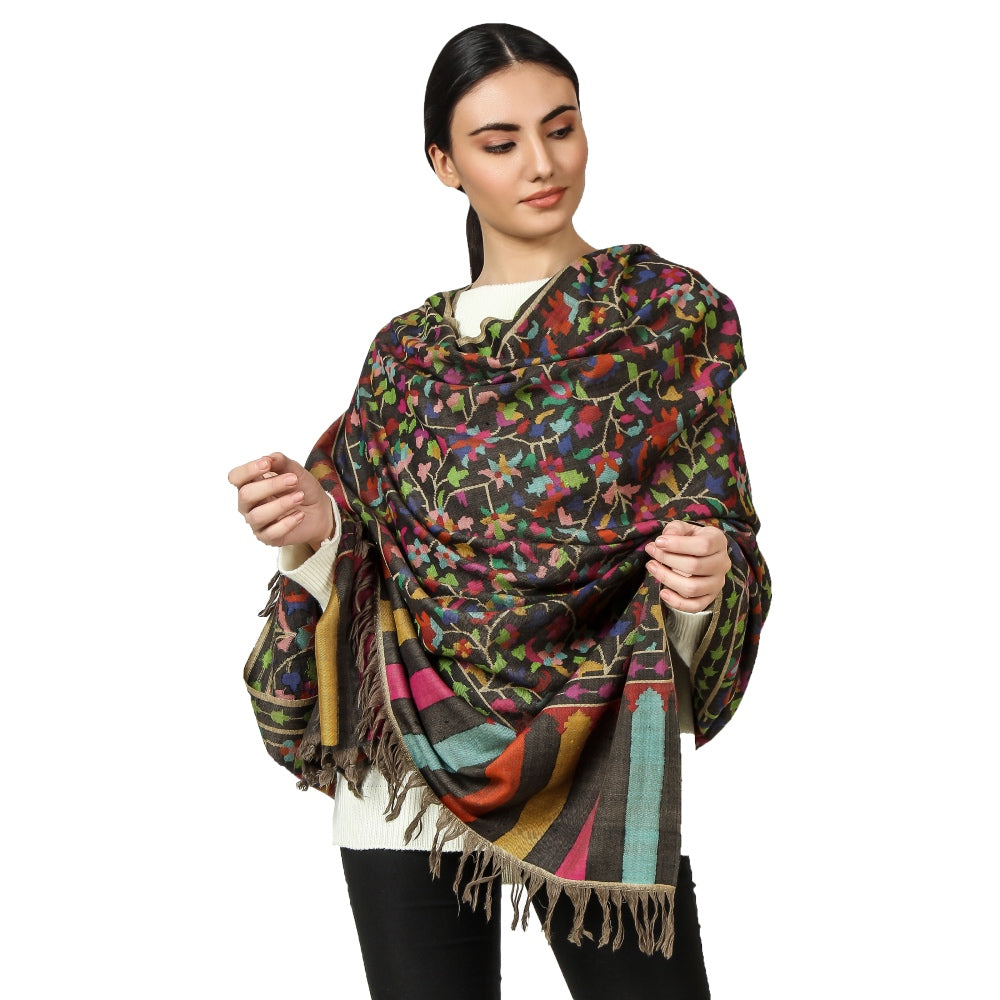
This structural difference explains something about the historical record that is often misunderstood: the most elaborate, colourful historic Kashmir shawls — the great kani moon shawls, the hashia-bordered pieces with their complex pictorial fields — are Pashmina, not Shahtoosh. Shahtoosh's role in the tradition was different: the plainest, finest, most expensive ground, valued precisely because it needed no embellishment. A deeply coloured Shahtoosh shawl was, by the standards of Kashmiri textile culture, a contradiction in terms.
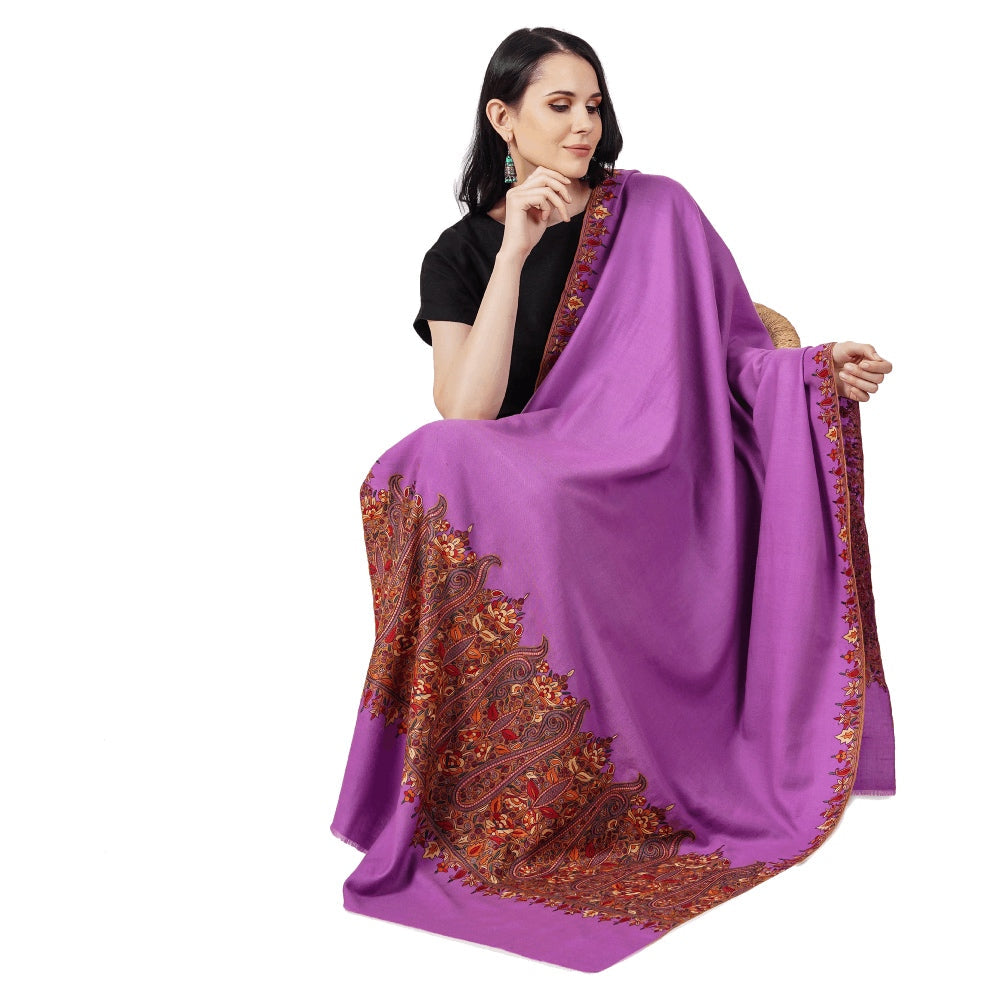
Authentic Kashmiri Pashmina from producers like Pashwrap is dyed using both traditional natural dye methods and carefully controlled modern acid dyes, across a full spectrum from ivory to deep midnight. The same fiber structure that the Mughal dyers valued for colour work continues to hold dye beautifully — and the shawl you hold is legal, traceable, and durable in a way that Shahtoosh could never be.
Colour is one indicator but not definitive on its own. A deeply saturated, evenly dyed Shahtoosh in a ground colour of navy, black, or rich red is highly suspicious — these depths require conditions that damage genuine ultra-fine chiru fiber. Authentic Shahtoosh ground fabric should be in the ivory-to-warm-mocha range.
However, a pale ivory colour does not confirm authenticity — ultra-fine Pashmina can be nearly as pale and similarly soft. The only reliable identification is fiber microscopy (SEM analysis) or DNA testing. Colour is a useful screening observation, not a legal test.
The embroidery and coloured borders on historic Shahtoosh pieces are typically worked in silk thread, or in Pashmina yarn — not in the Shahtoosh ground fiber itself. Skilled Kashmiri embroiderers (sozni work) applied coloured thread over the finished Shahtoosh ground using needle and thread, adding colour without ever subjecting the base fabric to a dye bath. The ground remained undyed; the decoration was applied on top. This is why museum Shahtoosh pieces can appear colourful while the structural fiber is pale.
Similarly, kani (loom-woven) border patterns introduce colour through the weft — threads of different colours are passed across the warp. The coloured threads are typically pre-dyed Pashmina or silk; the Shahtoosh warp remains natural.
The opposite is generally true. Pale surface-bonded dyes on Shahtoosh — particularly the historic plant-based yellows achieved with alum mordants — are known for poor lightfastness. The dye bonds primarily to the surface scales rather than penetrating the cortex, and UV light breaks these surface bonds relatively quickly. Historic pale Shahtoosh pieces in museum collections have often faded to near-white.
Well-mordanted Pashmina, dyed with good lightfastness mordants (chrome, alum) or modern certified acid dyes, holds colour substantially better. A deeply madder-dyed Pashmina from 150 years ago will often retain more of its original hue than a lightly saffron-dyed Shahtoosh from the same period.
Yes, in a way that makes the ring test even less reliable. A Shahtoosh shawl that has been subjected to a harsh dye bath — particularly synthetic acid dyes requiring high temperatures — may have undergone some degree of felting, which slightly stiffens the fabric and could in principle make it harder to pull through a ring. Conversely, ultra-fine Pashmina that has been carefully handled and not dyed at all may pass through a ring as easily as claimed Shahtoosh.
The ring test has no forensic validity. Fabric dimensions, weave construction, and thread count affect the result far more than the fiber species. It is not used in any legitimate authentication or enforcement context.
Pashmina fiber — at 14–19 microns — is fine enough to be extraordinarily soft, but robust enough in its scale and cortex structure to accept both natural and modern dye processes without damage. Pashwrap's pieces are dyed using methods appropriate to the fiber: controlled temperature acid dyes for full colour, or traditional plant-based processes for the natural palette range.
The breadth of colour in a Pashmina collection — from ivory through saffron, from rose through deep navy — reflects the fiber's genuine structural openness to colour work. This is not a limitation overcome; it is a capability that Shahtoosh's finer but more fragile structure simply never had.
There is no authenticated museum example of a black-ground Shahtoosh shawl. Black dye on protein fiber requires either a very high-concentration tannin/iron combination (which produces a brittle, degraded fiber — this is well documented in black-dyed historic wool and silk, which often self-destructs faster than lighter-dyed pieces) or an iron mordant used over a plant dye base, which also degrades ultra-fine fiber aggressively over time.
Items presented as "black Shahtoosh" in modern illegal trade are almost certainly Pashmina, silk, or blended fiber — not genuine chiru wool. The fiber's structural constraints make black a near-impossibility for an overall Shahtoosh ground.
Since Shahtoosh Is Illegal, Here Is the Best Alternative
Authentic Kashmiri Pashmina — the fiber that Shahtoosh's own dyers turned to when they wanted to express colour — is available in the full spectrum that chiru fiber could never achieve. Ethically sourced, legally sold, and beautifully dyed.
Shop Pashwrap Pashmina Shawls