
Shahtoosh Embroidery: Why the Finest Shawls Were Always Left Plain
In the Kashmir shawl tradition, decoration is the language of craft mastery — elaborate kani patterns and sozni embroidery are among the most painstaking textile arts on earth. And yet the most prized Shahtoosh pieces were almost always bare. Here is why that plainness was the ultimate luxury signal.
In This Article
- The Paradox — Kashmir's Most Decorative Tradition, Applied to Its Plainest Shawls
- The Structural Reason — What a Needle Does to 9-Micron Fiber
- Kashmir's Two Embroidery Traditions — Kani and Sozni
- The Craft Hierarchy — When Plain Means More Than Decorated
- The Plain Paradox — Common Assumptions vs Kashmir Reality
- What Was Possible — The Exceptions and Their Limits
- Genuine Pashmina Today — Plain and Decorated
- Frequently Asked Questions
Kashmir is home to some of the most elaborate textile decoration traditions on earth. The sozni needle-workers who spend months producing a single embroidered shawl panel, the kani weavers who integrate thousands of colored threads into a self-patterned weave without a single needle — these are craft traditions of extraordinary sophistication, built across centuries of Mughal court patronage and global demand.
And yet the pieces most coveted within the Shahtoosh trade — the finest, most expensive, most prized examples — were almost always completely plain. No embroidery. No kani pattern. Just the weave itself: a barely-there ground of 9–12 micron chiru fiber in a simple twill or plain weave, with perhaps a border, and nothing else.
This is not a coincidence or an artistic preference. It is a direct consequence of what happens when a needle meets a fiber too fine to survive its passage.
The Paradox — Kashmir's Most Decorative Tradition, Applied to Its Plainest Shawls
To understand why this is paradoxical, you need to understand the status of decoration in the Kashmir shawl tradition. From the Mughal court workshops documented in our article on Akbar and the Pashmina shawl onward, the decorated shawl — with its elaborate floral and geometric patterns, its integration of color across hundreds of warp and weft threads, its months or years of concentrated artisan labor — was the primary carrier of the Kashmir shawl's global prestige.
European nobility in the 18th and 19th centuries paid extraordinary sums for intricately patterned Kashmir shawls. The Empress Josephine reputedly owned dozens. The patterns that eventually gave rise to the global "paisley" trend were decoration, not weave structure alone. Within this context, a plain, undecorated shawl might be expected to represent the entry level — the affordable starting point before one moved up into the decorated tier.
In Shahtoosh, the opposite was true. The plain piece was the pinnacle.
The Structural Reason — What a Needle Does to 9-Micron Fiber
🔬 Why Shahtoosh Could Not Bear Embroidery
At 9–12 microns, the fiber has almost no structural resilience — as we explored in detail in our article on why Shahtoosh was so fragile. A needle passing through the weave must displace hundreds of fibers to create its passage. At this diameter, that displacement does not spring back — it tears, distorts, or permanently weakens the weave structure around the needle path. Conventional embroidery would visibly damage even the best Shahtoosh fabric.
At 12–16 microns, the fiber has meaningfully more structural area — roughly 70% more cross-section than the finest Shahtoosh. This extra resilience means a skilled needle-worker can pass a fine needle through the weave without permanently tearing the surrounding fiber structure. Fine sozni embroidery on genuine Pashmina is a well-established, centuries-old craft tradition precisely because the fiber can bear it.
This is not a stylistic choice any individual craftsperson made. It is a physical constraint imposed by the fiber itself. A Shahtoosh weave is so fine, so delicately structured, and so lacking in the fiber-to-fiber friction that gives coarser fabrics their resilience that even the finest embroidery needle leaves behind permanent evidence of its passage — a distortion, a thinning, a slight displacement that never fully recovers. In a fabric that weighs under 100 grams for a full shawl and is composed of fibers one seventh the width of a human hair, this is inevitable.
Kashmir's Two Embroidery Traditions — Kani and Sozni
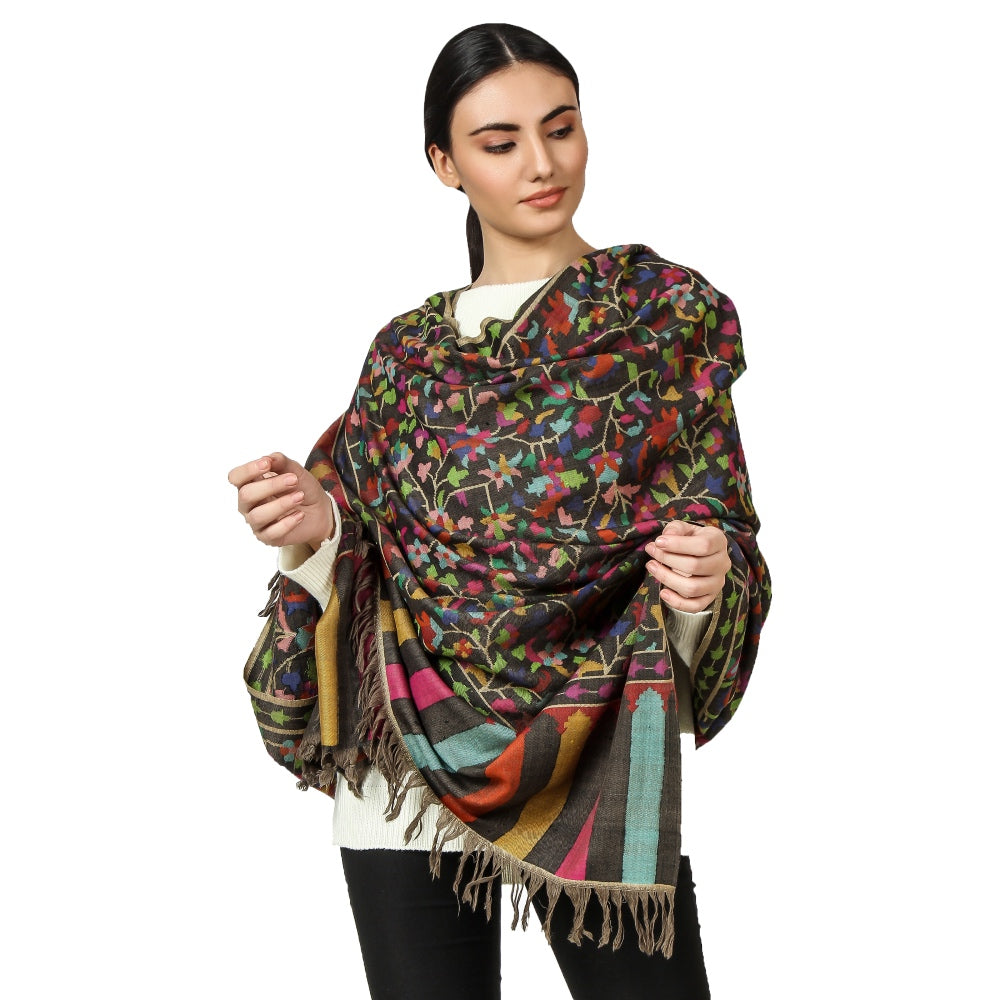
Kani work integrates pattern directly into the weave structure itself — not applied afterward with a needle, but built into the fabric as it is woven, using small wooden or bamboo bobbins (called kani) to introduce colored weft threads. The pattern is structural, not applied. A kani shawl's design exists within the weave itself.
On Shahtoosh: Extremely limited. While kani does not require a needle, the complexity of managing multiple weft threads at this fiber diameter — and the additional stress on an already fragile weave structure — meant that kani work on Shahtoosh was minimal at best. Fine single-color borders were more achievable than elaborate full-field kani patterns.
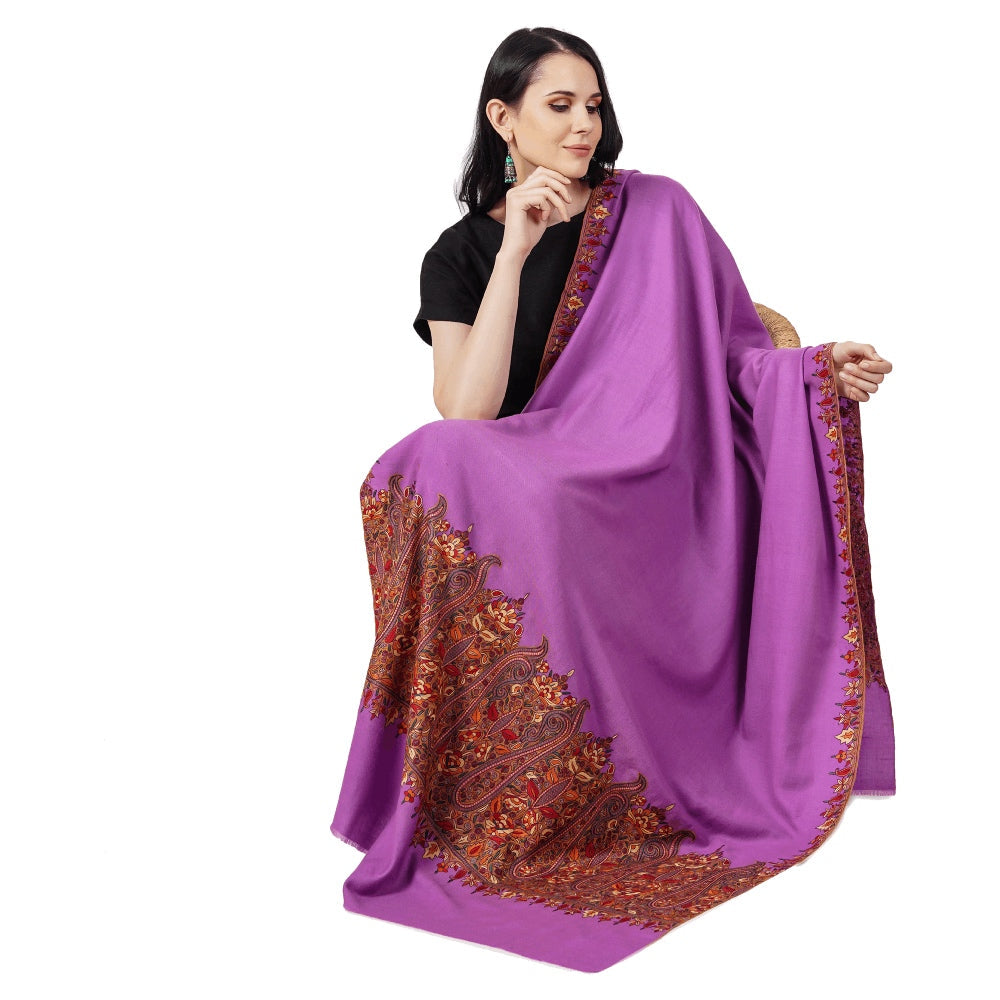
Sozni is needle embroidery applied after the base shawl is woven — a needle threaded with silk or fine wool, passed through the woven ground to create the elaborate floral, paisley, and geometric patterns most associated with decorated Kashmir shawls. A single sozni shawl can require months of work from multiple specialist embroiderers.
On Shahtoosh: Essentially impossible at any meaningful level. The needle itself constitutes structural damage to fiber at 9–12 microns. Any attempt at full-scale sozni embroidery on genuine Shahtoosh would visibly mar the base fabric — defeating the entire purpose of decorating a prized piece.
The distinction between these two traditions matters because kani and sozni represent fundamentally different relationships between the ground fabric and the decoration. Kani pattern exists within the weave from the moment the shawl is made. Sozni is applied afterward, with a needle. And it is the needle specifically — its physical passage through the weave — that Shahtoosh fiber cannot survive without visible damage.
The Craft Hierarchy — When Plain Means More Than Decorated
Understanding why plain Shahtoosh was the most prized requires understanding a specific inversion that operates within Kashmir's craft tradition: at the highest end of fiber quality, decoration becomes a complication rather than an enhancement, and its absence becomes the mark of extreme quality rather than its opposite.
A completely undecorated Shahtoosh shawl of the finest weave is the most unambiguous statement of quality in the entire Kashmir tradition: it says "the fiber alone is the point, and it needs nothing else." Its plainness is not minimalism — it is the only decoration the piece can truthfully wear.
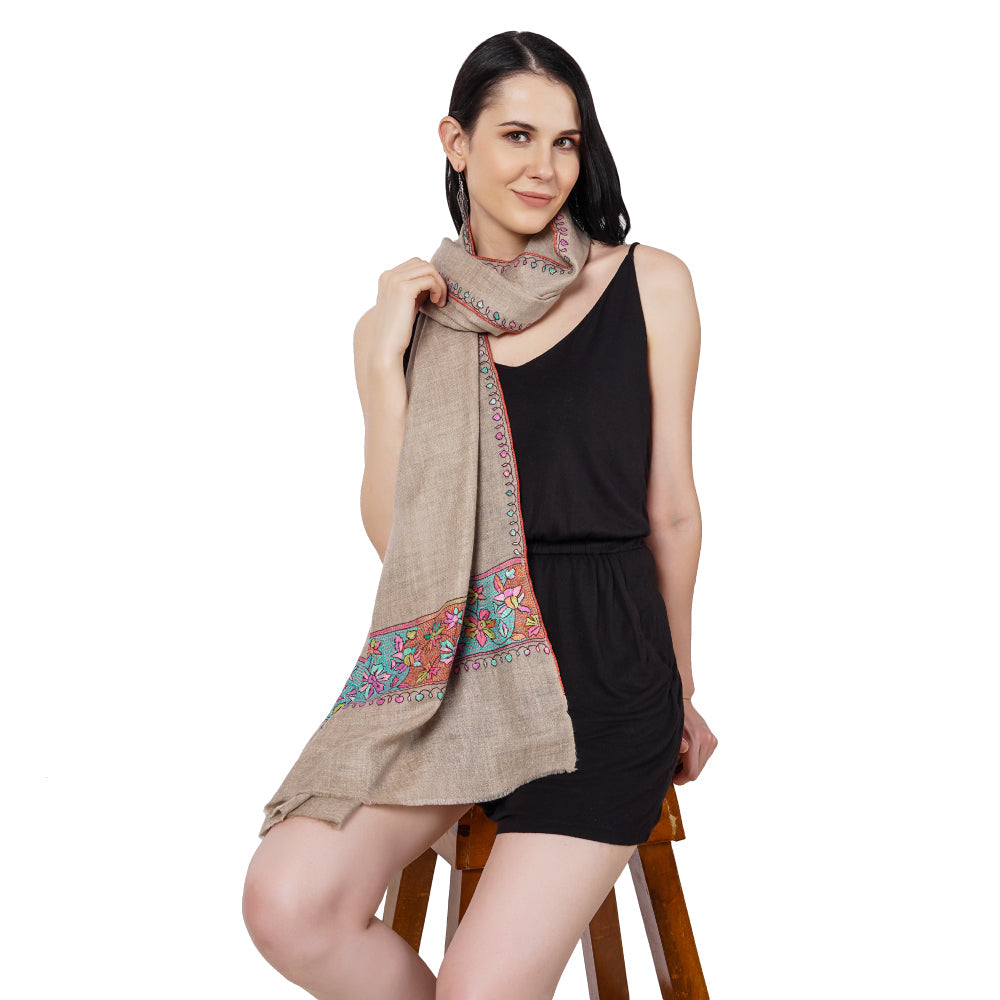
A narrow decorative border — a stripe of color at the hem or edge — was achievable without significant structural risk to the Shahtoosh ground, and was used on some finer pieces. This is the maximum decoration that the fiber's fragility could realistically accommodate.
Full kani-woven pattern on genuine Pashmina represents the height of Kashmir's weaving achievement: months or years of work, pattern integrated into the weave structure, no needle ever touching the ground. At 12–16 microns, the fiber can sustain the complexity of this process in a way Shahtoosh could not.
The most visually elaborate pieces: sozni needle embroidery on a Pashmina base, potentially covering the full field of the shawl with intricate silk-thread work. Months of specialist embroiderer time. Visually striking and commercially popular — but possible only because the Pashmina base can bear the needle.
✦ The Inversion
In most textile traditions, more decoration means more value. In Kashmir's finest tier, the hierarchy reverses: the plainest piece, in the finest fiber, represents the highest mastery — precisely because the fiber's own properties are the entire point, and decoration is either impossible or unnecessary. A sozni-embroidered shawl displays the embroiderer's art. A plain Shahtoosh displays the fiber's. The question is which one you are buying.
The Plain Paradox — Common Assumptions vs Kashmir Reality
↔ What People Assume vs What Kashmir Craftspeople Know
"A plain shawl is the basic version. The embroidered ones are more valuable."
At the finest fiber grades, a plain piece often commands a premium over a decorated one — because the fiber's quality can sustain no decoration, and any decoration present signals a less extreme level of fineness.
"All Shahtoosh pieces must have some visible decoration to prove their quality."
In the Kashmir tradition, the most expert buyers specifically looked for the absence of embroidery on the finest Shahtoosh as a quality indicator — knowing that the fiber itself is proof enough of what the piece is.
"An undecorated shawl is cheaper to make."
The fiber cost dominates entirely at the Shahtoosh level. An elaborately embroidered piece in a coarser fiber costs less than a plain Shahtoosh piece in the finest weave. The decoration adds labor cost; the fiber determines the price floor.
What Was Possible — The Exceptions and Their Limits
Plainness was the rule for the finest Shahtoosh, but it was not absolute. There were limited forms of decoration that skilled weavers found structurally compatible with the fiber's constraints.
Woven Borders
A narrow decorative border — a stripe woven in a contrasting color or with a simple geometric pattern at the shawl's edges — was achievable without the structural risk of full-field embroidery. The border uses the same weave structure as the ground; it introduces no needle, no additional thread passed through completed fabric, and no displacement of the existing weave. Fine borders appear on some documented Shahtoosh pieces and represent the maximum decoration that the fiber could gracefully carry.
Very Light, Superficial Silk Work
On rare pieces, extremely light, superficial silk embroidery — using the finest possible needles and minimal stitching — was attempted on Shahtoosh fabric. The results were invariably limited: the decoration is slight, the needle marks visible to a trained eye even where the work is at its most careful, and the overall effect far more restrained than comparable sozni work on a Pashmina base. Such pieces exist as curiosities in textile collections rather than as representatives of a viable decorated Shahtoosh tradition.
"In the Kashmir trade, a heavily embroidered shawl described as Shahtoosh should have raised immediate suspicion — not because embroidery was impossible, but because anyone who actually had the genuine article would have known the fiber could not carry it. The decoration would have been the tell."
Genuine Pashmina Today — Plain and Decorated
The craft hierarchy described in this article still defines genuine Pashmina production today, within the tradition our family has been part of for three generations. Genuine Kashmiri Pashmina at 12–16 microns sits at a diameter that makes both plain and decorated pieces viable — and both represent legitimate, beautiful expressions of the tradition.
A fine plain Pashmina shawl — the direct descendant of the plainness that characterized the most prized Shahtoosh — is an object where the fiber itself is the entire statement. Its texture, its drape, its almost absent weight, its immediate warmth on skin contact: these are the decoration, expressed in physics rather than pattern. No needle required, and none needed.
An elaborately kani-patterned or sozni-embroidered Pashmina shawl is a different kind of statement: the fiber supports the labor of artisans whose skill in pattern and color represents a different form of mastery entirely. Both are genuine. Both are valuable. The choice between them is a choice about what kind of excellence you want the piece to embody.
The finest Shahtoosh was plain because the fiber left no other choice. The finest Pashmina can be plain for the same reason — or decorated, because its fiber can bear it.
Both represent the same truth: at a certain level of quality, the material itself becomes the art.
Frequently Asked Questions
Rarely, and only in very limited, light forms. The extreme fragility of Shahtoosh at 9–12 microns made conventional Kashmir embroidery impossible — a needle passing through the weave would tear or distort fibers that have almost no structural resilience. The finest, most prized Shahtoosh pieces were invariably left plain, which in the Kashmir shawl tradition signals the highest fiber quality rather than a lack of artistry.
In Kashmir's craft hierarchy, at the finest end of fiber quality, decoration becomes either impossible or unnecessary — the fiber itself is the point, and its plainness signals that quality more honestly than any applied decoration could. A plain, unembroidered piece in the finest fiber says that no decoration was possible or needed: the material is the statement. This inversion — where less decoration means more quality — is one of the most distinctive features of the Kashmir tradition at its finest tier, and applied most acutely to Shahtoosh, where plainness was not an aesthetic choice but a structural necessity.
Kani work integrates pattern directly into the weave structure itself, using small wooden or bamboo bobbins to introduce colored weft threads as the shawl is woven — no needle touches the completed fabric. Sozni is needle embroidery applied after the base shawl is woven, using a needle threaded with fine silk or wool to create elaborate floral, paisley, and geometric patterns. Kani represents weaving mastery; sozni represents embroidery mastery. At the finest fiber grades like genuine Pashmina, both are possible. On Shahtoosh, neither was really viable, because even the stress of complex kani work on such a fine ground was problematic, and sozni needle work was categorically damaging.
Yes — genuine Kashmiri Pashmina at 12–16 microns has sufficient structural resilience to support both kani-woven pattern and sozni needle embroidery, which is precisely why both traditions flourished on Pashmina for centuries. Fine sozni embroidered Pashmina shawls require months of specialist artisan work and are among the most celebrated textile products of the Kashmir Valley. The key difference from Shahtoosh is the additional cross-sectional area of the Pashmina fiber, which allows it to survive a needle's passage without permanent structural damage.
Plain or decorated — both made possible by the fiber
Genuine Pashmina can do what
Shahtoosh never could.
Plain — for the statement that needs nothing added. Kani-woven — for pattern built into the weave itself. Sozni-embroidered — for months of artisan work made possible by a fiber that can carry it. All from genuine Changthangi goat fiber, handwoven in Kashmir.