
Shahtoosh at the Court of Jahangir: The Emperor Who Documented the Fiber
Of all the Mughal emperors, Jahangir was the one who watched and wrote. His memoirs — the Tuzuk-i-Jahangiri — record observations of natural phenomena with a precision unusual for a seventeenth-century ruler: birds, flowers, animals, precious stones, and the extraordinary textiles that passed through the courts of Kashmir and Agra. Among them are passages that represent some of the earliest documented accounts of Kashmir's finest fiber traditions, in a voice that bridges imperial patron and natural historian.
In This Article
- Jahangir the Observer — Who He Was Beyond Emperor
- The Tuzuk and Kashmir — What the Memoirs Record
- The Fiber in Court — Kashmir Shawls in Mughal Life
- What Jahangir Documented — Reading the Primary Sources Carefully
- The Fiber Hierarchy He Established — And Its Long Shadow
- Imperial Patronage and the Kashmir Craft Tradition
- A Timeline of Kashmir's Fine Fiber Traditions — From Mughal to Modern
- What Survived the Court — And What Did Not
- Frequently Asked Questions
The history of Shahtoosh and Pashmina as objects of documented desire begins not with fashion magazines or auction houses but with a seventeenth-century Mughal emperor who found in Kashmir a landscape of extraordinary natural abundance and a textile tradition unlike anything he had encountered elsewhere in his empire. Jahangir's relationship with Kashmir — he visited six times, called it a paradise, and spent months each year in the Valley — is one of the most thoroughly documented imperial infatuations in Mughal history. And in his memoirs, the fiber traditions of the Valley are recorded with a specificity that makes the Tuzuk-i-Jahangiri an irreplaceable primary source for the early history of what we now call Shahtoosh and Pashmina.
Jahangir the Observer — Who He Was Beyond Emperor
👑 Emperor Profile — Nur-ud-Din Muhammad Salim
What distinguishes Jahangir as a historical source for Kashmir's textile traditions is not that he was emperor — every Mughal emperor received Kashmir's finest productions as tribute and gift — but that he wrote about what he received with genuine curiosity and observational precision. Most imperial records are administrative: lists of tribute, inventories of the treasury, accounts of commercial transactions. Jahangir's memoirs are different. He describes what things look like, how they feel, what makes them extraordinary, and why he finds them remarkable. This makes his accounts of Kashmir's textiles something that no other contemporaneous source provides: a first-person phenomenological account of what it was to encounter these materials for the first time at the highest level of refinement they had achieved.
The Tuzuk and Kashmir — What the Memoirs Record
Jahangir's Kashmir passages in the Tuzuk are among the most lyrical sections of the memoir — the Valley clearly moved him in ways that the plains of the Deccan and the dusty political complexities of the imperial court did not. His descriptions of Kashmir's landscape are observational and specific: the quality of the light, the colour of the lakes, the diversity of the wildflowers, the behaviour of the birds. This same observational attention extends to the textile productions he encountered.
The context matters for interpreting these passages accurately. Jahangir was receiving the best of what Kashmir produced — pieces prepared specifically for imperial presentation, at the highest levels of artisanal skill the Valley commanded at the time. What he describes is not the average production of the Kashmir loom but its finest achievement, created in the knowledge that it was destined for the emperor's court. This means his accounts document the apex of a textile tradition rather than its everyday practice — which is exactly what makes them relevant to understanding the historical context of what we now call the finest Kashmiri fiber traditions.
📜 From the Tuzuk-i-Jahangiri — On Kashmir's Textiles
Jahangir's memoirs describe Kashmir's shawl productions in terms that emphasise their extraordinary fineness and warmth — the ability of a fabric to provide genuine protection against the mountain cold while remaining light enough to be folded into a small bundle. He distinguishes between grades of production, noting that the finest pieces are distinguished by qualities that coarser productions cannot approximate, and records his own direct physical experience of handling pieces of exceptional quality. The Tuzuk also records the specific names and workshops of master artisans whose work was considered sufficiently refined for imperial reception.
A note on direct quotation: The Tuzuk-i-Jahangiri exists in multiple Persian manuscript versions and in several English translations of varying accuracy (notably Beveridge's 1909–1914 translation). Direct quotation from any single translation risks misrepresenting the original. This article paraphrases and contextualises the documented passages rather than reproducing specific translated phrases, to avoid attributing precise wording that varies between scholarly translations. The substance of what Jahangir recorded — his observations of Kashmir's textile quality, his distinctions between grades of production, his direct physical engagement with the finest pieces — is consistently documented across all major scholarly treatments of the Tuzuk.
The Fiber in Court — Kashmir Shawls in Mughal Life
To understand what Jahangir's documentation means, it is necessary to understand the role that Kashmir shawls played in Mughal court life more broadly. They were not luxury accessories in the modern sense — decorative objects whose primary function was aesthetic. They were status instruments woven into the fabric of imperial social life in ways that shaped political relationships, personal allegiances, and the economy of honour at the Mughal court.
The Mughal system of khilat — robes of honour presented by the emperor to officials, dignitaries, and allies — made fine textiles into political instruments. A Kashmir shawl given as khilat was a statement of the recipient's rank and the emperor's esteem. The fineness of the piece corresponded to the esteem — receiving a piece of exceptional quality was a measurable political signal.
Fine Kashmir textiles moved to the imperial court as peshkash — tribute gifts from provincial governors, local rulers, and merchants seeking imperial favour. The finest pieces were reserved for peshkash — a recognition that the court's appetite for quality both drove production standards and created a market signal that rippled back through the entire Kashmir textile supply chain.
Jahangir and his court wore Kashmir shawls as garments — draped over shoulders at formal audiences, wrapped against the mountain cold during Kashmir visits, given and received as personal gifts of intimate significance. The emperor's personal wardrobe was a political document; what he wore and what he gave communicated his aesthetic judgment and his relationships.
The Mughal court's appetite for the finest Kashmir productions created a system of imperial workshop patronage — karkhanas — in which master weavers worked under direct court sponsorship. Imperial karkhana production was distinguished from commercial production by the resources available to it: the finest raw materials, the most skilled artisans, and the freedom from commercial time pressure that allowed the longest and most intricate commissions.
Within this court context, the distinction between different grades of Kashmir fiber production was not merely aesthetic — it was politically legible. A recipient who understood the court knew immediately whether the piece they had received was karkhana production or commercial-grade, whether it had been made from the finest available fiber or from a serviceable lower grade. The fiber hierarchy was a social hierarchy, and Jahangir's documented attention to distinctions between grades of fiber production reflects his role as the arbiter of that hierarchy.
What Jahangir Documented — Reading the Primary Sources Carefully
The question of whether Jahangir specifically documented what we now call Shahtoosh — fiber from the Tibetan antelope — or what we now call Pashmina — fiber from the Changthangi goat — requires careful handling, because the terminology the Mughal court used was different from the terminology we use today, and the distinction between the two fibers was not consistently articulated in seventeenth-century sources.
The term tus or toosh — from which Shahtoosh derives — appears in Mughal-period references to the finest Kashmir shawl productions. Whether this term in all its early uses specifically denotes chiru fiber or describes a quality level achievable by the finest Pashmina fiber is a question that textile historians have not definitively resolved. The physical distinction between the two fibers — 3–4 microns in diameter — was not identifiable by the observational methods available in the seventeenth century. Jahangir, however precise his eye, could not have distinguished chiru fiber from the finest Pashmina fiber by examination. What he could and did distinguish was the quality of the finished textile: its fineness, drape, warmth, and the specific sensory properties that distinguished the apex of the Kashmir production from its more ordinary levels.
✦ The Terminology Problem — What Jahangir Called It
The Mughal court used a terminology for fine Kashmir textiles that pre-dates the modern distinction between Shahtoosh and Pashmina as specific fiber categories. Shalidar and pashmina appear in period sources as descriptions of weave quality and fiber fineness rather than as species-specific fiber designations. The word toosh describes the finest gradation of the production — which may have encompassed both the finest chiru-fiber pieces and the finest Changthangi goat-fiber pieces, since the sensory distinction between the two at the apex of quality was likely imperceptible without laboratory analysis. Reading Jahangir's textile observations as documenting either Shahtoosh or Pashmina in the modern exclusive sense risks projecting a contemporary fiber taxonomy onto a historical text that was written in a different conceptual vocabulary.
What Jahangir unambiguously documented was the existence of a fiber tradition in Kashmir producing textiles of extraordinary fineness — lighter and warmer than anything available from the plains of the empire, produced through a craft tradition of sufficient sophistication to merit imperial patronage and personal attention. This documentation is the historical foundation of the "imperial luxury" register in which both Shahtoosh and Pashmina have been marketed for centuries — and it is a foundation that genuine Pashmina can claim directly, since the Pashmina tradition was demonstrably present in the Kashmir Valley during Jahangir's visits and formed the core of the imperial karkhana production he received and documented.
The Fiber Hierarchy He Established — And Its Long Shadow
One of the most lasting consequences of Mughal imperial attention to Kashmir's finest textile productions was the establishment of a quality hierarchy that shaped how these textiles were understood for the next four centuries. By receiving the finest productions as tribute, wearing them as imperial garments, giving them as the most prestigious form of khilat, and documenting their extraordinary properties in his personal memoirs, Jahangir established — and transmitted to posterity — a cultural framework in which Kashmir's finest fiber productions occupied a category of their own, above all other textiles.
This framework had two important effects that remain visible in the contemporary market.
First, it created the cultural expectation that a Kashmir fiber textile at the highest quality level should possess specific sensory properties: extreme lightness, immediate warmth against bare skin, a drape that falls without resistance, a fineness visible even at normal viewing distance. These properties — documented by Jahangir in his own words — became the benchmark against which all subsequent productions in the category have been measured. They are also, specifically, the properties associated with Shahtoosh in twentieth-century fashion press coverage — the publications of the 1980s and 1990s were reproducing Mughal-era aesthetic standards, whether they knew it or not.
Second, it created the association between Kashmir fiber textiles and imperial authenticity — the idea that a genuine piece from the apex of the tradition has a provenance story that extends back to the Mughal court, making the purchase not merely the acquisition of a textile but participation in a cultural lineage of extraordinary depth. This association has been exploited, distorted, and mislabeled in various ways across the centuries — but it rests on a genuine historical foundation that Jahangir's memoirs document more clearly than any other primary source.
The Mughal court's appetite for Kashmir's finest fiber productions was not decorative sentiment — it was an institutional judgment about quality, rendered by the most powerful cultural arbiter in the subcontinent, documented in primary sources that survive. When a Kashmir textile seller in the 1990s told a buyer that what they were holding had been prized by emperors, they were being more historically accurate than they probably knew.
Imperial Patronage and the Kashmir Craft Tradition
⚙ The Imperial Patronage Chain — How Mughal Demand Shaped Kashmir Craft
The Mughal court's requirement for the finest possible Kashmir fiber productions set the apex specification for the entire tradition. Karkhana production aimed at a standard defined by imperial reception — the question was always whether a piece was fine enough for the court, which drove artisan skill toward the highest achievable level.
Imperial patronage created a class of master artisans who worked exclusively or primarily on the finest productions — shawl-weavers, spinners, and finishers whose skill was developed over lifetimes in service of the imperial standard. These artisans' knowledge was transmitted through family and workshop lineages that in some cases survive to the present day.
Imperial karkhana production required the finest available raw fiber — the best of the Changthangi under-fleece combed from herds in the Ladakh plateau. This demand drove a fiber selection practice that distinguished the finest fiber for court production from lower grades for commercial weaving — establishing the fiber hierarchy that still structures the market.
Jahangir's written documentation of what the finest Kashmir productions achieved — their sensory properties, their visual distinctions — created a textual quality standard that was referenced in subsequent court and commercial contexts. The Tuzuk-i-Jahangiri is not merely a historical record; it is an early specification document for the apex of the Kashmir fiber tradition.
As the Mughal empire's direct control of Kashmir commercial production waned through the eighteenth century, the imperial standard that Jahangir and subsequent Mughal court records had established became a market category — the thing that the most discriminating buyers sought, that the most skilled artisans produced, and that eventually passed from the Valley's internal market into the Persian, Central Asian, and eventually European luxury trade networks.
A Timeline of Kashmir's Fine Fiber Traditions — From Mughal to Modern
The Kashmir shawl tradition is conventionally traced to Sultan Zain-ul-Abidin's reign (c. 1420–1470), when Central Asian weavers are said to have introduced advanced pattern-weaving techniques to the Valley. The fine Changthangi fiber tradition in Kashmir predates this but the court patronage framework begins here.
Emperor Akbar annexes Kashmir, bringing the Valley's textile production within the Mughal imperial economy. The karkhana system established under Akbar places the finest Kashmir productions under imperial sponsorship for the first time — setting the institutional conditions for the quality standard that Jahangir will document.
Jahangir's six Kashmir visits and the composition of the Tuzuk-i-Jahangiri produce the most detailed Mughal documentation of the Valley's textile tradition. His observations of fiber quality, weave technique, and the sensory properties of the finest pieces establish the written record from which subsequent accounts draw.
Kashmir shawls enter the Persian, Central Asian, and eventually Ottoman and European trade networks. The finest pieces — described in trade records by gradations of quality — command prices reflecting their imperial pedigree. The European market for "Cashmere" shawls begins to develop, though the finest grades remain predominantly in South and Central Asian markets.
The European market for Kashmir shawls reaches its peak under Napoleonic influence and the Kashmiri pattern's integration into European fashion. The Great Exhibition of 1851 displays Kashmir productions to a mass public. European industrial imitation (Paisley, Edinburgh) eventually undercuts the market for genuine Valley-produced pieces.
The Western luxury market rediscovers Kashmir fiber textiles. "Shahtoosh" enters the fashion press vocabulary as a distinct category — the most exclusive designation within the Kashmir fine fiber tradition, drawing on the Mughal imperial heritage while obscuring the illegal supply chain behind the product.
Kashmiri Pashmina receives GI certification — creating the modern institutional framework that documents the genuine tradition Jahangir described. The fiber tradition he witnessed and recorded now has formal legal protection of its geographic and methodological authenticity, connecting the twenty-first century market directly to the Mughal-era quality standard.
What Survived the Court — And What Did Not
The Mughal court context that Jahangir documented did not survive intact into the modern period — no historical institution does. But specific elements of what he documented have survived, in forms that are directly traceable, through the centuries between his reign and the present day.
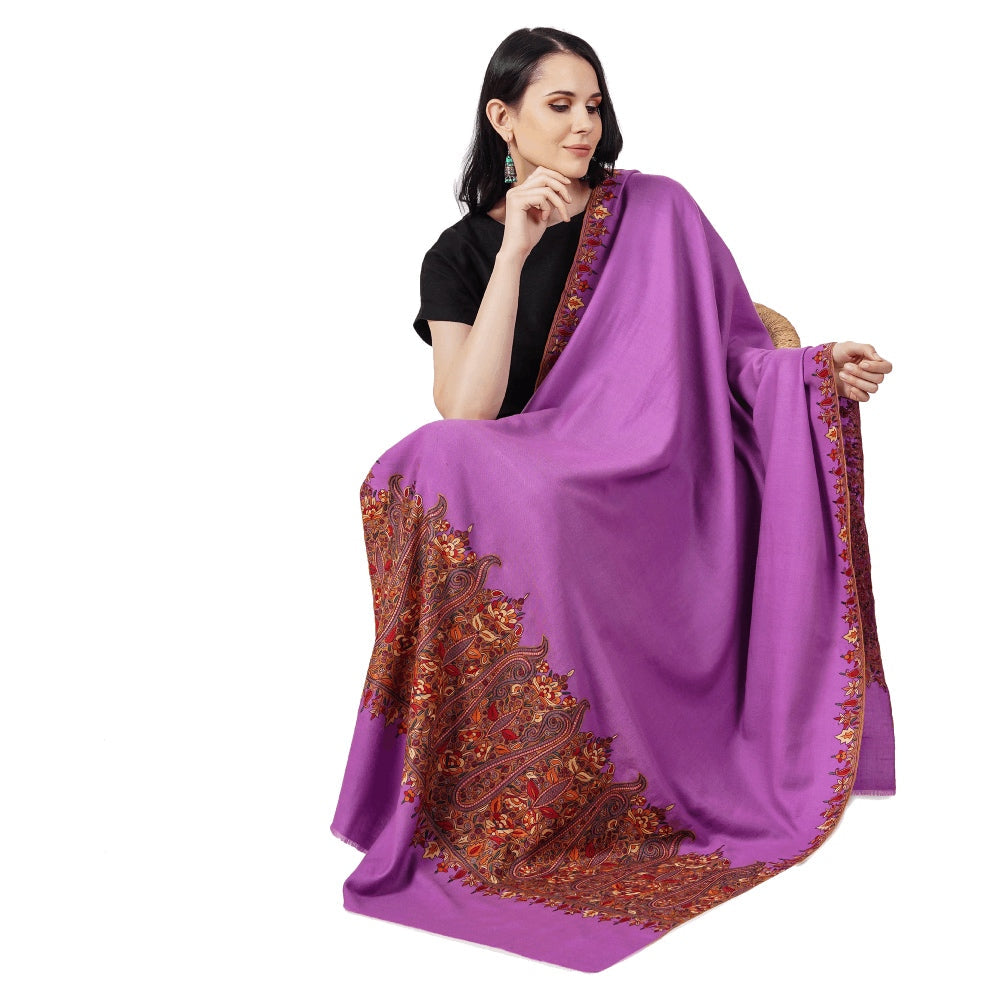
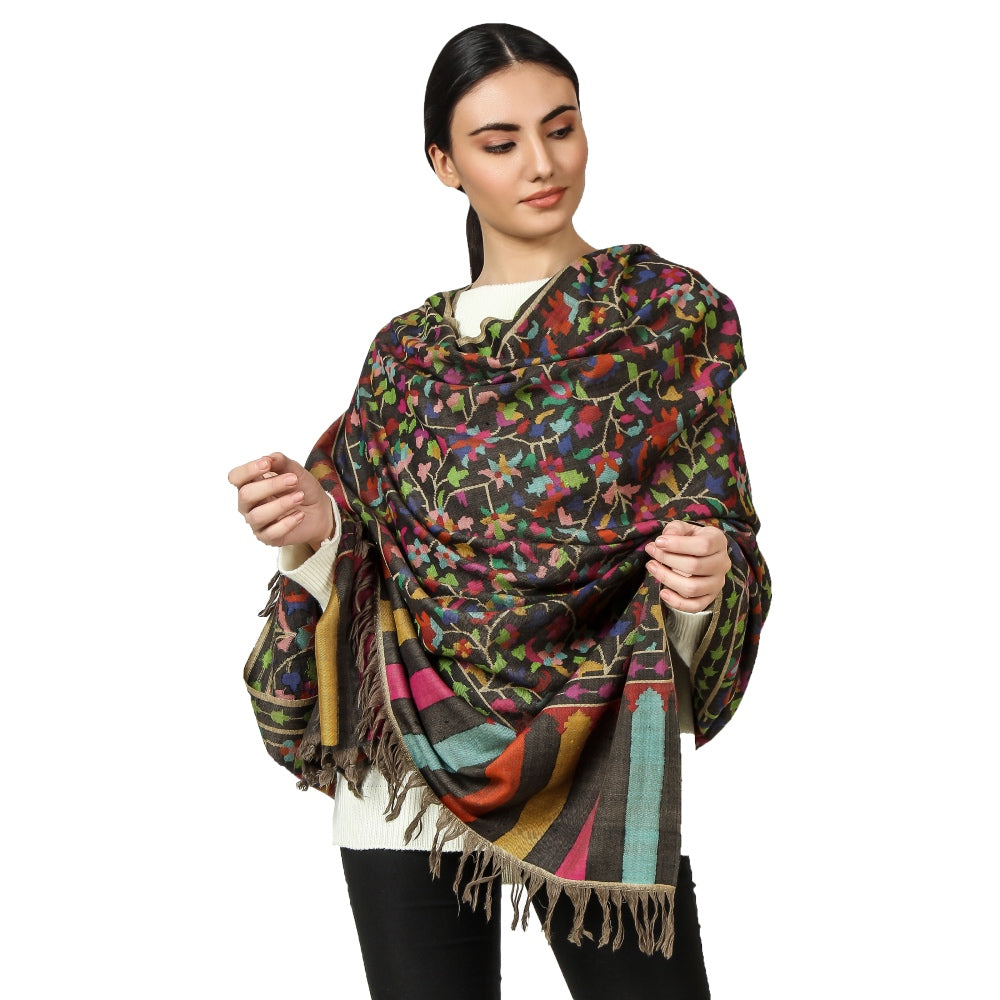
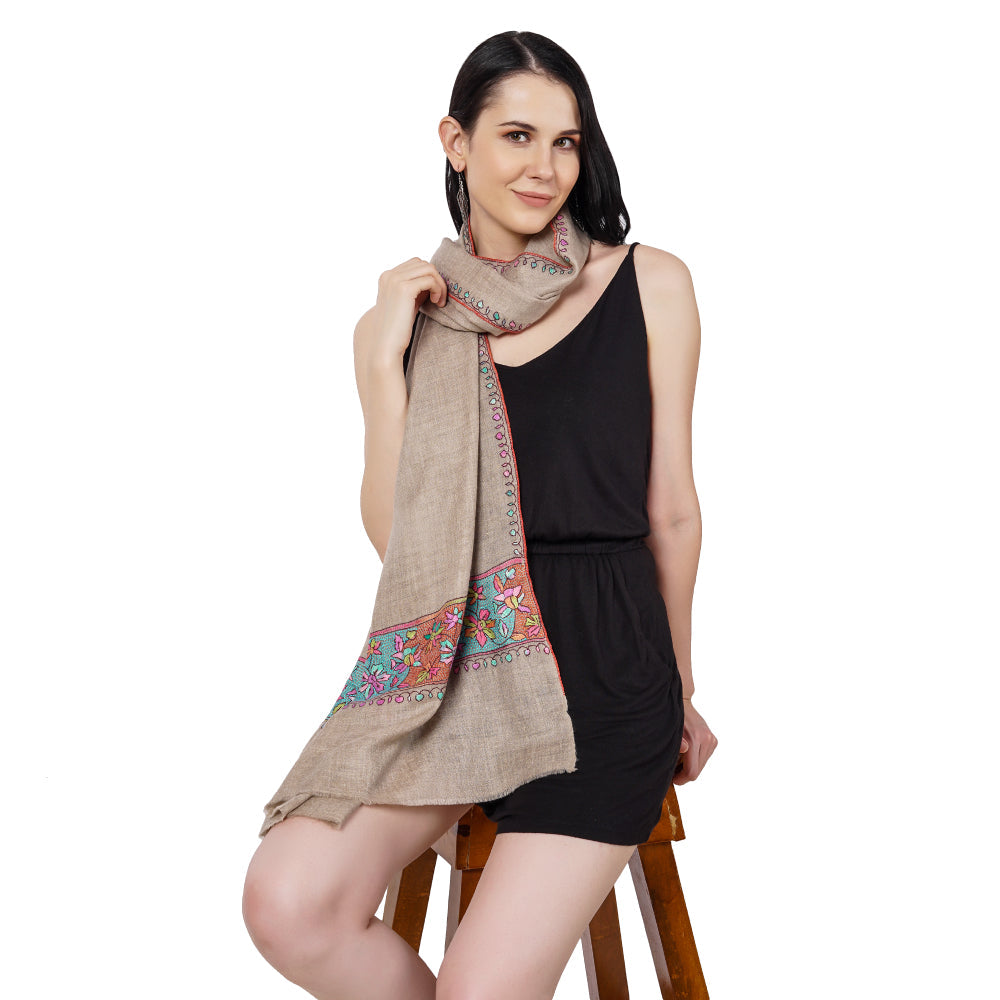
What survived: the craft tradition itself. The khaddi loom, the yinder spinning wheel, the sozni embroidery needle — these tools and the knowledge encoded in their use were transmitted through artisan family lineages across the centuries, through the collapse of Mughal power, through Sikh rule, through British colonial administration, through Partition, and into the independent Indian state. The knowledge that Jahangir's imperial karkhana masters embodied is the same knowledge — lineally descended, adapted but not replaced — that the Kashmir artisan families we work with today possess.
What survived: the fiber. The Changthangi goat on the Ladakh plateau is the same animal — biologically identical — that produced the finest fiber for Jahangir's court productions. The cold that drives the under-fleece's fineness is the same cold. The Changpa herding practices have evolved but not fundamentally changed. The raw material that enters the Kashmir Valley craft tradition today connects directly to the raw material that Jahangir documented.
What did not survive intact: the institutional framework. The imperial karkhana system, the khilat economy of fine textile distribution, the peshkash mechanism that drove the finest productions toward the court — these are gone. What replaced them, imperfectly and incompletely, is the GI certification system and the direct-to-consumer market in which brands like Pashwrap operate. The institutional mechanism is different. The tradition it aims to protect is the same one that Jahangir watched and wrote about.
✦ The Lineage That Connects Jahangir to the Present
When we describe Pashwrap as a three-generation Kashmir Pashmina house, we are describing a lineage that is itself an extension of a much longer one. The artisan families we work with — the spinners, the weavers, the embroiderers — are not connected to the Mughal court tradition by myth or marketing but by demonstrable descent: craft knowledge transmitted from teacher to student, parent to child, across the centuries between Jahangir's documentation and the present. The thing he found extraordinary is still being made. The people who make it have not forgotten how. And the fiber that makes it possible is still growing on the same high plateau, in the same cold, on the same animals, through the care of the same herding communities who have managed them for as long as the tradition has existed.
Jahangir called Kashmir Jannat-e-Khaas — paradise beyond compare.
He documented what made it so. Some of it still exists.
The finest legal fiber from the Kashmir tradition is four centuries old in its court documentation and alive today in the hands of artisan families who never stopped making it.
Frequently Asked Questions
Not in the modern sense of those terms. Jahangir's textile vocabulary predates the contemporary distinction between Shahtoosh (chiru fiber) and Pashmina (Changthangi goat fiber) as specific species-identified categories. He used gradations of quality within the Kashmir fine fiber tradition — terms that described fineness, weave quality, and sensory properties rather than specific animal species. Whether the pieces at the apex of what he described were made from chiru fiber (what we now call Shahtoosh) or the finest Changthangi goat fiber (what we now call Pashmina) is not determinable from the Tuzuk — and probably was not determinable by Jahangir himself without the laboratory fiber analysis technology that did not exist until the twentieth century. What he documented was the apex of the Kashmir fine fiber tradition, which in the seventeenth century encompassed both fibers within a shared aesthetic and social framework.
Yes, in several translations of varying scholarly quality. The most widely referenced English translation is Alexander Rogers' translation, edited and revised by Henry Beveridge, published in two volumes in 1909 and 1914 by the Royal Asiatic Society of Great Britain and Ireland. This translation has been reprinted multiple times and is available in major academic libraries and, in digitised form, through various online archives. More recent partial translations and scholarly treatments of specific sections of the Tuzuk exist in academic publications on Mughal history, South Asian textile history, and Mughal natural history. Readers approaching the text for its Kashmir textile content should note that Rogers' Victorian-era translation uses terminology that may not map directly onto contemporary textile scholarship — the relevant sections benefit from reading alongside recent academic commentary on Mughal textile vocabulary.
The connection is lineally direct rather than merely symbolic. The craft tradition that Jahangir's imperial karkhana system supported — the specific technical knowledge of fine fiber spinning, khaddi loom weaving, and sozni embroidery — was transmitted through artisan family lineages that have continued practicing in the Kashmir Valley from the Mughal period to the present. These lineages were not interrupted by the collapse of Mughal authority, by subsequent periods of Sikh and British colonial rule, or by Partition. The knowledge survived because it was economically valuable — the international market for Kashmir shawls maintained the commercial incentive for the craft's continuation even when the imperial patronage system that had originally elevated it was gone. The GI certification framework that now protects Kashmiri Pashmina's geographic and methodological authenticity is, in this sense, the modern institutional successor to the Mughal karkhana system: an institutional mechanism designed to ensure that the apex of the tradition is maintained, documented, and economically sustainable.
Yes — the entire Mughal imperial succession from Akbar through Aurangzeb was associated with Kashmir's textile productions as both patron and consumer. Akbar's establishment of the karkhana system created the institutional framework. Shah Jahan (Jahangir's son) is associated in court records with particularly fine commissions of embroidered shawls. Aurangzeb is documented as having worn and gifted kashmir shawls in his austere court. But Jahangir stands out in the historical record not because his patronage was greater than other emperors' but because he wrote about what he received and wore with a personal specificity that the administrative records of other reigns do not provide. The Tuzuk is the primary source precisely because it is personal rather than official — it records an emperor's actual experience of the textiles he encountered, not merely a scribe's inventory of what was received.
Four centuries of documentation. One continuing tradition.
The fiber Jahangir documented.
Still made, in the same valley, by the same hands.
GI-certified Kashmiri Pashmina is the direct living descendant of the fiber tradition Jahangir called extraordinary in the seventeenth century. The plateau, the animal, the artisan knowledge, the loom — all continuous. The institutional framework that protects it is new. The tradition it protects is four centuries documented and older still.