
The Shahtoosh Ring Test: Why It Doesn't Prove What Most People Think
The most famous test in luxury textiles is also the most unreliable. Pulling a shawl through a finger ring does not — cannot — tell you whether it is Shahtoosh or Pashmina. Here is exactly why, and what actually works.
⚠ The Verdict — Before Everything Else
The ring test is unreliable.Pulling a shawl through a finger ring cannot distinguish Shahtoosh from Pashmina — or from fine wool blends, modal, viscose, or other lightweight textiles. It measures fineness and weight. It does not identify species. Fine genuine Pashmina passes it. The only definitive test for Shahtoosh is laboratory fiber-diameter analysis at $50–$150. Everything else is theatre.
In This Guide
- What the Ring Test Is — and Where It Came From
- What the Ring Test Actually Measures
- What Passes the Ring Test — The Full List
- The Physics of Why Fine Pashmina Passes
- How the Test Became Famous — and Why It Stayed That Way
- First-Hand: What We Saw in the Kashmir Market
- Why the Test Is Still Used Despite Being Unreliable
- What Actually Works — Reliable Identification Methods
- If You Own a Shawl That "Passed" — What to Do
- Frequently Asked Questions
There is a moment that has played out in Kashmir markets, luxury boutiques, and private homes across the world for decades. A seller takes a shawl — fine, lightweight, extraordinarily soft — folds it loosely, and draws it through a finger ring. It passes. The buyer watches. The seller smiles. "Only Shahtoosh can do this," the seller says.
The buyer believes it. The buyer has been shown something theatrical and memorable. The seller has demonstrated something real — the shawl is genuinely fine. But the claim that follows — "only Shahtoosh can do this" — is false. And every piece of identification that rests on that claim is built on a foundation that cannot hold.
What the Ring Test Is — and Where It Came From
The ring test is simple in description: a shawl or scarf is loosely folded and drawn through a standard finger ring. If it passes through the ring without snagging or bunching — if the entire piece slides through cleanly — it is said to demonstrate exceptional fineness.
The test has been used in the Kashmir textile trade for at least a century. Its origins are genuinely connected to Shahtoosh — not as an identification test, but as a demonstration. When Shahtoosh weavers wanted to show the extraordinary quality of their work to buyers, the ring test was one of the most visually arresting ways to do it. A full shawl — 200 centimetres by 100 centimetres — passing through a ring no larger than a wedding band is striking. It communicates fineness better than any verbal description could. It creates a memory.
The problem occurred when the demonstration became a test. When "this shawl is so fine it passes through a ring" became "if a shawl passes through a ring, it must be Shahtoosh." That logical inversion — from demonstration of a property to species identification based on that property — is the error at the heart of the ring test myth.
📜 How the Ring Test Became Famous — A Brief History
What the Ring Test Actually Measures
To understand why the ring test fails as a species identifier, it helps to understand precisely what it does measure. The ring test is sensitive to four physical properties of a fabric — none of which are species-specific.
A lighter fabric compresses more easily and slides through a ring with less resistance. GSM (grams per square metre) is determined by fiber diameter, weave density, and number of plies. Both Shahtoosh and fine Pashmina produce low-GSM fabrics — typically 80–130 GSM — that are light enough to pass easily through a ring.
Not species-specific. Any fabric under ~130 GSM with sufficient drape can pass.
Finer fibers produce more compressible fabrics — each fiber takes up less space, and the fabric can be folded more tightly. Shahtoosh at 9–12 microns is finer than Pashmina at 12–16 microns, which is finer than commercial cashmere at 17–22 microns. But the ring test cannot read micron measurements. It registers only whether the resulting fabric is compressible enough to pass.
Not species-specific. Fine Pashmina is compressible enough to pass at standard ring sizes.
A more open weave — fewer interlacings per centimetre, more space between threads — compresses more easily than a tight, dense weave. A loosely woven fabric at 17 microns may pass the ring test more easily than a tightly woven fabric at 12 microns. Weave construction is a design choice, not a species characteristic.
Not species-specific. Weave density is controlled by the weaver, not determined by the animal.
The ratio of fabric dimensions to ring aperture affects whether the test passes or fails. A smaller scarf passes more easily than a larger shawl. A wider ring passes fabric more easily than a narrower one. The "standard" ring used in the test is not standardised — sellers choose the ring that demonstrates their product most favourably.
Not species-specific. The test result changes with ring size and fabric dimensions.
What Passes the Ring Test — The Full List
If the ring test measured Shahtoosh specifically, it would fail on everything else. It does not. Here is the honest picture of what passes — and what this means for the test's value as an identifier.
A full Shahtoosh shawl at under 100 grams passes through a standard ring without resistance. This is the property the ring test was originally designed to demonstrate. It is genuine — but it is not unique to Shahtoosh.
We have pulled our own production — single-ply handwoven Pashmina at 80 GSM from Changthangi fiber — through a standard finger ring. It passes. This is the core reason the ring test fails as a Shahtoosh identifier.
This is personal, first-hand observation. Not theoretical.
A lightweight single-ply merino scarf at 80–90 GSM can pass through a standard ring, particularly if the weave is open. Fine merino is not Shahtoosh, not Pashmina, and not even cashmere — but it passes the test.
Modal and viscose fibers are produced industrially at diameters as fine as 10–14 microns. Lightweight modal scarves — available at a fraction of the price of genuine Pashmina — pass the ring test routinely. The ring test cannot distinguish synthetic fiber from the finest natural fiber on earth.
Silk fiber measures 10–13 microns in diameter — comparable to or finer than Shahtoosh. Lightweight silk scarves pass through a finger ring easily. A silk scarf and a Shahtoosh shawl are indistinguishable by the ring test alone.
Heavier, double-ply Pashmina may not pass the ring test as easily — or may not pass at all — depending on the ring size and folding technique. This means the ring test can fail on genuine heavy Pashmina while passing on synthetic lightweight alternatives. It fails in both directions.
"The ring test cannot distinguish Shahtoosh from Pashmina. It cannot distinguish either from fine merino, silk, or modal. It identifies lightweight fine-fiber textiles. That is all it does. A test that everything fine passes is not a test for anything specific."
The Physics of Why Fine Pashmina Passes
🔬 Why the Physics Makes the Ring Test Fail
Genuine Pashmina at 80 GSM meets all four criteria. At 12–16 microns, handwoven Pashmina produces a fabric that is light, compressible, and fluid enough to pass through a standard ring. The difference in compressibility between a 12-micron and a 9-micron fiber — at normal shawl dimensions and ring aperture — is not large enough to be registered by the ring test. The test was calibrated by experience with Shahtoosh alone. It was never validated against the alternative it was supposed to exclude.
The physical properties that allow Shahtoosh to pass the ring test — low weight, fine fiber, open drape — are shared by genuine fine Pashmina. The test was conceived as a demonstration of an extraordinary property. It was then misapplied as a verification of a specific fiber. The misapplication persists because it is theatrical, memorable, and convenient — for sellers who want to demonstrate quality and for buyers who want a simple answer to a complex question.
Simple answers to complex questions, in textile identification as elsewhere, are rarely accurate.
First-Hand: What We Saw in the Kashmir Market
✦ From the Pashwrap Team — Three Generations in the Kashmir Trade
"We have seen the ring test performed more times than we can count — in shops on Boulevard Road in Srinagar, in private homes, in markets where tourists were being shown what they were being told was Shahtoosh. We have pulled our own Pashmina through a ring in front of customers to demonstrate its quality. It passes. Every time.
The test was never a scientific instrument. It was a performance. In the hands of a skilled seller, it could convince a buyer that they were holding something irreplaceable. In the hands of an honest seller, it demonstrated real quality — of Pashmina or Shahtoosh, without claiming to distinguish between them.
The buyers who came away believing they had bought Shahtoosh because it passed the ring test were, in the majority of cases, holding genuine fine Pashmina. Some of them paid Shahtoosh prices for it. A few were holding actual Shahtoosh without reliable documentation. Almost none could tell the difference from the test alone — because the test cannot tell the difference."
— Pashwrap, Kashmir textile trade, three generations
Why the Test Is Still Used Despite Being Unreliable
If the ring test is unreliable, why does it persist? The answer involves psychology, commercial incentive, and the difficulty of replacing a simple narrative with a complex truth.
It is memorable. A shawl passing through a ring creates a strong visual memory. People who have seen it remember it years later. This memorability gives the test a cultural persistence that its reliability does not warrant.
It is convenient for sellers. Any seller — honest or dishonest — benefits from having a simple, dramatic demonstration of quality. An honest seller of fine Pashmina uses it to demonstrate genuine fineness. A dishonest seller uses it to imply species identification it cannot support.
It is convenient for buyers. Buyers want simple answers. "If it passes the ring, it's Shahtoosh" is a simple rule. "The only reliable test is a $100 laboratory fiber analysis" is a less satisfying answer to a question you want answered immediately in a shop.
The alternative is inconvenient. Laboratory testing requires pulling a few fringe threads, sending them to a specialist lab, waiting 5–10 days, and paying $50–$150. This is the correct answer. It is also the answer that ends the immediate transaction — which is why sellers do not recommend it.
⚠ The Commercial Incentive to Preserve the Myth
The ring test benefits sellers in two ways simultaneously. For sellers of genuine Pashmina, it demonstrates quality without requiring species-specific claims. For sellers of Shahtoosh — or of Pashmina being sold as Shahtoosh — it provides apparent validation without forensic accountability. Both types of seller benefit from a buyer community that believes the test works. Neither has a commercial incentive to correct the record. This is why the correction has to come from somewhere else.
What Actually Works — Reliable Identification Methods
The following are the methods that can reliably answer the question "is this Shahtoosh or Pashmina?" — ranked by the reliability and the specificity of what they can confirm.
Optical Fiber Diameter Analysis (OFDA) or Scanning Electron Microscopy (SEM) measures the precise micron diameter of the fiber. Shahtoosh: 9–12 microns. Pashmina: 12–16 microns. Commercial cashmere: 17–22 microns. The overlap is small (12–12.5 microns) and the result is precise, species-specific, and admissible in court. A few fringe threads are sufficient — no damage to the main fabric required. Cost: $50–$150 at specialist textile testing laboratories.
✓ Definitive. Species-level identification. Used by customs agencies and wildlife investigators.
For inherited pieces, purchase receipts, auction house certificates, or estate inventories that name Shahtoosh specifically — particularly if dated before the 1979 CITES listing — provide strong provenance evidence. Major auction houses (Christie's, Sotheby's) conduct fiber analysis before accepting textile lots and maintain records. Documentation supports but does not replace laboratory testing.
~ Strong indicator. Use alongside laboratory testing for inherited pieces.
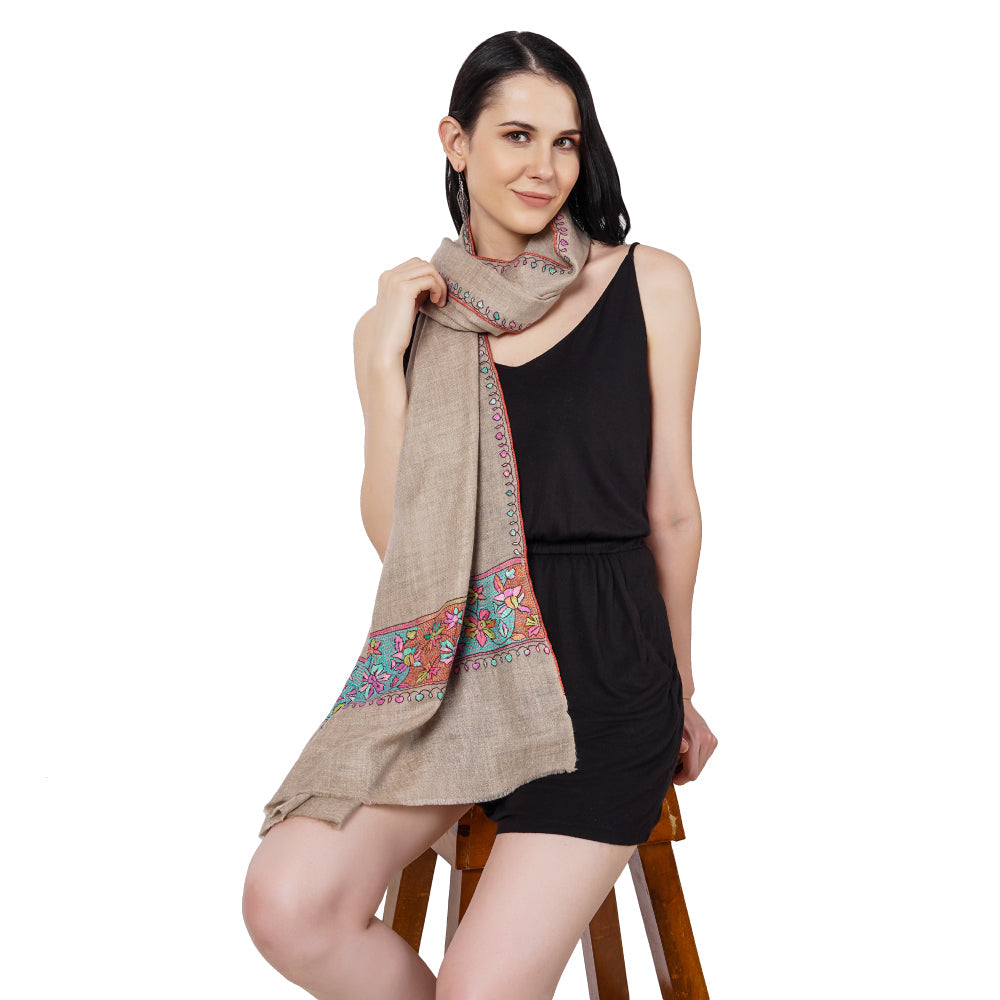
Shahtoosh is typically plain-woven, slightly more translucent than fine Pashmina when held to light, and almost never embroidered. Pashmina is often embroidered with Sozni needle-work or woven with Kani patterns. A heavily embroidered piece is almost certainly Pashmina. A plain, diaphanous piece warrants closer examination — but visual identification is indicative, not conclusive.
~ Useful as a supporting indicator. Cannot confirm species independently.
A burn test on fringe fibers confirms protein-based (animal) origin — protein fibers burn slowly, smell of burning hair, and leave crushable ash. This rules out synthetic fakes. It cannot distinguish Shahtoosh from Pashmina, wool, or silk. A useful first step to eliminate synthetics before proceeding to laboratory testing.
~ Limited. Rules out synthetics only. Cannot confirm species.
For the complete identification guide — covering all methods, the decision flowchart, and how to access laboratory testing — see our dedicated article on how to tell if your shawl is Shahtoosh.
If You Own a Shawl That "Passed" — What to Do
If you own a shawl that has been identified as Shahtoosh on the basis of the ring test — whether by a seller, a family member, or your own application of the test — that identification is not reliable. Here is what to do.
✦ The Three Steps
Step 1: Pull 3–5 fringe threads from the corner of the shawl. These are structurally identical to the main weave fibers and require no damage to the fabric body.
Step 2: Send them to a specialist textile laboratory for OFDA fiber-diameter analysis. Cost: $50–$150. Turnaround: 5–10 business days. The result gives you the precise fiber diameter in microns — which definitively identifies the species.
Step 3: If the result shows 9–12 microns (Shahtoosh), review the guidance in our article on the legal status of Shahtoosh and consult a wildlife law specialist in your country. If the result shows 12–16 microns (Pashmina), you have confirmation of genuine Pashmina — no legal concern, only the pleasure of knowing what you own.
In our experience, the majority of shawls that have been informally identified as Shahtoosh through the ring test turn out to be genuine fine Pashmina — sometimes of excellent quality, often from Kashmir, always worth knowing about. The ring test created a category of "possible Shahtoosh" that laboratory testing has largely resolved into "confirmed Pashmina." That is the correct outcome.
The ring test is the most famous test in luxury textiles and the least reliable one. It proves a shawl is fine. It cannot prove what it is fine from.
The only honest answer to "is this Shahtoosh?" costs $100 and takes 10 days. That is a small price for knowing what you actually own.
Frequently Asked Questions — The Ring Test
If my shawl passes the ring test, does that mean it's Shahtoosh? ▾
No. Passing the ring test confirms that your shawl is fine and lightweight — it does not confirm species. Fine genuine Pashmina at 80 GSM passes the ring test. Fine wool blends pass it. Modal and viscose products pass it. Silk passes it. The ring test cannot distinguish Shahtoosh from any of these alternatives. The only definitive test is laboratory fiber-diameter analysis, which measures the precise micron count of the fiber and identifies species.
Does genuine Pashmina pass the ring test? ▾
Yes. Genuine single-ply Pashmina at 80 GSM — handwoven from Changthangi goat fiber at 12–16 microns — passes through a standard finger ring without difficulty. This is confirmed by first-hand observation in the Kashmir textile trade. We have pulled our own handwoven Pashmina through a ring in front of customers. It passes. This is why the ring test cannot be used to identify Shahtoosh — because the property it tests (fineness and lightness) is shared by genuine Pashmina.
Why do sellers still use the ring test if it's unreliable? ▾
Because it is visually dramatic, memorable, and commercially useful regardless of its reliability as a species identifier. For honest sellers of genuine Pashmina, it demonstrates real quality — the shawl is genuinely fine and the demonstration is genuine. For dishonest sellers, it provides apparent validation without forensic accountability. The test also persists because buyers want simple answers — and "if it passes the ring, it's Shahtoosh" is simpler than "the only reliable answer requires a laboratory." Simple narratives that feel definitive have long lives, even when they are wrong.
What is the correct way to test for Shahtoosh? ▾
The only definitive method is laboratory fiber-diameter analysis — OFDA (Optical Fiber Diameter Analysis) or scanning electron microscopy (SEM). Pull 3–5 threads from the fringe of the shawl. Send them to a specialist textile testing laboratory. The result gives the precise fiber diameter in microns: Shahtoosh measures 9–12 microns; Pashmina measures 12–16 microns; commercial cashmere measures 17–22 microns. Cost is typically $50–$150 and results are available within 5–10 business days. This result is precise, species-specific, and admissible in legal proceedings.
Can you tell Shahtoosh from Pashmina by feel? ▾
Not reliably, without the specific experience of having held both fibers for direct comparison. Shahtoosh at 9–12 microns is perceptibly softer and more delicate than fine Pashmina at 12–16 microns to a trained hand that has held both. But to someone without that specific comparative experience — which describes almost all buyers — the difference is not obvious. Both feel extraordinary. Both feel unlike commercial cashmere. Distinguishing them by feel alone requires the kind of specific, repeated exposure that very few people outside the Kashmir trade have had.
The shawl that needs no test
Genuine Kashmiri Pashmina.
Certified. Traceable. No ring required.
You do not need to test genuine Pashmina from Pashwrap — because we tell you exactly what it is: fiber diameter, origin, weaving method, artisan certification. Three generations of transparency, built into every piece.