
Shahtoosh and the Silk Road: How the Fiber Traveled Ancient Trade Routes
The chiru has lived on the Tibetan Plateau for millennia. Long before export bans and CITES listings, its fiber moved westward along the Silk Road's Himalayan corridors — from nomadic hunters to Kashmiri weavers, from Mughal treasuries to Persian courts and eventually to European drawing rooms. This is the history of that journey.
The Silk Road Was Not One Road — and It Was Not Only About Silk
The term "Silk Road" — coined by the 19th-century German geographer Ferdinand von Richthofen — is a convenient simplification of what was actually a shifting, multi-branched network of overland and maritime routes connecting East Asia, Central Asia, South Asia, the Middle East, and Europe across roughly two millennia. Silk was its most famous cargo, but the network carried everything that carried value across distance: spices, glass, horses, gold, lapis lazuli, cotton, dyes, opium, slaves, and ideas — religions, technologies, diseases, and artistic styles among them.
Textiles occupied a privileged position in this trade because they combined high value with relative portability. A single bale of premium fabric could fund a merchant's entire journey; a single extraordinary shawl could serve as a diplomatic gift that sealed an alliance. Within the textile tier, fiber rarity created its own hierarchy — and at the apex of fiber rarity, above silk, above cotton, above all but the most extraordinary wool, sat the fiber that would later be called Shahtoosh.
In pre-industrial textile trade, the value of a fiber was determined by three factors that the modern world has largely lost track of: rarity of source (could the fiber be obtained anywhere else?), difficulty of processing (how much skilled labor did it require to become cloth?), and performance characteristics (warmth-to-weight ratio, softness, durability against a harsh climate). Shahtoosh — the fiber combed from the Tibetan chiru, processed through Kashmir's established weaving tradition — satisfied all three criteria at levels that no other naturally occurring material could match.
The Route: From Plateau to Court
Shahtoosh's journey from the Tibetan Plateau to the courts of Asia and eventually Europe was not a single trade transaction but a multi-stage relay, with each node adding value, processing, and markup. Understanding this route helps explain why Kashmir became the indispensable intermediary — and why the trade eventually concentrated there rather than dispersing across multiple weaving centres.
The geography of this route is not incidental. The Himalayan barrier forced all trade between the Tibetan Plateau and the subcontinent through a small number of mountain passes — primarily those controlled by Ladakh and the Kashmir Valley. This geographic chokepoint gave Kashmir's rulers and merchants a structural advantage that lasted centuries: they could not be bypassed. Any trader who wanted chiru fiber for the subcontinent or westward markets had to transact through the Ladakh-Kashmir corridor.
Leh and Ladakh: The Trans-Himalayan Entrepôt
Leh, the capital of Ladakh, sits at 3,500 metres elevation at the junction of several Himalayan trade routes. From at least the 10th century CE, it functioned as the primary entrepôt for goods moving between Tibet, Central Asia, Kashmir, and the subcontinent. The annual trade fair at Leh drew merchants from Tibet, China, Central Asia, Persia, and the subcontinent — making it one of the most cosmopolitan cities in the medieval mountain world despite its small size.
For Shahtoosh specifically, Leh served as the place where raw fiber from the Tibetan Plateau was first formally traded. Nomadic hunters and herders from the Changtang would bring raw chiru underfleece — loosely combed, unspun, heavy with guard hair — to Leh's markets, where Ladakhi and Kashmiri merchants would purchase it by weight. The raw fiber would then move south and west over the Zoji La pass into the Kashmir Valley, where the spinning and weaving infrastructure capable of processing it existed.
Ladakh had the geographic access to chiru fiber but not the weaving tradition to transform it. The Kashmir Valley, sheltered at 1,600 metres, had a climate hospitable to year-round skilled textile work, a guild system of weavers that stretched back centuries, and a specific tradition of working ultra-fine fibers with tools and techniques developed over generations. The chiru's fiber is among the finest of any animal — with a diameter of 7–10 microns in the underfleece, comparable to the finest Pashmina. Processing it into cloth required the Kashmiri spinner and weaver's accumulated craft knowledge. Without Kashmir, the fiber was just raw material.
Kashmir: Where Raw Fiber Became Impossible Cloth
The Kashmir Valley's role in the Shahtoosh trade was not merely logistical — it was alchemical. Raw chiru fiber arrived in Srinagar as an undifferentiated mass of extraordinarily fine down mixed with coarser guard hair. Kashmiri craftspeople — primarily women spinners and male weavers working in a highly specialised division of labour — transformed it into cloth of a quality that had no equivalent anywhere in the pre-industrial world.
Raw Fiber (Leh)
Unprocessed chiru underfleece: mixed with guard hair, unspun, low value per unit of potential
Kashmir Processing
Pashm dehairing → hand-spinning to extreme fineness → dyeing → Kani or Sozni weaving over months
Finished Shawl (Srinagar)
A finished Shahtoosh shawl: lighter than air, warmer than wool, worth more per gram than silver in Mughal court trade
This transformation took time measured in months. A Kani-woven Shahtoosh shawl — where each thread of the pattern was interlocked with the warp using small wooden bobbins called kanis, rather than woven as a continuous weft — could take a master weaver and his assistants six months to two years to complete. The resulting fabric was not merely warm; it was the closest the pre-industrial world came to something that defied physical logic — a textile that kept the Mughal emperor comfortable in a Himalayan winter while being light enough to pass through a finger ring.
"The shawl of tus — which comes from the navel of the deer that lives in the mountains above Kashmir — is so fine that a shawl of it may be passed through a signet ring, and yet will cover a man from head to foot."
— Composite of period accounts; the "ring test" appears in multiple Mughal, Persian, and European travel accounts from the 16th–18th centuriesThe "ring test" — the demonstration that a large shawl could be drawn through a small ring — was not merely a party trick. It was the trade's central marketing device, demonstrating at a glance the fiber's extraordinary fineness. It appears in Mughal court records, European travellers' accounts, and Persian poetry across several centuries. The test worked because Shahtoosh's fiber diameter of 7–10 microns, combined with the loose twill weave structure, produced a cloth that despite its insulating properties had almost no structural resistance to compression.
A History of the Trade — Key Periods
Earliest Evidence — Central Asian Nomadic Trade
The earliest documented trade in exceptional Tibetan plateau fibers appears in Central Asian merchant records, though the specific identification of chiru fiber as distinct from other plateau wools is later. Nomadic peoples of the Tibetan Plateau have utilised chiru hides and fiber since antiquity — the animals would have been hunted for meat and fiber both, with excess fiber entering regional barter networks.
Kashmir's Shawl Industry Formally Established
Traditional accounts attribute the organised Kashmir shawl industry to the reign of Sultan Zain-ul-Abidin (r. 1420–1470), who is credited with bringing weavers from Persia and Central Asia to establish the industry in the Kashmir Valley. Whether or not this founding narrative is precisely accurate, by the 15th century Kashmir had a functioning weaving industry producing luxury shawls from both Pashmina and Shahtoosh fibers. The Kani weaving technique — producing elaborate woven patterns — likely developed in this period.
Mughal Empire — Shahtoosh Enters Court Culture
Under the Mughal emperors, Kashmir shawls — including Shahtoosh — became embedded in the political economy of gift-giving and status display. The Ain-i-Akbari (1590), the administrative document of Akbar's empire, records specific categories and values of Kashmir shawls including those made from "tus" fiber. Emperor Akbar reportedly owned thousands of shawls. Jahangir's memoirs (the Tuzuk-i-Jahangiri, c. 1605–1627) record the use of Shahtoosh shawls as imperial gifts and describe the annual tribute in shawls from Kashmir. The Mughal court created a formal system of grading shawls — the finest carrying rank-specific significance as imperial gifts.
Persian Courts and the Westward Trade
Safavid Persia (1501–1736) maintained active trade with Mughal India through the Kabul-Kandahar corridor, and Kashmir shawls — including the finest Shahtoosh grades — were among the most valued items in this exchange. The Persian court developed its own aesthetic vocabulary around Kashmiri shawls, which influenced both the patterns woven in Kashmir (the paisley/boteh form has Persian origins) and the distribution network that eventually carried shawls to Istanbul, Cairo, and the Levant. Persian and Armenian merchants based in Isfahan and Tabriz served as the westward distribution layer.
European Arrival and Demand Explosion
European contact with Kashmir shawls intensified through the East India Companies and was dramatically accelerated by Napoleon's Egyptian campaign (1798–1801), after which Joséphine Bonaparte's patronage transformed Kashmir shawls — including Shahtoosh — into the defining luxury item of early 19th-century European fashion. French and British manufacturers attempted to replicate Kashmir patterns in Lyons and Paisley respectively, but could not replicate the fiber — their versions were wool imitations. The genuine article, including genuine Shahtoosh, commanded prices that placed it among the most expensive objects in European luxury trade.
British Colonial Period — Documentation and Formalisation
British colonial administrators in Kashmir documented the shawl trade extensively, creating the first systematic records of fiber grades, production volumes, and trade values. These records are the primary historical source for understanding the scale and structure of 19th-century Shahtoosh production. The British also created formal classifications distinguishing "shawl wool" (Pashmina) from "tus" (Shahtoosh), establishing in bureaucratic documentation the distinction that wildlife law would later codify in criminal statute. Kashmir shawl production declined sharply after 1860–70 due to European competition and changing fashions, but Shahtoosh continued as a specialist luxury item.
Modern Demand Surge — and the Population Collapse It Caused
The revival of Shahtoosh as a luxury item in the 1970s–1980s, driven by the Gulf oil boom and the growth of a new global ultra-luxury consumer class, drove demand to levels the trade had not seen since the height of Mughal court consumption. Unlike the Mughal era, this demand was concentrated in a small geographic and demographic target — Western fashion capitals and Gulf royal households — and was met by a supply chain that had never been regulated and was now able to reach volumes historically limited by the difficulty of Himalayan transport. The result was a poaching surge that reduced the chiru population from historical levels of 1 million+ to below 75,000 within two decades.
Where Shahtoosh Sat in the Silk Road Luxury Hierarchy
To understand why Shahtoosh attracted the courts and merchants it did, it helps to place it alongside the other prestige goods in Silk Road trade. The following comparison uses relative value per unit weight as a proxy for prestige, based on period merchant records and court inventories.
At its finest — a multi-year Kani weave with complex pattern work — a Shahtoosh shawl occupied a tier of its own. The Ain-i-Akbari records Akbar organising his shawl collection into the "do-shala" (double-shawl) category with specific grades; the imperial gift registers of Jahangir record individual shawls given as diplomatic gifts worth more than the annual salary of a high imperial official. This was not hyperbole — it reflected genuine scarcity and genuine skill.
The Trade Corridors in Detail
Tibet → Leh → Yarkand → Samarkand
The northernmost route carried fiber and finished goods through Ladakh's Nubra Valley, over the Karakoram Pass (5,540m), into Yarkand (in modern Xinjiang), and then westward through the Tarim Basin toward Samarkand and Bukhara. This was the primary route for Central Asian merchants — Uighur, Sogdian, and later Uzbek traders who connected the Kashmir shawl trade to Persia's overland routes. Finished Shahtoosh shawls moving this way could reach Tabriz or Istanbul within one trading season.
Srinagar → Kabul → Kandahar → Isfahan
The western corridor through Afghanistan was the primary route for Mughal-Safavid trade. Kabul served as the transit hub where Indian goods — including Kashmir shawls — were exchanged for horses, metals, and Central Asian goods. Kandahar, contested between Mughal and Safavid empires for much of the 16th–17th centuries, was the gateway to Persia proper. From Isfahan, goods dispersed westward to Constantinople, Cairo, and by the 17th century to the Levantine ports for onward shipment to Europe.
Lahore → Surat → Maritime Trade
By the 17th century, as European trading companies established themselves on the Mughal coast, a southward route carried Kashmir shawls from Lahore to Surat (the major Mughal port) and into the maritime trade networks of the Indian Ocean. The English, Dutch, and later French East India Companies all traded in Kashmir shawls as part of the luxury goods they shipped to European markets. This route would eventually become the dominant channel for Shahtoosh's entry into European fashion.
Court to Court — The Gift Economy
Beyond merchant trade, a parallel flow of Shahtoosh moved through the gift economies of Asian courts. Mughal emperors sent shawls to Safavid shahs; Kashmiri rulers sent tribute in shawls to Delhi; governors sent gifts of shawls to maintain imperial favour. This diplomatic circuit operated outside normal merchant trade and often involved the finest pieces that would never reach open markets. The court-to-court flow is why the best Shahtoosh shawls appear in the inventories of Topkapi Palace, the Peacock Throne treasury, and the collections of Mughal princesses — not only in merchant inventories.
Napoleon's Egypt and the Western Demand Surge
The definitive entry of Kashmir shawls into European fashion came with Napoleon's Egyptian campaign (1798–1801), after which French officers brought back examples as gifts for their wives. Joséphine Bonaparte's collection and public use of Kashmir shawls — including Shahtoosh — transformed them from exotic curiosities to essential status symbols. The resulting demand drove both European imitation (Paisley, Lyons) and imports of genuine article through East India Company channels. This is the moment when the trade ceased to be purely Asian and became global — with consequences that built over the next two centuries.
The Gulf Circuit — 1970s Revival
The final, most commercially intense phase of Shahtoosh trade opened with the Gulf oil wealth of the 1970s. Gulf royal households, newly equipped with extraordinary purchasing power and a cultural tradition of valuing exceptional textiles as gifts and status markers, became major consumers of Shahtoosh. Kashmiri merchants who had maintained the trade at low volumes during the mid-20th century saw demand — and prices — surge. This revival phase coincided with the chiru population crisis documented by George Schaller and others in the late 1980s–early 1990s, eventually triggering the enforcement response.
Ancient Trade vs Modern Trade: What Changed and What Did Not
Almost certainly yes, in broad terms. The Ain-i-Akbari and other Mughal administrative records describe "tus" as a fiber obtained from a specific mountain animal ("the deer of the mountains above Kashmir" in period descriptions). Hunting accounts from the Tibetan Plateau documented in Chinese and Central Asian sources make clear that chiru were hunted, not herded.
What ancient traders did not have was any concept of species population sustainability or conservation biology. The idea that a hunted species could be driven to extinction by commercial demand was not part of any framework available to Mughal court administrators or Silk Road merchants — extinction as a documented phenomenon, and the scientific understanding of minimum viable populations, are products of 19th and 20th-century biology. The ethical framework that now makes the trade impermissible simply did not exist in the eras when Shahtoosh was first traded.
They traveled the same routes and were processed by many of the same craftspeople, but they occupied different tiers of the market. Pashmina — the fiber of domesticated Changtang goats, collected by combing in spring — was the mainstream luxury; produced in substantial volumes, available to wealthy merchants and upper-court officials, and forming the bulk of Kashmir's shawl export trade. Shahtoosh was the ultra-premium tier — rarer, finer, much more expensive, and associated specifically with the imperial gift economy and the very wealthiest consumers.
A Mughal nobleman might own fine Pashmina shawls as status items while aspiring to Shahtoosh; a provincial governor might send Pashmina as tribute while reserving Shahtoosh for a gift directly to the emperor. The distinction was understood, documented, and economically significant — much as the distinction between a fine cashmere suit and a bespoke one-of-a-kind textile commission would be understood today.
Several tried. European Paisley and Lyons weavers in the early 19th century attempted to produce pattern-equivalent shawls in locally available fibers (merino wool, silk-wool blends). They succeeded in replicating the aesthetic vocabulary — the paisley/boteh pattern became globally widespread — but could not replicate the fiber's physical properties. The ring test was not performable with European wool; the warmth-to-weight ratio was incomparable; and the hand-feel was categorically different. The imitations found a large middle-market but never replaced the genuine article for the customers who could afford it.
Within Asia, Central Asian and Persian weavers worked with silk and fine wool but lacked both the fiber source (the chiru's range didn't extend to Persia or Central Asia in accessible numbers) and the specific spinning technology refined in Kashmir over generations. The Kashmiri craft tradition was a geographic and historical accident that proved impossible to replicate elsewhere.
Yes — significant collections exist in several major museums. The Victoria and Albert Museum (London) holds important examples of historic Kashmir shawls including Shahtoosh pieces, acquired during the 19th century when the trade was legal and Britain administered Kashmir. The Metropolitan Museum of Art (New York), the Musée des Arts Décoratifs (Paris), the Hermitage (St. Petersburg, which received pieces through the Russian imperial court's trade with Central Asia and Persia), and several Indian museums hold documented Shahtoosh pieces from the Mughal period and later.
These museum pieces are held under institutional CITES permits for scientific and cultural heritage purposes. They are the only category of genuine historic Shahtoosh that exists in fully documented legal status — precisely because they were acquired and catalogued before the species was CITES-listed, and have been held continuously in institutional collections ever since. They are a research resource for fiber scientists, textile historians, and wildlife forensics alike.
In its essential geography, yes — with modern infrastructure layered over the ancient routes. Raw Pashmina fiber is still collected from Changtang Pashmina goats by nomadic herders in Ladakh (the same highland plateau corridor that fed the ancient trade), transported to Srinagar for spinning and weaving, and then distributed globally through Kashmir's merchant networks. The ancient Leh-Srinagar-Lahore-Kabul-Isfahan route has been replaced by air cargo and modern logistics, but the geographic logic — fiber from the Himalayan plateau, transformation in the Kashmir Valley, distribution through established commercial networks — is structurally identical to what the Mughal trade documents record.
The crucial difference is that Pashmina's supply chain is fully legal, fully documented under India's GI certification system for Kashmir Pashmina, and fully sustainable — the Changtang goat is domesticated and the fiber is combed rather than requiring the animal's death. The ancient trade's legal and ethical heir traveled the same roads.
The ring test — drawing a large shawl through a finger ring — was the Silk Road merchant's proof of fiber fineness. It works because extraordinarily fine fiber, loosely woven in a twill or plain weave, has very low structural resistance to compression in a radial direction. The shawl does not resist being gathered and pushed through a small aperture; it compresses into a bundle small enough to pass, then springs back to its full drape. It is a genuine physical test, not a trick.
Shahtoosh at 7–10 microns fiber diameter passes the ring test reliably. Fine hand-spun Pashmina at 12–16 microns, woven in the right weight and structure, can also pass — or come very close. The ring test is therefore not a definitive distinguishing test between Shahtoosh and fine Pashmina; only fiber diameter measurement under microscopy or DNA analysis provides definitive identification. The ring test is a test of fineness, not of specific species origin. A fine Pashmina shawl from Pashwrap, woven to appropriate specifications, demonstrates the same ancient quality that the Silk Road merchants were testing — through fully legal means.
Since Shahtoosh Is Illegal, Here Is the Best Alternative
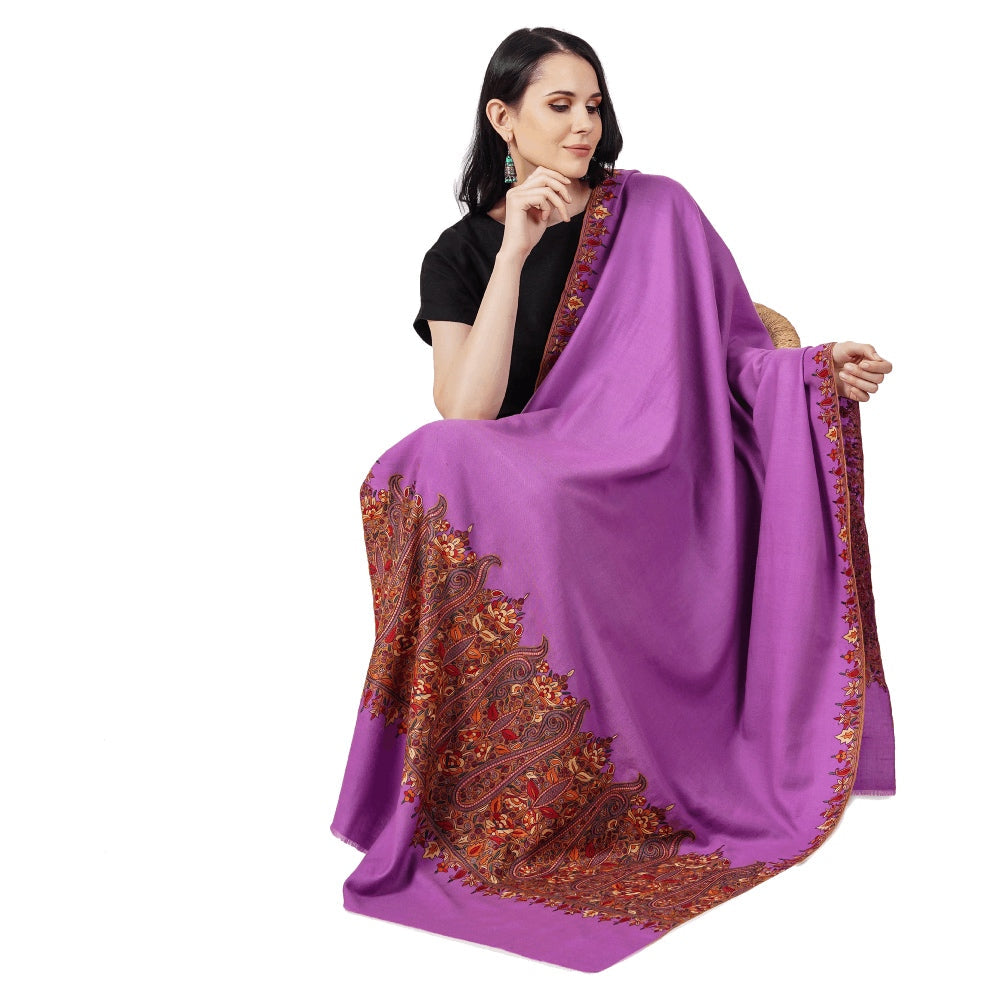
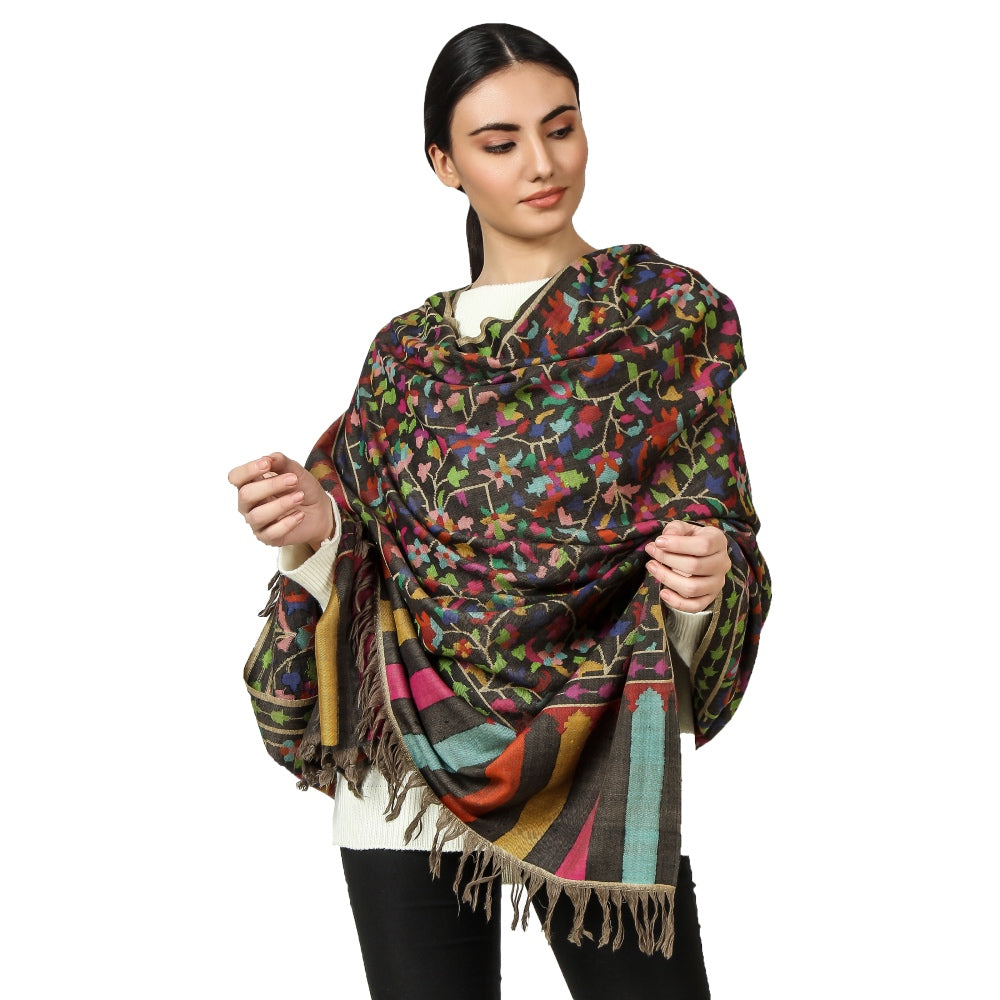
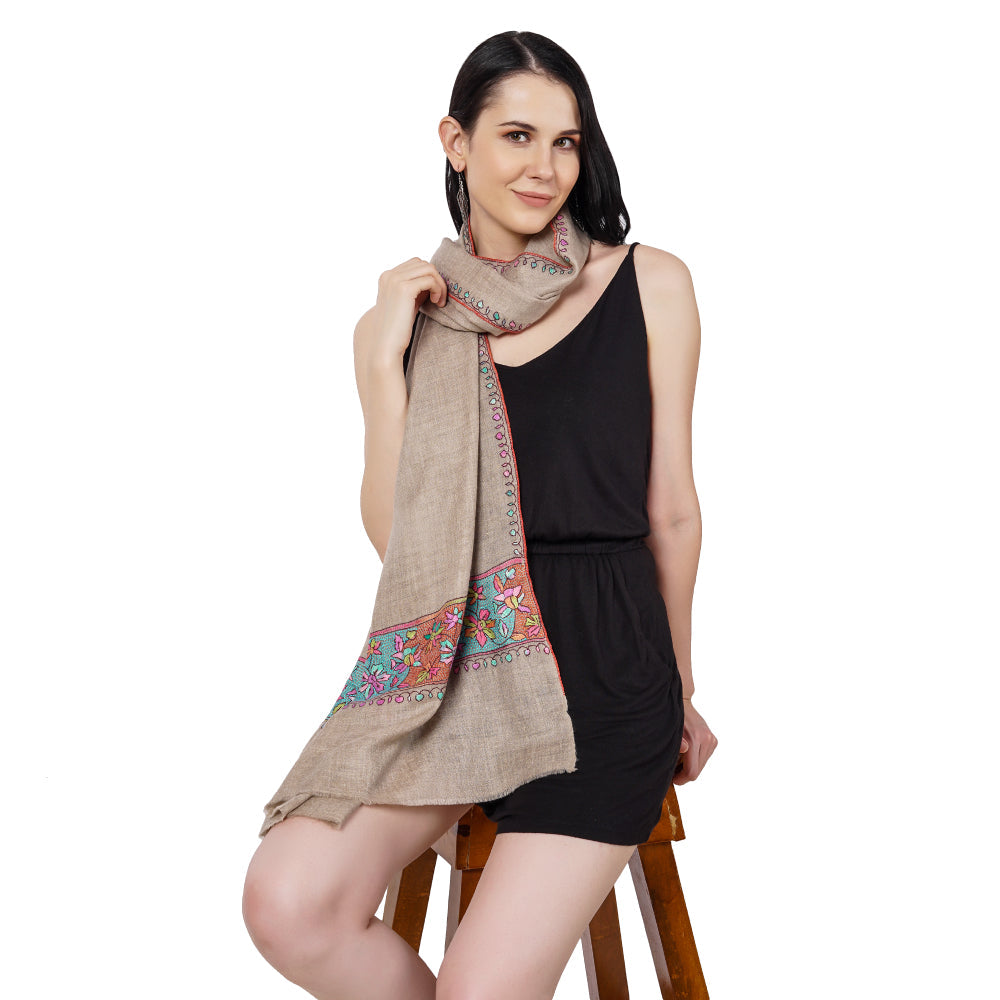
Pashmina traveled the same Silk Road corridors, was woven by the same Kashmiri craftspeople, and was prized by the same Mughal courts. The ancient trade's legal heir — lighter, warmer, and carrying a craft tradition that stretches back to Sultan Zain-ul-Abidin's Kashmir — is available today through an unbroken family tradition.
Explore Pashwrap Pashmina Shawls