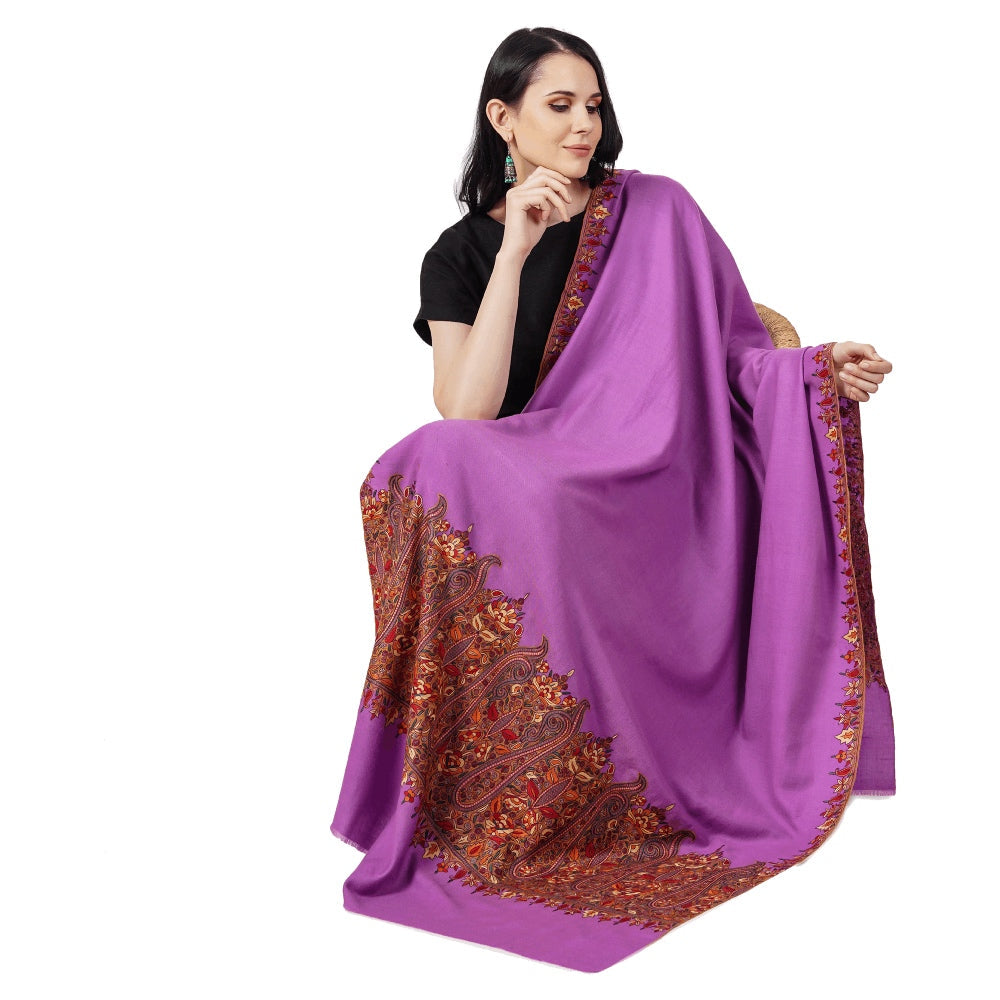

How Shahtoosh Was Smuggled: Trade Routes from Tibet to Kashmir to the World
A woman in a Paris boutique runs a finished shawl through a ring. Three weeks earlier, that same fiber was packed in raw bales crossing a Himalayan pass at minus thirty degrees. Six months before that, it was the undercoat of a dead Tibetan antelope on a frozen plateau. The distance between the killing field and the luxury counter was roughly 4,000 kilometres. This is how the fiber traveled it.
The 4,000-Kilometre Route
- 01 The Source: The Killing Fields of the Changthang
- 02 The First Leg: Tibet to Nepal Through the Himalayan Passes
- 03 The Second Leg: Nepal to North India via the Open Border
- 04 The Receiving Network: How Raw Wool Entered Srinagar
- 05 The Export Architecture: Kashmir to the World's Boutiques
- 06 The Economics of the Route: Who Actually Made the Money
- 07 The Collapse: How the Routes Were Shut Down in 2000–2003
Understanding what Shahtoosh is requires understanding how it physically moved from the animal to the buyer. A Shahtoosh shawl was never a product that existed in a single place. It was assembled across four countries, processed by at least three different sets of hands, transported through some of the most inhospitable terrain on Earth, and laundered through commercial systems designed to make an illegal wildlife product look like a legitimate luxury good. The supply chain was not a straight line. It was a series of handoffs, each one adding a layer of anonymity, a markup in price, and a degree of separation between the end consumer and the dead animal that made the product possible. We are describing these routes because the geography of the trade explains the enforcement failures, the market dynamics, and ultimately, how the trade was finally shut down.
The Source: The Killing Fields of the Changthang
The route began on the Tibetan Plateau, primarily in the remote regions of the Changthang, the Aru Basin, and the western reaches of Qinghai and Xinjiang provinces. These are among the most isolated places on Earth — vast, treeless expanses at 4,500 to 5,000 metres where winter temperatures drop below minus 40 degrees Celsius. The chiru live here, and the poachers followed them here.
The poaching operations of the 1980s and 1990s were not carried out by small-time opportunists. They were organized, equipped, and mobile. Poachers used vehicles — originally introduced to the plateau by road construction crews — to follow migrating herds. They used military-style rifles, many of which filtered into the region through the same porous borders that the wool would later cross. A single poaching team could kill dozens of animals in a day, skin them on the spot, and pack the raw wool into bales. The extraction was brutally efficient: the animal was killed, the hide was scraped for the undercoat, and the carcass was left. The wool was the only thing that left the plateau.
From the plateau, the raw wool had to move south. But the direct border between the Tibetan Plateau and the Kashmir Valley — through Ladakh — is extremely difficult to cross with commercial quantities of goods, and by the 1990s, Indian authorities were increasingly aware of the Ladakh corridor. The primary route went east and south, into Nepal.
The First Leg: Tibet to Nepal Through the Himalayan Passes
The Tibet-to-Nepal leg was the most physically dangerous segment of the route, and the one where the raw wool was most vulnerable to interception. The wool moved through a handful of established crossing points in the Himalayas, primarily in the Purang (Taklakot) area of western Tibet and the Zangmu (Kodari) area further east. These are high-mountain passes, exceeding 5,000 metres, open only during a narrow window in late spring and early autumn. In winter, they are impassable.
The raw Shahtoosh wool was transported in compact bales, wrapped in multiple layers — typically coarse yak hair or low-grade sheep wool on the outside, with the Shahtoosh packed in the interior. This was the first layer of disguise. To a casual inspection, the bale looked like a standard shipment of coarse Tibetan wool. Only by cutting it open and handling the interior fiber could an inspector identify the fine, distinctive undercoat of the chiru. The fiber's extreme fineness at 9–12 microns meant it compressed into a remarkably small volume. A kilogram of raw Shahtoosh — enough for several shawls — could fit in a bag the size of a small backpack. This made it easier to conceal than bulkier wildlife products like ivory or rhino horn.
✦ The Nepal Transit Point
Nepal served as the indispensable transit country for the Shahtoosh trade. It bordered both the Tibetan Plateau (the source) and India (the processing centre). It had a poorly regulated border economy, active cross-border trading communities, and — critically — limited capacity to inspect goods at remote mountain crossings. The wool entered Nepal through mountain passes, was stored briefly in border towns, and was then moved south to the Terai region — the flat, subtropical strip along Nepal's southern border with India.
The Nepal leg was handled by specialist cross-border traders — not the Kashmiri buyers, not the Tibetan poachers, but a separate network of middlemen who understood the mountain routes, the border post routines, and the bribery economics of the Himalayan transit trade. They were the essential link between the source and the market.
The Second Leg: Nepal to North India via the Open Border
The India-Nepal border is one of the most porous international boundaries in the world. Under the 1950 Treaty of Peace and Friendship, citizens of both countries can cross without passports or visas at most points along the roughly 1,800-kilometre border. This treaty was designed for the benefit of ordinary people living in border communities. For the Shahtoosh trade, it was an architectural feature of the smuggling route.
From the Nepal Terai, the raw wool crossed into India — typically through Uttar Pradesh or Bihar. The crossing was usually made on foot, by bicycle, or in local buses. The bales were concealed among legitimate agricultural goods, textiles, or standard wool shipments. At this stage, the risk of interception was extremely low. Indian customs authorities were not systematically inspecting the bags of people crossing from Nepal for a fiber that looked, to the untrained eye, like ordinary wool. The volume of daily cross-border traffic — hundreds of thousands of people — made individual inspection logistically impossible.
Once across the Indian border, the wool moved by rail or road to North India — typically to Delhi, from where it was routed to Kashmir. In some cases, it went directly to Punjab and then into Jammu and Kashmir by road. The rail route from the Nepalese border to Delhi to Jammu was a standard commercial corridor for textiles, and Shahtoosh wool traveled within that legitimate flow. By the time the bales reached North India, they were hundreds of kilometres from the border, surrounded by the infrastructure of a legal textile supply chain. The illegal fiber had been successfully laundered into the domestic Indian transport system.
The Receiving Network: How Raw Wool Entered Srinagar
This is the part of the route we witnessed directly. In the 1980s and 1990s, the arrival of Shahtoosh raw wool in Srinagar was an open secret within the textile trade. It was not advertised, and it was not discussed with outsiders. But within the network of raw wool dealers, spinners, and master weavers in the old city, the arrival of "the special wool" was known, anticipated, and quietly accommodated.
The raw wool arrived in Srinagar in bales that looked identical to standard Pashmina wool bales. It was stored in the same warehouses, handled by the same workers, and initially processed through the same sorting and cleaning procedures. The first point of difference was in the spinning. Shahtoosh fiber is so fine — 9–12 microns compared to Pashmina's 12–16 microns — that it required specialist spinners. Not every spinner in Kashmir could handle it. The fiber broke if handled too aggressively, and the yarn had to be spun to an extraordinarily fine gauge. The spinners who could do this were a small, specialized group, and they were well compensated.
"In our family's workshop, we were approached twice in the early 1990s by middlemen offering 'special raw wool' at prices significantly above standard Pashmina rates. We were told, implicitly, what it was. We refused. But we knew which workshops in the neighbourhood had accepted. The wool arrived in the evening. The spinning happened in back rooms. The looms were moved away from windows. The secrecy was not total — everyone in the trade knew roughly where it was happening — but it was maintained enough to create plausible deniability. That deniability was the entire point of the Srinagar receiving network."
The weaving was done on standard handlooms, but often in concealed locations — back rooms, upper floors of buildings without street access, or in residential areas rather than commercial workshop zones. A skilled weaver could produce a finished Shahtoosh shawl in two to four months, depending on the complexity of the weave. The finished shawl was then passed to the selling network — a separate layer of the operation that handled the domestic and international distribution. The weaver was paid a premium wage, given the specialized difficulty of the work, but the weaver did not participate in the selling. The compartments were kept distinct.
The Export Architecture: Kashmir to the World's Boutiques
Moving a finished Shahtoosh shawl from a back room in Srinagar to a display case on Rue du Faubourg Saint-Honoré in Paris required a different set of logistics than moving the raw wool. Raw wool was bulky and anonymous. A finished shawl was light, identifiable, and — if recognized by customs — immediately incriminating. The export architecture was designed to bridge this gap.
The most common method was mislabelling. Finished Shahtoosh shawls were almost never declared as Shahtoosh on export documents. They were declared as "100% Pashmina," "special handwoven Cashmere," or "pure wool shawl." This was effective because, to a customs inspector who is not a textile specialist, a fine Shahtoosh shawl and a fine Pashmina shawl look nearly identical. Both are extremely thin, both have a characteristic soft drape, and both are handwoven. Without laboratory fiber testing — which no customs agency was conducting on routine textile shipments in the 1980s and 1990s — the mislabelling was virtually undetectable. This is why the market for fake Shahtoosh became so entangled with the market for genuine Shahtoosh: the same concealment mechanism that protected genuine Shahtoosh also protected the fraudsters selling standard Pashmina under the Shahtoosh name.
Personal carriage was also common. Wealthy buyers — particularly from the Middle East, Europe, and North America — would travel to Kashmir, purchase Shahtoosh shawls directly from dealers in Srinagar, and carry them home in their personal luggage. A finished Shahtoosh shawl weighs under 150 grams and folds into a small package. In an era before routine airport X-ray screening of hand luggage was capable of identifying specific fiber types, personal carriage was a low-risk method. The buyer was, in effect, acting as the final smuggling link in the chain — often without fully understanding, or choosing not to understand, the legal implications.
The transhipment route — routing finished goods through Dubai or Hong Kong before they reached their final destination in Europe or America — was used to break the paper trail. If a shawl was shipped from Srinagar to Dubai to Paris, the customs paperwork in Paris showed the country of origin as UAE, not India. This obscured the Kashmir connection and made enforcement tracing significantly more difficult. The shawl had been geographically laundered.
The Economics of the Route: Who Actually Made the Money
The cruelty of the Shahtoosh supply chain was not only biological. It was economic. The wealth generated by the trade was distributed with staggering inequality along the route. The poacher who killed the animals and extracted the fiber — the person who bore the greatest physical risk and committed the core criminal act — received the smallest fraction of the final retail price.
The Kashmiri weaver occupied a unique position in this economics. They earned a premium wage — significantly more than a standard Pashmina weaver — because their skill was rare and the work was demanding. But they did not earn anything approaching the margins made by the middlemen and the international sellers. The weaver's compensation was a wage. The middleman's and the boutique's compensation was profit. This distinction is important because it explains why the enforcement crackdown in 2000-2003 fell so heavily on the weavers: they were the physically visible, geographically fixed point in a chain where every other link had already dispersed. The poachers were on another plateau. The smugglers were across a border. The boutiques were in another country. The weavers were in Srinagar, at their looms, in their homes. They were the easiest to find.
The Collapse: How the Routes Were Shut Down in 2000–2003
A supply chain that spans four countries, relies on porous borders, and operates through mislabelling and personal carriage seems almost impossible to dismantle. Yet between 2000 and 2003, the Shahtoosh trade in Kashmir was effectively shut down. The routes did not close because a single border was sealed. They closed because pressure was applied simultaneously at every node.
On the Tibetan Plateau, Chinese anti-poaching patrols in the Kekexili and Changtang nature reserves became aggressive and armed. The poaching risk increased, and the raw wool supply began to dry up. In Nepal, under international pressure, border surveillance at the key Himalayan passes was intensified, and Nepalese authorities began cooperating with Indian and Chinese enforcement agencies — a cooperation that had been absent in the 1980s. In India, the Wildlife Protection Act was applied to Shahtoosh cases for the first time, and the Wildlife Crime Control Bureau began coordinating with state police in Jammu and Kashmir.
✦ What We Saw in Srinagar
The change in Srinagar was sudden and visible. In 2000 and 2001, the raids began. Law enforcement, often accompanied by wildlife NGO personnel, targeted specific workshops in the old city. Looms were sealed with wax. Stocks of raw wool and finished shawls were seized. Artisans were arrested. The middlemen — who had been the economic beneficiaries of the trade — largely disappeared. They had the resources, the connections, and the warning to relocate or liquidate their involvement before the raids reached them. The weavers, the spinners, and the workshop owners — the people at the bottom of the economic pyramid — were the ones left dealing with the legal consequences.
By 2003, the fear in the Srinagar textile community was palpable. The economic penalty for being caught with Shahtoosh — imprisonment, seizure of all textile inventory, destruction of looms — was catastrophic for a family workshop. The risk-reward calculation that had sustained the trade for decades inverted almost overnight. The routes were still geographically open. The borders were still porous. But the human network that had operated them — the trust, the intermediaries, the distribution of risk — had been shattered by enforcement.
The international end of the route collapsed in parallel. As awareness of the legal status of Shahtoosh grew among Western customs agencies and luxury retailers, the boutique market contracted. Major fashion houses quietly removed Shahtoosh from their inventories. Undercover operations by wildlife crime units in the UK, France, and the US targeted individual dealers. The personal carriage route became dangerous as customs agencies in destination countries began specifically screening for fine wool shawls from South Asia.
The route did not close because one border was sealed. It closed because every link in the chain became simultaneously more dangerous and less profitable. The poacher faced armed patrols. The smuggler faced coordinated border enforcement. The weaver faced raids and imprisonment. The boutique faced criminal prosecution and reputational destruction. When every node in a supply chain becomes unprofitable at the same time, the chain does not slow down. It stops.
The Shahtoosh supply chain required secrecy at every stage — hidden bales, back-room looms, mislabeled shipping documents, plausible deniability. A supply chain that requires total secrecy to function is a supply chain that knows it is wrong. The route is closed now. The truth about how it operated should remain open.
4,000 kilometres of lies, ending in a Paris boutique.
The contrast with genuine Kashmiri Pashmina is the final point worth making. Pashmina travels the same geography — from the Changthang Plateau through Ladakh to the Kashmir Valley. But it travels openly. The Changpa herders comb their goats in daylight. The raw wool is transported on public roads with commercial documentation. The spinning happens in visible workshops. The weaving is done on looms that are not hidden from windows. The finished handwoven Pashmina shawl is exported with accurate customs declarations under a legitimate, GI-certified product name. The entire supply chain is transparent because it has nothing to hide. The Shahtoosh route and the Pashmina route cover the same mountains. But one route operated in darkness, and the other operates in daylight. That difference — secrecy versus transparency — is the difference between a criminal supply chain and a living craft tradition.
Frequently Asked Questions
Could customs officials have detected Shahtoosh if they had tried? +
Not visually, and not without laboratory equipment. Shahtoosh and fine Pashmina are visually nearly identical to a customs inspector. The only reliable detection method is OFDA fiber diameter analysis, which requires pulling threads and sending them to a specialist lab — a process that takes days and costs $50–150 per test. No customs agency in the 1980s or 1990s was conducting fiber-diameter tests on routine textile shipments. The detection failure was not a failure of diligence. It was a failure of available technology at the point of inspection.
Did tourists who bought Shahtoosh in Kashmir know they were smuggling? +
It varied. Some buyers knew exactly what they were doing — they sought out Shahtoosh specifically, understood the legal risk, and relied on the low probability of detection. Others were misled by sellers who described the shawl as "special Pashmina" or "the finest Cashmere" without using the word Shahtoosh. In either case, ignorance of the law is not a legal defence. Tourists caught with Shahtoosh at their home country's customs have faced confiscation, fines, and in rare cases, prosecution. The legal consequences fell on the buyer, not the Srinagar dealer who had already been paid and was 5,000 kilometres away.
Are any of these smuggling routes still active today? +
The physical routes — the mountain passes, the open borders, the rail corridors — are all still open. They carry legitimate trade. What has been dismantled is the specific human network that moved Shahtoosh through those routes. Occasional seizures of small quantities of Shahtoosh still occur, typically involving individual dealers or collectors rather than an organised supply chain. But the industrial-scale route — the one that moved 20,000 kilograms of raw wool per year at the peak — has not functioned since the early 2000s. The enforcement infrastructure is now permanent in a way it was not in the 1980s, and the economic incentives are nowhere near what they were. See the population data in our article on the Tibetan antelope population for context on why the supply is also physically constrained.
Why was Kashmir the processing centre and not somewhere else? +
Because Kashmir had the only artisans in the world with the skill to spin and weave Shahtoosh. The fiber at 9–12 microns is too fine for machine processing and too fragile for standard hand-spinning. It required spinners who had spent a lifetime working with the finest Pashmina — and even then, only a subset of those spinners could handle Shahtoosh without breaking the yarn. Kashmir's 500-year tradition of fine Pashmina weaving created the only workforce on Earth capable of converting raw Shahtoosh into a finished textile. The processing came to Kashmir because the skill was only in Kashmir. The complete history of Shahtoosh explains how this craft specialisation developed over centuries.
What happened to the weavers who lost their income when the trade ended? +
The most skilled Shahtoosh weavers were, by definition, also the most skilled Pashmina weavers. Most transitioned — willingly or by necessity — to weaving the finest grades of Pashmina. The income drop was real, because Shahtoosh weaving commanded a premium. But the skill was transferable. The artisans who suffered most were not the master weavers but the secondary participants — the raw wool sorters, the transporters, the back-room assistants — whose involvement was specific to the Shahtoosh economy and who did not have equivalent Pashmina roles to move into. The human cost of shutting down an illegal trade falls disproportionately on the lowest-paid participants. That is a structural reality of enforcement, not a unique feature of the Shahtoosh trade.
Continue Reading — The Shahtoosh Series
M2·01 · History Pillar
The Complete History of Shahtoosh: From Mughal Courts to Modern Ban
Legal Sub-Pillar · The Law
Is Shahtoosh Illegal? A Country-by-Country Legal Guide for 2026
M1·26 · Identification
Fake Shahtoosh: How to Spot a Counterfeit and Why It Still Matters
M2·06 · Conservation Data
Tibetan Antelope Population: From One Million to 100,000 — The Data Story
The fibre that travels in daylight
Genuine Kashmiri Pashmina.
From the same plateau to your door — without a single secret along the way.
The Shahtoosh route required hidden bales, back-room looms, and mislabeled documents. Our Pashmina route requires none of that. The Changpa herders comb their goats openly. The spinners work in visible workshops. The shawls cross borders under their real name. Transparency is not just our ethics. It is our supply chain.