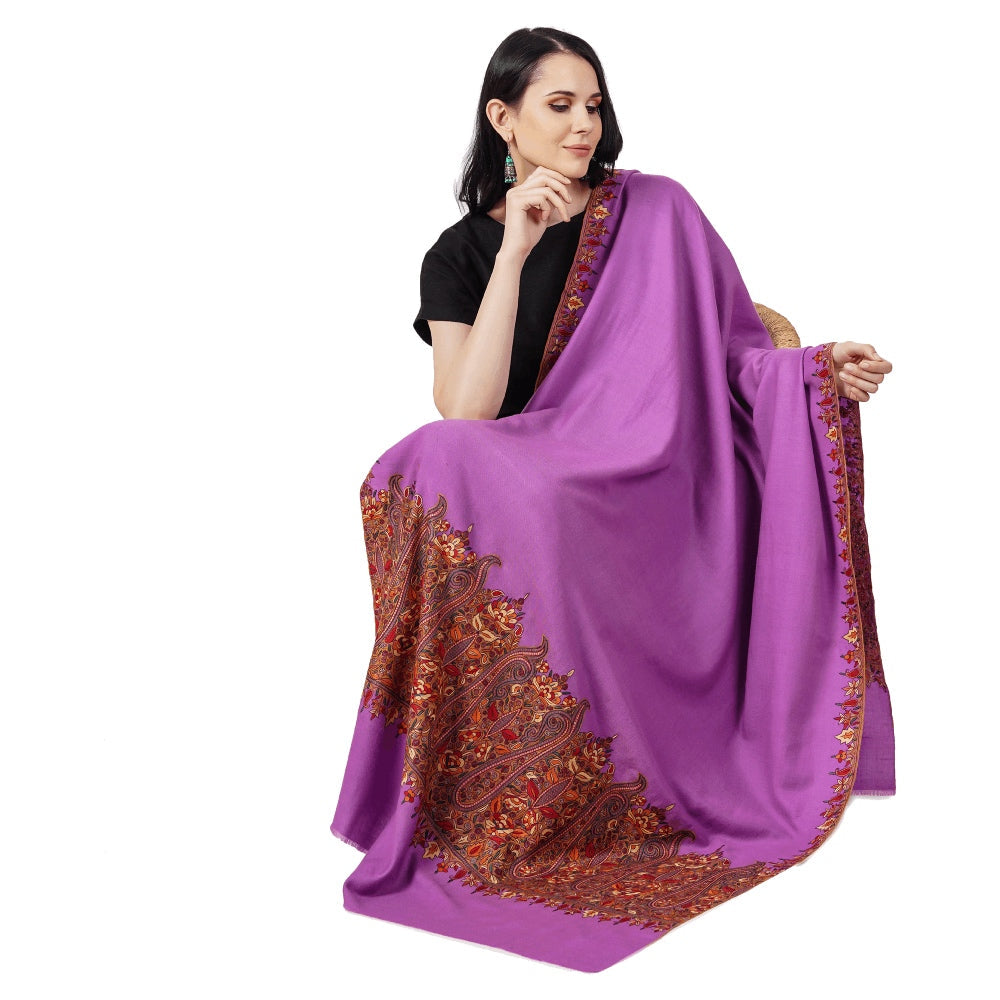

How the Shahtoosh Trade Was Exposed: The Role of Wildlife Investigators
The Shahtoosh trade operated in plain sight for decades — in Bond Street boutiques, Fifth Avenue shops, and the private showrooms of the Kashmir Valley — before a coordinated effort by wildlife investigators, conservation scientists, and enforcement agencies dismantled it. This is the story of how that happened.
In This Article
- Why It Took So Long — The Structural Conditions of the Open Trade
- Early Science — When Researchers First Documented the Connection
- TRAFFIC Enters — Market Surveys and the Documentation Strategy
- The Investigators — Who Did the Work
- The Fiber Identification Problem — How Science Made Prosecution Possible
- The Raids — When Investigation Became Enforcement
- How the Kashmir Valley Responded
- What the Investigation Did Not Do — The Limits of the Enforcement Era
- The Legacy — What the Exposure Changed
- Frequently Asked Questions
Wildlife crime investigations face a specific challenge that distinguishes them from most other criminal inquiries: the crime is distributed across multiple jurisdictions, involves parties at every point of a supply chain who may have varying degrees of awareness of the illegal nature of what they are handling, and produces a finished product that — by the time it reaches the consumer — shows no visible evidence of the crime that produced it. The Shahtoosh investigation confronted all of these challenges simultaneously, in a trade that had been operating openly for decades before any coordinated enforcement response existed. Understanding how it was finally exposed requires understanding why it was so difficult to expose in the first place.
Why It Took So Long — The Structural Conditions of the Open Trade
The Shahtoosh trade had been operating in some form since at least the early twentieth century, and in its modern commercial form — organized export from the Kashmir Valley to wealthy Western buyers — since at least the 1960s. The CITES Appendix I listing of the chiru in 1979 established an international legal framework for treating the trade as wildlife crime. India's Wildlife Protection Act had listed the Tibetan antelope since 1972. The legal foundation for enforcement existed for two decades before significant enforcement actually occurred.
Several structural factors explain this gap:
- The product was visually indistinguishable from legal alternatives. A Shahtoosh shawl sitting in a shop looked identical to a Pashmina shawl. Without laboratory fiber analysis, enforcement officers examining a shop's inventory could not determine whether any given piece was an illegal wildlife product or a legal textile. This created an evidentiary problem that required scientific solutions before enforcement could proceed.
- The supply chain crossed multiple jurisdictions. The chiru was killed in Tibet (Chinese jurisdiction), the fiber was processed in Kashmir (Indian jurisdiction), the shawls were sold in London, New York, Paris, and Tokyo. No single enforcement agency had visibility across the entire chain, and the international coordination required to address it took years to develop.
- The buyers did not know what they were buying. The "naturally shed" mythology, the ring test misdirection, and the confident retail presentation of Shahtoosh as an ancient sustainable tradition meant that the end consumer — typically a wealthy and otherwise law-abiding individual — was not aware of participating in wildlife crime. This reduced the political urgency of enforcement compared to trades where consumers were knowingly purchasing illegal products.
- The trade generated significant economic value in an economically marginal region. The Kashmir Valley's economy was under severe stress from the insurgency and security situation of the 1990s. Enforcement that threatened a significant income stream for weavers, traders, and associated occupations faced implicit political resistance that made regulatory action slower and more cautious than the legal framework alone would have required.
Early Science — When Researchers First Documented the Connection
The chiru (Tibetan antelope, Pantholops hodgsonii) is listed on CITES Appendix I, establishing the international legal prohibition on commercial trade in chiru products. The listing reflects documented population decline attributable to the Shahtoosh trade, but the enforcement mechanism does not yet exist to act on it. The trade continues openly across all jurisdictions.
Significance: The legal foundation is in place, but documentation of the trade's scale and the scientific tools for fiber identification that would make enforcement actionable do not yet exist.
Wildlife biologists working on the Tibetan Plateau begin systematic surveys of the chiru population. The surveys document a population in significant and continuing decline from historical levels — but establishing the direct connection between observed population decline and the Shahtoosh trade requires documentation of the trade's actual scale, which is not yet available.
Significance: Population data creates the conservation imperative. The commercial scale of the trade killing these animals needs to be documented separately before the connection can be made actionable.
TRAFFIC (the Wildlife Trade Monitoring Network, operating jointly under WWF and IUCN) begins systematic market surveys in Kashmir, India, and Western consumer markets to document the scale of the Shahtoosh trade. Researchers enter shops, record prices, purchase samples for laboratory analysis, and document the full supply chain from the Valley to the retail point. The surveys establish for the first time that the trade is operating at a scale of thousands of shawls per year, requiring the killing of tens of thousands of chiru annually.
Significance: This is the pivotal research phase — without documented trade scale, enforcement agencies lack the commercial evidence base needed to justify coordinated action.
Wildlife biologist George Schaller conducts extensive surveys on the Tibetan Plateau, documenting both the chiru population's continued decline and direct evidence of large-scale poaching operations — carcasses, bullet casings, pelts — at locations that establish the industrial scale of the killing operation. Schaller's field documentation bridges the gap between the conservation surveys that had tracked population decline and the market surveys documenting the trade's commercial end.
Significance: Field evidence of poaching at industrial scale, combined with TRAFFIC's market documentation, creates the complete chain of evidence from killing to retail. The investigative picture is now complete.
TRAFFIC publishes major reports documenting the Shahtoosh trade's scale, the supply chain from Tibetan poaching through Kashmir processing to Western retail, and the connection to the chiru's population decline. The reports are the first comprehensive public documentation of the trade that combines market survey data, fiber analysis results, population survey data, and field evidence of poaching. They circulate in conservation, enforcement, and — slowly — media circles.
Significance: The published evidence base is now in place for enforcement agencies in India, the UK, the US, and other jurisdictions to act — and for the conservation press to build the story that will eventually reach mainstream media.
TRAFFIC Enters — Market Surveys and the Documentation Strategy
TRAFFIC's investigative methodology for the Shahtoosh case was straightforward in principle and demanding in execution: document the trade as it actually operated, at every point in the supply chain, with enough specificity and laboratory confirmation that the documentation would hold up in enforcement and legal contexts. This meant researchers entering shops as buyers, purchasing shawls, having the fiber analyzed by independent laboratories, and recording the full commercial context — prices, seller claims, location, date — that would be needed for any subsequent prosecution.
🔬 What TRAFFIC's Investigation Documented
The supply chain end-to-end: TRAFFIC's surveys documented the trade from its source on the Tibetan Plateau through the Kashmir Valley processing and weaving stages, through export networks, to retail points in Western consumer markets. Each stage was documented with purchasing records, interviews, and fiber samples submitted for laboratory analysis.
The scale: TRAFFIC's market surveys estimated that 15,000–20,000 Shahtoosh shawls per year were being produced and sold at the trade's commercial peak — requiring the killing of 45,000–100,000 chiru annually. These figures, derived from market survey data combined with the known fiber yield per animal, established the commercial scale that connected the visible retail trade to the invisible poaching operation.
The mislabeling: TRAFFIC documented systematic mislabeling of Shahtoosh as Pashmina, as "toosh," as "king wool," and under various other names — establishing that traders were aware of the product's illegal status and were actively working to obscure it. This mislabeling evidence was critical for prosecution: it established intent rather than ignorance.
The retail destinations: TRAFFIC's Western market surveys documented Shahtoosh being sold in named boutiques on Bond Street in London, on Fifth Avenue in New York, and in equivalent premium retail locations in Paris, Tokyo, and other major cities — providing enforcement agencies in those jurisdictions with specific targets and documented evidence of sales.
The Investigators — Who Did the Work
Operating jointly under WWF and IUCN, TRAFFIC conducted the foundational market surveys that documented the trade's scale, supply chain, and retail destinations across India, Kashmir, and Western consumer markets. TRAFFIC's published reports provided the evidence base that enforcement agencies in multiple jurisdictions used to justify coordinated action. Without TRAFFIC's systematic documentation, the enforcement raids of the late 1990s and 2000s would have had no evidential foundation.
Key contribution: The complete published evidence chain — market surveys, fiber analysis results, population data correlation, retail documentation — that made prosecution possible in multiple jurisdictions.
Indian enforcement agencies — operating under the Wildlife Protection Act 1972 which listed the chiru from its inception — conducted raids on Kashmir Valley textile operations during the enforcement era. The challenge for Indian enforcement was the domestic political sensitivity of actions that threatened an economically important industry in a region already under severe security and economic stress. Enforcement proceeded, but cautiously, with significant attention to distinguishing legitimate Pashmina operations from illegal Shahtoosh production.
Key contribution: Domestic enforcement actions in the production hub — the raids and seizures that disrupted the production end of the supply chain rather than only the retail end.
Wildlife biologists working on the Tibetan Plateau — including George Schaller at the Wildlife Conservation Society — provided the field evidence of both the chiru's population decline and the poaching operations responsible for it. This field documentation was the biological counterpart to TRAFFIC's commercial documentation: it established what was happening to the animal at the source, while TRAFFIC established what was happening to the fiber at the market end.
Key contribution: Field evidence of industrial-scale poaching operations and population decline data that established the conservation urgency underlying the commercial case.
The bridge between the conservation press — which had been covering the chiru story since the early 1990s — and the mainstream press that reached the fashion world's audience was crossed in the late 1990s, when enforcement actions involving named Bond Street and Fifth Avenue boutiques created news events large enough to be covered by general newspapers and magazines. Investigative journalists at major publications followed the enforcement story into its commercial context, producing pieces that connected the Shahtoosh fashion moment to the chiru conservation crisis for the first time in a mainstream audience.
Key contribution: The translation of conservation documentation into mainstream media coverage that reached and changed the social context in which Shahtoosh ownership occurred.
The Fiber Identification Problem — How Science Made Prosecution Possible
The most technically demanding challenge in the Shahtoosh investigation was fiber identification. Without a reliable scientific method for distinguishing chiru fiber from Pashmina and other legal fine fibers, every seizure could be contested on the grounds that the fiber in question was not, in fact, from an illegal species. The "it's Pashmina" defense was available to any seller whose goods were seized — and at the visual inspection level, it was a defense that could not be refuted without laboratory analysis.
The solution was the development and refinement of microscopic fiber analysis techniques — primarily Optical Fiber Diameter Analysis (OFDA) and Scanning Electron Microscopy (SEM) — that could distinguish chiru fiber from Pashmina and other legal fibers with sufficient accuracy and reproducibility to be admissible in legal proceedings. As documented in detail in our article on Shahtoosh fiber microscopy, the key discriminating features between chiru fiber and Pashmina at the microscopic level are the scale height, scale frequency, and edge morphology of the fiber's cuticle — characteristics that differ between the two species and that can be measured and documented photographically.
✦ Why Fiber ID Was the Pivotal Technical Achievement
Before reliable fiber identification techniques were validated for legal use, the entire investigation had a fundamental gap: documentation of trade and commercial evidence of sales could establish that something was being sold as Shahtoosh, but if the seller claimed the goods were actually Pashmina, the burden of proof was on the prosecution to demonstrate otherwise. The validation of OFDA and SEM techniques — and their acceptance in court proceedings in India, the UK, and the US — closed this gap definitively. A seized shawl could now be analyzed, identified to species, and the result used as evidence in prosecution regardless of what the seller claimed it was.
The Raids — When Investigation Became Enforcement
UK enforcement agencies, acting on TRAFFIC documentation of specific retailers selling confirmed Shahtoosh, conducted raids on Bond Street and Knightsbridge boutiques that had been identified in market surveys as active Shahtoosh vendors. The raids resulted in seizure of stock and the initiation of prosecution proceedings. The specific boutiques named were among those whose clientele overlapped directly with the social circuits where Shahtoosh had been most publicly celebrated — collapsing the social distance between "illegal wildlife trade" and "the shop where I bought this."
Outcome: Prosecutions of named retail businesses; significant media coverage in UK mainstream press; rapid withdrawal of Shahtoosh from all accessible London retail.
US Fish and Wildlife Service agents, coordinating with TRAFFIC's documentation of US-based retailers, conducted undercover purchasing operations and subsequent enforcement actions against named shops. US wildlife law — the Lacey Act and ESA provisions implementing CITES — provided the legal framework. Prosecutions included both the retail shops and, in some cases, their suppliers.
Outcome: Prosecutions in US federal courts; civil penalties and criminal charges; some convictions with fines and suspended sentences. The US actions received substantial mainstream press coverage that reached the fashion press.
Indian enforcement agencies conducted raids on textile operations in the Kashmir Valley identified as producing or holding Shahtoosh. The raids were politically sensitive — conducted in a region with a complex security situation and an economy heavily dependent on the textile trade — and were designed to target Shahtoosh specifically while minimizing disruption to the legitimate Pashmina trade. Some seizures included significant quantities of raw Shahtoosh fiber as well as finished shawls.
Outcome: Seizures of fiber and finished goods; arrests and prosecutions under the Wildlife Protection Act; significant deterrent effect on the visible Valley trade in Shahtoosh.
Major auction houses — Christie's, Sotheby's, and others — had been approached with Shahtoosh shawls for auction as the enforcement era intensified. In response to TRAFFIC guidance and legal advice, the major houses developed testing protocols (OFDA fiber analysis) for any submitted textile claimed to be or likely to be Shahtoosh, and began consistently refusing lots that tested positive. This effectively closed the legitimate secondary market for Shahtoosh, eliminating the ability of existing owners to sell confirmed pieces through reputable channels.
Outcome: No major auction house has sold confirmed Shahtoosh since the enforcement era's peak. The secondary market for confirmed pieces exists only in private transactions with full legal risk attaching to the seller.
How the Kashmir Valley Responded
The enforcement era's effects in the Kashmir Valley were complex and — from the perspective of the legitimate Pashmina trade — ultimately positive, though the path to that outcome involved significant disruption and economic cost for some parts of the Valley's textile community.
Traders and weavers who had been producing genuine Shahtoosh faced the direct enforcement risk of prosecution under the Wildlife Protection Act. Many stopped the Shahtoosh-specific aspects of their business before enforcement reached them directly, responding to the news of raids and prosecutions in other Valley operations. The informal information networks that had always kept the Valley's textile community aware of what its members were doing also kept it aware of what enforcement was doing.
"From our position in the Pashmina trade, the enforcement era was not a threat — it was, eventually, a clarification. The market that had always mislabeled Pashmina as Shahtoosh was now under pressure from both directions: the enforcement agencies looking for genuine Shahtoosh, and the buyers who were increasingly aware of what genuine Shahtoosh required. Pashmina, properly labeled and properly authenticated, was the product that emerged from this clarification. The GI certification process that followed is the institutional form of what enforcement made necessary."
What the Investigation Did Not Do — The Limits of the Enforcement Era
The enforcement era disrupted the tourist-facing and boutique retail end of the Shahtoosh trade — the shops on Bond Street and Fifth Avenue, the upper-floor showrooms in the old city lanes of Srinagar that had depended on international tourist buyers. It did not eliminate the trade entirely, and it is important to be honest about what it did and did not achieve.
The private network tier — the specialist dealers who operated entirely through personal introduction and had no retail presence accessible to investigators operating through standard market survey methods — was not reached by the enforcement actions that shut down the visible trade. Whether it continues to operate, at what scale, and in what jurisdictions is not knowable with confidence from outside the enforcement agencies that monitor it. What is clear is that this tier's market — the international tourist economy that generated the vast majority of historic demand — no longer exists in the form it once did.
⚠ What Remains Unresolved
The chiru's population recovery — from a nadir of approximately 65,000–75,000 in the mid-1990s to approximately 100,000 today — suggests that enforcement pressure reduced the killing rate substantially from the peak. But the recovery remains incomplete: 100,000 animals is below historical population estimates, and the Near Threatened designation reflects ongoing vulnerability. The enforcement era achieved a significant reduction in demand and supply at the visible market level. It did not achieve the complete elimination of the trade or the full recovery of the chiru population to historical levels.
The Legacy — What the Exposure Changed
The Shahtoosh investigation's most durable legacy is not the prosecutions it produced or the boutiques it closed — it is the change in the information environment that made continued public celebration of Shahtoosh socially impossible. The gap between the conservation press and the fashion press — the information wall that had allowed the trade to be celebrated in one world while being condemned in another — was permanently breached by the enforcement actions that created mainstream news events. Once mainstream newspapers connected the Bond Street boutiques with the TRAFFIC documentation and the chiru population surveys, the information became part of the general social knowledge of anyone who consumed general news. The social currency of Shahtoosh ownership reversed from positive to negative within a few years.
The secondary legacy — the elevation of genuine Pashmina into the luxury recognition space that Shahtoosh had occupied — is documented in our Kashmir economy article and our Pashmina investment value article. The GI certification framework that now protects and authenticates genuine Kashmiri Pashmina is the institutional infrastructure that the enforcement era made necessary — and that has produced a more defensible, more documented, and more genuinely premium market for the fiber that the Shahtoosh trade had always overshadowed.
The investigation exposed a trade that had operated in plain sight for decades.
What it built, in the space the trade left, was the authenticated Pashmina market.
The same enforcement that ended one trade created the conditions for the legitimate one to be seen for what it always was.
Frequently Asked Questions
The investigation was a collaborative effort across several organizations and disciplines. TRAFFIC (the Wildlife Trade Monitoring Network, operating under WWF and IUCN) conducted the foundational market surveys that documented the trade's scale, supply chain, and retail destinations. Wildlife biologists — particularly George Schaller at the Wildlife Conservation Society — documented the chiru's population decline and the poaching operations on the Tibetan Plateau. Enforcement agencies in India, the UK, and the US acted on TRAFFIC's documentation to conduct raids on identified retailers and producers. Conservation and mainstream journalists then translated the documented evidence into press coverage that reached the fashion world's audience. No single individual or organization was solely responsible — the exposure required all of these working in sequence.
TRAFFIC's role was foundational. Without TRAFFIC's market surveys — which documented the trade through researcher purchasing of samples, fiber laboratory analysis, recording of sales contexts, and mapping of the supply chain from Kashmir to Western retail — enforcement agencies would have had no evidential foundation for their actions. TRAFFIC also published the reports that established the conservation case in the public record: documenting that the trade required killing 45,000–100,000 chiru per year, and correlating the trade's scale with the chiru's observed population decline. TRAFFIC's work transformed the investigation from a general concern about chiru conservation to a documented, jurisdiction-specific, evidence-backed case that prosecutors in multiple countries could act on.
Yes. Retailers in the UK, US, and other jurisdictions were prosecuted under wildlife protection law following enforcement actions in the late 1990s and 2000s. In the UK, prosecutions under the Control of Trade in Endangered Species (COTES) regulations resulted in convictions with fines for named boutiques. In the US, enforcement under the Lacey Act and Endangered Species Act produced prosecutions in federal courts, with some resulting in fines and suspended sentences. In India, prosecutions under the Wildlife Protection Act 1972 proceeded against Valley-based traders and producers. Sentences in most cases were financial penalties rather than custodial, but the prosecutions created substantial deterrent effects and the associated publicity ended the visible retail trade in Western markets.
The visible, tourist-facing trade — the boutiques on Bond Street and Fifth Avenue, the upper-floor showrooms in Srinagar's old city bazaar, the houseboat shikara traders on the Dal Lake — has been effectively ended as an accessible consumer market. The private network tier that operated exclusively through personal introduction and trusted relationships was not accessible to the market survey investigations that documented the visible trade, and whether it continues to operate at any scale is not publicly documented with confidence. The chiru's partial population recovery from the mid-1990s nadir suggests that the killing rate has substantially reduced — but the animal remains Near Threatened rather than recovered, indicating that the trade has not been completely eliminated.
What the investigation built space for
GI-certified Kashmiri Pashmina —
the legitimate luxury the exposure made visible.
The enforcement era that ended the visible Shahtoosh trade created the conditions for authenticated Pashmina to be recognised for what it always was: an extraordinary fiber from a living animal, produced through a craft tradition of unmatched depth, documented and certified rather than obscured by myth.