
The Hand-Spinning & Weaving Process of Pashmina
From raw fibre to finished shawl — every stage of the most labour-intensive textile production process on earth, documented in full technical detail.
A Pashmina shawl begins as a handful of raw fibre combed from the belly of a goat on a Himalayan plateau. It ends — weeks or months later — as one of the most refined textile objects in the world. In between, it passes through the hands of multiple specialists across different villages and workshops in Kashmir, each contributing a stage of transformation that cannot be skipped, automated, or meaningfully accelerated.
This article documents every stage of that process in full technical detail — the Kashmiri names for every tool and technique, the hours each stage demands, the people who perform it, and the specific constraints that make each step irreplaceable. No other account of this process available online goes to this level of specificity. This is the definitive record.
For the broader context of what makes Pashmina unique as a fibre — its micron count, its geographic origin, and how it differs from standard cashmere — see our articles What Is Real Pashmina? and Pashmina vs Cashmere: Scientific Breakdown.
The Numbers That Frame Everything
Before entering the process, it helps to understand the scale of what a single finished shawl requires. These numbers are not approximations — they are the actual production data from artisans working in Kashmir today.
The Complete Production Pipeline
A Pashmina shawl passes through seven distinct stages before it is complete. Each stage is performed by a different specialist — often in a different location across the Kashmir Valley. The pipeline below maps the full sequence with Kashmiri terminology at each stage.
Combing & Fibre Preparation
Changthang, Ladakh → Kashmir Valley
Raw pashm is combed from Changthangi goats during the spring moulting season. Approximately 240g of raw fibre is harvested per goat per year. After transportation to Kashmir, the fibre undergoes dehairing to remove coarse guard hairs, leaving 80–100g of usable fine pashm per goat.
Hand-Spinning
Yindeer · Villages across Kashmir Valley
Cleaned pashm is hand-spun into yarn on the yindeer — the traditional Kashmiri spinning wheel. 24 hours of continuous skilled work produces 100g of spun yarn. Performed exclusively by women across Kashmir.
Starching, Drying & Winding
Maya / Anima treatment · Tulun (winding) · Prech (spool)
Spun yarn is treated with rice starch (maya or anima) to add tensile strength for weaving. After drying, the yarn is wound onto small wooden or bamboo spools called prech — a process called Tulun — making it manageable for the intensive warping process that follows.
Warping
Yarun · Requires multiple artisans
Between 1,200 and 2,400 individual warp threads — depending on shawl size — are measured and laid out by hand across the loom. This is physically demanding, precision work that requires multiple people to manage the threads simultaneously without tangling. The warping stage determines the structural integrity of the entire weave.
Dyeing (Optional at this stage)
Applied to yarn before weaving for certain designs
For shawls requiring multicoloured weave patterns — particularly Kani shawls — yarn is dyed before it reaches the loom. Natural dyes were historically used; synthetic dyes are now common for commercial production. For plain-weave shawls, dyeing may occur after weaving and finishing instead.
Hand-Weaving
Khaddi (loom) · Srinagar & surrounding workshops
The warped loom is woven by hand on the khaddi. For a plain-weave shawl, a skilled weaver makes 100,000 to 150,000+ individual weft passes. A full plain shawl takes 54 hours. Kani patterned shawls require 1,080+ hours of weaving for even simple designs.
Washing & Finishing
River washing locations, Kashmir
The woven fabric is washed in cold, clean water using natural agents to remove the starch treatment, soften the fibre, and raise the characteristic Pashmina nap. This 6-hour finishing stage is the transformation from stiff woven cloth to the cloud-like softness that defines the finished product. Embroidery, if required, is applied after this stage by a separate sozni artisan.
Stage 2 in Depth: Hand-Spinning on the Yindeer
Of all the stages in Pashmina production, spinning is the one most invisible to the outside world — and the one that most defines what the finished fabric can become. The quality of the spin determines the quality of the weave. There is no correcting a poorly spun yarn at the loom.
The Yindeer — Not a Charkha
The spinning wheel used for Pashmina in Kashmir is called the yindeer — the authentic Kashmiri name for the tool. It is commonly referred to as a charkha by those familiar with the Hindi word, and while the two instruments share a superficial resemblance, the correct Kashmiri term is yindeer. This distinction matters because the yindeer is specifically suited to the extreme delicacy of Pashmina fibre — the tension it applies to the yarn is calibrated for a fibre that breaks under mechanical stress.
The spinner feeds the loose, cleaned pashm fibre onto the spindle with one hand while controlling the wheel with the other. The action is continuous, rhythmic, and demands constant tactile attention. Too much tension and the 12–14 micron fibre snaps. Too little and the yarn is uneven, which produces an irregular weave. The balance point is learned over years, not months.
Spinning is performed exclusively by women across the Kashmir Valley — a cultural practice rooted in economic history. For generations, spinning on the yindeer was one of the only skilled trades a Kashmiri woman could perform from within her home, allowing her to contribute income to the household without leaving. The craft passed from mother to daughter, and continues to do so today.
Skill in spinning is measured in years of practice. A more experienced spinner is not just faster — she produces a more consistently even yarn, which directly affects the quality of the finished fabric. The best spinners are senior women who have spent decades at the wheel.
Single-Ply vs. Plied Yarn
The overwhelming majority of Pashmina yarn is spun as a single-ply — one continuous thread, untwisted with any other. Double-ply or triple-ply Pashmina yarn exists but is produced for specific, rare purposes only. Single-ply yarn is finer, produces a lighter fabric, and preserves the extreme softness of the raw fibre more fully than plied constructions. It is also structurally more demanding to weave with, requiring greater precision at the loom to maintain even tension across the fabric.
⚗️ Why Machine Spinning Is Impossible
Industrial spinning machinery applies mechanical tension to fibre that fibres below approximately 15–16 microns in diameter cannot withstand without breaking. At 12–14 microns, Pashmina sits well below this threshold. The yindeer — operated by a human hand with direct tactile feedback — applies variable, responsive tension that adjusts in real time to the behaviour of the fibre. No machine replicates this. The hand-spinning requirement is not tradition. It is physics.
Stages 3 & 4: From Spun Yarn to Warped Loom
Between spinning and weaving lies a sequence of preparatory stages that are rarely discussed but are essential to the structural integrity of the finished fabric. Skipping or shortcutting any of these steps produces weaving failures — broken threads, uneven tension, structural weakness in the cloth.
The Starch Treatment — Maya
Freshly spun Pashmina yarn is extremely fine and fragile. In its unprocessed state it cannot withstand the repeated mechanical action of the weaving loom — the raising and lowering of warp threads, the passage of the shuttle, the beating of the weft into place. To give the yarn temporary strength for weaving, it is treated with rice starch — known in Kashmir as maya or anima.
The starch is applied to the yarn in a controlled coating process, then the yarn is dried carefully. This starch treatment will later be washed out during the finishing stage — it is a temporary structural scaffold, not a permanent treatment. The finished shawl contains no starch.
Winding onto the Prech — Tulun
After drying, the starched yarn is wound onto small wooden or bamboo spools called prech. This winding process — Tulun — transforms the yarn from loose hanks into a manageable, tangle-free form ready for warping. The prech is a small, precise object; the winding must be tight enough to hold the yarn securely but not so tight as to compress or distort the fibre.
Warping — Yarun
Warping is the most physically demanding preparatory stage and the one that most clearly requires multiple people. Between 1,200 and 2,400 individual warp threads — depending on the width and weight of the shawl being produced — must be measured to identical length and laid out across the loom in precise, consistent tension. A single tangled or broken warp thread creates a visible flaw running the entire length of the finished fabric.
The yarun (warping) process involves one or more people feeding yarn from the prech spools while others manage the growing arrangement of threads on the loom frame. The coordination required is significant, and the precision demanded is exacting. A warped loom represents hours of careful, skilled preparation before a single weft thread has been passed.
📐 The Warp in Numbers
A standard Pashmina shawl (approximately 100 × 200 cm) is warped with 1,200 individual threads. A wider or heavier shawl may require up to 2,400 warp threads. Each thread is measured and set by hand. The density of the warp — threads per centimetre — determines the fineness of the weave and the weight of the finished fabric.
Stage 6 in Depth: Hand-Weaving on the Khaddi
The khaddi is a traditional pit loom — the weaver sits at ground level with their legs positioned in a pit beneath the loom structure, operating foot pedals (treadles) that raise and lower alternating sets of warp threads to create the shed through which the weft shuttle passes. It is a simple mechanical principle operated entirely by the human body, with the weaver's hands, feet, and eyes working in continuous coordination.
The Mechanics of Plain Weave
In plain weave, the weft thread passes alternately over and under each warp thread, then reverses on the return pass. Each pass of the shuttle — called a weft throw — is beaten into place using a beater bar to consolidate the weave structure. To complete a standard plain-weave Pashmina shawl measuring approximately 100 × 200 cm, a weaver makes between 100,000 and 150,000 individual weft passes.
150,000 individual hand movements. One shawl. 54 hours. This is what plain weave means at Pashmina fineness.
The number is not a rhetorical device. It is the actual count that follows from the thread density of Pashmina fabric and the dimensions of a standard shawl. Each one of those passes is made by a human hand, at consistent tension, maintaining even selvedge edges and uniform weft spacing across the full width of the fabric.
What the Weaver Controls
The khaddi provides no automation. Every variable in the fabric structure is controlled by the weaver's physical judgment and accumulated skill:
- Weft tension — how tightly the shuttle thread is beaten into the warp determines the density and drape of the finished fabric
- Selvedge consistency — the vertical edges of the fabric must be maintained at even tension across thousands of passes. Natural slight irregularities in the selvedge are the signature of hand-weaving and one of the physical indicators of authenticity
- Beat consistency — the force applied to the beater bar with each weft pass determines thread spacing. Inconsistency produces visible horizontal banding in the finished cloth
- Shed clarity — the weaver's foot pressure on the treadles must open a clean shed for each pass, without threading errors that would produce weave defects
Weaving on the khaddi is learned through family transmission — passed from father to son, or from master to apprentice within the craft community. There is no formal institutional training that produces khaddi weavers at scale. The knowledge lives in families and workshops, and its continuation depends on that transmission chain remaining unbroken.
While a single skilled artisan can operate a khaddi loom alone, the loom setup — particularly the warping stage — requires additional hands. The weaving itself, once the loom is prepared, is a solitary, meditative process: one person, one loom, one shawl at a time.
The Kani Process: Weaving at Its Absolute Limit
Plain weaving on the khaddi is demanding. Kani weaving exists in a different category of difficulty entirely. It is not a decoration technique applied to a woven base — the pattern is the weave itself, created simultaneously with the fabric structure using a system of small wooden needles, a coded design notation, and a level of sustained concentration that places it among the most technically demanding craft processes practised anywhere in the world.
What Kani Actually Is
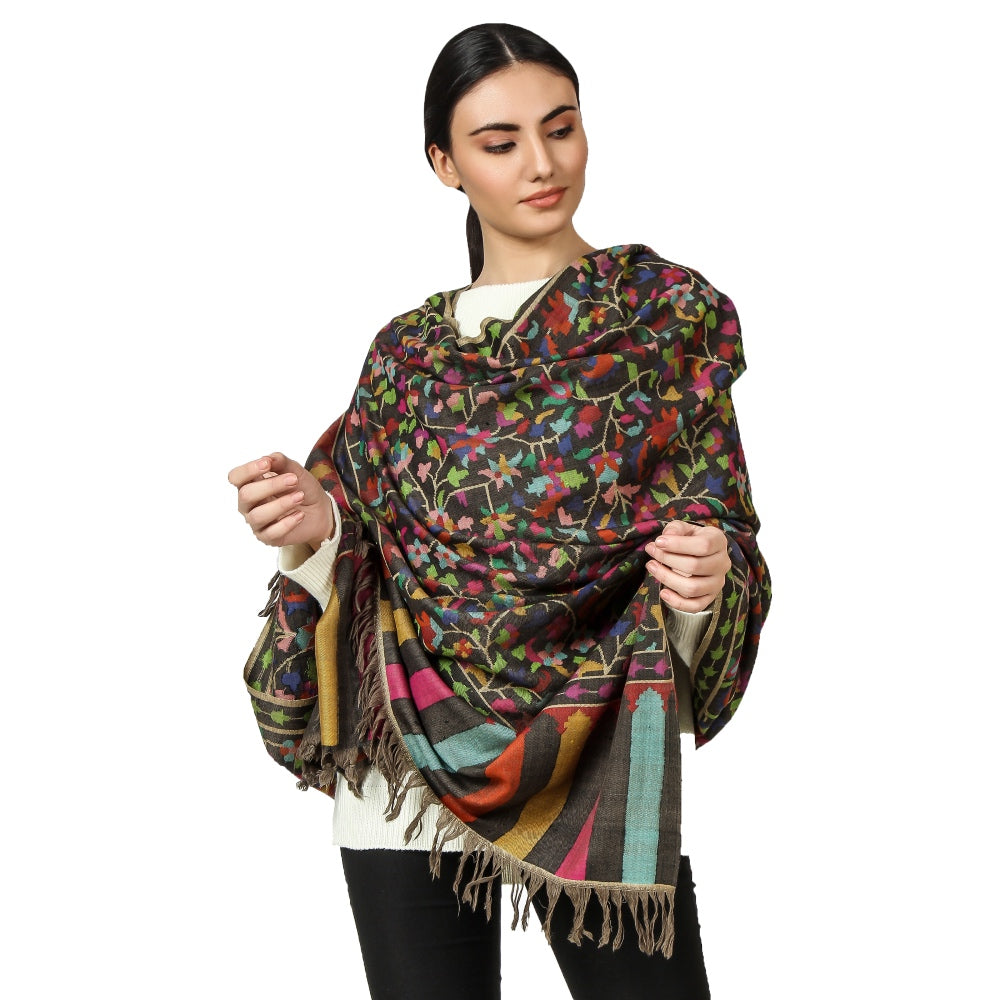
In Kani weaving, the standard shuttle is replaced by dozens — sometimes hundreds — of small, tapered wooden needles called tujis (commonly referred to as kanis, which gives the technique its name). Each tuji carries a different coloured yarn. To create the pattern, the weaver introduces each coloured yarn into the weave at precise points, interlocking them at colour boundaries so that the pattern is structurally woven into the fabric rather than embroidered onto its surface.
For a moderately complex Kani pattern, between 75 and 100 tujis are in use simultaneously. For highly intricate designs — the kind associated with master-level Kani shawls — the number of active tujis can reach 200 to 1,000 or more, all being managed by a single weaver working from a coded design instruction.
🪡 The Kani Numbers in Context
A simple Kani shawl requires 55 hours of spinning and 1,080 hours of weaving — a total of 1,141 hours before finishing. At 8-hour working days, that is 142 working days — nearly five months — for one artisan, on one shawl, of simple design complexity. Master-level Kani shawls with dense all-over patterns can take 2 to 3 years.
The Talim: Kani's Coded Language
Kani weaving is executed from a coded design notation called a talim. The talim is the bridge between the designer's visual concept and the weaver's physical execution — without it, Kani weaving at any level of complexity would be impossible to reproduce with accuracy.
The Kani Design-to-Fabric Pipeline
The talim is a specialised notation — a row-by-row instruction set that specifies exactly which coloured tuji needle goes over or under which warp thread at every point in the design. It is not readable by the general public or even by most craftspeople. It is a coded language specific to Kani weaving, understood only by trained weavers and the Talim Masters who create it.
Historically, when multiple weavers worked together on a large carpet, one person would read the talim aloud while the others followed the instructions simultaneously — a form of call-and-response craft production. In Kani shawl weaving specifically, however, a single artisan works alone on a single loom, reading and executing the talim without assistance.
The talim is created by a Talim Master — a specialist coder who translates the Naqash's visual design into weaving instructions using Talim-Guru, a specialist software developed specifically for this purpose. Before this software existed, the translation was done entirely by hand on paper — an extraordinarily labour-intensive process that added weeks to the design phase.
The Naqash: Designer of Kani Patterns
The original design for every Kani shawl begins with a Naqash — a master designer who draws the pattern on graph paper, where each square of the grid corresponds to a specific warp-weft intersection in the finished weave. Naqash designs are typically inspired by natural forms — flowers, leaves, the buta (paisley) motif — as well as Persian court art and Mughal architectural ornamentation that entered Kashmiri design vocabulary during the Mughal period.
The Naqash role is hereditary — passed down within families just as weaving itself is. The number of active Naqash families in Kashmir today is small, and their accumulated design vocabulary — developed over centuries — represents a form of intellectual and artistic heritage as endangered as the weaving technique it serves.
Kani weaving is taught through family transmission — a father to son tradition that has continued without formal institutional support for centuries. The knowledge does not exist in textbooks or curricula. It exists in the hands and memories of the roughly 2,000 master weavers still practising in Kashmir today.
That number — approximately 2,000 — represents the entire global population of people who can execute this technique at master level. It is not growing. The economic precarity of craft production, the slow pace of Kani work relative to its earnings, and the absence of formal apprenticeship pathways have made transmission increasingly fragile. Each master who retires without passing the skill forward represents a permanent reduction in a capability that no institution can recreate from scratch.
The Full Labour Accounting: Hours by Product Type
The table below represents the complete labour investment in each Pashmina product type — from spinning through to finishing. Every figure here is drawn from active production in Kashmir and represents the honest cost of genuine Pashmina in human time.
| Product | Spinning | Weaving | Embroidery | Finishing | Total Hours | Working Days (8hr) |
|---|---|---|---|---|---|---|
| Plain Pashmina Scarf | 24 hrs | 30 hrs | — | 6 hrs | 60 hours | 7.5 days |
| Full Plain Pashmina Shawl | 43 hrs | 54 hrs | — | 6 hrs | 103 hours | 13 days |
| Light Sozni Embroidered Shawl | 43 hrs | 54 hrs | 130 hrs | 6 hrs | 233 hours | 29 days |
| Heavy Sozni Embroidered Shawl | 43 hrs | 54 hrs | 480 hrs | 6 hrs | 583 hours | 73 days |
| Kani Shawl (simple pattern) | 55 hrs | 1,080 hrs | — | 6 hrs | 1,141 hours | 142 days |
Why This Process Cannot Be Industrialised
The question of why Pashmina production has not been mechanised — given that industrial textile production has existed for over two centuries — deserves a direct answer, because the answer is not romanticism or cultural resistance. It is a set of hard physical and technical constraints.
- The fibre cannot be machine-spun. At 12–14 microns, Pashmina breaks under the mechanical tension of industrial spinning. The yindeer and the human hand are not tradition — they are the only viable technology for this fibre diameter.
- The warp cannot be machine-set at this thread count. 1,200 to 2,400 individual threads, each requiring precise, consistent tension — the warping process involves judgment calls that machine automation has not yet replicated at the scale and precision Pashmina requires.
- The Kani pattern cannot be machine-woven. The tuji needle system — with up to 1,000 individual needles active simultaneously, each placed at specific warp positions according to a coded instruction — has no industrial equivalent. Power looms can produce jacquard patterns, but not at the thread density, fibre fineness, and pattern complexity of master-level Kani weaving.
- The finishing cannot be rushed. The washing and finishing stage that produces Pashmina's softness is a physical process dependent on time, water temperature, and manual handling. Compressing it damages the fibre.
Each of these constraints is not a problem waiting for a technological solution. They are the natural limits of the material and the process. They are also, collectively, the reason the finished product is what it is — and the reason no cheaper imitation can replicate it.
To explore the finished products that emerge from this process, visit the Pashwrap collection — including our Kani Shawls, each produced by master weavers in Kashmir in extremely limited numbers. For the full cost breakdown of what this process represents in financial terms, read our article Why Is Kashmiri Pashmina Expensive? For guidance on authenticating a Pashmina product, read How to Identify Fake Pashmina.