
What Is a Cashmere Scarf?
Everything a serious buyer needs to know — what cashmere actually is, how quality is measured, what most buyers get wrong, and how to buy one that lasts a lifetime.
The words "cashmere scarf" appear on thousands of products at prices ranging from $15 to $500. They are not all the same thing. In most cases, they are not even the same category of product. The word "cashmere" on a label tells you almost nothing without knowing the fibre's origin, its micron count, its processing method, and the construction of the finished piece.
This guide answers the question completely — what a genuine cashmere scarf is, how it is made, what the quality indicators are, what size you actually need, and what mistakes most buyers make that leave them with something that will pill and fade within a season. By the end, you will have everything you need to make the right decision once and not revisit it.
1. What Cashmere Actually Is
Cashmere is the fine undercoat of the Capra hircus goat — a soft, insulating layer of fibre that grows beneath the coarser outer guard hair. The international standard for cashmere, ISO 17751, defines it as fibre from this species with a mean diameter of ≤19 microns and a coarse fibre content of no more than 3%.
It is produced across a wide geographic range — Mongolia, China's Inner Mongolia, Iran, Afghanistan, and India. The fibre diameter, softness, and quality vary significantly by region and breed, primarily determined by altitude and climate.
Why Pashwrap Cashmere Scarves Are Different
The cashmere scarves in the Pashwrap collection are not standard commercial cashmere. They are made from Changthangi Pashmina-grade fibre — sourced from Changthangi goats grazing on the Changthang plateau in Ladakh, India, at altitudes between 4,000 and 5,000 metres above sea level.
This fibre measures 12–14 microns in diameter — substantially finer than the ≤19 micron ISO cashmere standard, and finer than the vast majority of commercial cashmere on the market. The practical consequences of this difference are not cosmetic: finer fibre means lower bending rigidity, which produces a fundamentally different drape and softness that standard cashmere cannot match at equivalent weight.
🔬 Why Microns Matter in a Scarf
Bending rigidity in textile fibre scales with the fourth power of fibre radius. Reducing diameter from 17 microns (standard commercial cashmere) to 13 microns (Pashwrap grade) — a 24% reduction in diameter — reduces bending rigidity by approximately 59%. This is the physical basis for why Pashwrap cashmere scarves drape, move, and feel the way they do. It is not marketing. It is fibre physics.
We use the word "cashmere" in our product descriptions because it is the term buyers in the US and Europe recognise and search for. What is in the scarf, however, is technically Pashmina — the finest subset of cashmere, governed by India's BIS IS 17269 standard, hand-spun and hand-woven in Kashmir. For the full scientific breakdown of the distinction, see our article Pashmina vs Cashmere: Scientific Breakdown.
2. The Size Guide: Scarf, Wrap, or Shawl?
One of the most consistent sources of confusion in the cashmere market is the terminology around sizing. "Scarf," "wrap," "stole," and "shawl" are used interchangeably by many brands — sometimes deliberately, to make smaller pieces appear more substantial. Here are the precise definitions and dimensions used at Pashwrap.
📐 The Pashwrap Standard Size
Pashwrap produces one size of cashmere scarf/wrap: 28 inches × 80 inches (70 × 200 cm). This is the most versatile dimension in the cashmere category — wide enough to wear as a shoulder wrap, long enough to drape fully, and fine enough to fold compactly. We made a deliberate decision to perfect one size rather than produce multiple sizes at variable quality.
3. The Weave: Why Diamond Weave Matters
Most buyers focus on fibre quality — and rightly so. But the weave structure of a cashmere scarf is the second critical quality variable. It determines how the finished fabric looks, how it feels against the skin, how it drapes, and how it ages with wear. Not all cashmere scarves are woven — many are knitted, which is a fundamentally different construction with different properties.
Knitted Cashmere
Machine or hand-knit construction
Plain Weave
Standard handloom construction
Diamond Weave ★ Pashwrap
Cheshme Bulbul — Kashmiri handloom
Cheshme Bulbul — The Eye of the Nightingale
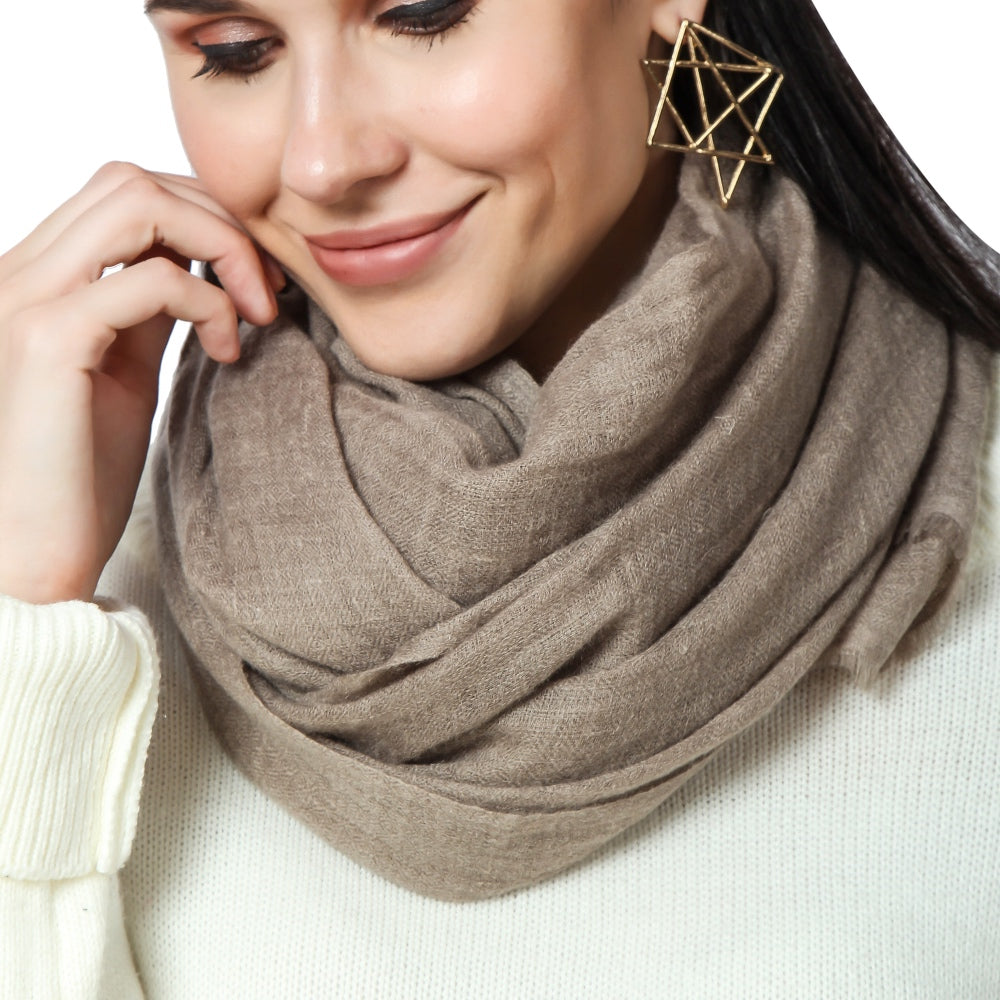
The diamond weave used in Pashwrap cashmere scarves has a Kashmiri name: Cheshme Bulbul — literally "eye of the nightingale." It is a traditional pattern specific to Kashmiri handloom weaving, where the interlacing structure of warp and weft threads creates a continuous diamond-shaped motif across the entire fabric surface.
It is not an embellishment. It is the weave itself — the structure of the cloth. Every diamond in the pattern is formed by the weaver's hands on the khaddi loom, not by any machine process. This is why two Pashwrap scarves will never be absolutely identical — the diamonds carry the subtle variation of hand production, which is also why they look the way they do under light.
Cheshme Bulbul — Eye of the Nightingale. A pattern woven by hand, in Kashmir, into every Pashwrap scarf.
4. The Five Mistakes Most Buyers Make
After years of working directly in the Pashmina and cashmere supply chain, the mistakes buyers make are consistent and predictable. None of them are the buyer's fault — they are the result of an industry that has systematically obscured quality information to make inferior products easier to sell.
Not Checking Micron Count
The single most important quality indicator in cashmere is fibre diameter — measured in microns. Most buyers never ask about it because most sellers never mention it. A scarf labelled "100% cashmere" can legally contain fibre anywhere from 15 to 19 microns — a range that produces dramatically different softness, drape, and longevity. Pashwrap cashmere is 12–14 microns. Always ask for the micron count before purchasing any cashmere product above $50.
Confusing Knitted with Woven Cashmere
Knitted and woven cashmere are different products with different properties. Knitted cashmere — the most common construction — is stretchier, often thicker, and more prone to pilling over time. Woven cashmere on a handloom produces a finer, more structured fabric with superior drape and longer life. Most buyers cannot tell the difference at point of purchase, and most product descriptions do not explain it clearly. If the description does not specify woven or knitted, ask.
Buying "Cashmere Blend" Without Reading the Blend
"Cashmere blend" is one of the most misleading terms in the textile market. A product labelled "cashmere blend" can legally contain 5% cashmere — the remaining 95% may be acrylic, viscose, or cheap sheep wool. The cashmere content percentage is almost never prominently displayed. If it is not disclosed clearly and completely, assume the cashmere content is low. A blend is not inherently dishonest — but it is not cashmere.
Using Price as the Only Quality Signal — in Both Directions
The first mistake is buying cheap cashmere because it seems like good value — a $30 cashmere scarf has input costs that do not support genuine fine cashmere fibre. The second, less obvious mistake is assuming an expensive price from a major luxury brand guarantees superior fibre quality. Many luxury brands charge significant premiums for branding rather than fibre — a $400 branded cashmere scarf is not automatically superior in fibre quality to a $200 scarf from a transparent direct-source producer. Price is a signal. It is not proof.
Treating It as a Seasonal Product
The most common category mistake buyers make is thinking of a cashmere scarf as a winter-only product. Genuine fine cashmere — particularly at 12–14 microns — is breathable, lightweight, and temperature-regulating. It is as appropriate in spring and autumn as it is in winter. Buying it as a seasonal product means most buyers underuse a piece that, at this quality level, should be worn year-round. This mistake usually stems from experience with heavier knitted cashmere rather than fine woven pieces.
5. Is a Cashmere Scarf Only for Winter?
No. And this is one of the most important things to understand about fine cashmere before purchasing.
Genuine cashmere at 12–14 microns is a temperature-regulating fibre. Its extremely fine structure — near-zero medullation, flat cuticle scales, high breathability — means it traps warmth efficiently in cold air and allows moisture vapour to escape when the body generates heat. It does not hold heat the way synthetic insulation does. It responds to the body.
A Pashwrap cashmere scarf weighing 95–105 grams is fine enough to be worn against bare skin in mild weather without overheating, and warm enough to provide meaningful protection against cold wind in winter. This is not a claim about a specific temperature range — it is the natural consequence of the fibre's thermal physics at this diameter and weight.
📅 Four-Season Wearability
Winter: Genuine warmth against cold air. Layered under or over a coat.
Autumn / Spring: Perfect for variable temperatures — warm enough for cool mornings, breathable enough for mild afternoons.
Summer evenings: Air-conditioned environments, evening occasions, travel. A fine cashmere scarf at 95–105g is one of the most practical travel accessories for exactly this reason.
Formal occasions year-round: The drape and elegance of a handwoven cashmere scarf has no seasonal restriction.
The perception of cashmere as winter-only typically comes from experience with heavier, machine-knitted cashmere products — which are bulkier and less breathable. A fine, hand-woven piece at 12–14 microns behaves differently. Wearing it is the easiest way to understand why.
6. Colour, Dye, and What Safe Means
Cashmere fibre takes dye exceptionally well — its protein structure and near-zero medullation rate produce uniform, rich colour absorption without the patchy results seen in coarser or more medullated fibres. For buyers, the important question is not whether cashmere dyes well but what kind of dye is used.
All Pashwrap cashmere scarves are dyed using natural dyes and AZO-free synthetic dyes. AZO dyes — the most commonly used industrial dyes in the global textile market — contain nitrogen compounds that can break down into potentially harmful aromatic amines under certain conditions. AZO-free means these compounds are not present.
| Dye Type | What It Is | Pashwrap Position |
|---|---|---|
| Natural dyes | Plant, mineral, or insect-derived. Traditional in Kashmiri textile production. | ✅ Used |
| AZO-free synthetic dyes | Modern synthetic dyes that produce consistent, vibrant colour without harmful AZO compounds. | ✅ Used |
| AZO synthetic dyes | Standard industrial dyes containing nitrogen compounds that may break down into harmful amines. | ❌ Not used |
| Chemical softeners | Added to artificially replicate softness in lower-grade fibre. Washes out over time. | ❌ Not used |
This matters particularly for buyers in the EU, where REACH regulations restrict certain AZO dyes, and for buyers purchasing for sensitive skin. A cashmere scarf worn against the neck and face should contain nothing that requires chemical qualification.
7. How to Care for a Cashmere Scarf
The longevity of a genuine cashmere scarf — which, at this quality level, should last decades — depends almost entirely on care. The fibre itself is resilient. The mistakes happen in washing and storage.
Hand-wash in cool water only
Use cool or lukewarm water — never hot. Hot water causes the fibre's cuticle scales to interlock and felt irreversibly. A mild, pH-neutral detergent or specialist cashmere wash is sufficient. Never use biological detergents containing enzymes — they digest protein fibres.
Press gently — never wring or twist
After washing, press the water out gently between your palms. Wringing or twisting stretches the fabric and distorts the weave structure. The diamond weave of a Pashwrap scarf is particularly vulnerable to mechanical distortion when wet.
Dry flat in shade
Lay the scarf flat on a clean, dry towel in a shaded area. Never hang to dry — a wet cashmere scarf will stretch significantly under its own weight. Never tumble dry. Avoid direct sunlight, which can fade natural and AZO-free dyes over time.
Store folded, not hung
Store cashmere folded in a breathable cotton bag or drawer. Never hang cashmere long-term — it stretches at the shoulders or hanging point over time. For seasonal storage, a cedar block or lavender sachet in the bag provides natural moth deterrence without chemical damage to the fibre.
Deal with pilling correctly
Genuine fine cashmere at 12–14 microns has high resistance to pilling. If minor pilling occurs in areas of friction (under the arm, where a bag strap rests), use a cashmere comb or fabric shaver on the lowest setting. Never pull pills off by hand — this pulls live fibres from the weave.
For the complete care guide including stain treatment and long-term storage, see our Pashmina Care Guide.
8. The Buyer's Quality Checklist
Before purchasing any cashmere scarf — from Pashwrap or any other source — run through this checklist. A seller confident in their product's quality will have clear, specific answers to every point.
9. What Makes a Pashwrap Cashmere Scarf Different
Every claim Pashwrap makes about its cashmere scarves is specific, verifiable, and rooted in the production reality documented across this knowledge base. Here is the complete picture in one place.
| Quality Factor | Pashwrap Cashmere Scarf | Standard Commercial Cashmere |
|---|---|---|
| Fibre origin | Changthangi goat, Changthang plateau, Ladakh | Variable — Mongolia, China, Iran, blended sources |
| Fibre diameter | 12–14 microns (BIS IS 17269) | 15–19 microns (ISO 17751 maximum) |
| Yarn construction | Single-ply, hand-spun on yindeer | Usually machine-spun, often plied |
| Weave type | Diamond weave (Cheshme Bulbul) on khaddi handloom | Usually machine-knitted or plain weave |
| Weight | 95–105 grams | Variable — often heavier due to coarser fibre |
| Size | 28" × 80" (70 × 200 cm) — one perfected size | Variable, often inconsistent |
| Dye | Natural and AZO-free only | Often standard AZO synthetic dyes |
| Chemical softeners | None — softness is fibre-native | Commonly used on coarser fibre to mimic softness |
| Supply chain | Direct — goat to spinner to weaver to buyer | Usually multiple undisclosed intermediaries |
The softness of a Pashwrap cashmere scarf is not added. It is the fibre. At 12–14 microns, it cannot be anything else.
To explore the full Pashwrap cashmere scarf collection, visit our Cashmere Scarves page. To understand the full production process behind every piece, read The Hand-Spinning & Weaving Process. To learn how to identify genuine cashmere from imitations, read our guide How to Identify Fake Pashmina.