
What Is Real Pashmina?
Most pashmina sold today is fake. This is how you know the difference — and why it matters.
Walk into any market from Jaipur to London, and you will find shawls labelled "100% Pashmina" selling for $20. The label is, in almost every case, a lie. The fabric is acrylic, or viscose, or a blended weave of machine-spun merino. The real thing — authentic Pashmina, woven by hand in Kashmir from the undercoat of a high-altitude Himalayan goat — is one of the rarest natural fibres on earth. And it looks almost identical to the fake unless you know precisely what to look for.
This article defines real Pashmina with precision: its biology, its geography, its production process, and the specific characteristics that distinguish it from every imitation. No fluff. No vague adjectives. Only the facts that matter.
1. The Definition: What Pashmina Actually Is
"Pashmina" is not a brand name, a marketing term, or a fabric category. It is a specific fibre: the ultra-fine undercoat of the Changthangi goat (Capra hircus laniger), a breed indigenous to the high-altitude plateau of Changthang in Ladakh, India — at elevations between 4,000 and 5,000 metres above sea level.
The word itself comes from the Persian pashm, meaning soft gold. That name reflects both its texture and its value — and the value is earned by the fibre's extreme fineness.
📐 The Number That Defines Real Pashmina
Authentic Pashmina-grade Changthangi cashmere measures between 12 and 14 microns in diameter. For context: a single strand of human hair averages 70 microns. Standard cashmere (already considered a luxury fibre) is certified at ≤19 microns. Pashmina is finer still — which is why it cannot be machine-spun without breaking.
This measurement is not a marketing claim. It is a physical property that can be verified by optical fibre diameter analysis (OFDA) or scanning electron microscopy (SEM) — the two laboratory-standard methods for authenticating cashmere fibre. There is no reliable home test that can distinguish genuine Pashmina from high-quality merino wool. Anyone who tells you otherwise is misinformed.
2. The Geography: Why Changthang Cannot Be Replicated
The Changthangi goat's fibre is extraordinarily fine for one reason: survival. The Changthang plateau experiences winter temperatures that regularly drop below −40°C. The goat's body responds by developing an undercoat — called pashm — of exceptional thermal efficiency. The finer the fibre, the more air it traps, and the more warmth it retains at minimal weight.
No other goat breed, on any other landscape, produces fibre at this micron count under natural grazing conditions. Attempts to breed Changthangi goats at lower altitudes have consistently resulted in coarser fibre — the cold is not incidental to the quality, it is the cause of it.
| Parameter | Changthangi Pashmina | Standard Cashmere | Merino Wool |
|---|---|---|---|
| Fibre diameter | 12–14 microns | 15–19 microns | 17–24 microns |
| Altitude of origin | 4,000–5,000m | Variable | Low altitude |
| Annual yield per animal | ~240g (raw) | ~500g (raw) | ~4,500g (raw) |
| Usable fibre after processing | 80–100g | ~250g | ~2,500g |
| Machine-spinnable? | No | Yes | Yes |
| Geographic restriction | Changthang, Ladakh | Central Asia / China | Global |
The data above reveals something critical: a single Changthangi goat yields only 80 to 100 grams of usable Pashmina fibre per year after the raw harvest (approximately 240 grams) has been dehaired, cleaned, and processed. A standard Pashmina shawl weighing 100 grams therefore requires the entire annual yield of one goat — sometimes more. This is not a romantic detail. It is the structural reason why genuine Pashmina cannot be cheap.
3. The Legal Status: India's Geographical Indication Tag
In 2013, authentic Kashmiri Pashmina was granted a Geographical Indication (GI) tag by the Craft Development Institute (CDI), Srinagar — the same body that oversees traditional Kashmiri craft authentication. A GI tag functions like a controlled appellation: it legally restricts use of the name to products that meet defined origin and quality standards.
Under the GI definition, authentic Pashmina must be: (a) made from the fibre of Changthangi goats of Ladakh, (b) hand-spun, and (c) hand-woven by artisans in Jammu & Kashmir. Any product that fails one of these three criteria — regardless of how it is labelled — is not legally entitled to the name Pashmina in India.
⚠️ The Enforcement Gap
The GI tag is legally robust inside India, but it has limited reach internationally. Retailers in the US, UK, and EU face no legal consequences for mislabelling viscose blends as pashmina. The responsibility for verification falls entirely on the buyer — which is why understanding the fibre itself matters more than trusting any label.
4. The Fraud Problem: What Is Actually Being Sold
The market for fake pashmina operates at industrial scale. Walk any tourist market in South Asia, or browse any mass-market e-commerce platform, and the pattern is consistent: scarves and shawls labelled "pure pashmina" or "100% cashmere pashmina" retailing for anywhere between $10 and $80.
Here is what those products typically are:
| What the Label Says | What It Often Is | Giveaway |
|---|---|---|
| 100% Pashmina | Viscose / rayon | Shiny surface, cold to touch, burns like paper |
| Pashmina-Silk blend | Synthetic blend | Excessive sheen, no warmth, frays unnaturally |
| Pure Cashmere Pashmina | Machine-spun merino | Uniform weave, too perfect, no variation |
| Cashmere blend | Acrylic or polyester | Pills heavily, melts when burned, no warmth retention |
| Handmade Pashmina | Machine-woven acrylic | No selvedge irregularity, identical fringe spacing |
The most sophisticated adulteration involves high-quality machine-spun merino wool — and this is where many experienced buyers are fooled. Fine merino (17–18 microns) is genuinely soft, genuinely warm, and visually similar to Pashmina when woven tightly. It is also entirely legitimate as a product in its own right.
Pashwrap sells Merino Wool Wraps that are clearly labelled as such — beautiful, warm, and honestly represented. The problem is not merino. The problem is when merino (or something worse) is sold as Pashmina.
5. How Authentic Pashmina Is Made: A Process That Cannot Be Faked
The reason authentic Pashmina cannot be mass-produced is not a matter of choice — it is a physical constraint imposed by the fibre itself. At 12–14 microns, Pashmina is too fragile for industrial machinery. The entire journey from fibre to finished shawl is done by hand. You can read the full process in our article How Pashmina Shawls Are Made, but here is the structural overview:
Combing — Changthang, Ladakh
Each spring, Changthangi goats naturally shed their undercoat. The pashm is combed out by hand — not sheared. This preserves fibre length and quality. Approximately 240 grams of raw pashm is collected per goat per season.
Dehairing — Specialist Processing
Raw pashm contains coarse guard hairs that must be removed before spinning. This dehairing process reduces the raw yield significantly. After cleaning and dehairing, only 80 to 100 grams of usable fine fibre remains per goat.
Hand-Spinning — Kashmir Valley
The cleaned fibre is spun by hand using a traditional wooden spinning wheel called a yinder. This is skilled work traditionally performed by Kashmiri women. Machine spinning is impossible at this micron count — the fibre breaks under mechanical tension.
Hand-Weaving — Traditional Looms
The spun yarn is woven on a hand-operated loom called a khaddi. A skilled artisan can produce approximately 6–7 inches of plain-weave Pashmina per day. A full shawl takes 3 to 4 days of continuous work for an experienced weaver.
Washing & Finishing
After weaving, the shawl is washed in cold river water with natural soaps to soften the fabric and set the weave. This finishing step is what produces the characteristic softness that defines high-quality Pashmina.
6. How to Authenticate Pashmina: What Actually Works
What Does Not Work
The internet is full of advice about home authentication tests — the ring test, the burn test, the pilling test. None of these can reliably distinguish genuine Pashmina from high-quality machine-spun merino wool, which is the most common sophisticated substitute. A fine merino scarf will pass a ring test. It will feel soft. It will behave similarly under flame. These tests were designed for an era before ultra-fine merino processing existed.
What Actually Works
There is one definitive method: laboratory fibre analysis. Specifically:
- OFDA (Optical Fibre Diameter Analysis): Measures average fibre diameter in microns. Authentic Pashmina will measure ≤14 microns. Merino wool will measure ≥17 microns.
- Scanning Electron Microscopy (SEM): Examines the scale pattern of individual fibres. Pashmina has a distinctive scale morphology that differs from all sheep wool breeds, including merino.
- DNA Fibre Testing: Emerging technology that can identify species origin at the genetic level. Not yet widely available commercially but represents the gold standard of the future.
💡 The Practical Buyer's Heuristic
If you cannot access lab testing, apply this rule: authentic Pashmina cannot be cheap. The math does not allow it. One goat, one year, 80–100 grams of usable fibre, all processed entirely by hand. A genuine Pashmina shawl from a credible source will retail from $200 upward. Anything below that threshold is, with very rare exception, not what it claims to be.
7. Pashmina vs. Cashmere: The Precise Distinction
All Pashmina is cashmere. Not all cashmere is Pashmina. This is the single most misunderstood distinction in the luxury fibre market.
"Cashmere" is a broad industry term for fibre from the Capra hircus species of goat, provided it meets the international standard of ≤19 microns diameter. It is produced across a wide geographic range — China, Mongolia, Iran, Afghanistan, and India — from numerous goat breeds and sub-breeds.
"Pashmina" refers specifically to cashmere produced from Changthangi goats in the Changthang region — fibre that measures 12–14 microns, which is substantially finer than the ≤19 micron cashmere standard. It is a subset of cashmere, defined by both geographic origin and fibre fineness.
The practical implication: a garment can legitimately be labelled "cashmere" and not be Pashmina. A garment labelled "Pashmina" that is not from Changthangi goats is mislabelled, regardless of how fine the alternative fibre may be.
8. The Characteristics of Authentic Pashmina
Because authentic Pashmina is beyond the reach of most buyers for independent laboratory testing, the following characteristics — while not individually definitive — collectively build a reliable picture when experienced together:
| Characteristic | Authentic Pashmina | Common Fake |
|---|---|---|
| Weight | Lightweight — surprisingly so for warmth | Either too heavy or too light |
| Warmth | Exceptional warmth-to-weight ratio | Warm only if thick/heavy |
| Texture | Soft with slight natural variation | Artificially uniform or slippery |
| Weave | Slight irregularities visible under light | Machine-perfect regularity |
| Fringe | Hand-knotted, slight variation in spacing | Machine-cut, uniform |
| Pilling | Minimal — high-quality fibre resists pilling | Heavy pilling within weeks of use |
| Drape | Fluid, moulds to the body naturally | Stiff or slides off the shoulder |
| Edge (selvedge) | Slightly uneven, organic | Machine-straight |
9. The Pinnacle: Kani Pashmina
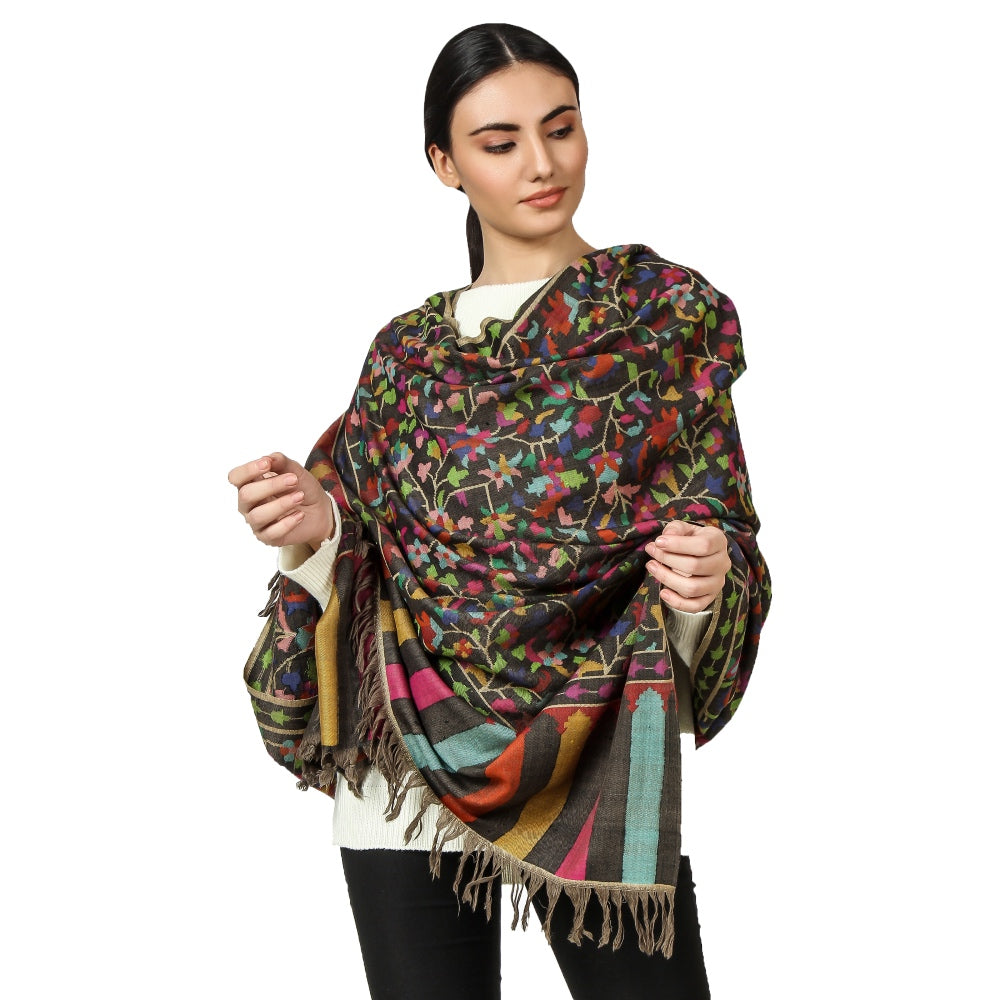
Within the world of authentic Pashmina, one category stands entirely apart: Kani weaving. A technique originating in the Kanihama village of Kashmir, Kani involves weaving intricate patterns directly into the fabric using small wooden needles (kanis) — no embroidery, no printing, no shortcuts. The pattern is part of the weave itself.
A single Kani shawl can take a master weaver between 6 months and 3 years to complete, depending on the complexity of the pattern. The number of artisans alive today with the skill to execute this technique is diminishing with each generation. These are not products. They are woven documents of a disappearing knowledge.
You can explore Pashwrap's Pashmina Kani Shawl collection — each piece is produced in extremely limited numbers and sourced directly from master weavers in Kashmir.
10. Caring for Authentic Pashmina
Because the fibre is so fine, Pashmina requires specific care to maintain its quality over time. We cover this in full detail in our Pashmina Care Guide, but the essential principles are these: hand-wash in cool water with a gentle detergent, never wring or twist the fabric, dry flat in the shade, and store folded (not hung) in a breathable bag. Authentic Pashmina, properly maintained, will last decades.
The Summary: Five Facts That Define Real Pashmina
It comes from one specific goat
The Changthangi goat of Changthang, Ladakh. No other source produces genuine Pashmina.
It measures 12–14 microns
Finer than standard cashmere (≤19µm), finer than any sheep wool. Verifiable only by laboratory analysis.
One goat yields only 80–100 grams of usable fibre per year
This scarcity is structural. It is why genuine Pashmina cannot be mass-produced or cheaply priced.
It must be hand-spun and hand-woven
The fibre is too fine for machine processing. The entire production chain is human.
It carries a GI tag
Registered in 2013 by the Craft Development Institute, Srinagar. A legal protection — though one with geographic limits.
Pashmina's value is not manufactured by marketing. It is earned — fibre by fibre, gram by gram, year by year — by the combined effort of a Himalayan goat, a plateau climate, and a lineage of Kashmiri craftspeople who have spent centuries mastering a process the rest of the world has never been able to replicate.