
What Is the Difference Between a Cashmere Scarf and a Cashmere Wrap?
Brands use these terms interchangeably. They are not the same thing. Here is exactly what each is, how they differ, and how to choose the right one for you.
If you have tried to buy a cashmere scarf or wrap online and found yourself confused by contradictory sizing, inconsistent terminology, and products that look the same but are described differently — you are not confused. The market is. Most brands use "scarf," "wrap," and "stole" interchangeably, attaching whichever term seems most appealing without any consistent definition behind it. The result is that buyers frequently purchase something that does not fit how they intended to wear it.
This article ends that confusion. It defines each product precisely — in dimensions, weight, construction, styling, and occasion — and gives you a clear framework for choosing the right one before you buy.
1. Why the Confusion Exists
The cashmere market has no enforced standard for what constitutes a "scarf" versus a "wrap." Unlike fibre diameter — where ISO 17751 sets a measurable threshold — there is no governing body that defines size categories for cashmere accessories. Brands set their own dimensions and apply their own labels.
The result is a market where a product measuring 70 × 180 cm might be called a "large cashmere scarf" by one brand and a "cashmere wrap" by another. A product measuring 28 × 80 inches might be marketed as a "scarf" in the US and a "stole" in the UK by the same manufacturer. None of these labels are technically wrong — which is exactly what makes them useless to a buyer trying to make an informed decision.
📋 The Three Terms You Will Encounter
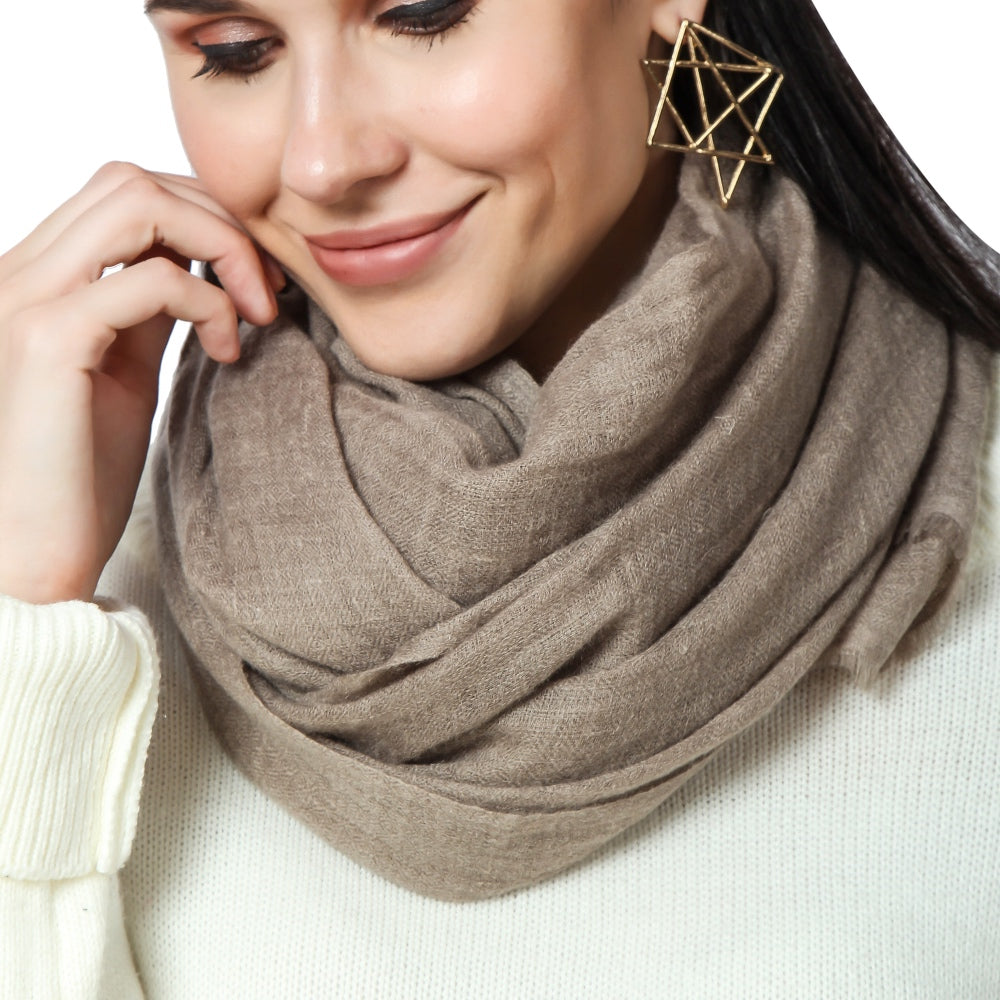
Scarf: Traditionally the narrower, shorter piece — worn primarily around the neck. Up to approximately 55 × 180 cm.
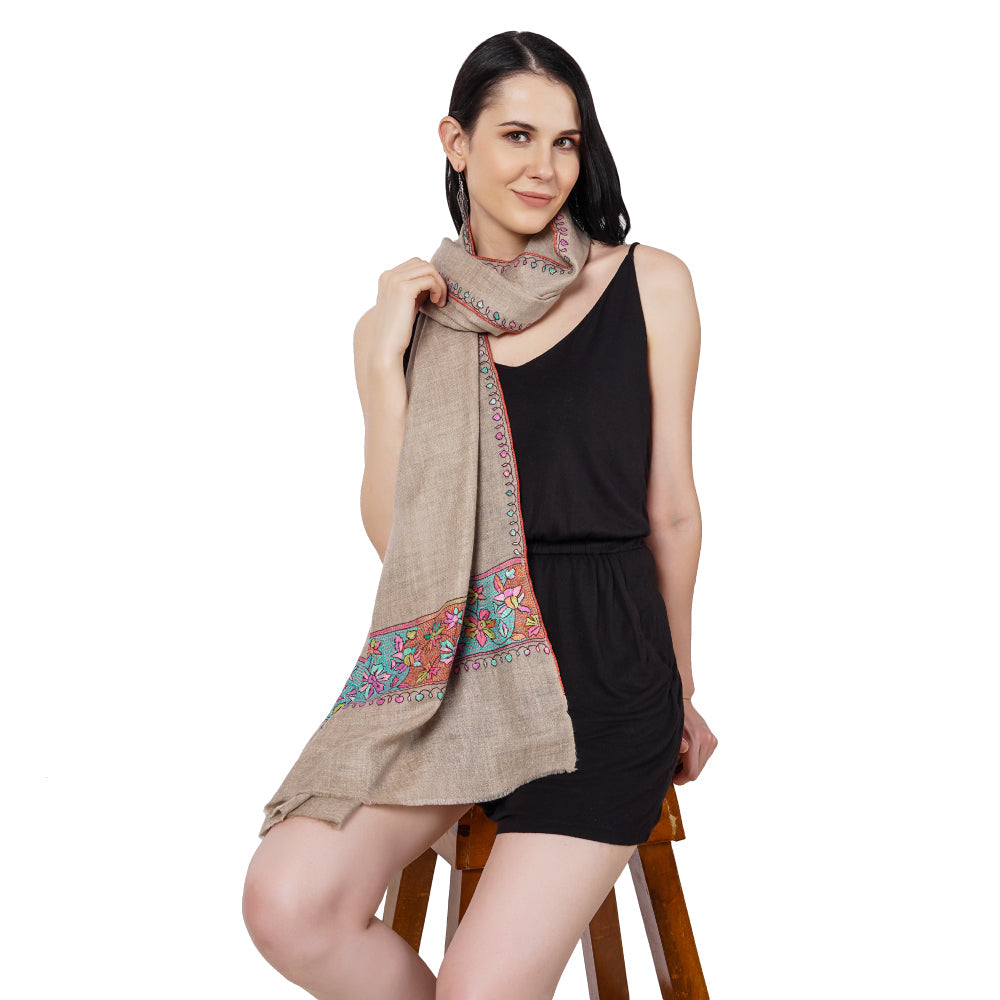
Wrap / Stole: The wider, more substantial piece — worn over the shoulders as well as around the neck. Typically 70–80 cm wide × 180–200 cm long. These two words mean the same thing and are completely interchangeable.
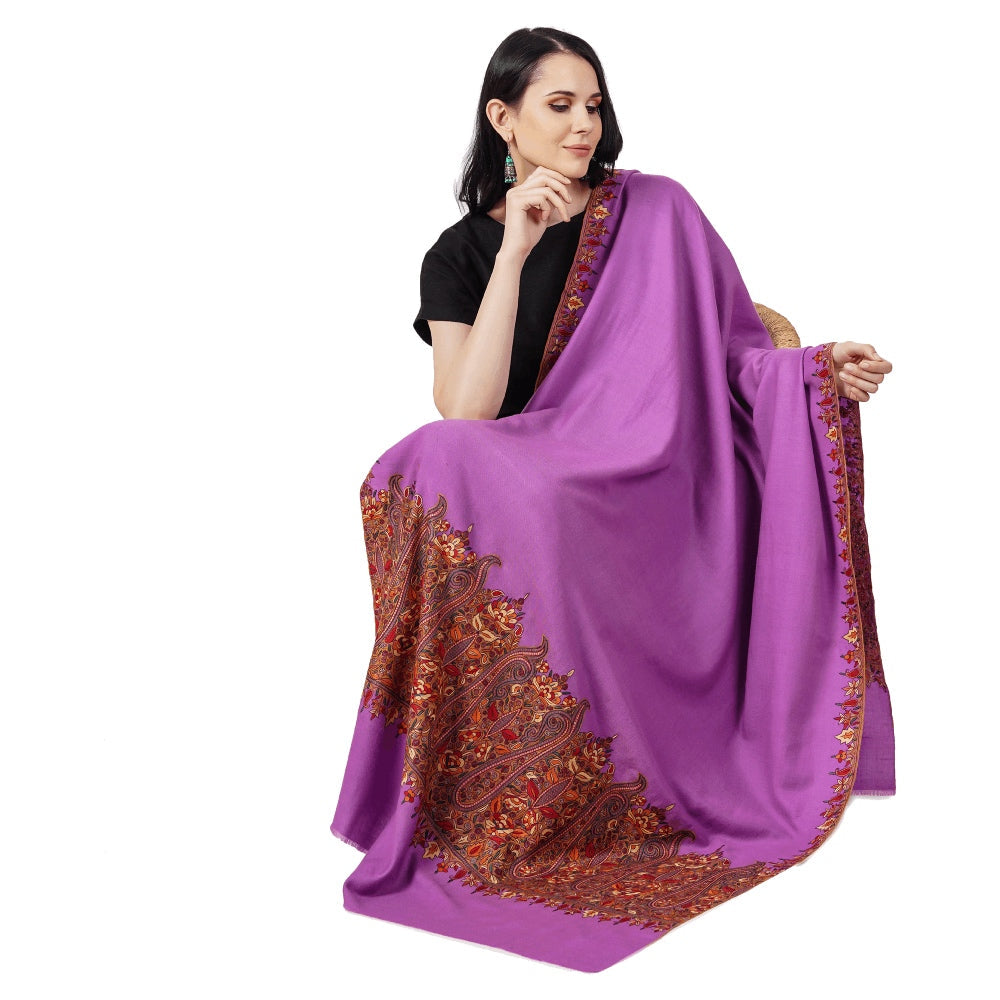
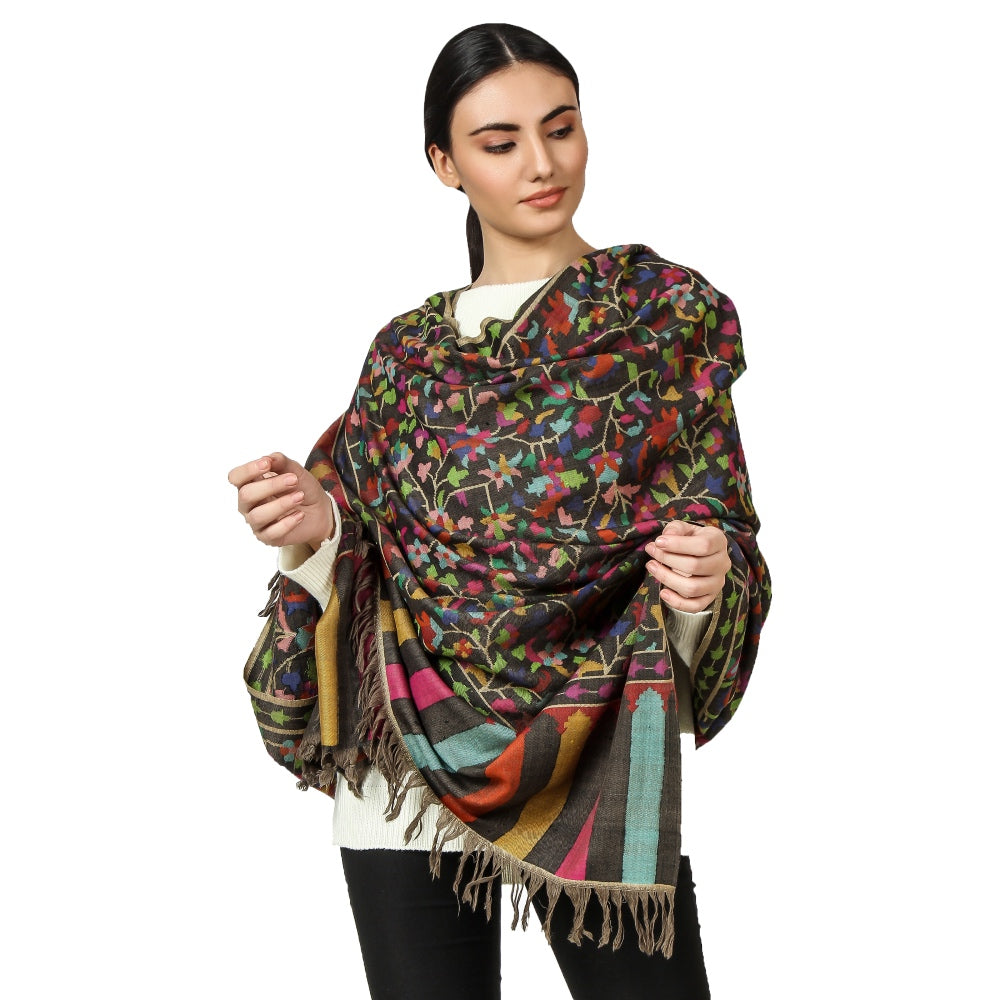
Shawl: The largest category — a full shoulder covering piece. Typically 100 × 200 cm (40 × 80 inches). Distinct from both scarf and wrap in size, weight, and how it is worn.
The confusion between scarf and wrap is genuine and understandable. The confusion between wrap and shawl is also common. This guide addresses all three — but focuses primarily on the scarf vs wrap distinction, which is where most purchasing mistakes happen.
2. Scarf vs Wrap: Side by Side
Width: Narrow — typically 45 to 55 cm. Designed to loop, fold, or drape around the neck without excess fabric.
Length: Up to 180 cm. Long enough to wrap once around the neck with ends hanging, or to loop with a knot.
Weight: Lighter — less fabric means a lighter finished piece at equivalent fibre quality.
Primary use: Neck accessory. Fits comfortably under a coat collar. Pairs naturally with tailored outerwear where a wider piece would create bulk.
Folding: Compact. Fits easily in a coat pocket or small bag.
Shoulder coverage: Not designed for it — too narrow to drape over shoulders with comfort or elegance.
Width: Wide — 70 to 80 cm. Wide enough to drape over both shoulders and cover the upper body, or to fold in half lengthwise and wear as a structured neck piece.
Length: 180 to 200 cm. Long enough to create a full shoulder drape with substantial length at the front.
Weight: Heavier than a scarf at equivalent fibre quality — more fabric, more grams.
Primary use: Multi-position — worn as a shoulder wrap, a loose shawl, a doubled neck scarf, or a travel blanket. The most versatile piece in the cashmere category.
Folding: Folds to a compact rectangle but takes more space than a scarf. Fits in a handbag or carry-on.
Shoulder coverage: Full — designed for it. The defining characteristic of a wrap vs a scarf.
3. The Size Spectrum — Visualised
The four main cashmere accessory sizes, arranged from narrowest to widest, with the functional implications of each dimension:
4. How Each Is Worn
Size is the structural difference. How each piece is worn is the practical one. The width of a cashmere piece determines which wearing positions are available — and width is the single variable that most clearly separates a scarf from a wrap.
How a Cashmere Scarf Is Worn
The Loop
Fold the scarf in half lengthwise, drape around the neck, and pull the ends through the loop created. Clean, structured, sits close to the neck. Works under a coat collar without bulk.
Works for: Tailored coats, office wear, formal outerwearThe Drape
Drape over the neck with both ends hanging at equal length at the front. The simplest wearing position. Elegant with a blazer or structured jacket.
Works for: Smart casual, blazers, light jacketsThe Wrap-Around
Loop around the neck twice, letting the ends hang. Creates warmth close to the throat — the most practical position for cold weather. A scarf's narrowness makes this position neat rather than bulky.
Works for: Cold weather, casual outdoor wear, travelHow a Cashmere Wrap Is Worn
The Shoulder Wrap
Draped over both shoulders with ends hanging at the front or crossed over the chest. The defining wearing position of a wrap — only possible at 70+ cm width. Creates an elegant, unhurried silhouette that a scarf cannot replicate.
Works for: Evening wear, formal occasions, summer evenings, indoor eventsFolded as a Neck Scarf
Fold the wrap in half or thirds lengthwise — it now behaves like a thick, substantial neck scarf with more body and presence than a scarf alone. A wrap worn this way has the same neck-covering function as a scarf, plus the option to unfold when more coverage is needed.
Works for: Any occasion where a scarf works, with added versatilityThe Travel Blanket
At 28 × 80 inches, a cashmere wrap covers the lap and torso on a plane, train, or in an air-conditioned space. At 95–105 grams of fine cashmere, it provides meaningful warmth at a weight and packed size that no conventional travel blanket can match.
Works for: Long-haul flights, train journeys, air-conditioned officesThe Evening Shawl
Draped loosely over the shoulders for formal or semi-formal occasions. At 28 inches wide, a cashmere wrap sits in the precise range between a scarf (too narrow for this position) and a full shawl (too wide for a lighter look). The most elegant middle ground.
Works for: Evening events, formal dinners, weddings, theatre📐 The Width Rule
A piece below 60 cm wide cannot drape over both shoulders with stability — it slides off. A piece above 60 cm wide can. This is the functional threshold between a scarf and a wrap, regardless of what the label says. When buying, measure the width before anything else.
5. Occasions — Which Piece for Which Situation
Cashmere Scarf — Best For
- Under a coat collar — fits without adding bulk
- Office and tailored daywear — neat, structured
- Cold weather neck warmth — loops close to the throat
- When carrying a small bag — more compact than a wrap
- Men's wear — the narrower proportion is more conventional
- Gift giving when size preference is unknown — less risk of fit issues
Cashmere Wrap — Best For
- Evening and formal occasions — shoulder drape is elegant
- Long-haul travel — doubles as a blanket
- Year-round versatility — functions as scarf, wrap, and light shawl
- Women's wear — the wider proportion suits more wearing positions
- Warmer climates — shoulder drape adds elegance without neck warmth
- Anyone who wants one piece that does everything
6. Weight and What It Means
At identical fibre quality and weave density, a wider piece will weigh more — simply because it contains more fabric. A 28-inch wide wrap at 95–105 grams of Pashmina-grade cashmere is heavier than a 22-inch scarf of the same fibre, because the wrap contains more material across its width.
This is worth understanding because weight affects how the piece behaves when worn:
| Property | Lighter Scarf | Heavier Wrap |
|---|---|---|
| Drape when worn | Falls closer to the body — less movement | Falls with more fluid motion — more drape |
| Shoulder stability | Slides off — not enough weight to anchor | Sits on shoulders with natural weight |
| Warmth | Good neck warmth | Neck and upper body warmth |
| Pack size | Smaller — fits in a coat pocket | Slightly larger — fits in a bag |
| Versatility | 3–4 wearing positions | 5–6 wearing positions |
| Year-round use | Primarily autumn to spring | All four seasons |
⚖️ The Weight Nuance at Pashmina Grade
At 12–14 micron Pashmina-grade cashmere, the weight difference between a scarf and a wrap is less significant than it would be at standard commercial cashmere grades. The extreme fineness of the fibre means that even a 28-inch wide wrap at 95–105 grams is substantially lighter than a standard cashmere scarf of equivalent width made from 17–19 micron fibre. The wrap is wider — but it is not heavier in the way a heavier-grade cashmere would make it feel.
7. Which One Should You Buy?
The right answer depends entirely on how you intend to wear it and what you need it to do. Use this framework to decide.
If you want one piece that does everything — neck, shoulder, travel, formal, casual — choose a wrap.
If you want the most compact, understated neck accessory — choose a scarf.
8. Why Pashwrap Makes One Size — and Why That Size Is a Wrap
Most cashmere brands offer multiple sizes across their range — narrow scarves, medium scarves, wraps, stoles, shawls — at varying price points. Pashwrap does not. We produce one size of cashmere scarf and wrap: 28 inches × 80 inches (70 × 200 cm). It is worth explaining why.
The decision was deliberate and came from a specific observation: the most common complaint about cashmere scarves is that they are not as useful as expected. Buyers purchase a narrow scarf for versatility and find it cannot do what they imagined. They wanted shoulder coverage but bought a neck-only piece. They wanted a travel blanket but bought something too narrow to cover their lap.
The 28 × 80 inch dimension solves this. It is the precise size at which a single piece crosses the threshold from neck accessory to full shoulder wrap — wide enough to drape over both shoulders with stability, long enough to create elegant front fall, fine enough at 95–105 grams of 12–14 micron Pashmina-grade cashmere to fold compactly into a bag.
It wears as a neck scarf when folded. It wears as a shoulder wrap when opened. It functions as a travel blanket on a long-haul flight. It is appropriate at a formal dinner and at a Sunday market. This range of function in a single piece — at a single size — is what we set out to produce.
We did not make multiple sizes because doing one size exceptionally well is harder and more honest than producing multiple sizes at variable quality. Every Pashwrap cashmere scarf and wrap is the same piece — the same fibre, the same diamond weave (Cheshme Bulbul), the same hand-spinning and hand-weaving process, the same 28 × 80 inch dimension. The only variable is colour.
📐 The Pashwrap Cashmere Wrap — At a Glance
Size: 28" × 80" (70 × 200 cm)
Weight: 95–105 grams
Fibre: Changthangi Pashmina-grade cashmere — 12–14 microns
Weave: Diamond weave (Cheshme Bulbul) on khaddi handloom
Yarn: Single-ply, hand-spun on yindeer
Dye: Natural and AZO-free only
Wearing positions: Neck scarf, shoulder wrap, travel blanket, evening shawl, folded neck piece
To explore the Pashwrap cashmere scarf and wrap collection, visit our Cashmere Scarves page. For the complete guide to what makes genuine cashmere worth buying, read our article What Is a Cashmere Scarf? The Complete Buyer Guide. To understand how to identify genuine cashmere from imitations before purchasing anywhere, read How to Identify Fake Pashmina.