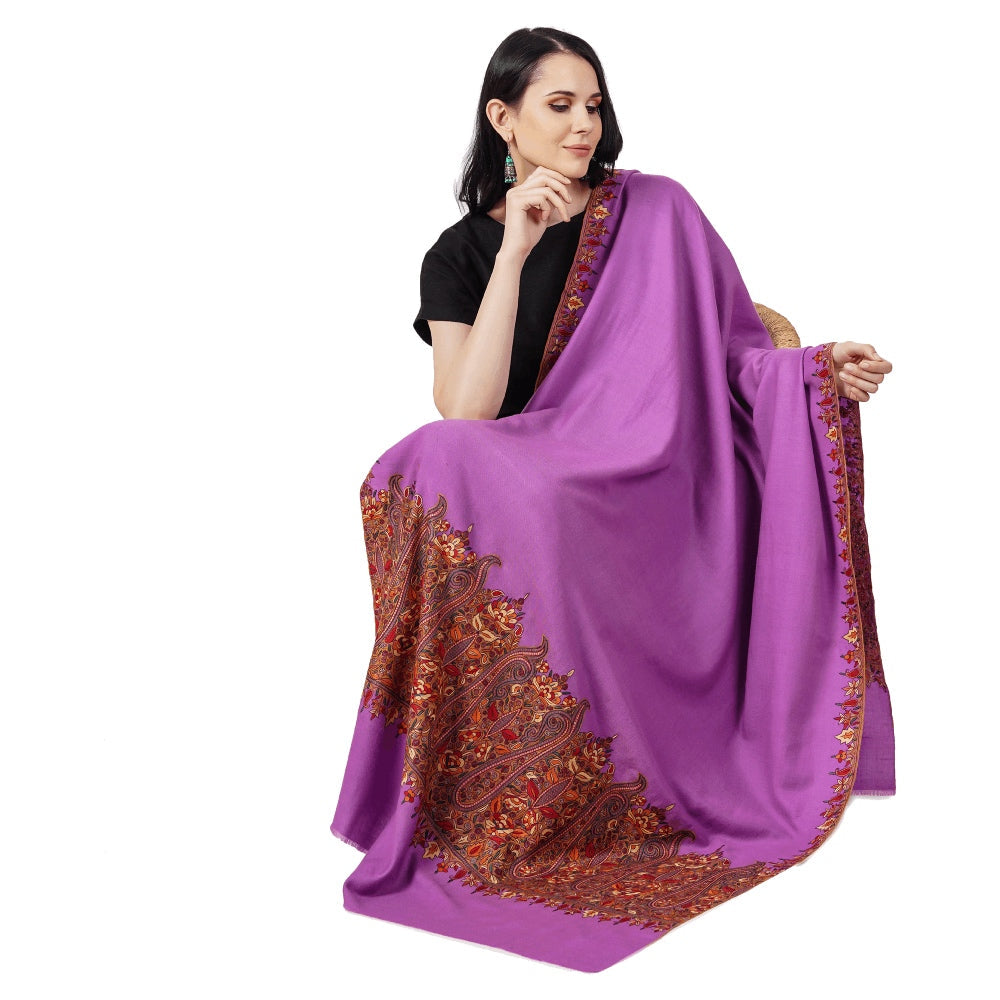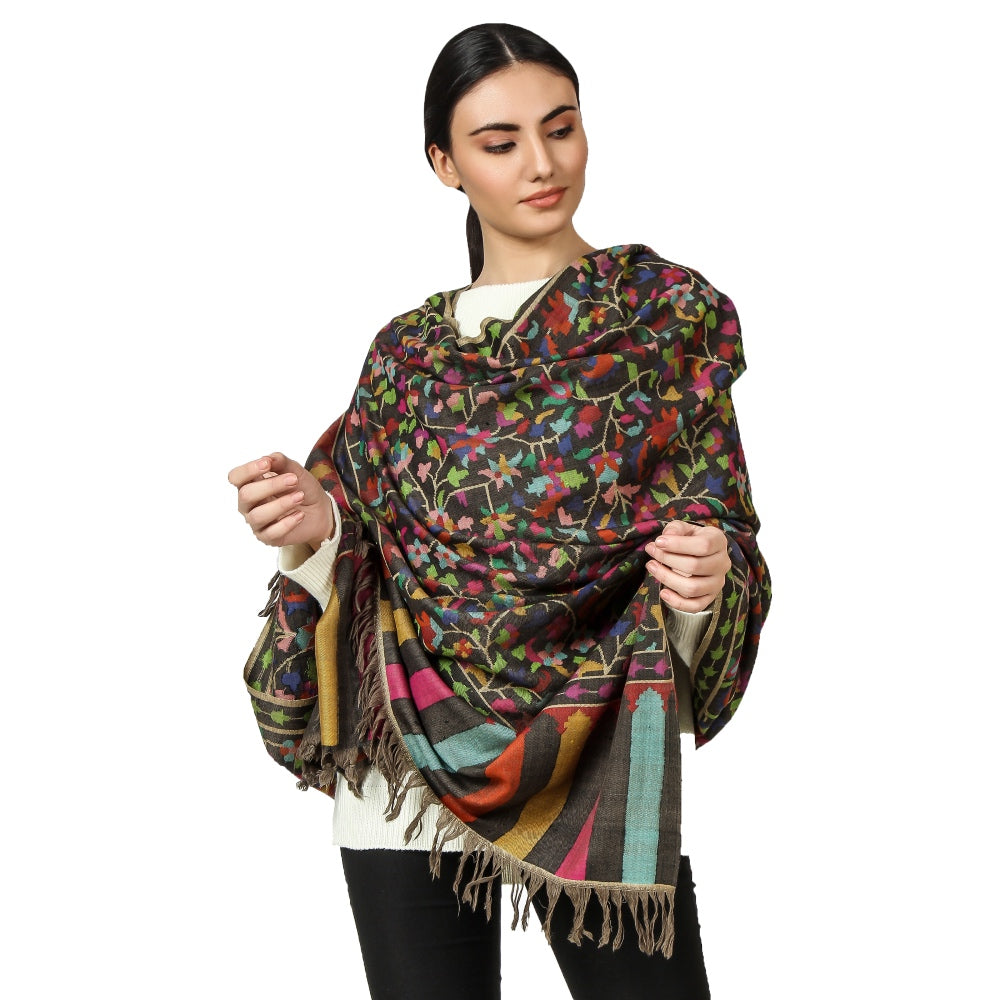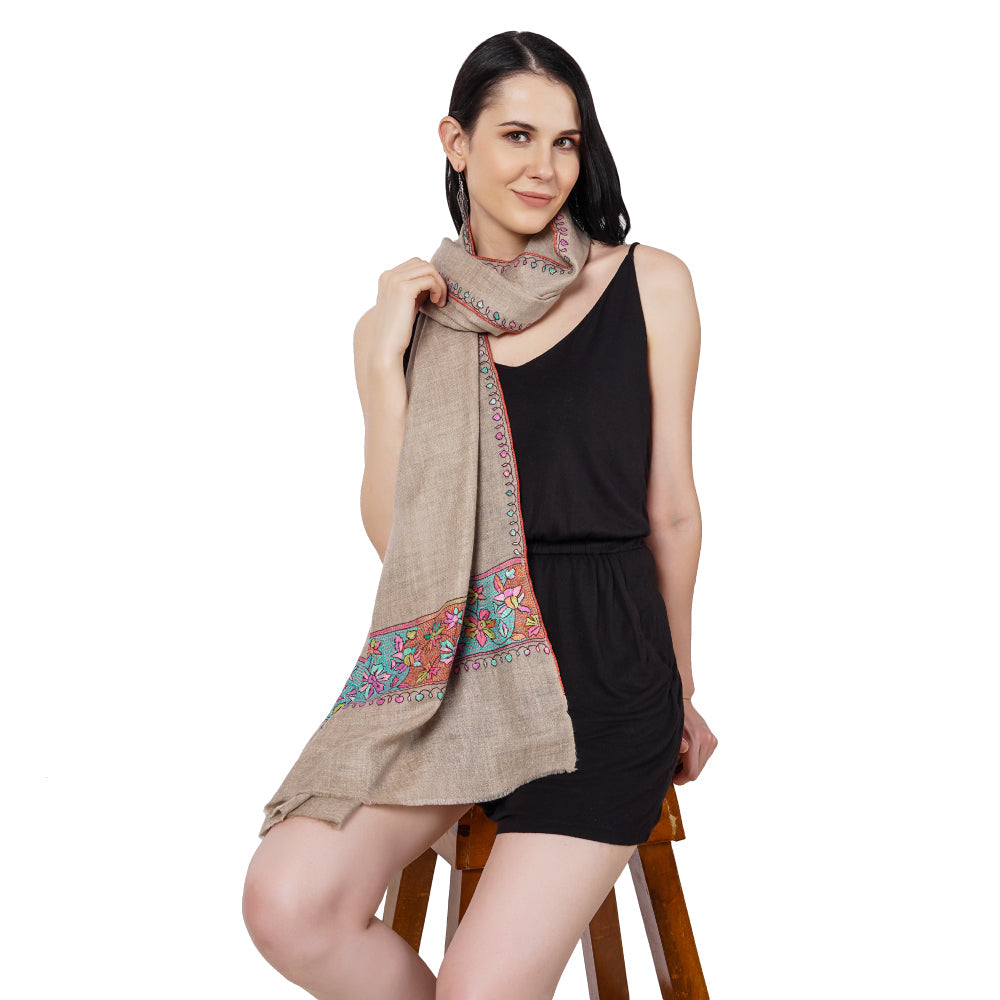

What Makes Kashmiri Cashmere Special?
The fibre, the history, the artisan tradition, and the honest answer to why Kashmir-made cashmere is not the same product as cashmere made elsewhere — even when the label says the same thing.
Every cashmere-producing country makes a claim on the word. China produces the most cashmere by volume. Mongolia has built a strong reputation for consistent quality. Iran has a long domestic tradition. Scotland processes and finishes cashmere with centuries of mill expertise. Each has its place in the global cashmere story.
Kashmir is different. Not because of national pride, not because of marketing, and not because of the GI tag — though the GI tag exists for a reason. Kashmir is different because of three things that cannot be replicated anywhere else on earth: the specific fibre that comes from the Changthang plateau, the specific artisan knowledge that has been developing in the Kashmir Valley for five centuries, and the specific combination of the two that produces something no other place in the world produces.
This article makes that case directly. The history, the fibre science, the craftsmanship, the honest comparison with other producing regions, and the fragility of the tradition — because understanding what makes it special is inseparable from understanding why it is at risk.
1. The Fibre — Finer Than Anywhere Else on Earth
The first thing that makes Kashmiri cashmere special is the raw material it starts with. The cashmere fibre used in Kashmir — pashm from the Changthangi goat of the Changthang plateau in Ladakh — is the finest naturally occurring cashmere on earth. This is not a claim. It is a measurement.
The Changthangi goat lives at 4,000 to 5,000 metres above sea level on one of the highest inhabited plateaus on earth. Winters reach −40°C. The extreme cold drives the animal's biology to produce the finest, densest undercoat it can — and at this altitude, that means fibre at 12 to 14 microns. This is not selective breeding or careful husbandry — it is the direct result of the environment the goat lives in. Take the same animal to lower altitude and within a generation the fibre coarsens. The fineness belongs to the place.
The practical consequence of this fibre advantage is not marginal. Because bending rigidity scales with the fourth power of fibre radius, the difference between 13-micron Pashmina and 16-micron Mongolian cashmere — just three microns — produces approximately a 60% reduction in bending rigidity. The Pashmina fibre is not slightly softer. It yields to the touch in a way that Mongolian cashmere, fine as it genuinely is, simply cannot match. And both sit well above standard Chinese commercial cashmere, which at 17 to 19 microns is approaching the prickle threshold where sensitive skin begins to register discomfort.
🔬 The Altitude–Fineness Relationship
The Changthang plateau sits 1,500 to 3,500 metres higher than the Gobi Desert — the next most significant cashmere-producing region. The cold-fineness relationship in cashmere is direct: the animal's biology produces finer undercoat fibre in proportion to the severity of the winter cold it must survive. At 4,500 metres in Ladakh, that mechanism produces fibre that is measurably and perceptibly finer than any other region. The altitude gap between Changthang and every other cashmere-producing region is not a geographic detail. It is the quality gap in the fibre.
2. Five Centuries of Unbroken Craft — The History of Kashmiri Pashmina
Kashmiri Pashmina is not a recent luxury product. It has a documented history stretching back five centuries — through the courts of the Mughals, across the trade routes of Central Asia, into the drawing rooms of Napoleonic France, and through the colonial period into the modern market. Understanding that history explains why the craft tradition in Kashmir is categorically different from cashmere production anywhere else.
"The Paisley pattern — one of the most recognised textile designs in the world — was created to imitate Kashmiri shawl designs on European power looms. The imitation became so widespread that the design lost its name. The original never needed one."
— Pashwrap3. Kashmir vs Mongolia vs China — The Honest Comparison
This is the question most buyers eventually ask, and it deserves a direct answer rather than diplomatic evasion.
Mongolia produces genuinely fine cashmere. The best Mongolian cashmere — from well-managed Gobi Desert herds — is a real, high-quality product at 15 to 17 microns. European luxury brands source from Mongolia with good reason. It is not Pashmina-grade, but it is excellent commercial cashmere and should be respected as such.
China produces the most cashmere in the world by volume. At its best — from highland herds in remote regions — Chinese cashmere approaches Mongolian quality. At its worst — from intensively farmed lowland operations — it is indistinguishable from coarse wool. The problem with Chinese cashmere is not that it is uniformly poor. It is that it is uniformly unlabelled by quality, and the same country label covers an enormous quality range.
Kashmir produces the finest cashmere fibre in the world and processes it using an artisan tradition that no other region possesses. The comparison is not simply one of fibre quality — it is one of fibre quality plus processing tradition plus centuries of accumulated craft knowledge operating together.
| Factor | Kashmir (Pashmina) | Mongolia | China |
|---|---|---|---|
| Fibre diameter | 12–14µm — finest on earth | 15–17µm — genuinely fine | 15–19µm — widely variable |
| Spinning method | Hand only — machine impossible at 12–14µm | Machine-spun — fibre diameter allows it | Machine-spun — most commercial production |
| Weaving tradition | 500-year khaddi handloom tradition — Kani, Cheshme Bulbul | Limited weaving tradition — primarily raw fibre export | Industrial weaving dominates — some artisan production |
| GI protection | Yes — BIS IS 17269, GI tag 2013 | No formal GI equivalent | No |
| Can fibre be machine-spun? | No — breaks under mechanical tension | Yes — standard industrial process | Yes |
| Craft heritage depth | Five centuries — Mughal court to present | Traditional nomadic — weaving not primary tradition | Variable — some genuine heritage, much industrial |
| Artisan community | Shrinking — endangered tradition | Herding community stable — processing elsewhere | Large industrial workforce — artisan community small |
| What you are paying for | Finest fibre + 500yr craft tradition + hand processing | Fine fibre + industrial processing | Variable fibre + primarily industrial processing |
The critical point in this comparison is not just that Kashmiri Pashmina fibre is finer — it is that the combination of fibre fineness and hand-processing tradition produces something that industrial processing of even fine Mongolian cashmere cannot replicate. Machine-spinning produces a different yarn structure from hand-spinning. Machine-weaving produces a different fabric surface from hand-weaving on a khaddi. The processing method is part of the product — not incidental to it.
A 16-micron Mongolian cashmere scarf machine-spun and machine-woven is a good product. A 13-micron Kashmiri Pashmina hand-spun on a yindeer and hand-woven on a khaddi is a different product — finer in fibre, different in construction, carrying a craft tradition in its structure that the machine product cannot contain.
4. The Craft Knowledge — What Five Centuries Builds
Craft knowledge is different from technical knowledge. Technical knowledge can be written down, taught in classrooms, and transferred between people efficiently. Craft knowledge lives in the hands. It is transmitted through years of practice under the supervision of someone who already has it — typically a family member, in a tradition passed from parent to child across generations.
In Kashmir, the craft knowledge embedded in Pashmina production is approximately five centuries deep. The spinner who knows the exact tension of Pashmina yarn without measuring it learned that knowledge from her mother, who learned it from hers. The weaver who maintains the Cheshme Bulbul diamond pattern across 40 hours of weaving without a mechanical guide is exercising knowledge that was developed over generations of weavers refining the same technique on the same loom type in the same valley.
The Spinner's Tension — Knowledge That Cannot Be Written
The correct drafting tension for Pashmina yarn — the balance between drawing speed and wheel speed that produces even, consistent yarn from 12–14 micron fibre — cannot be specified in any manual. It is a physical knowledge that lives in the fingertips of a trained spinner. A new spinner typically needs two to three years of daily practice before producing yarn of commercial quality. This knowledge exists nowhere else in the world at this fibre fineness.
The Kani Weaver's Pattern Memory
Kani weaving — the technique that produces Kashmir's most complex shawl patterns — uses small wooden bobbins called kani instead of a running shuttle, allowing the weaver to build pictorial patterns of extraordinary intricacy. A master Kani weaver works from a pattern code called a talim — a notation system specific to Kashmiri weaving — and can build patterns with hundreds of colour changes per row entirely from this notation and their own trained hands. Fewer than 2,000 master Kani weavers remain.
The Naqash — The Pattern Designer
In the traditional Kashmiri production chain, the Naqash is the pattern designer — the artisan who creates the original design that the weaver will execute. The Naqash translates visual patterns into the talim notation that the weaver reads. This is a specialist role that requires both artistic ability and a deep understanding of what is technically achievable on the khaddi loom. There are very few practicing Naqash families in Kashmir today, and most of their knowledge is not institutionally documented.
The Dyer's Colour Knowledge
Kashmir's traditional dye masters — working with natural dyes from regional plant and mineral sources — developed colour formulations and mordant combinations specific to Pashmina fibre over centuries of practice. The mordanting sequences that produce stable, deep colour in Pashmina without damaging the fine protein structure at 12–14 microns are not available in any published dye manual. They exist in the practice of the dyers who inherited them.
5. The Threatened Tradition — Why This Matters Now
Everything described above — the finest fibre, the five centuries of craft knowledge, the artisan community that carries it — is at risk. Not abstractly, not theoretically. Concretely, measurably, right now.
The economic mechanism of the threat is straightforward: if machine-made imitations can be sold at the same price as genuine handmade Pashmina — because most buyers cannot distinguish them and the market does not enforce the distinction — the economic argument for maintaining the genuine craft collapses. Why spend 60 hours hand-spinning and weaving a scarf if a machine can produce something labelled identically in 20 minutes?
The answer, of course, is that they are not the same product. The machine product does not have the fibre fineness, the yarn structure, the weave character, or the lifespan of the genuine article. But if the market does not value those differences — if buyers purchase on price and label without asking the questions that distinguish real from imitation — the distinction becomes economically invisible. And economically invisible distinctions, over time, disappear.
This is not a hypothetical future. It is the present trajectory. The master Kani weavers who remain are not being replaced at the rate they are retiring. The spinners who know the tension of Pashmina yarn are older than those who do not. The Naqash families who carry the pattern design knowledge are few, and almost none of that knowledge is institutionally documented. The clock is running.
6. Buying Genuine Kashmiri Cashmere Is a Preservation Decision
Understanding what makes Kashmiri cashmere special leads to a conclusion that goes beyond quality. When you buy a genuine Kashmiri Pashmina product — sourced directly from the artisan community, priced to reflect the actual cost of genuine production, labelled honestly — you are making an economic argument. You are saying, with your purchase, that the distinction between real and imitation has value. That the spinner's 24 hours deserves payment. That the weaver's 40-hour diamond pattern deserves recognition. That the Naqash's design knowledge deserves a future.
Kashmiri Pashmina has survived five centuries —
the Mughal court, the colonial period, the mass market.
What it has not survived yet is a buyer who does not know the difference.
Now you do.
To understand the fibre science behind why Kashmiri Pashmina at 12–14 microns is categorically different from commercial cashmere, read Pashmina vs Cashmere: Scientific Breakdown. To see the complete production process behind every Pashwrap scarf, read How Is a Cashmere Scarf Made? To explore the Pashwrap collection — sourced directly from the Kashmiri artisan community — visit Cashmere Scarves and Kani Shawls.