
Why Is Kashmiri Pashmina Expensive?
A precise cost breakdown of one of the world's rarest textiles — from a single Himalayan goat to a finished shawl.
There is a question every serious buyer eventually asks: why does a Pashmina shawl cost what it costs? The answer is not brand premium. It is not heritage marketing. It is not the mystique of Kashmir. It is arithmetic — the cold, precise mathematics of extreme scarcity, irreplaceable human skill, and a production chain so labour-intensive that no version of it can be meaningfully accelerated without destroying the product itself.
This article gives you the complete picture. Every number here is real. Every hour is counted. By the end, you will not just understand why authentic Pashmina is expensive — you will understand why, given what goes into it, the price is actually justified.
1. It Starts With One Goat, One Year, 80 Grams
Every conversation about Pashmina pricing must begin here, because this is where the scarcity is born. As we detail in our article What Is Real Pashmina? — the fibre comes from a single source: the Changthangi goat of the Changthang plateau in Ladakh, India, at altitudes between 4,000 and 5,000 metres.
📊 The Scarcity Equation — Per Goat, Per Year
Raw pashm harvested per goat per season: ~240 grams
After dehairing, cleaning & processing: 80–100 grams of usable fibre
Weight of a finished plain-weave Pashmina shawl: ~100 grams
Conclusion: The entire annual yield of one Changthangi goat goes into a single shawl. Not some of it. All of it.
This is not a romantic metaphor. It is a production constraint. The fibre cannot be stockpiled in large quantities because the goats cannot be industrially farmed at altitude without the cold that produces the fineness. The scarcity is geological. It is climate-locked.
And this is before a single human hand has touched the fibre. The cost of the raw material alone — ₹3,000 per 100 grams of cleaned Pashmina fibre — already sets a floor that no cheap imitation can honestly meet.
2. The Real Cost Breakdown: One Plain Pashmina Shawl
Below is the actual cost anatomy of a single plain-weave Pashmina shawl — not a retailer's margin calculation, but the raw input costs paid to artisans and suppliers at source in Kashmir. All figures are in Indian Rupees (INR) with approximate USD equivalents at ₹84 to the dollar.
| Cost Component | Cost (INR) | Cost (USD) | Notes |
|---|---|---|---|
| Raw Pashmina fibre (100g) | ₹3,000 | ~$36 | Cleaned, dehaired pashm |
| Spinning (100g portion) | ₹300 | ~$3.60 | ₹3,000 per 1,000g |
| Weaving (100g shawl) | ₹800 | ~$9.50 | Hand-woven on khaddi loom |
| Washing & Finishing | ₹600 | ~$7.15 | Avg. of ₹500–700 range |
| TOTAL — PLAIN SHAWL | ₹4,700 | ~$56 | Input costs only — before logistics, quality control, packaging, export duties, or any margin |
That ~$56 is the floor — the minimum input cost before a single rupee of profit, packaging, export duty, logistics, or retail margin is added. A shawl retailing at $200–$300 internationally is not generating obscene profit. It is covering the true cost of production in one of the world's most remote and labour-intensive craft industries.
3. The Human Hours: What Your Shawl Actually Cost in Time
Cost in rupees is one way to understand value. Cost in human hours is another — and in the case of Pashmina, the hours are the more striking number.
| Product Type | Spinning | Weaving | Embroidery | Finishing | Total Hours |
|---|---|---|---|---|---|
| Plain Pashmina Scarf | 24 hrs | 30 hrs | — | 6 hrs | 60 hours |
| Full Plain Pashmina Shawl | 43 hrs | 54 hrs | — | 6 hrs | 103 hours |
| Light Sozni Embroidery Shawl | 43 hrs | 54 hrs | 130 hrs | 6 hrs | 233 hours |
| Heavy Sozni Embroidery Shawl | 43 hrs | 54 hrs | 480 hrs | 6 hrs | 583 hours |
| Kani Shawl (simple pattern) | 55 hrs | 1,080 hrs | — | 6 hrs | 1,141 hours |
Read those numbers again. A heavy sozni embroidered Pashmina shawl represents 583 hours of skilled human labour. A Kani shawl — where the pattern is woven directly into the fabric using wooden needles, not embroidered onto it afterwards — demands over 1,100 hours of work for even a relatively simple design. That is the equivalent of a skilled artisan working 8-hour days for nearly five months, on a single piece.
1,141 hours. One Kani shawl. One artisan. Five months of a human life, woven into fabric.
These are not abstract statistics. They represent a specific person — in a specific village in Kashmir — who spent those hours bent over a loom, counting threads, executing a pattern that may have been passed to them by their father or grandfather. The price of a Kani shawl is not what someone decided to charge. It is the honest accounting of what it cost to make.
4. Five Artisans. Five Locations. One Shawl.
What makes Kashmiri Pashmina's cost structure uniquely complex — and uniquely justified — is that it is not produced by one person in one place. A single shawl passes through five distinct sets of specialist hands, each working in a different part of Kashmir. This is not inefficiency. It is centuries-old division of craft labour, where each stage demands a lifetime of specialised skill.
The Comber · Changthang, Ladakh
Unpaid seasonal work — part of pastoral life
The Changthangi herder combs the raw pashm from the goat's undercoat each spring during the natural moulting season. This is not a factory process. It is a pastoral family, at altitude, doing what their community has done for generations. The fibre is then transported down from the plateau to the Kashmir Valley.
The Spinner · Villages across Kashmir Valley
₹3,000 per 1,000g spun
The cleaned fibre is hand-spun on a traditional wooden wheel called a yinder. This work is almost exclusively done by women, passed down through families. At 12–14 microns, the fibre is too fine for any machine — mechanical tension breaks it. A full shawl's worth of yarn (100g) takes 43 hours of continuous spinning to produce.
The Weaver · Weaving workshops, Srinagar & surrounding areas
₹800 per 100g woven
The spun yarn travels to a weaver who works on a hand-operated loom called a khaddi. Weaving a full plain shawl takes 54 hours. For a Kani shawl, the weaver executes the pattern simultaneously with wooden kani needles — the pattern is woven in, never added after. A simple Kani pattern adds over 1,000 hours to the weaving stage alone.
The Embroiderer (Sozni Artisan) · Specialist ateliers, Kashmir
₹500–700 per day
For embroidered shawls, the woven base travels to a sozni embroiderer — a separate specialist whose skill is entirely distinct from weaving. Light embroidery takes 130 hours. Heavy, all-over sozni embroidery takes 480 hours. At ₹500–700 per day, a heavily embroidered shawl represents between 60 and 96 working days of a single artisan's time.
The Washer & Finisher · River washing locations, Kashmir
₹500–700 per piece
The finished fabric is washed in cold, clean water with natural agents to soften the weave and raise the nap. This final step — approximately 6 hours — is what transforms a stiff woven fabric into the cloud-like softness Pashmina is known for. It cannot be rushed or industrialised without damaging the fibre.
Each of these artisans is a different person. Each has trained for years — often decades — in their specific discipline. The shawl you hold is not the work of a factory. It is the collective output of five specialists whose skills represent centuries of accumulated Kashmiri craft knowledge.
5. The Wage Question: Are Kashmiri Artisans Fairly Paid?
This is a question worth asking directly, because the answer matters both ethically and economically.
A skilled embroidery artisan in Kashmir earns between ₹500 and ₹700 per day — approximately $6 to $8.30 USD. This figure varies with skill level, speed, and the intricacy of the work being executed. Senior artisans working on fine sozni patterns command the higher end.
⚖️ Wage Context
₹500–700/day sits above India's national minimum wage (approximately ₹400/day in most states) and reflects the skilled-trade premium that craft work commands in the Kashmir economy. However, it also reflects the limited market for this skill globally — which is precisely why the international sale of genuine Pashmina at honest prices matters for artisan livelihoods.
When you purchase genuine Pashmina at a price that reflects its true cost, you are not paying a luxury surcharge to a brand. You are sustaining an income for a weaver, a spinner, an embroiderer — craftspeople whose skills exist nowhere else on earth and who have no industrial alternative to fall back on.
When you purchase a $25 "pashmina" scarf online, the person who loses is not the retailer. It is the Kashmiri artisan who has been cut out of the transaction entirely.
6. Why Embroidered and Kani Pashmina Cost Significantly More
The table in Section 3 makes this clear in numbers, but it is worth understanding the mechanism behind the leap in cost.
Sozni Embroidery
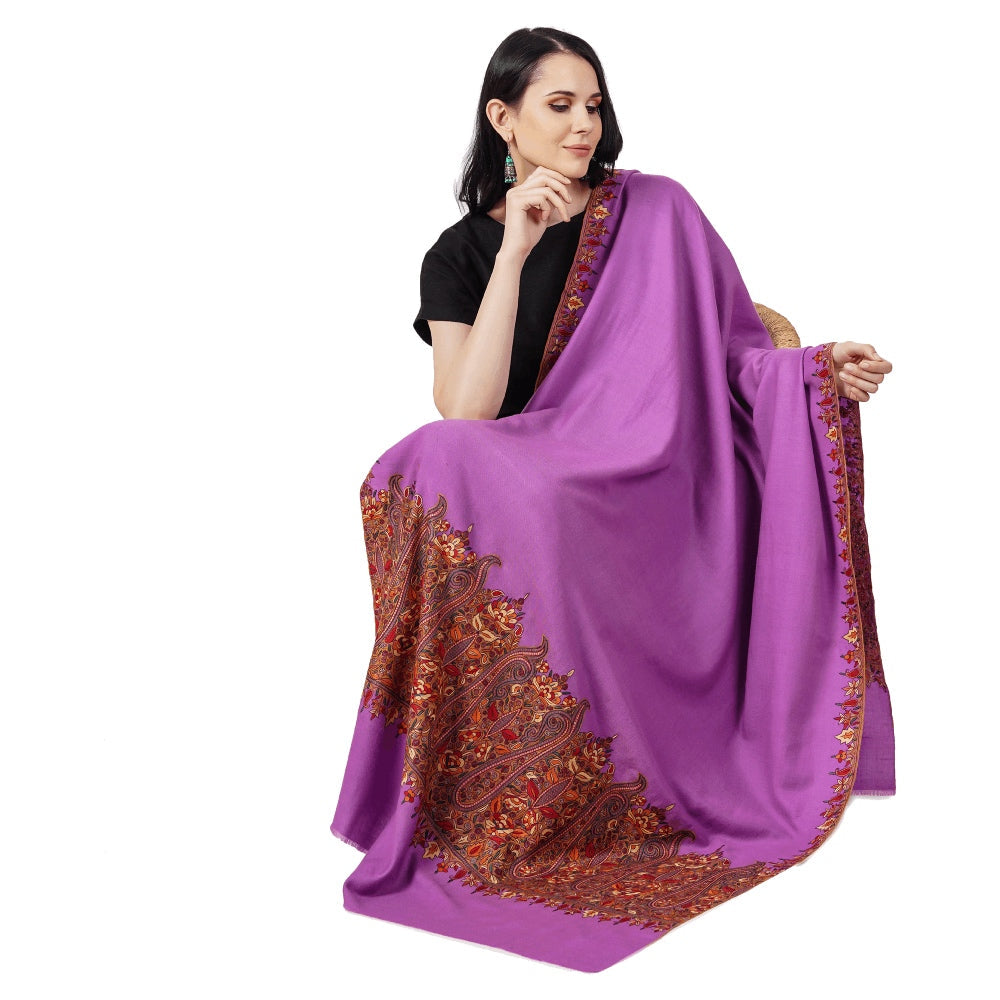
Sozni is a needle-embroidery technique applied to the surface of a woven Pashmina base. The artisan works from the reverse side of the fabric, pushing the needle through to create patterns on the face. There is no template, no transfer, no machine assist. The pattern lives in the artisan's memory and hands. Light sozni — a delicate border pattern — adds 130 hours to an already 97-hour base shawl. Heavy all-over sozni adds 480 hours. That single number explains why a heavily embroidered Pashmina shawl can legitimately retail for $600, $800, or more.
Kani Weaving
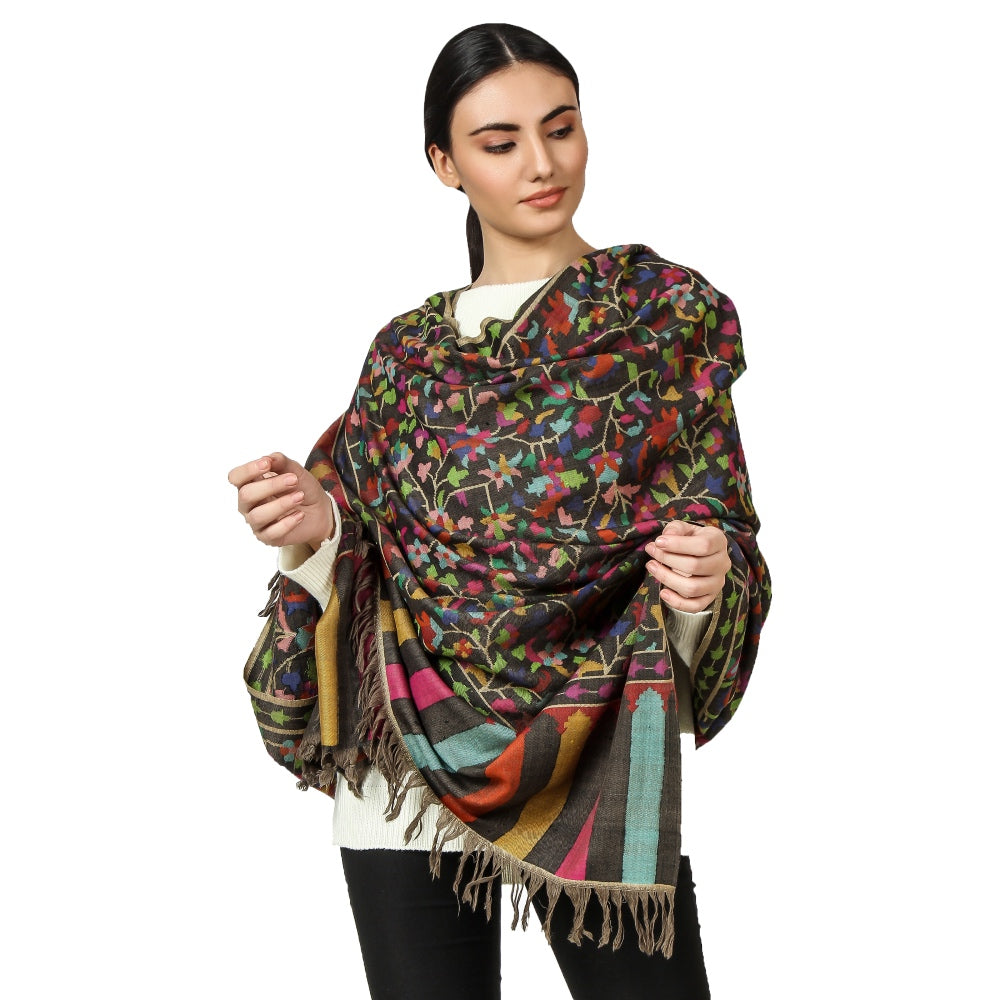
Kani is categorically different from embroidery. The pattern is not added after weaving — it is created during weaving, using small wooden needles (kanis) to introduce coloured yarns into the weave at specific points. The weaver must follow a complex coded pattern chart called a talim. Even a relatively simple Kani pattern requires 1,080 hours of weaving alone — meaning the weaver spends approximately 135 eight-hour days on a single shawl. This is not artisanal romanticism. It is why a genuine Kani shawl is priced in the thousands of dollars and why our Kani collection is produced in extremely limited numbers.
7. The Comparison That Exposes Every Fake
Here is the question that settles the argument about pricing permanently: how can a product that costs ₹4,700 in raw inputs alone — before a single rupee of logistics, export duty, quality control, or margin — retail for $20?
It cannot. The answer is that it doesn't. What retails for $20 is not Pashmina. It is viscose, or acrylic, or machine-spun merino — products with a fraction of the input cost, none of the human hours, and none of the fibre properties that make Pashmina what it is.
| Product | Approx. Input Cost | Typical Retail | Human Hours | Real Fibre? |
|---|---|---|---|---|
| Genuine Plain Pashmina Shawl | ~₹4,700 (~$56) | $200–$400 | 103 hours | ✅ 12–14 micron |
| Genuine Sozni Embroidered Shawl | ~₹12,000+ (~$143+) | $400–$900 | 233–583 hours | ✅ 12–14 micron |
| Genuine Kani Pashmina Shawl | ~₹20,000+ (~$238+) | $800–$3,000+ | 1,141+ hours | ✅ 12–14 micron |
| Machine-spun merino "pashmina" | ~₹300–500 | $20–$80 | <1 hour | ❌ 17–24 micron |
| Viscose / acrylic "pashmina" | ~₹100–200 | $10–$40 | <1 hour | ❌ Synthetic |
The gap between the first three rows and the last two is not a brand premium. It is the honest difference between a product and a counterfeit. One has 103 hours of skilled human labour in it. The other has none.
8. Why Genuine Pashmina Is a Lifetime Investment
There is a final dimension to the price question that is rarely discussed: longevity. A genuine Pashmina shawl, properly maintained, does not wear out in a season or two. The fibre's natural resilience means that with correct care — as detailed in our Pashmina Care Guide — a well-made piece will retain its softness, structure, and appearance for decades.
A $25 viscose scarf will pill, fade, and lose its shape within months. Calculated over a ten-year horizon, the cost-per-wear of an authentic Pashmina shawl is lower than almost any fast-fashion alternative. This is the economics of quality: a higher price point that pays for itself over time.
🧮 The Cost-Per-Wear Calculation
A $300 genuine Pashmina shawl worn 50 times per year for 20 years = $0.30 per wear.
A $25 viscose "pashmina" replaced every 2 years across the same period = 10 purchases = $250 spent, with inferior warmth and zero craft value at every stage.
The Bottom Line
Kashmiri Pashmina is expensive because everything that makes it what it is — the altitude, the goat, the fibre fineness, the hand-spinning, the hand-weaving, the embroidery, the finishing — resists every attempt to make it cheaper without making it something else entirely.
The price is not a luxury surcharge. It is the honest sum of:
- One goat's entire annual fibre yield, processed by hand
- A minimum of 60 hours of skilled human labour for the simplest piece
- Five different artisan specialists, each a master of a distinct craft
- A production chain that cannot be industrialised without destroying the fibre
- Centuries of preserved craft knowledge with no industrial substitute
When you understand what is in the price, the question stops being "why is it so expensive?" and becomes "how is this not more expensive?"