
What Genuine Pashmina Feels Like vs Shahtoosh: A Sensory Comparison Guide
The question is asked often and answered rarely with any precision: how different do Shahtoosh and genuine Pashmina actually feel? Not what the numbers say — what the hands say. This guide answers from direct experience of both fibers, across every sensory dimension that matters to someone holding a fine shawl for the first time.
In This Article
- The Honest Answer First — How Similar They Actually Are
- First Contact — The Initial Touch
- Weight — What You Feel When You Lift It
- Warmth — The Hollow-Core Effect
- Drape — How It Moves
- Against Skin — The Wearing Experience
- Durability Feel — What Long-Term Ownership Reveals
- The Touch Test — What You Can and Cannot Determine by Hand
- The Complete Sensory Comparison
- Frequently Asked Questions
✦ The Honest Starting Point
At its finest — 12–14 microns, hand-spun, handwoven on a khaddi loom in Kashmir — genuine Pashmina is among the most extraordinary tactile experiences available from a legal fiber. It is warmer than cashmere, softer than merino, lighter than any standard wool. Against bare skin it is undetectable as weight and immediately warming. Most people who have held genuine fine Pashmina believe they are holding the finest fiber they have ever encountered. Most of them are right.
Shahtoosh is perceptibly finer than even the finest Pashmina — the 2–4 micron difference at the fine end of both ranges is detectable to a trained hand, and the overall sensory impression is of something slightly more ethereal, slightly less present as a physical object. The difference is real. It is also smaller than most buyers who paid $5,000–$20,000 for a shawl were told it would be. And it is produced by killing an endangered animal that cannot be farmed. The sensory premium does not justify the ethical cost — and it never did.
The Honest Answer First — How Similar They Actually Are
The honest starting point for this comparison is one that the Shahtoosh trade was never incentivised to make: the sensory difference between the finest genuine Pashmina and Shahtoosh is smaller than the price difference between them suggests, and smaller than the ring test demonstration and the "once in a lifetime fiber" marketing implied. A buyer who had paid $8,000 for a Shahtoosh shawl and was then given a fine Pashmina shawl to hold would, in most cases, be surprised by how close the experiences were — not how far apart.
This is a statement about the extraordinary quality of fine Pashmina, not a diminishment of Shahtoosh's genuine properties. Both fibers share the hollow medullary core structure that produces the characteristic warmth-without-weight sensation. Both are in the ultra-fine range — Shahtoosh at 9–12 microns, fine Pashmina at 12–16 microns — where the sensory differences between adjacent micron counts are progressively smaller and harder to detect. Both are produced by animals whose fiber has been shaped by survival at extreme altitude. The convergence is real.
What follows is a precise account of the differences that do exist — and they are real differences — alongside an honest account of where the two fibers are essentially equivalent.
First Contact — The Initial Touch
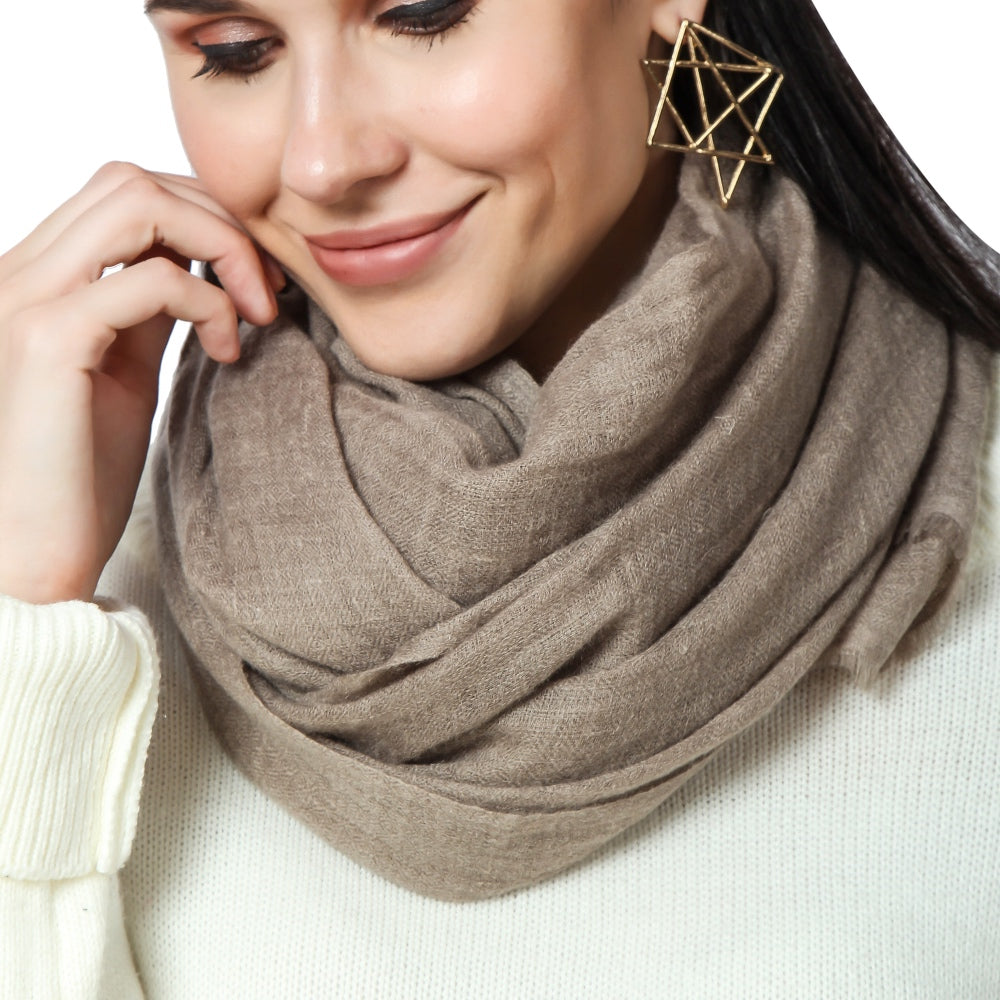
The first thing a fine Pashmina surface communicates to the hand is an absence — the absence of the slight roughness or resistance that almost all other textiles, including commercial cashmere, offer on first contact. There is nothing catching the fingertips. The surface is smooth in the sense of offering no obstacle to the moving hand, but it is not the smooth-cold sensation of silk — it is smooth-warm, immediately. The hand moves across the surface and the surface seems to offer no friction, only a slight gentle pressure in return.
Shahtoosh's initial touch is described by those who have handled both as a slightly more complete version of the Pashmina experience — the same absence of resistance, but extended a further degree toward the experience of touching something that barely registers as a material object at all. One description that recurs among handlers is "like touching air that has been warmed." The difference from fine Pashmina is not large but it is perceptible to a handler who has experience of both, particularly at the fine Pashmina/fine Shahtoosh comparison.
Comparison: Both produce the extraordinary smooth-warm first contact that distinguishes the hollow-core fine fiber category from everything else in the textile world. Shahtoosh takes this a perceptible degree further — detectable to an experienced handler, less reliably detectable to a first-time fine fiber handler.
A fine handwoven Pashmina shawl at standard dimensions (approximately 200 × 100cm) typically weighs between 100–160 grams depending on the weave count and whether embroidery is present. When lifted, the weight sensation is one of profound lightness relative to any other warm textile of similar dimensions. A standard Pashmina shawl weighs less than a typical commercial cashmere sweater while covering a much larger surface area and providing comparable or greater warmth. The weight-in-hand is one of the most reliable quality indicators for genuine fine Pashmina.
A fine Shahtoosh shawl at similar dimensions typically weighed 90–120 grams — somewhat lighter than fine Pashmina at equivalent dimensions, because the finer thread count produced a lower fabric weight at the same weave density. The difference is perceptible when lifting pieces of identical dimensions side by side but is less immediately obvious than the marketing of Shahtoosh as "impossibly light" suggested. A buyer lifting a fine Pashmina shawl for the first time will not think "this could be lighter" — the weight already defies expectation.
Comparison: Shahtoosh is measurably lighter at equivalent dimensions — approximately 15–30% lower weight than comparable fine Pashmina. The difference is real but the absolute weight of fine Pashmina is already far below any other warm textile, which means the subjective impression of both is "extraordinary lightness" rather than a clear sensory hierarchy between them.
The hollow medullary core of the Changthangi goat's fiber traps air across an extremely high surface area per gram — this is the physical mechanism behind Pashmina's exceptional warmth-to-weight ratio. The warmth sensation is immediate — not the delayed warmth of wool that requires the body to heat the fiber before warmth is returned, but an immediate sensation that the cold air between body and fabric has been displaced by something that conducts the body's own heat back. A fine Pashmina shawl at 130 grams provides genuine cold-weather warmth at a weight that conventional intuition says cannot be warm.
Shahtoosh's warmth-to-weight ratio is the highest of any natural animal fiber — the finest diameter and the hollow core together produce a per-gram warmth performance that marginally exceeds even fine Pashmina. The sensation is similar — the same immediate warmth without the delayed warmth-up period — but intensified slightly by the additional fineness and the lower overall fabric weight that fineness allows. Handlers who have worn both in cold conditions consistently report that Shahtoosh felt slightly warmer than expected for its weight, and that Pashmina also felt slightly warmer than expected for its weight, making the comparison a matter of degree rather than kind.
Comparison: Both share the hollow-core immediate-warmth mechanism. Shahtoosh's warmth-to-weight ratio marginally exceeds Pashmina's — but at the weights involved (90–160 grams for a full shawl in either case), both provide warmth that exceeds what the weight suggests, and the subjective difference in wearing is small.
Fine handwoven Pashmina drapes with a fluidity that its weight does not suggest — the combination of low GSM, high thread count, and the specific flexibility of the hollow-core fiber produces a fabric that falls in continuous, uninterrupted curves rather than in the angular folds that heavier fabrics create. When lifted from one end, a fine Pashmina shawl pools in the hand rather than falling in separate layers. When worn, it follows the body's contour rather than holding its own shape. The drape is one of the most immediate quality signals in genuine fine Pashmina — the difference from commercial cashmere is visible at a distance.
Shahtoosh drape was described by those who handled the finest pieces as the most extreme version of the fine-fiber fluid drape — the fabric almost appeared to dissolve into the air when held from one end, falling in a single continuous curve with no visible weight or structure. The additional fineness relative to Pashmina, combined with the slightly lower GSM of the finest pieces, produced a drape that was perceptibly more liquid than even the finest Pashmina. This is probably the single sensory dimension where the Shahtoosh premium was most clearly justified by a perceptible and consistent difference.
Comparison: Drape is where the two fibers are most clearly distinguishable by an experienced handler. Shahtoosh's additional fineness produces a measurably more liquid drape. Fine Pashmina's drape already exceeds any other accessible fine textile — but the Shahtoosh difference in this dimension is the most reliably detectable of the sensory distinctions between them.
Genuine fine Pashmina is non-irritating against bare skin — including sensitive skin types that react to cashmere or wool. At 12–16 microns, the fiber diameter is below the threshold (approximately 22–24 microns) at which individual fibers are stiff enough to deflect rather than bend at skin contact, which is the mechanism behind wool prickle. The result is that fine Pashmina can be worn directly against the neck, face, and wrists without irritation for extended periods. This is one of the most commercially significant properties of genuine fine Pashmina and one of the clearest points of practical distinction from commercial cashmere.
Shahtoosh at 9–12 microns is even further below the prickle threshold than fine Pashmina — the skin experience is one of complete absence of any fiber sensation, leaving only the warmth and the slight pressure of the fabric's weight. Extended-wear handlers described the sensation as "wearing warmth without wearing anything" — the fabric essentially ceasing to register as a distinct sensation separate from the skin temperature it was maintaining. This is the most extreme version of the non-prickle, non-irritant skin experience that fine animal fiber produces.
Comparison: Both are entirely non-irritating against sensitive skin. Fine Pashmina produces a wearing experience that most wearers describe as extraordinary — the absence of any fiber sensation is already highly unusual compared to any other textile. Shahtoosh extends this absence a degree further, but the baseline that Pashmina establishes is already at the extreme end of what most wearers have previously encountered.
Durability Feel — What Long-Term Ownership Reveals
The sensory comparison between Pashmina and Shahtoosh takes a significant turn when considered across the full lifecycle of ownership rather than at the moment of first handling. Shahtoosh's extreme fineness — the property that produces its most distinctive sensory qualities — is also the source of its principal practical limitation: durability.
At 9–12 microns, Shahtoosh thread has low tensile strength per filament. The fiber breaks more easily under mechanical stress than Pashmina at 12–16 microns, and the cumulative effect of wear, folding, and washing produces visible surface degradation faster than an equivalent Pashmina piece. Owners of genuine Shahtoosh pieces who wore them regularly found that the surface quality that justified the price began to decline within a few years of active wear — pilling at contact points, slight surface matting where the fabric folded repeatedly, and a progressive loss of the extreme fluidity of drape that characterized new pieces.
✦ The Durability Reversal
In the short term — at first handling, in the first wearing season — Shahtoosh's sensory qualities exceed Pashmina's in every measurable dimension. Over a five-to-ten-year ownership period of active wear, fine Pashmina holds its sensory qualities better than Shahtoosh did, because the slightly coarser fiber has greater tensile strength per thread and resists the mechanical stress of wear more effectively. The sensory comparison between the two fibers at year one and at year eight would produce different rankings on several dimensions — with Pashmina moving closer to or ahead of Shahtoosh on surface quality, drape consistency, and visual clarity of weave as time passes.
The Touch Test — What You Can and Cannot Determine by Hand
🤲 A Step-by-Step Touch Assessment — What Each Step Reveals
Pashmina: Falls in continuous curves, pools rather than stacking in layers. Weight shocks by its absence.
Shahtoosh: Appears even more continuous — closer to a single liquid surface than to a folded fabric.
Pashmina: The back of the hand — which is more sensitive than the palm — detects no friction, no catch, no texture. Only smooth warmth.
Shahtoosh: Equivalent experience, possibly marginally more complete in its smoothness. The difference is at the limit of what the back of the hand can reliably distinguish.
Pashmina: No prickle, no irritation. Immediate warmth. After 30 seconds, the fabric is indistinguishable from bare skin in terms of surface sensation — only the warmth persists as a distinct quality.
Shahtoosh: Equivalent — possibly the most equal dimension of comparison. Both are well below the prickle threshold and both reach skin-temperature equilibrium quickly.
Pashmina: Translucency is a function of weave count and GSM. Fine Pashmina at high thread count shows some translucency — you can see light through it but not read through it.
Shahtoosh: Slightly more translucent at equivalent dimensions due to lower GSM. The ring test exploits this combined with fineness, but translucency alone proves nothing about fiber identity.
Pashmina: Recovers quickly from compression — the hollow-core structure springs back. Minor creasing resolves within seconds to minutes.
Shahtoosh: Similar recovery — the identical hollow-core structure produces equivalent crease recovery. No reliable distinction can be made here by hand.
- ✦Whether a fiber is genuinely fine — coarse fibers, acrylic blends, and commercial wool are immediately distinguishable from fine animal fiber by touch
- ✦Approximate quality tier — very fine Pashmina vs standard commercial cashmere vs fine cashmere is reliably distinguishable by an experienced hand
- ✦Whether a piece is handwoven vs machine-woven — the slight surface texture variation of hand-weaving is detectable at very fine thread counts
- ✦Drape quality — which correlates with fiber fineness and weave count, and is a reliable indicator of production quality
- ✗Whether you are holding Shahtoosh or very fine Pashmina — the sensory properties are too close for reliable species identification by hand
- ✗Whether a piece is genuine Pashmina or high-quality cashmere — the distinction requires lab fiber analysis, not hand assessment
- ✗Whether the ring test proves species — passing a ring proves fineness and weave density, not animal identity. Silk, modal, and fine Pashmina all pass identically
- ✗Legal status — nothing about the physical properties of a shawl reveals the legal status of the fiber it was made from
The Complete Sensory Comparison
| Dimension | Fine Pashmina (12–16µm) | Shahtoosh (9–12µm) | Verdict |
|---|---|---|---|
| Initial touch surface | Extraordinarily smooth, no friction, warm | Marginally smoother — detectable to trained hand | Shahtoosh (slightly) |
| Weight of full shawl | 100–160g — shocks by lightness | 90–120g — slightly lighter | Shahtoosh (measurably) |
| Warmth-to-weight | Highest legal fiber — immediate warmth | Marginally higher — same mechanism | Shahtoosh (marginally) |
| Drape / fluidity | Extraordinary — liquid, continuous curves | More liquid still — clearest perceptible difference | Shahtoosh (clearly) |
| Against bare skin | Zero prickle, non-irritant, immediately warm | Equivalent — both well below prickle threshold | Equal |
| Crease recovery | Excellent — hollow core springs back | Equivalent — same structure | Equal |
| Long-term durability | Good — holds qualities over years of wear | Fragile — qualities decline with active wear | Pashmina (clearly) |
| Washability | Hand-wash with care — holds well | More fragile to washing — higher risk | Pashmina |
| Legal to own | Yes | No (or: insupportable legal position) | Pashmina |
| Available to buy | Yes — authenticated, GI-certified | No legal market | Pashmina |
"The honest summary is this: Shahtoosh was better than Pashmina in the dimensions that matter in a shop — the initial touch, the drape demonstration, the weight in the hand, the ring test. It was worse than Pashmina in the dimensions that matter across a decade of ownership — durability, washability, the ability to continue wearing the piece without anxiety about its legal status. The trade sold the first set of properties and omitted the second. Genuine Pashmina, honestly presented, has the better of the complete comparison."
The finest Pashmina is extraordinary.
It was always extraordinary — even when Shahtoosh was in the room.
The comparison that the Shahtoosh trade suppressed was the one that would have been most useful to the buyer: not "is this finer than cashmere" but "is it finer than what it costs three to five antelope's lives to produce."
Frequently Asked Questions
It is perceptibly softer to an experienced fine-fiber handler — the 2–4 micron difference at the fine end of both ranges is detectable as a slight additional smoothness on first contact and a more complete absence of any surface texture. Whether it is "noticeably" softer to a first-time fine fiber buyer depends heavily on prior experience: someone who has handled a lot of commercial cashmere will find fine Pashmina dramatically softer, and may not have the baseline sensitivity yet to detect the additional increment that Shahtoosh provides. The most reliable report is that people who have handled both describe the difference as real but smaller than they expected from the price difference.
Reliably, no — not even experienced fine-fiber handlers can consistently distinguish very fine Pashmina from Shahtoosh by touch in a blind test. The drape difference is the most detectable sensory distinction, and even that requires handling fine Pashmina and Shahtoosh side by side to be reliably apparent. Species identification requires laboratory fiber analysis — OFDA (Optical Fiber Diameter Analysis) or Scanning Electron Microscopy — which examines the microscopic scale pattern of the fiber cuticle. Touch is useful for identifying quality tier but not for identifying fiber species. This is also why the ring test was useless as a species identifier: it measured a physical property (fineness and weave density) that multiple legal fibers share.
Yes, significantly and immediately. Commercial cashmere averages 17–22 microns — above the 16-micron upper boundary of genuine Pashmina at the finest grades. The 5–8 micron difference between fine Pashmina and commercial cashmere is much larger than the 2–4 micron difference between fine Pashmina and Shahtoosh, and it produces clearly perceptible differences: fine Pashmina is smoother on first contact, lighter in weight at equivalent dimensions, more fluid in drape, and more completely non-irritant against sensitive skin. The comparison between genuine fine Pashmina and commercial cashmere is one that most people can make reliably on their first handling of both. The comparison between fine Pashmina and Shahtoosh is one that most people cannot make reliably without significant prior exposure to both.
The most reliable manual quality indicators for genuine fine Pashmina: (1) weight relative to size — a full shawl at 200 × 100cm should weigh 100–160g; significantly heavier suggests lower grade fiber or blend; (2) drape — fine genuine Pashmina pools continuously in the hand and falls in uninterrupted curves; angular folding or structural stiffness indicates coarser fiber or machine weaving; (3) back-of-hand surface test — run the back of the hand slowly across the fabric; genuine fine Pashmina offers no friction or catch at all; (4) face contact — held against the side of the face, genuine fine Pashmina produces no prickle sensation whatsoever within the first 5–10 seconds. GI certification and a traceable provenance document remain the only definitive authentication for genuine Kashmiri Pashmina.
Feel it for yourself
Genuine Pashmina — the sensory experience
that needs no illegal fiber to justify it.
GI-certified Changthangi goat fiber, hand-spun on a yinder, handwoven on a khaddi in the Kashmir Valley. The fiber that the comparison above describes as extraordinary — not as a consolation for Shahtoosh, but as the thing it always was: one of the finest textiles on earth, produced without killing anything.