
Is Cashmere Good for Winter?
The short answer is yes. The honest answer is better than that: genuine cashmere — specifically genuine Kashmiri Pashmina — is not just good for winter. It is the finest winter textile that exists. The reason is a single property that surprises everyone who encounters it for the first time in cold weather: the warmth-to-weight ratio. It breaks a rule that every other winter textile observes. That rule, and why Pashmina alone ignores it, is the entire answer.
Every winter textile a person has previously worn teaches the same lesson: warmth costs weight. A heavy wool scarf is warmer than a light one. A thick puffer jacket is warmer than a thin one. A chunky knit is warmer than a fine one. The relationship between weight and warmth is so consistent across every material that it becomes an assumption — the cost of being warm in winter is carrying more fabric.
Genuine Kashmiri Pashmina breaks this assumption completely. A full-size Pashmina shawl at 80 GSM weighs approximately 112 grams — less than a bar of soap, less than a mobile phone. And yet it provides genuine neck and shoulder warmth in temperatures where a wool scarf three times its weight delivers less. The first time someone holds a genuine Pashmina in winter and feels immediate warmth against the skin, the experience is almost always described the same way: surprise. Not because the piece is beautiful. Because it is warm. That specific surprise — warmth arriving where weight was expected — is the moment the question "is cashmere good for winter?" is answered permanently.
The answer is yes. But the more useful answer is: why — because the reason genuine Pashmina outperforms every other winter textile explains not just whether cashmere is good for winter but why nothing else is quite as good.
Every winter textile teaches that warmth costs weight. Genuine Pashmina is the only textile that proves this is not a law — it is simply a limitation of every other material.
Under 120 grams. Warmer than wool three times heavier. The warmth-to-weight ratio that winter dressing has been looking for.
The warmth is not in the weight.
It is in the structure of each individual fiber.
The Changthangi goat of the Changthang Plateau in Ladakh — living at 4,000 metres altitude in temperatures that fall to −40°C — produces a fiber with a hollow channel running along its length. This hollow core traps air structurally within each individual strand. Air has a thermal conductivity of 0.025 W/m·K — lower than any solid material in textile production. The warmth comes from the air inside each fiber, not from the mass of many fibers. This is why adding more weight does not improve the insulation — and why so little weight is needed to achieve so much warmth. The warmth-to-weight ratio is not a design achievement. It is an evolutionary one.
This is the specific physics that makes genuine Pashmina the best winter textile available. Every other winter material — wool, fleece, synthetic insulation — achieves warmth by accumulating mass. More fiber, more warmth. The relationship is proportional and unavoidable in solid-core fiber. Pashmina's hollow-core structure breaks this proportionality: the warmth comes from the air, not the fiber mass, which means the fiber mass can be dramatically reduced without reducing the warmth. The result is a textile that weighs almost nothing and warms more than anything heavier.
The chart reveals the counterintuitive result: the lightest option provides the most warmth. Genuine Pashmina at 112 grams outperforms wool at 280 grams — not despite weighing less, but because of how it achieves warmth. The hollow core does the work that solid fiber mass cannot replicate at equivalent weight.
Double-wrapped at the neck under a heavy coat
At severe temperatures, the Pashmina functions as the neck and jaw insulation layer inside the coat collar. Double-wrapped, it provides four layers of hollow-core insulation at the throat without the bulk of a heavy wool scarf. A 120 GSM double-ply Pashmina is the correct choice here.
Shoulder drape or single wrap with a winter coat
At standard winter temperatures, an 80 GSM Pashmina in a full shoulder drape provides complete upper-body warmth alongside a coat — covering the back and shoulders where most heat escapes. Nothing at this weight provides equivalent coverage.
Pashmina as the sole outer layer — no coat required
In mild winter temperatures, a genuine Pashmina as a full shoulder drape over knitwear eliminates the need for a coat entirely. The hollow-core warmth covers the full upper body at a weight no coat approaches for equivalent coverage.
Lap layer or shoulder drape at the desk
Air-conditioned winter offices run below comfortable temperature for most people. A Pashmina draped across the lap provides the warmth of a light blanket at under 120 grams — removable in seconds, invisible when not needed.
Flight blanket that fits in a jacket pocket
Aircraft cabins frequently fall below 18°C. A genuine Pashmina at 112 grams — folded to pocket size — serves as a genuine flight warmth layer with immediate hollow-core warmth that synthetic alternatives cannot replicate at this pack size.
Elegant cover from cold street to warm venue
Winter evenings demand something warm enough for the cold walk and elegant enough for the formal occasion inside. A Pashmina in a full shoulder drape is both simultaneously — a solution no jacket or heavy wrap provides at equivalent elegance and warmth.
Genuine pure Pashmina shawls are available in two weights — and the choice for winter use is the difference between a piece suited to mild winter and indoor use and one built for serious cold. Both use the same Changthangi fiber. Both have the same hollow-core warmth mechanism. The weight determines the thermal output.
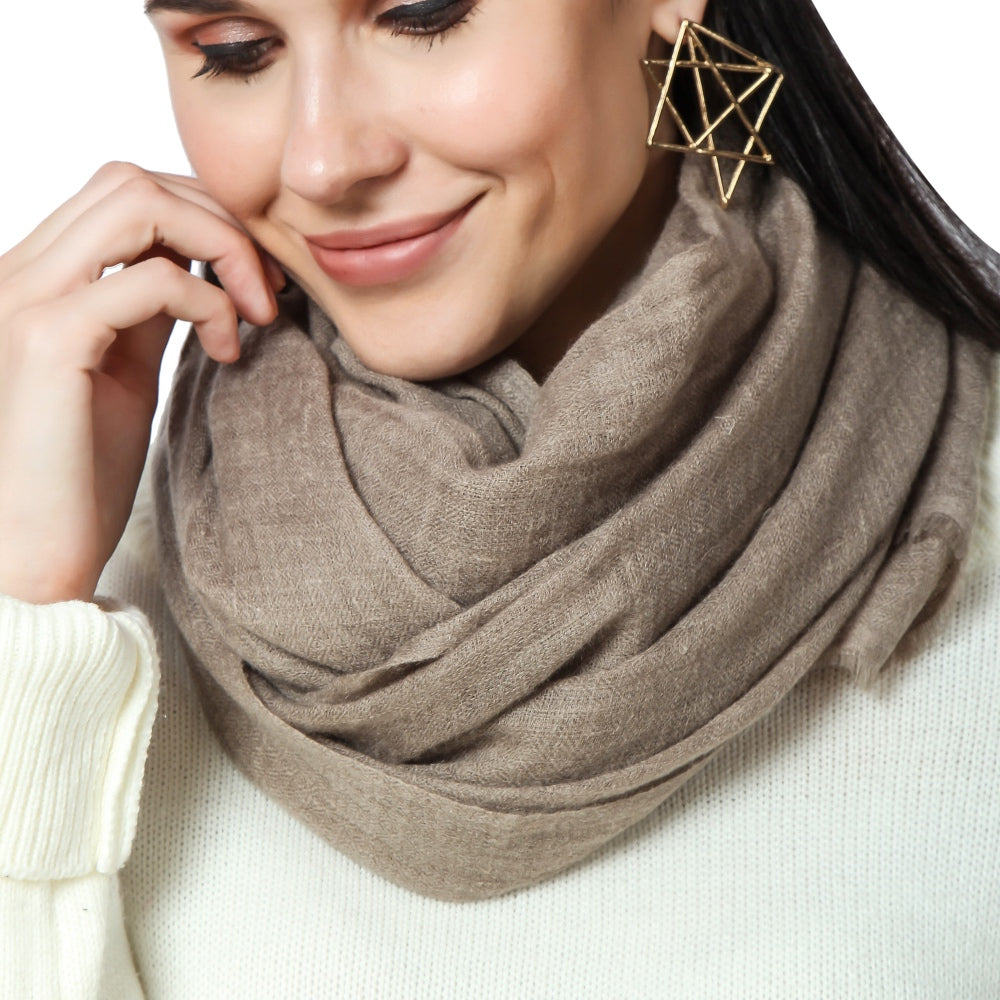
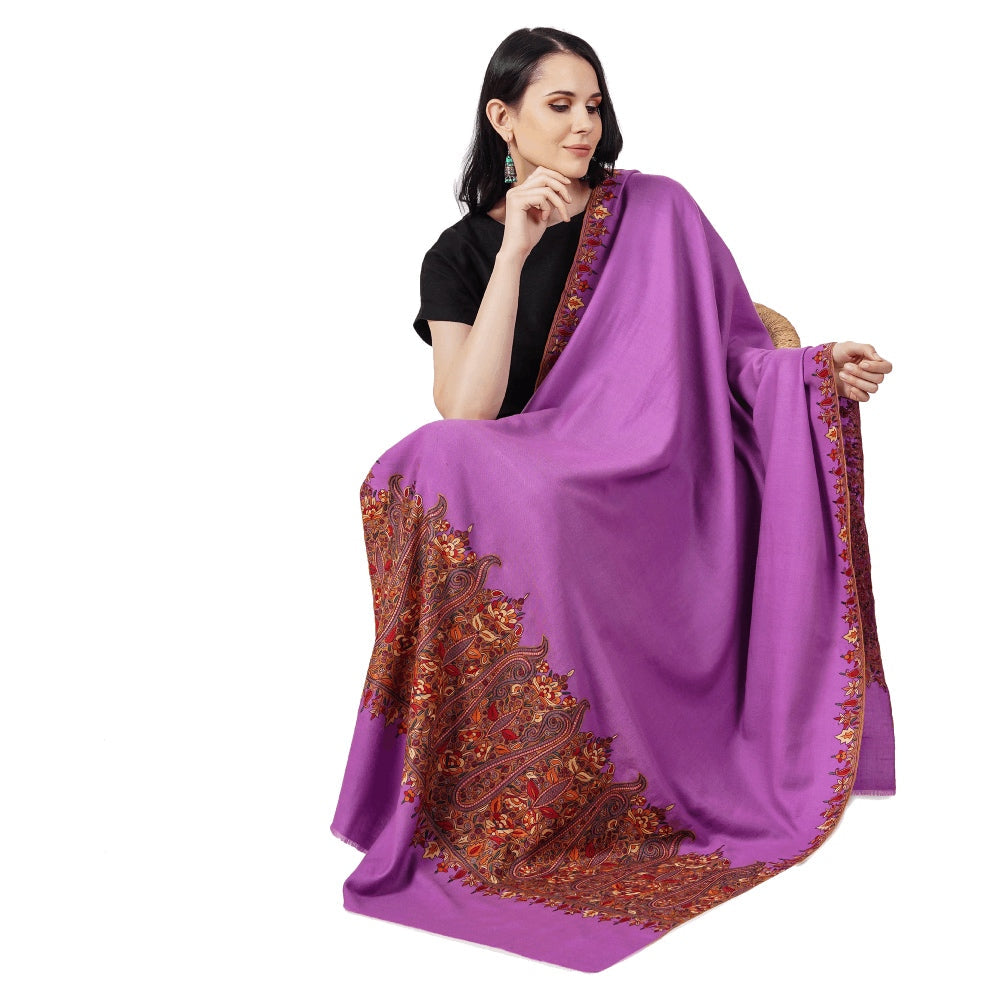
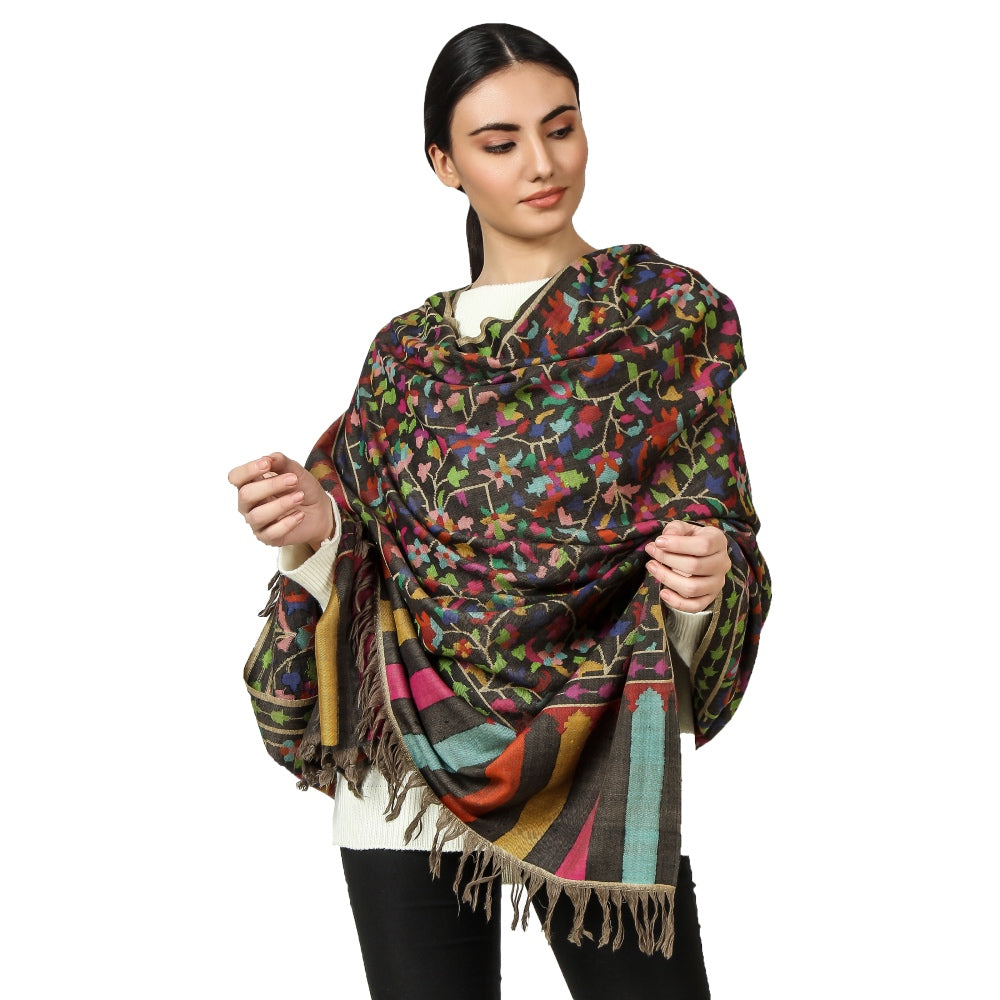
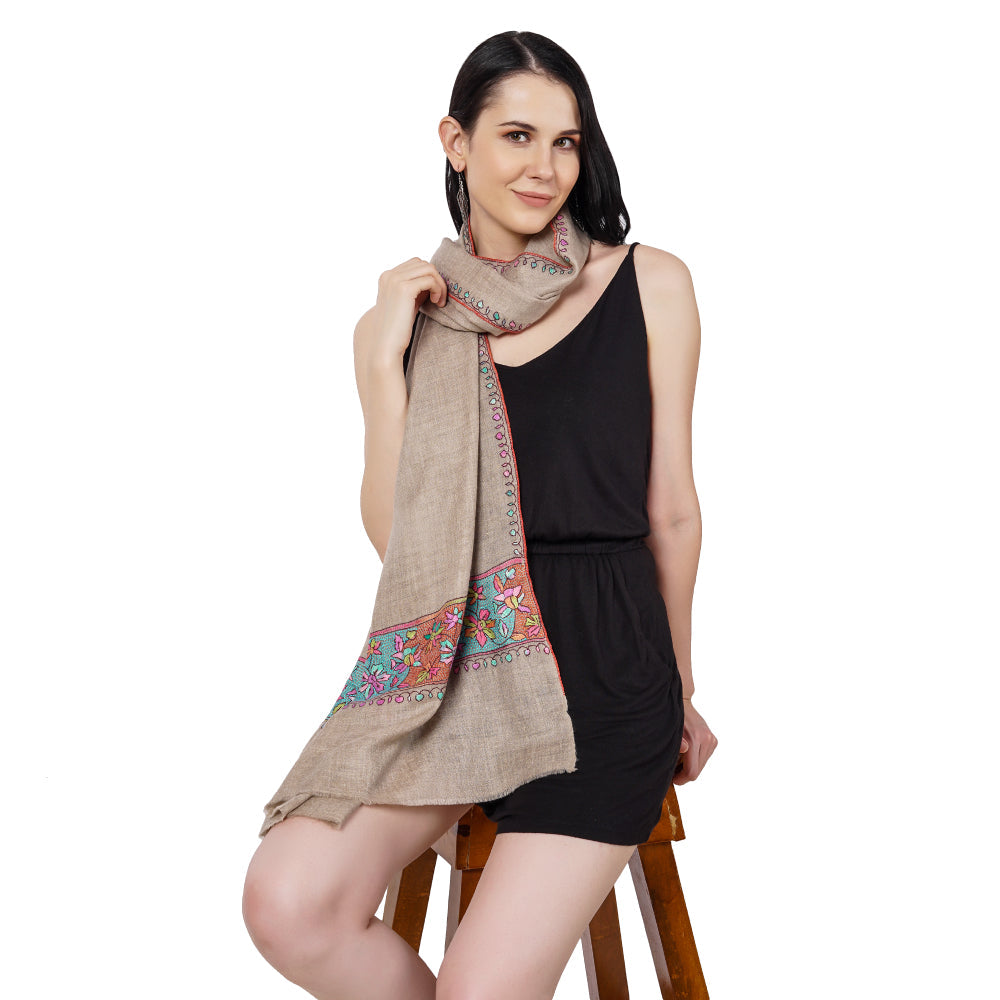
In winter, luxury cashmere scarves in deep, warm tones perform best visually — the matte protein surface of genuine Pashmina absorbs warm winter light and returns it as depth rather than glare. The colours that look most beautiful in winter respond to the specific quality of winter light: lower, warmer, often amber-toned and artificial.
🎨 The Best Winter Pashmina Colours
Toosh / Natural Camel — In winter light, Toosh develops a golden warmth. The most versatile winter colour — works with every winter wardrobe and looks most completely itself in December and January.
Natural Ivory / Kora — Luminous in candlelight and firelight. The most beautiful winter evening colour — particularly against dark coats and formal winter outfits. In warm interior winter light, ivory Kora glows in a way no dyed alternative replicates.
Deep Burgundy — The quintessential winter colour — the matte surface makes it richer in warm winter light than it appears in summer. Over black or charcoal, the most striking winter combination available.
Midnight Navy — Deep, authoritative, appropriate in every formal winter context. Works over ivory, cream, and camel for the most composed winter combinations.
Charcoal — The cool winter universal. Works with every colour in a winter wardrobe without competition.
The Answer
Is cashmere good for winter? Yes — and more specifically, genuine cashmere scarves from Kashmir are the finest winter textile available for neck and shoulder warmth. The warmth-to-weight ratio that consistently surprises first-time wearers is not a marketing claim. It is the measurable, physical result of hollow-core fiber at 12–14 microns — the specific evolutionary adaptation of the Changthangi goat to survive −40°C winters at 4,000 metres altitude.
That adaptation, refined by five centuries of Kashmiri craft into a handwoven shawl that weighs 112 grams and warms more than wool three times heavier, is the complete answer. Not just good for winter. The best winter textile for neck and shoulder warmth that human hands have ever produced.
To understand the complete science behind the warmth-to-weight ratio, read Why Real Cashmere Feels Warmer but Lighter. To understand the best winter outfit combinations with a genuine Pashmina, read Winter Outfit Ideas with a Cashmere Scarf. To understand how to choose the right winter weight, read What GSM Is Best for a Cashmere Scarf? To find the winter Pashmina, visit the Pashwrap collection.