
Luxury Gift Guide: Cashmere Wrap for Her
Most luxury gifts are appreciated with the eyes. A genuine Kashmiri Pashmina is appreciated in a single tactile second — the moment warmth reaches the skin while the fabric remains weightless in the hand. That moment is what no other gift at any price point replicates. This is the complete guide to choosing, giving, and understanding the most enduring luxury gift available.
Every year the same problem presents itself: a woman in your life deserves something genuinely exceptional, and the options available are nearly all the same. Perfume that runs out. Jewellery that requires knowing her exact taste. Experience gifts that require scheduling. Hampers that are finished in a week. Flowers that last three days. All of these are good gifts. None of them stays.
The question worth asking before any significant gift purchase is not "what will she like?" but "what will she still be reaching for in ten years?" The answer to that question, for almost any woman who values quality and warmth and the quiet pleasure of something made with extraordinary care, is the same: a genuine Kashmiri Pashmina.
Not because it is the most expensive option. Not because it carries the heaviest brand. But because of a single physical property that no other luxury textile possesses in the same combination: warmth that arrives at the skin before the fabric has had time to announce its own weight. The warmth-without-weight paradox — the specific achievement of the Changthangi goat's hollow-core fiber at 12–14 microns — is the reason a genuine Pashmina is remembered when other gifts are forgotten.
It isn't the weight. It isn't the brand on the box. The moment of realisation happens in a single tactile second — warmth against the skin while the fabric remains weightless. That is the pulse of genuine Pashmina. No other gift produces it.
Warmth without weight.
The pulse no other luxury gift produces.
She lifts the shawl. It is lighter than she expected — lighter than anything that should be this warm. Then, within seconds, warmth arrives at the skin. Not from the heat of the fabric — from the hollow core of each fiber reflecting her own body heat back. The expectation of weight was there. The weight is not. The warmth arrives anyway. That gap between expectation and reality is the moment a genuine Pashmina is registered as something categorically different from every luxury gift she has received before it.
The physics behind this moment are specific and not accidental. The Changthangi goat of the Changthang Plateau in Ladakh — living at 4,000 metres altitude in temperatures that fall to −40°C — produces a fiber whose hollow core traps air structurally within each individual strand. Air has a thermal conductivity of approximately 0.025 W/m·K — lower than any solid material. Each fiber is, in effect, a miniature insulating tube. The warmth is structural, not cumulative. It does not require mass. It does not require weight. It arrives immediately because it is reflecting heat back from within each fiber, not building heat through bulk.
This is why genuine pure Pashmina shawls feel the way they feel at the moment of first contact — and why that moment is unlike any other textile experience in fashion. The recipient is not feeling a warm fabric. She is feeling a fabric that makes her warm, which is a different thing entirely.
The three numbers above describe something that no other luxury gift at a comparable price point can claim simultaneously. The lifespan of 50+ years means the gift given today will be present in her wardrobe when she gives it to someone else. The four goats represent the specific scarcity of the raw material — genuine Changthangi fiber, harvested once a year by combing rather than shearing, at an altitude where the quality of the fiber is determined by the severity of the winter. The 500 years of craft tradition means that the piece she holds has been made by the same method, in the same valley, by artisans whose knowledge was passed from hand to hand across generations that have never needed to write it down because the hands remember.
The word "cashmere" and the word "Pashmina" are among the most misused terms in the luxury textile market. Fewer than 5% of products sold globally under these names are what they claim to be. The market is not organised to make this easy to navigate — and the gift-giver who does not know what to look for will, in the majority of cases, buy something that produces none of the properties described in this guide.
Genuine handmade Pashmina has specific, verifiable properties that distinguish it from every commercial alternative. The fiber must come from the Changthangi goat — not any cashmere goat, but specifically this breed, from this plateau, at this altitude. The fiber diameter must be 12–14 microns — measured, not assumed. The yarn must be hand-spun on the traditional yinder wheel by an artisan whose fingers read and correct the fiber in real time during spinning — the only process that preserves the hollow core intact. The fabric must be handwoven on a khaddi loom in Kashmir.
Each of these requirements can be verified. A transparent seller can state the fiber diameter, name the origin, confirm hand-spinning, and explain what Kora and Talim mean — because these are the terms that live inside the supply chain, not on the marketing page. A seller who cannot answer these questions is selling something other than what is described.
⚠️ The Price Test
A genuine handmade Pashmina cannot be produced honestly for under $100 at retail. The raw fiber cost, hand-spinning time (approximately one week per scarf), and handweaving time make the economics of lower prices impossible without compromising the fiber, the process, or both. A "cashmere" or "Pashmina" scarf priced at $20–$60 is not the product described in this guide. It may be a fine product — but it will not produce the warmth-without-weight moment at first touch, and it will not be in her wardrobe in 50 years.
The woman who will wear it every single day
No recipient reaches for a genuine Pashmina more consistently than a mother or grandmother — on cold mornings, at family gatherings, on long journeys, across every season. The warmth-without-weight is particularly meaningful for women who find heavy layers uncomfortable. This is the gift that sits on the chair where she reads, already there when she reaches for it.
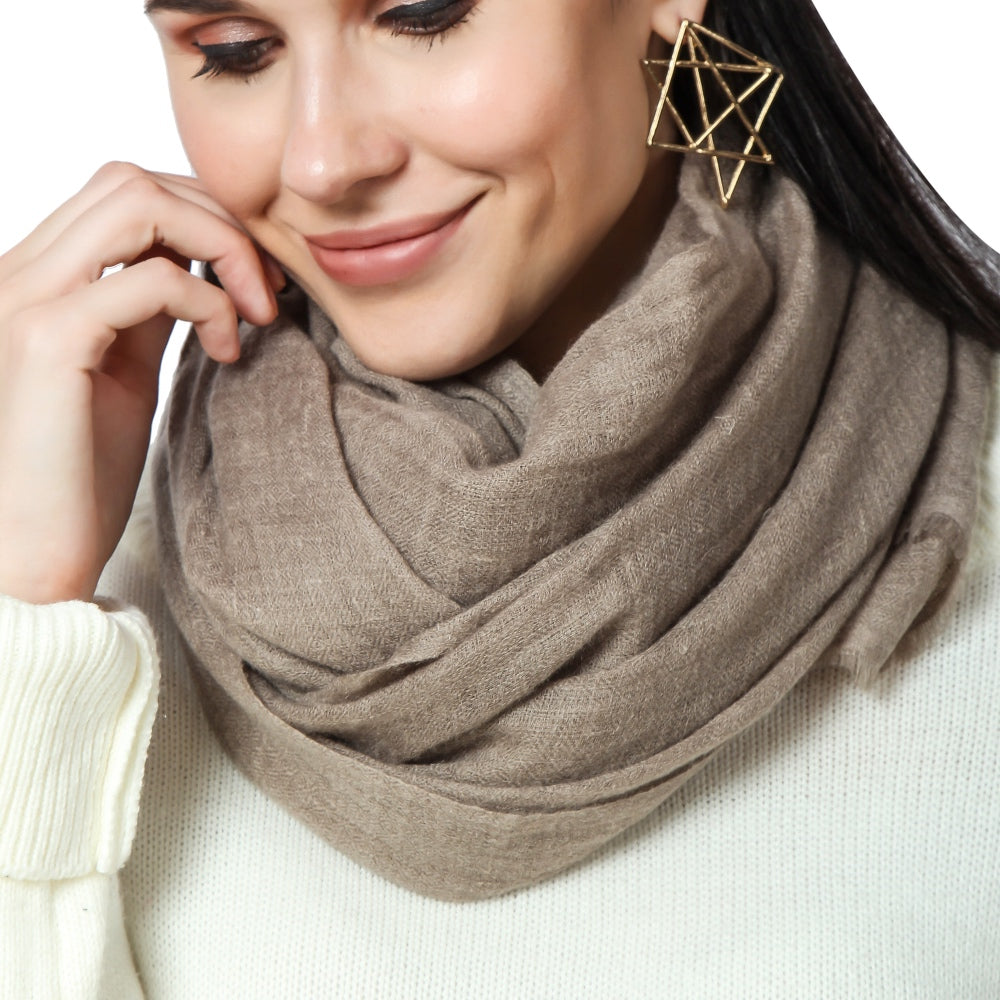
Best colours: Toosh natural camel · Ivory · Warm stone · Deep navy
The gift that says you were paying attention
The colour of a Pashmina chosen for a partner is a statement about how well the giver knows her wardrobe. Toosh if her wardrobe runs warm — camel, brown, cream. Charcoal if it runs cool — black, grey, navy. Ivory if her base is always dark. This is a gift where the right choice signals considered attention, which is the most intimate luxury available in gift-giving.
Best colours: Matched to her wardrobe's undertone — see colour guide below
The gift she will understand fully in ten years
A young woman receiving her first genuine Pashmina may not fully understand the gift at the moment of receipt. She will understand it completely when she pulls it from her wardrobe a decade later and discovers it is softer than when she received it. The gift that grows in meaning as the recipient grows into it is the rarest and most valuable kind.
Best colours: Toosh · Ivory Kora — neutrals that work with every wardrobe chapter ahead
The gift that produces a reaction she has never had
For a woman with a sophisticated wardrobe and discerning taste, a genuine luxury cashmere scarf from Kashmir produces the rarest gift experience: genuine surprise. She has received fine things before. She has not felt the warmth-without-weight moment before — because nothing else produces it. This is the gift that tells her something she did not know.
Best colours: A deep jewel tone she does not own — forest green, midnight navy, deep burgundy
The colour of a Pashmina gift is the single decision that distinguishes a considered gift from a generic one. The right colour communicates that the giver was thinking about the recipient's actual life — her wardrobe, her complexion, her occasions. The wrong colour is still a beautiful piece, but it sits in the wardrobe less often. Here is the honest guide.
Toosh / Natural Camel ✦
The universal first choice. Warm enough to add richness, neutral enough to pair with 90% of any wardrobe. The colour that cannot miss. If uncertain — always choose Toosh.
Natural Ivory / Kora
Luminous over dark wardrobes. The most beautiful evening gift colour — particularly striking in candlelight and warm indoor light. Best for women who dress in predominantly dark tones.
Charcoal
The cool universal. For women whose wardrobe is built around black, grey, and navy — charcoal is the neutral that works with everything they already wear.
Midnight Navy
Deep, formal, authoritative. The most refined deep colour for a first bold gift — works over ivory, cream, and camel. Particularly beautiful for professional women.
Deep Burgundy
The winter evening colour. Over black or charcoal it is instantly striking. For women who attend formal events — the most versatile statement colour.
Forest Green
Rich, grounded, historically resonant in Kashmiri textile tradition. For women whose wardrobe includes earth tones — a colour that feels both natural and distinctive.
🧵 The Colour Decision Rule
If you know her wardrobe: match the Pashmina's warmth to her wardrobe's undertone. Warm wardrobe (brown, camel, cream) → Toosh. Cool wardrobe (black, grey, navy) → Charcoal or ivory. Dark base wardrobe → Ivory Kora for maximum contrast. If you do not know her wardrobe: Toosh. Always.
Genuine Pashmina is available in two weights — and the choice between them is the difference between a piece suited to year-round use and one optimised for winter warmth. Both are genuine handmade Pashmina. The weight determines the occasions it serves best.
A genuine Pashmina is one of the few gifts that is worth explaining at the moment of giving — not as a sales recitation, but as the specific story that gives the piece its full weight. She will feel the warmth-without-weight in the first second. But knowing where it comes from — the Changthang Plateau, the Changthangi goat, the artisan's hands on the yinder wheel, the five centuries of craft in the Kashmir Valley — transforms the physical experience into a complete one.
Consider including a brief handwritten note with three facts: the fiber comes from the Changthangi goat in Ladakh, hand-combed once a year. It was hand-spun by a Kashmiri artisan — approximately one week of spinning for this single piece. It was handwoven on a khaddi loom in the Kashmir Valley, by the same technique used for five hundred years. Three facts. One note. The piece becomes a story she can tell.
✓ One Care Instruction Worth Including
The most important thing she can know: store it folded flat, never hung. Hanging a genuine Pashmina under its own weight causes cumulative fiber elongation over months and years — invisible per session, irreversible over time. Fold it into thirds, store flat in a breathable cotton bag with a cedar block. That single instruction, followed consistently, is the difference between a Pashmina that lasts twenty years and one that lasts fifty.
The Gift
A luxury gift for her — genuinely, honestly, at a price that reflects what has been made rather than what has been marketed — is rarer than it appears. Most of what is positioned as luxury is brand. A percentage of the price buys the material and the making; the rest buys the logo on the box.
A genuine Kashmiri Pashmina inverts this equation. The price buys the fiber — rare, specific, harvested from four goats' annual yield. It buys the hands — the artisan who spent a week spinning the yarn, the weaver who spent several days at the loom. It buys the five hundred years of knowledge that produced both of them. Nothing is spent on a logo, because the piece does not need one. The warmth-without-weight moment speaks for itself, in the first second she holds it, and every time afterward.
That is the luxury gift. Not the most expensive thing available. The thing she will reach for on the cold morning ten years from now, and discover is still exactly what it was — or better. The gift remembered not for the moment it was opened, but for all the moments it continues to be worn.
To explore the complete collection of genuine handmade pieces, visit the Pashwrap collection. To understand how to verify authenticity before purchasing any Pashmina gift, read Where to Buy Authentic Cashmere Scarves Online. To understand the colours that work best as gifts, read Best Colors for a Cashmere Scarf. To understand the craft tradition behind every piece, read 500 Years of Cashmere Craftsmanship in Kashmir.