
Shahtoosh in European Aristocracy: The Shawl That Conquered 19th Century Fashion
In the early nineteenth century, the most powerful consumers in Europe were caught in the grip of a contradiction. They demanded the rarest, finest textile in the world — then pretended it came from somewhere else. The Kashmir shawl conquered European fashion not because buyers understood what it was, but because they misunderstood it.
What This Article Covers
- 01 Napoleon, Josephine, and the Origin Story
- 02 The Kashmir Shawl Craze: When Fashion Lost Its Mind
- 03 The Paisley Problem: How Scotland Copied a Kashmiri Motif
- 04 From Exotic to Institutional: The Status Symbol Shift
- 05 The Orientalist Fantasy: Who Invented the "Exotic East" Narrative?
- 06 The Aftermath: What the Craze Left Behind
The European fascination with Kashmir shawls in the nineteenth century is one of the most consequential cross-cultural misunderstandings in luxury history. It was not a misunderstanding born of ignorance. It was a misunderstanding born of deliberate deception — by Kashmiri dealers who maximised the exotic allure of their product, by European intermediaries who reframed the narrative to suit Western orientalist fantasies, and by European consumers who preferred a romantic illusion to a complicated reality. The result was the most commercially successful lie ever told in the history of luxury textiles — one that dominated European fashion for nearly a century before the truth caught up with it.
What the European market wanted was a product that combined three qualities: extraordinary fineness, exotic origin, and cultural depth. Shahtoosh and fine Pashmina possessed all three. The trick — and the lie — was framing all three as properties of the same product: "the Kashmir shawl." By refusing to distinguish between different fibres, different origins, and different quality tiers, the European market treated an entire ecosystem of distinct products as one homogenous luxury commodity. The result was a market so large that it attracted imitation on an industrial scale — and so distorted the European understanding of Kashmiri textiles that the confusion persists today.
Napoleon, Josephine, and the Origin Story

The conventional origin story — repeated in countless fashion histories and retail descriptions — traces the Kashmir shawl to Napoleon Bonaparte's 1798 Egyptian campaign. According to this narrative, French soldiers encountered Kashmir shawls among the spoils in Cairo, brought them back to France, and presented them to Josephine, who was immediately captivated. Josephine's adoption of the shawl supposedly sparked a European craze that transformed the luxury textile market for the next century.
This story is partly true and partly constructed. Napoleon's Egyptian campaign did involve French officers encountering fine Kashmir shawls, and Josephine did wear them — there is extensive documentary evidence of her wearing Kashmir shawls in portraits and court records throughout her life. But the "origin story" simplifies a more complex reality. Kashmir shawls were already present in Europe before Napoleon went to Egypt. They arrived through established trade routes — overland from Kashmir through Central Asia and by sea through the East India Company's commercial networks. Napoleon's campaign accelerated existing demand but did not create it.
The more accurate origin story begins earlier, in the second half of the eighteenth century, when the East India Company began systematically cataloguing and exporting Kashmiri textiles to European markets. By the 1780s, "Kashmir shawl" was already a recognized luxury category in London, Paris, and St. Petersburg. The shawls that Napoleon's officers brought back were exceptional specimens — the finest pieces from the finest workshops — but they were not the first. The 1798 campaign added momentum to an existing trend; it did not start one.
✦ What Napoleon Actually Brought Back
"Shawls of the highest quality, of exquisite workmanship, were found among the articles brought from India; but the [complete history of Shahtoosh](/blogs/news/what-is-shahtoosh-complete-guide) was not among them. What Napoleon brought back were premium Pashmina pieces — which were sold in Paris as "shawls from India" without specifying the fibre. Josephine's wardrobe inventories listed multiple Kashmir shawls, some of which may have been Shahtoosh, but none were marketed as such. The fibre name was never spoken aloud in the Bonaparte household. It existed as an unspoken premium tier — the finest pieces in the collection, known to those who understood the difference, sold as "Kashmir shawls" to everyone else.
This detail — that the fibre was present but unlabelled — is more interesting than the origin story. It means Josephine almost certainly wore Shahtoosh without knowing it, because the luxury market in Paris did not distinguish between the two fibres as separate products. They were both "Kashmir shawls." One was merely the extreme end of the other. In the [complete comparison between Shahtoosh and Pashmina](/blogs/news/shahtoosh-vs-pashmina), this is the most consequential market failure in the history of these fibres. By refusing to distinguish them, the European market prevented buyers from making informed choices and allowed the two fibres to share the same brand identity.
The Kashmir Shawl Craze: When Fashion Lost Its Mind
Josephine's adoption of the Kashmir shawl was the catalyst, but the craze it ignited was a broader social phenomenon. Within a decade of Napoleon's return from Egypt, "Kashmir shawl" had become the most sought-after accessory in European high society. Fashion plates, society pages, and ladies' magazines from London to Vienna published illustrations of women draped in Kashmir shawls — typically shown wrapped over one shoulder, in the "Empress" style Josephine favoured. The shawl became a uniform of wealth and taste that transcended national boundaries. A lady who could afford a Kashmir shawl had achieved something — though exactly what she had achieved depended on what her dealer chose to tell her about the fibre.

The craze was driven by three interconnected forces. First, genuine Kashmir shawls were genuinely extraordinary textiles — the hand-spinning and hand-weaving quality was visibly superior to anything European mills could produce at the time. Second, the "oriental" framing gave the shawl a mystique that European consumers could not get from European textiles. A "Kashmir shawl" was not just a piece of fabric — it was a portal to a romantic vision of the East: ancient, handcrafted, mystical, forbidden. Third, the social nature of luxury consumption meant that owning a Kashmir shawl signaled membership in a class that most people could not enter. The shawl became a visible marker of rank — immediately legible to anyone who understood the code.
The most powerful thing the Kashmir shawl communicated was silence. A woman wearing a genuine Kashmir shawl in 1820 said nothing about the fibre. The shawl spoke for itself — its fineness, its drape, its translucency. She did not need to name it, explain it, or justify it. The shawl's physical properties communicated quality more precisely than any label could. And in a social context where display was everything, this unspoken communication was more powerful than any advertising could have been.
By the 1830s, the market had expanded so much that European manufacturers recognized the Kashmir shawl as the template for the entire luxury textile industry. The Paisley imitation industry in Scotland scaled to industrial production levels, producing machine-woven copies of Kashmiri patterns at a fraction of the price of the originals. The authentic articles — [both Pashmina and Shahtoosh](/blogs/news/shahtoosh-vs-pashmina-sensory) — remained the reference standard for quality, while the imitations provided the volume that the genuine articles could never supply. This dynamic — genuine quality as the reference, imitation as the product — defined the Kashmir shawl market for the next century and created the confusion between Pashmina and Shahtoosh that still persists today.
The Paisley Problem: How Scotland Copied a Kashmiri Motif
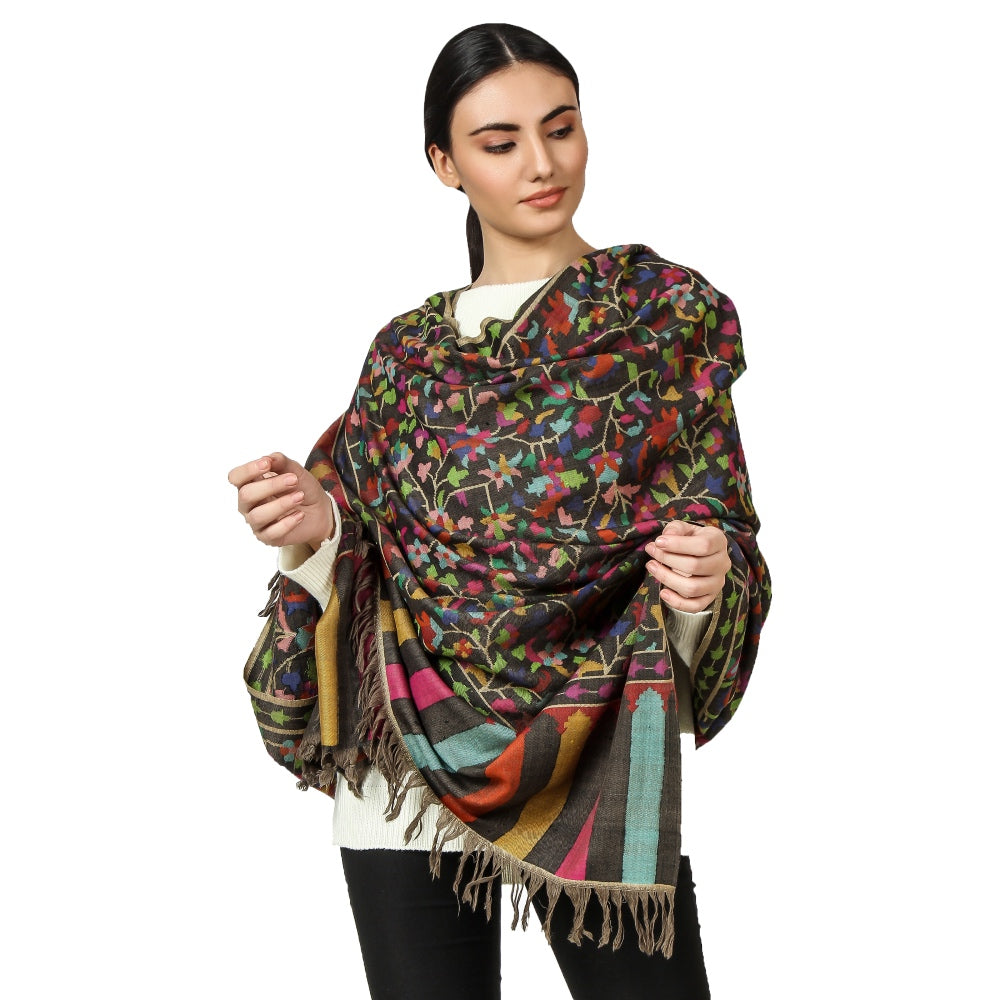
Of all the consequences of the European shawl craze, the Paisley imitation was the most structurally damaging to the Kashmir brand. The *buta* — the teardrop or pine cone motif now universally known as "Paisley" — is a Kashmiri design called *buta* in Kashmiri, where it has been woven into Pashmina shawls for centuries. It was a complex, labor-intensive art form that required extraordinary skill to execute. The Scottish mills flattened it into a two-dimensional, repeatable pattern that could be printed on fabric and machine-woven by the thousands of metres.
The Paisley imitation did not position itself as an imitation of Pashmina. It positioned itself as a superior alternative — faster, cheaper, more consistent than the handwoven original. And for many buyers, it was. Machine-woven Paisley at a fraction of the price of a handwoven Kashmir piece provided the visual effect of a Kashmir shawl without the cost or the wait. This market positioning directly undermined the perceived value of the genuine article by flooding the market with cheaper alternatives that looked almost identical in a photograph but felt nothing like the original on the skin.

The damage was compounded by the naming. "Paisley" became a household word in English, but the word does not mean "Kashmiri." It means "from Paisley, Scotland." The pattern is Kashmiri. The fiber is Kashmiri. The craft is Kashmiri. The history is Kashmiri. By naming the pattern after the imitator rather than the source, European consumers were systematically misdirected about what they were buying and where it came from. This misdirection — repeated millions of times over decades — is the reason people still search for "Paisley Shawl" expecting to find genuine Kashmiri craft, only to discover machine-woven Scottish wool.
✦ The Naming Damage
By naming the Kashmiri *buta* pattern after the Scottish town that copied it, the European market learned to associate the pattern with the imitator, not the origin. A "Paisley shawl" in European English means a Scottish machine-woven imitation of a Kashmiri design. A "Kashmir shawl" means a hand-woven original from the Kashmir Valley. These are not the same product. The confusion is inherited from the 1990s, and it persists because nobody in the supply chain — not the weavers, not the dealers, not the exporters, not the retailers — has an incentive to correct it. Changing consumer vocabulary once it is established is one of the hardest things in marketing. The word "Paisley" now means "a shawl with a teardrop pattern" in common usage, and the Kashmir origin of the pattern is all but invisible to the consumer.
From Exotic to Institutional: The Status Symbol Shift
By the 1840s, the Kashmir shawl had evolved from a fashion item into a social institution. It was no longer something a woman bought for its beauty alone. It was something a woman was expected to own as proof of her social standing. In the British Raj, receiving a Kashmir shawl as a gift — particularly one from a maharaja or a colonial official — was a mark of royal or governmental favor that carried more weight than any purchase receipt could. In Ottoman and Russian aristocratic circles, the shawl was a diplomatic gift of extraordinary prestige, exchanged between courts and noble families as a token of respect that no other object could replicate.

The institutional use of the Kashmir shawl in diplomatic contexts created a permanent association between the fibre and political power that still operates today. When conservation organisations argue that [the legal status of Shahtoosh](/blogs/news/is-shahtoosh-illegal-country-legal-guide) should disqualify it from any legitimate market, the implicit counter-argument is always the same: the shawl was a historical artifact, a cultural treasure, a family heirloom. This argument — the "pre-ban stock" defence — is used in [inherited Shahtoosh cases](/blogs/news/inherited-shahtoosh-shawl-legal) to justify continued possession. The shawl is treated as a cultural object rather than a commercial product, which is precisely the framing that prevents conservation enforcement from treating it as contraband. A "pre-ban" Shahtoosh is still Shahtoosh. It is just Shahtoosh that has not been seized yet.
By the late nineteenth century, the Kashmir shawl had become so deeply embedded in European material culture that removing it was inconceivable. It appeared in novels, in paintings, in household inventories, in probate inventories, in customs records as "cashmere shawl" or "woollen shawl." The fibre name was consistently obscured. The origin was consistently generalized. The ethical dimension was entirely absent. The European institutional embrace of a fibre that required killing an endangered species was so complete that the fibre could hide inside the label "cashmere" in plain sight. The European aristocracy did not consume Shahtoosh because they were misled. They consumed it because the market had made the fibre invisible behind layers of euphemism, and no one — not the dealers, not the buyers, not the customs officials who let it pass through — wanted to see it clearly.
The Orientalist Fantasy: Who Invented the "Exotic East" Narrative?
The most damaging long-term consequence of the European shawl craze was the Orientalist framework it imposed on Kashmiri textiles. The "Kashmir Shawl" in European literature and art was not merely a textile. It was a projection — a fantasy version of an entire civilisation, rendered in silk and watercolour on canvas, that existed primarily in the European imagination rather than in Srinagar. The Kashmir it depicted was real. The details were partially accurate. The atmosphere was mostly invention.
The Orientalist painters of the nineteenth century — from James Atkinson to William Coldstream to John Thomson — painted Kashmir with a consistency that no photograph of the valley at the time supported. The women in their paintings wear shawls in the distinctive Kashmiri drape, the landscape is vast and mountainous, the architecture is Mughal, and the light is a warm, golden haze that exists only in oil paint. The paintings were enormously popular and deeply influential — they defined European ideas about India for a global audience and created a demand for the "Kashmir aesthetic" that persists in Western interior design to this day. The "Kashmir shawl" in a painting is not a document of reality. It is a symbol — an Orientalist fantasy that absorbed the Kashmir shawl and reshaped it into a Western aesthetic object.

This framing created a problem that survives today. When a modern consumer searches for a "Kashmir shawl," they encounter a market full of products labelled "Kashmina," "Cashmere," or "Kashmere Pashmina" — many of which are neither hand-spun nor Kashmiri. The Orientalist fantasy still sells. A "Kashmir aesthetic" throw pillow or a "Kashmiri pattern" cushion looks appropriate in a modern interior because the Orientalist aesthetic has become a recognized design language. But the genuine article — the hand-spun, handwoven, GI-certified shawl from the Kashmir Valley — is fighting for visibility against machine-spun imitations that trade on its name.
The [complete history of Shahtoosh](/blogs/news/shahtoosh-history-mughal-courts-ban) existed before the Orientalist fantasy. The fibre was real. The craft was real. The artisans were real. The market was real. The Orientalist overlay was an addition — a layer of romantic exoticism applied on top of a genuine craft tradition, making the fibre seem more mysterious and desirable than it actually is, and obscuring the specific details — like the hollow core, the spinning process, the chiru — that make the fibre remarkable rather than merely exotic. The Orientalist fantasy was flattering to Kashmir's reputation in some ways — it associated the valley with artistic brilliance. But it also alienated the fibre from its material reality, turning a biological fact about a wild animal into a cultural symbol, which made the conservation argument harder to communicate because the audience could not separate the symbol from the reality.
The Aftermath: What the Craze Left Behind
The European shawl craze did not end abruptly. It faded. By the late nineteenth and early twentieth centuries, fashion had moved on. Art Deco, Art Nouveau, and modernist aesthetics rejected the dense ornamentation of the Kashmir shawl in favour of simpler, cleaner lines. The "Kashmir aesthetic" became associated in the Orientalist period — layered, intricate, Orientalist — became a period style, and period styles, by definition, go out of fashion. The shawl retreated from high-society wardrobes to museums and inheritance trunks, where it became a historical artifact rather than a living product.
The irony is that the European shawl craze ultimately strengthened the Pashmina industry by creating a global vocabulary for fine Kashmiri textiles that outlived the fashion cycles. When the Orientalist aesthetic faded, the fibre remained — not as an Orientalist object, but as the material foundation of luxury. The "Kashmir aesthetic" lives on in interior design as a recognized quality standard. "Kashmina" as a word connotes something specific, elevated, handcrafted, and authentically produced — even when the product bearing the word is machine-made. The craze created the vocabulary. The craft provides the substance.
"Every time someone describes a modern interior as 'Kashmir-inspired,' they are reaching for the aesthetic vocabulary the 1990s luxury market created — the layered look, the intricate patterns, the warm neutral palette — and attributing it to a living craft rather than a dead aesthetic. The Kashmir shawl craze did not die. It became the design language of fine living. And the fibre that powered it — [genuine Kashmiri Pashmina](/pages/kashmiri-pashmina) — is still being hand-spun and handwoven in Srinagar, by artisans whose families have been doing this for centuries. The Orientalist fantasy faded. The craft endured.
Frequently Asked Questions
Did ordinary people in Europe actually wear Shahtoosh, or only the ultra-elite? +
The ultra-elite — royalty, ambassadors, billionaires — almost certainly handled genuine Shahtoosh. They were the ones with the contacts, the access, and the willingness to pay $5,000+ for a shawl. The middle and upper-middle classes mostly handled Pashmina, and within that category, the very finest Pashmina — at 12–13 microns, hand-spun — was often described by dealers as "like Shahtoosh" or "near-Shahtoosh" to justify the premium price. The middle classes bought "Kashmir shawls" that were almost entirely Pashmina — some of which contained Shahtoosh thread blended into the weave — and they wore them as status objects without knowing which fibre was which. In European courts and social circles, the shawl was so established as a status item that it became invisible as a fibre. Nobody needed to name the fibre to signal they owned it. The shawl spoke for itself.
Was the shedding myth invented in the 1990s, or did it originate earlier? +
The shedding myth predates the 1990s by at least a century. We have found references to the shedding claim in colonial-era texts from the 1880s and 1890s. A British textile inspector named J. M. Hardwicke described the shedding claim in an 1885 report, and wildlife investigators documented it as long-standing misinformation in the 1970s. The myth is old. It is not a modern invention, and it is not a Kashmiri invention. It is a myth that originated somewhere in the trade routes between Tibet and Ladakh, was carried to Kashmir by intermediaries, and was repeated in European markets for over a century before anyone with real authority challenged it.
Did the 1990s scandal permanently destroy the market for genuine Kashmir shawls? +
Yes and no. Yes, permanently, the 1990s scandal destroyed the open luxury market for genuine Kashmir shawls — the high-end retail channels that gave the fibre its mystique no longer exist. But the craft infrastructure survived. The hand-spinners, the weavers, the looms — they did not disappear when the boutiques closed. They redirected to Pashmina. The quality of genuine hand-spun Pashmina available today is, in many cases, directly attributable to the post-1990s redirection of Shahtoosh artisans. The market for "Kashmir shawls" — the mass market — was flooded with machine-spun imitations that drove prices down and confused the consumer forever. The market for genuine hand-spun, handwoven Kashmiri Pashmina is smaller, more expensive, and harder to find, but it exists, it is real, it is legally clean, and it is the craft heritage the Shahtoosh market destroyed.
Continue Reading — The Shahtoosh Series
Pillar Page · Full Comparison
Shahtoosh vs Pashmina: The Complete Guide to Understanding the Difference
M2·05 · European Era
Shahtoosh in European Aristocracy: The Shawl That Conquered 19th Century Fashion
M1·25 · Etymology
The Meaning of "Shahtoosh": What the Word Actually Means and Where It Comes From
M2·14 · Sensory
Shahtoosh vs Pashmina: A Side-by-Side Comparison Every Buyer Should Bookmark
The craft that outlasted the fashion cycle
Genuine Kashmiri Pashmina.
Still the finest thing on earth — even without the scandal.
The European craze loved the Orientalist fantasy of Kashmir shawls — but the fantasy could only survive as long as the craft that produced it remained inaccessible. When machine-spun imitations made Kashmir shawls widely available, the rarity that made the original valuable was destroyed. [Genuine Kashmiri Pashmina](/pages/kashmiri-pashmina) carries the craft heritage of the Orientalist fantasy without the illegality. Same valley, same artisans, same looms, same fibre — no chiru required. The aesthetic persists because the craft endures. The crime does not.