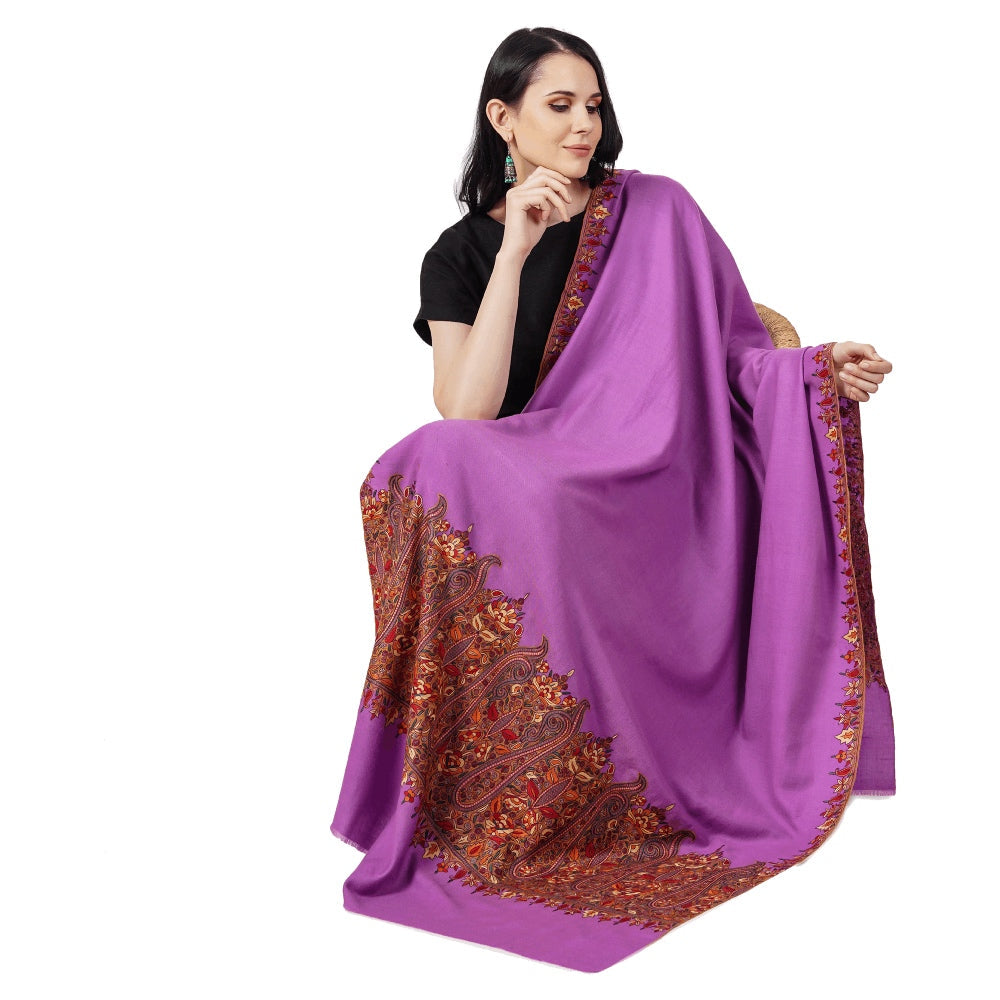

Shahtoosh and the Paisley Pattern: How Kashmir's Most Famous Design Was Born
There is a widespread misconception that the Paisley pattern was invented for Shahtoosh. It was not. The teardrop motif, known in Kashmir as 'Ambi' or 'Kani,' was born on the looms of Srinagar centuries before Shahtoosh became the West's most coveted illegal fiber. The pattern belongs to Kashmiri Pashmina — and understanding why it is so closely associated with Shahtoosh tells the entire story of how a craft tradition was misunderstood by the luxury market.
The Origins of a Motif
- 01 The Misconception: Why People Think Paisley Belongs to Shahtoosh
- 02 The Name: From a Scottish Town to the Kashmiri 'Ambi'
- 03 The Boteh: The Ancient Root of the Teardrop
- 04 The Kani Loom: The Engineering Marvel That Made Paisley Possible
- 05 Shahtoosh vs. Pashmina: How the Same Pattern Behaved on Different Fibers
- 06 The European Misunderstanding: How a Weave Became a Print
- 07 The True Legacy: Paisley on Pashmina Today
When most people in the West hear the word "Paisley," they think of a 1960s bohemian print, a swirling teardrop on a silk tie, or a vintage bandana. When textile historians hear it, they think of a specific weaving technique developed in Kashmir. But when vintage textile dealers and auction houses describe a "Paisley Shahtoosh," they are invoking a phrase that carries a heavy load of historical confusion. To understand [what Shahtoosh is](https://www.pashwrap.com/blogs/news/shahtoosh-vs-pashmina) in the context of this pattern, we have to separate the motif from the fiber — and understand why the luxury market fused them together in the public imagination.
The Misconception: Why People Think Paisley Belongs to Shahtoosh
In the 18th and 19th centuries, the finest, most expensive Kashmiri shawls reaching Europe were indeed made from Shahtoosh. The European aristocracy — the Empress Joséphine, Queen Victoria, the Russian czarinas — prized these shawls above all other textiles. Many of these elite shawls featured the intricate, repeating teardrop pattern. Because Shahtoosh was the most expensive fiber, and the teardrop shawls were the most expensive pattern, a mental association was formed: the finest pattern must belong to the finest fiber.
This association is false. The teardrop pattern — which we will call by its Kashmiri name, Ami, or its technical name, Kani — was not invented for Shahtoosh. It was invented for Pashmina. The Kani weaving technique, which creates the pattern, was developed centuries before Shahtoosh became the dominant luxury fiber in the European market. The confusion arose because European buyers rarely understood the difference between the two fibers, and the dealers who sold to them had every incentive to blur it.
⚠ The Dealer's Convenience
In the 19th century, calling a patterned Pashmina shawl a "Shahtoosh" allowed a dealer to command a significantly higher price. Because the pattern was so intricate and the weave so fine, the buyer could not visually distinguish between high-grade Pashmina and genuine Shahtoosh. The pattern became complicit in the fraud. A dense Kani Pashmina shawl, labelled as Shahtoosh, could sell for five times its actual value. The motif was used as "proof" of the fiber's alleged rarity — a circular logic that served the dealer and deceived the buyer.
Many of the "Shahtoosh" shawls in Western museum collections today, when tested, turn out to be [genuine Kashmiri Pashmina](https://www.pashwrap.com/pages/kashmiri-pashmina). The pattern was real. The fiber was misidentified — often deliberately, centuries ago.
The Name: From a Scottish Town to the Kashmiri 'Ambi'
"Paisley" is not a textile term. It is a place name — a town in Scotland, near Glasgow. In the early 19th century, Paisley became the centre of a massive British shawl-weaving industry that copied Kashmiri designs using mechanized looms. The Scottish weavers could not replicate the fiber, but they could copy the pattern. The pattern became so strongly associated with the town's output that the design permanently acquired its name.
In Kashmir, no one calls it Paisley. The pattern has two primary names, each referring to a different aspect of the same tradition:
When a foreign buyer asks for a "Paisley shawl," they are using a Scottish town's name for a Kashmiri motif. When a Kashmiri weaver describes the same object, they say "Kani shawl" — identifying it by the extraordinary technical method used to create it, not by the shape of the design. The difference in naming reflects a difference in understanding: the West sees a pattern. Kashmir sees a craft.
The Boteh: The Ancient Root of the Teardrop
The Ami shape did not originate in Kashmir. The ancestral form of the motif is the Boteh — a Persian word meaning "bush" or "shrub," though its visual origin is debated among art historians. The most widely accepted theory traces the Boteh to Zoroastrian and Sassanid Persia (pre-7th century CE), where it represented a cypress tree, a flame, or a stylised floral spray. It was a symbol of life, eternity, and fertility in the ancient Persian visual vocabulary.
When the motif arrived in Kashmir — carried along the same trade routes that brought Islam, Persian language, and Central Asian artistic traditions to the Valley — it was absorbed into the local visual culture. In Kashmir, the cypress tree was not an exotic symbol. It grew in the Valley's Mughal gardens. The local aesthetic sensibility reinterpreted the rigid Persian Boteh into something softer, more curved, and more organic. The sharp Persian cypress became the rounded Kashmiri Ami. The exact point of transition is lost to history, but by the 16th century, during the early Mughal period, the Ami was firmly established as a Kashmiri design element.
The Mughal courts — particularly under Emperor Akbar, who ruled from 1556 to 1605 — played a crucial role in elevating the motif. Akbar established the imperial workshops (karkhanas) that formalised Kashmiri shawl weaving as a court art. He and his successors patronised designs that combined Persian geometry with Indian naturalism. The Ami, with its Persian lineage and its new Kashmiri softness, was perfectly suited to this aesthetic fusion. The complete history of Shahtoosh and Pashmina in the Mughal era shows how court patronage transformed a regional craft into an imperial art form — and the Ami was at the centre of that transformation.
The Kani Loom: The Engineering Marvel That Made Paisley Possible
The Ami motif could be embroidered. But embroidery on a fine Pashmina shawl is slow, and the result is a pattern that sits *on top of* the fabric. The Kani technique is fundamentally different: the pattern is *woven into* the fabric itself. There is no embroidery. The shawl is a single, integrated textile where the pattern and the background are created simultaneously on the loom.
The Kani loom is a pit loom — the weaver sits in a pit with their feet operating the treadles. But instead of a single shuttle carrying weft yarn across the entire width, the Kani weaver uses dozens, sometimes hundreds, of small wooden bobbins called tujis. Each tuji carries a different coloured yarn. The weaver follows a coded pattern — traditionally an oral or written instruction system passed down within weaving families — selecting the correct tuji for each tiny section of the weft. The tuji is passed through the shed (the gap between the warp threads) for exactly the number of warp threads required by that colour in the pattern, then another tuji is picked up.
✦ What This Means in Practice
A single Kani shawl might contain 50 to 100 different coloured yarns, each on its own tuji. The weaver makes thousands of individual tuji passes per row. A complex Kani shawl — the kind with dense, overlapping Ami patterns that European buyers paid fortunes for — can take two skilled weavers working simultaneously for 12 to 18 months to complete. The pattern is not printed, not embroidered, not stamped. It is physically constructed, one coloured thread at a time, in the structure of the fabric itself. This is why a genuine Kani shawl cannot be faked by any printing or embroidery process — the weave structure is visible under magnification and is impossible to replicate without the loom technique.
This technique was developed for Pashmina, not Shahtoosh. The Kani method requires a warp and weft with sufficient tensile strength to withstand the constant passing of tujis and the tension of the loom. Pashmina at 12–16 microns, while extraordinarily fine, has the structural integrity required for this technique — particularly when the yarn is spun tightly by an expert hand-spinner. It is demanding, slow work, but the fiber holds.
Shahtoosh vs. Pashmina: How the Same Pattern Behaved on Different Fibers
This is where the physics of the fiber intersects with the art of the pattern. Could Shahtoosh be woven in the Kani technique? Yes, but rarely, and with extreme difficulty.
Shahtoosh at 9–12 microns is significantly more fragile than Pashmina. The Kani technique places considerable stress on the weft yarn — the constant pulling of tujis through the warp shed creates friction and tension that can break Shahtoosh yarn if the weaver's tension is not perfectly calibrated. Weaving a dense Kani pattern in Shahtoosh was considered the ultimate test of a weaver's skill precisely because the margin for error was so small. A single broken thread in a Kani pattern is visible and difficult to repair without showing the mend.
The reality is that the overwhelming majority of Kashmiri shawls featuring the Ami/Paisley pattern throughout history were woven in Pashmina, not Shahtoosh. Shahtoosh shawls were more commonly woven in plain twill — without pattern — because the fiber's primary value was its extraordinary softness and warmth, not its capacity to carry a complex design. The most prized Shahtoosh shawls were often the plainest: a single colour, a simple twill weave, letting the fiber itself be the statement. Adding a heavy Kani pattern to Shahtoosh was, in a sense, fighting against the fiber's nature — adding weight, stress, and visual complexity to a material whose entire appeal was its weightlessness and simplicity.
"In our family's experience, the weavers who worked with Shahtoosh treated it with a kind of reverence that was different from how they treated Pashmina. Pashmina was the workhorse — strong enough to be woven into anything, any pattern, any complexity. Shahtoosh was treated like something fragile that had to be coaxed onto the loom. The idea of subjecting it to the stress of a dense Kani pattern made the older weavers uncomfortable. They did it when a buyer demanded it and paid for it. But they didn't think it was the best use of the fiber."
The European Misunderstanding: How a Weave Became a Print
The transformation of the Kani Ami into the "Paisley print" is one of the most consequential misunderstandings in textile history. When Kashmiri shawls began arriving in Europe in significant numbers in the late 18th century, European textile manufacturers — particularly in Scotland and France — were desperate to copy them. But they could not copy the fiber (they had no Pashmina), and they could not copy the technique (the Kani loom was too slow and too skilled for industrial production).
What they could copy was the visual pattern. Using the Jacquard loom — invented in 1804 — European manufacturers could reproduce the *appearance* of a Kani pattern in woven wool, silk, or cotton. Later, printing techniques allowed the pattern to be stamped onto fabric at industrial speed. The pattern was divorced from the technique, the technique was divorced from the fiber, and the fiber was forgotten entirely. "Paisley" became a two-dimensional print, not a three-dimensional weave structure.
This had a devastating secondary effect on the understanding of Shahtoosh. As the European market became flooded with machine-made "Paisley" shawls, the term became generic. Dealers selling genuine Kashmiri shawls — many of which were actually Pashmina — used the word "Paisley" to signal authenticity and quality. "Paisley Shahtoosh" became a marketing phrase that combined a Scottish town name, a misunderstood Kashmiri motif, and an often-misidentified fiber. The actual craft — the Kani weaving, the hand-spinning, the loom technique — disappeared behind the commercial label. The [history of Shahtoosh in European fashion](https://www.pashwrap.com/blogs/news/shahtoosh-european-aristocracy-19th-century) is, in large part, a history of this kind of mislabeling.
The True Legacy: Paisley on Pashmina Today
The Kani technique survives in Kashmir today — but exclusively on Pashmina. The reason is straightforward: Shahtoosh is illegal, and the Kani shawl requires months of labor on a single piece. No weaver is going to spend 18 months weaving a pattern into a fiber they cannot legally obtain, cannot legally sell, and cannot legally export. The entire living tradition of Kani weaving now exists on handwoven Pashmina shawls, where it has always belonged.
A genuine Kani Pashmina shawl is one of the most technically accomplished textiles a human being can produce. It is not a print. It is not embroidery. It is a structure — thousands of individually placed coloured threads, woven simultaneously into the fabric on a handloom operated by a weaver sitting in a pit. The pattern exists not as a surface decoration but as the fundamental architecture of the textile. Turn a Kani shawl over, and the pattern is visible on the reverse — slightly muted, but structurally present — because it is part of the weave, not applied to it.
The Paisley pattern was born on Pashmina looms, perfected by Pashmina weavers, and sustained by Pashmina's tensile strength. Shahtoosh was a temporary, expensive, and ill-suited canvas for a pattern that was never designed for it. The craft survived. The illegal fiber did not. That is the true history of Kashmir's most famous design.
The pattern belongs to the loom. The loom belongs to Pashmina.
The confusion between Paisley, Pashmina, and Shahtoosh is ultimately a confusion between a craft and a commodity. The European market treated the Kashmiri shawl as a commodity — a luxury good to be copied, mass-produced, and mislabeled. The Kashmiri weavers treated it as a craft — a technical tradition passed down through families, refined over generations, and executed with a precision that machines still cannot replicate. The Ami pattern, woven in the Kani technique on genuine Pashmina, is craft at its highest expression. Understanding this distinction is the beginning of understanding not just the pattern, but the entire world it comes from.
Frequently Asked Questions
Are Paisley shawls always made using the Kani technique? +
No. In the modern market, "Paisley" almost always refers to a printed pattern, not a woven one. A printed Paisley shawl is made by stamping or screening the teardrop design onto a piece of fabric. A Kani shawl has the pattern woven into its structure. They are completely different products with different values, different durability, and different craftsmanship levels. A printed shawl costs a fraction of a genuine Kani shawl. The distinction is the single most important thing to understand when shopping for Kashmiri textiles.
Can you still buy genuine Kani Pashmina shawls? +
Yes. Kani weaving is still practiced in Kashmir, though the number of master weavers capable of producing top-quality work is declining. A genuine Kani Pashmina shawl is a significant investment of both time and money — the weaving alone takes many months. It is one of the most technically demanding textile arts in the world. Pure Pashmina shawls with genuine Kani work represent the highest tier of the Kashmiri weaving tradition.
How can I tell if a Paisley pattern is printed or woven (Kani)? +
Turn it over. A printed pattern will be visible only on the front surface. The back will be plain fabric with faint traces of ink bleeding through. A Kani woven pattern will be clearly visible on both sides — slightly less sharp on the reverse, but structurally present because the coloured threads are part of the weave, not applied to it. You can also look at the edges: a Kani shawl's pattern extends seamlessly to the selvedge, because the pattern is woven across the entire width. A printed pattern often shows slight misalignment or truncation at the edges.
Did the Kani technique originate with Shahtoosh or Pashmina? +
Pashmina. The Kani technique was developed for Pashmina because Pashmina has the tensile strength required for the constant tension of multiple tujis passing through the warp. Shahtoosh is too fragile for this technique to be used routinely. The Kani loom is a Pashmina technology, born from centuries of Pashmina weaving expertise. The association with Shahtoosh is a later, market-driven misattribution. Understanding the difference between Shahtoosh and Pashmina makes this clear.
Why is the pattern called a "teardrop" in the West if it represents a mango in Kashmir? +
Because the 19th-century European textile copyists who reproduced the pattern had never seen a mango. They saw a curved, pointed shape and named it based on their own visual vocabulary — a teardrop, or sometimes a pine cone. The Kashmiri weavers, who grew up with mangoes as a central part of their visual and culinary culture, immediately recognised the form. The same motif carries different names depending on which culture is looking at it — Persian cypress, Kashmiri mango, Scottish teardrop. The shape travelled. The names stayed home.
Continue Reading — The Shahtoosh Series
M2·01 · History Pillar
The Complete History of Shahtoosh: From Mughal Courts to Modern Ban
M2·05 · European History
Shahtoosh in European Aristocracy: The Shawl That Conquered 19th Century Fashion
Pillar Page · Full Comparison
Shahtoosh vs Pashmina: The Complete Guide to Understanding the Difference
M1·27 · Craft & Science
Shahtoosh Weaving: Why Only a Handful of Artisans Could Do It
The pattern's true home
Genuine Kashmiri Pashmina.
The fiber that invented the pattern. The craft that perfected it.
The Paisley pattern was never designed for Shahtoosh. It was designed for Pashmina, by Pashmina weavers, on Pashmina looms. When you choose a genuine Pashmina shawl, you are choosing the fiber that this extraordinary craft tradition was built for.