
Sozni Embroidery on Pashmina: The Artisan Alternative to Plain Shahtoosh
The finest Shahtoosh shawls were always left plain. Not from lack of ambition — from structural necessity. A fiber at 9–12 microns cannot survive the sozni needle without visible damage. Pashmina, at 12–16 microns, not only survives the needle — it is transformed by it into something Shahtoosh could never become: a canvas for one of the world's most demanding and most beautiful embroidery traditions.
In This Article
- Why Shahtoosh Was Always Plain — The Structural Reason
- What Sozni Is — Kashmir's Needle Embroidery Tradition
- The Sozni Process — From Blank Cloth to Finished Shawl
- The Motif Vocabulary — What Sozni Artisans Draw From
- The Artisan — Who Does This Work and How Long It Takes
- Sozni Grades — From Border Work to Full Jama
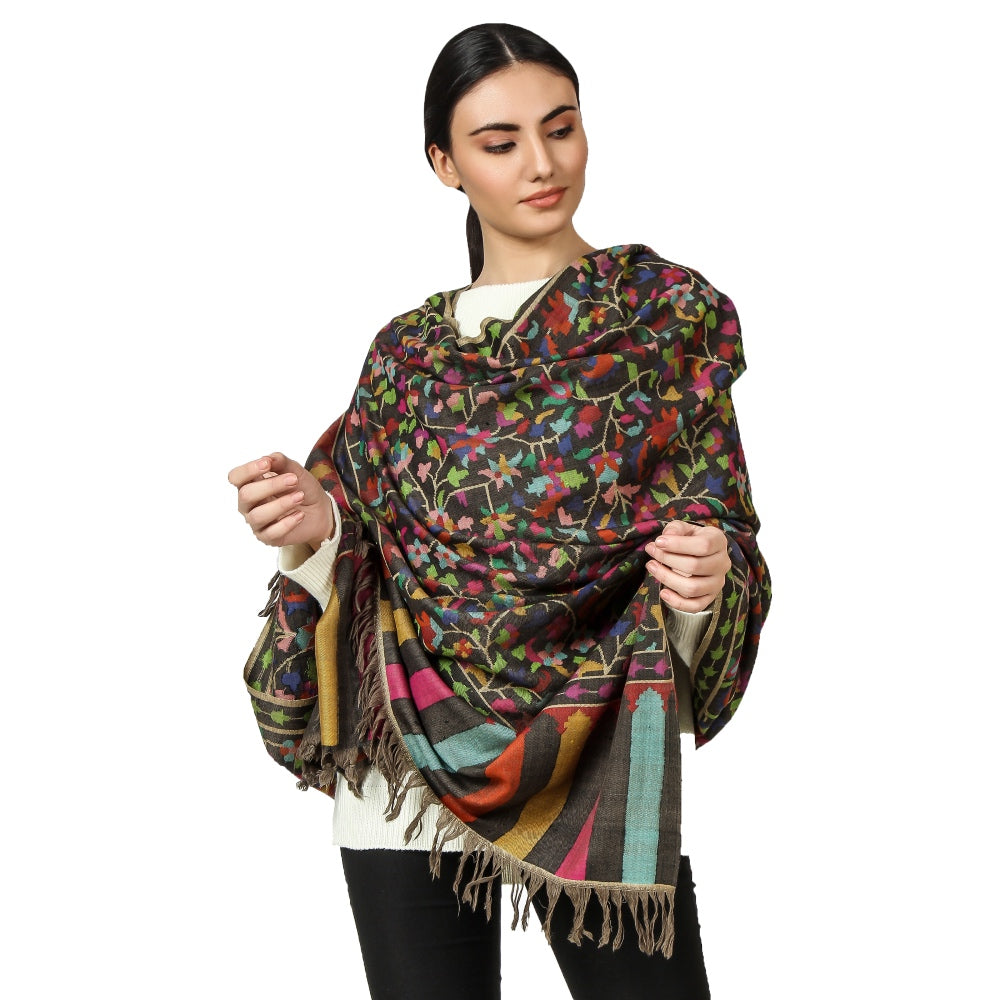
- Sozni vs Kani — The Two Great Pashmina Decoration Traditions
- What Shahtoosh Could Not Give — Why Embroidery Matters
- Frequently Asked Questions
Every craft tradition has its ceiling — the technical limit beyond which the material's own properties prevent further elaboration. For Shahtoosh, that ceiling was surprisingly low: the fiber so fine that the weave so delicate that a needle passing through it left a permanent scar. The finest Shahtoosh pieces in existence are plain weave, undecorated from selvedge to selvedge, because decoration was structurally impossible. The ceiling was the floor.
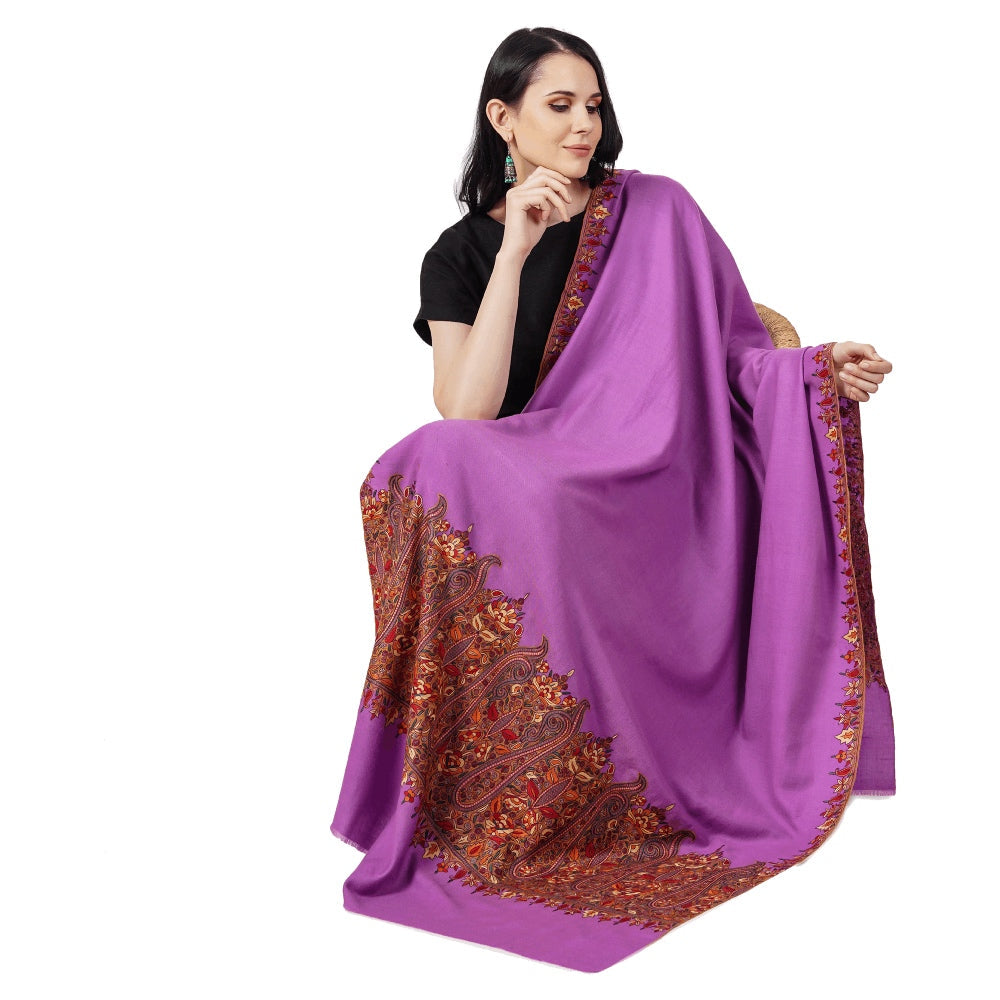
Pashmina's ceiling is different. At 12–16 microns, the fiber has sufficient tensile strength to accommodate the passage of a sozni needle without permanent structural damage — and the hasil, the result, is a category of embroidered textile that represents one of the world's highest achievements in needle art. The sozni shawl is not a decorated Pashmina; it is a transformed one. The embroidery does not add to the cloth — it becomes the cloth's purpose.
Why Shahtoosh Was Always Plain — The Structural Reason
🪡 Why One Fiber Can Be Embroidered and One Cannot
At this fineness, the warp and weft threads have insufficient mass to spring back after needle penetration. Each stitch of a sozni needle displaces two or three adjacent warp threads permanently — creating a micro-deformation that is invisible in isolation but accumulates across an embroidered surface into a visible texture irregularity. The deformation also creates a structural weakness: needle tracks become stress concentration points that are more likely to tear under the normal mechanical stresses of wear and washing. The finest Shahtoosh weavers understood this immediately: decorating their most extraordinary fabric would destroy the very qualities that made it extraordinary.
At genuine Pashmina fineness, the thread has enough mass that needle penetration creates a temporary displacement that largely recovers as the fabric is handled and settles after embroidery. The woven structure is robust enough to retain its integrity across the thousands of needle passages that a fully embroidered sozni shawl requires. The result is a fabric that absorbs the embroidery without visible structural compromise — the embroidered surface has the same visual clarity and surface quality as unembroidered Pashmina, with the additional density and colour of the sozni thread laid over it. The structural difference of 3–4 microns opens an entire artistic dimension that was permanently closed to Shahtoosh.
This structural distinction — documented in our earlier article on Shahtoosh embroidery and plain weave — is among the most practically significant differences between the two fibers from a craft perspective. Shahtoosh buyers who paid a premium for the finest pieces were buying the extreme end of a product category whose maximum achievement was and could only ever be plain cloth. Pashmina buyers who commission sozni embroidery are buying entry into a craft tradition that has been developing its motifs, techniques, and artistic vocabulary for centuries — a tradition to which Shahtoosh never had access.
What Sozni Is — Kashmir's Needle Embroidery Tradition
Sozni is the Kashmiri term for the fine needle embroidery that is one of the Valley's two great textile decoration traditions — the other being kani tapestry weaving, in which coloured threads are woven into the fabric structure rather than embroidered onto its surface. Where kani embroidery is produced simultaneously with the weaving, sozni is applied to an already-completed handwoven Pashmina cloth by a specialist embroiderer whose training and tools are entirely separate from the weaver's.
The needle used in sozni work — itself called a sozni — is extremely fine: typically of surgical-grade steel, with a point ground to a needle-fineness that allows it to pass between warp and weft threads without severing them, and an eye small enough to carry the fine silk or Pashmina thread used for embroidery without creating a visible hole at the thread entry point. The sozni artisan works with this needle under magnification (natural light from a north-facing window is traditionally preferred, supplemented today with magnifying lenses for the finest work) and stitches designs that may have been transferred onto the fabric by a specialist pattern-drawer called a naqqash or worked directly from memory by master embroiderers who carry the motif vocabulary in their hands.
✦ Sozni vs Aari — The Two Kashmir Embroidery Needles
Sozni should be distinguished from aari embroidery — the other major Kashmir needle tradition — which uses a hooked needle to create chain stitch from the reverse side of the fabric, working relatively quickly across large areas. Aari creates bolder, more three-dimensional embroidery suited to heavier fabrics. Sozni uses a straight needle to create flat stitches from the surface of the fabric, allowing extremely fine and detailed work at a much slower pace. The finest sozni embroidery on a full Pashmina shawl may take a master artisan twelve to eighteen months to complete — entirely from the right side of the fabric, stitch by stitch, building up a surface that from a distance reads as a continuous painted field and up close reveals thousands of individually placed stitches of extraordinary precision.
The Sozni Process — From Blank Cloth to Finished Shawl
The sozni artisan receives a completed handwoven Pashmina shawl — already woven, washed, and finished — as the ground fabric for embroidery. The first step is inspection: examining the weave for any irregularities that would affect the embroidery's registration, and assessing the fabric's tension and stability to ensure it will hold its shape through the months of handling that embroidery requires. The shawl is then framed — stretched gently across a wooden frame that keeps it at consistent tension throughout the embroidery process — or worked in sections held taut by the artisan's own hand.
Time: 1–2 days for a full shawl preparation.
For all but the most experienced master sozni artisans who work from memory, the design is transferred to the fabric by a naqqash — a specialist pattern-drawer who traces or stamps the design onto the cloth surface in a water-soluble ink or chalk that will disappear during the final washing of the finished piece. The naqqash holds the complete design vocabulary in their head and translates it to the specific fabric dimensions, adjusting the motif scale and spacing to the shawl's proportions. This is itself a skilled job: a poorly transferred pattern creates problems for the embroiderer at every stage.
Time: 1–5 days depending on design complexity. Master artisans working from memory skip this stage entirely.
Sozni embroidery proceeds in two passes: first an outlining phase in which the major motifs are defined by their outlines in a single thread colour, establishing the design's structure across the whole piece before any fill work begins. This pass allows the artisan to check the design's proportions and balance before committing to the far more time-consuming fill phase. In traditional sozni, the outlining thread is often in a colour that will be covered by the fill — it functions as a structural guide rather than a visible design element.
Time: Weeks to months for a fully outlined shawl, depending on design density.
The fill phase is the heart of sozni embroidery and the source of most of its time investment. Each outlined motif is filled with carefully placed parallel stitches — typically worked in the same direction throughout a given petal, leaf, or geometric element, creating the sheen-play effect that characterises fine sozni as the filled areas catch light differently from the surrounding woven ground. Colour changes within a single motif — shading from light to dark across a petal, transitioning between tones within a leaf — are achieved by the artisan mixing thread colours on the needle or changing threads stitch by stitch. There are no shortcuts in sozni fill work. Each stitch is placed once, by hand, with precision.
Time: The dominant phase — months to years for densely embroidered pieces.
On completion of the embroidery, the shawl is washed to remove any remaining pattern ink or chalk, to settle the embroidery threads into their final positions, and to restore the overall drape of the fabric after the months of handling and tension during embroidery. The washing is done by hand, gently, with particular attention to the embroidered areas where thread density creates moisture-retention zones that must be dried carefully to avoid distortion. Final inspection checks the evenness of the fill, the registration of the motifs, and the fabric's condition after the embroidery process.
Time: 2–5 days for washing and drying; inspection may require rework on individual stitches.
The Motif Vocabulary — What Sozni Artisans Draw From
The floral motif tradition in Kashmiri sozni draws from both the Valley's own garden culture and the Mughal court's Persian-derived floral aesthetic. The iris — the Valley's most characteristic flower, which grows wild across Kashmir's meadows — appears in thousands of variations across the sozni tradition, from highly naturalistic renderings to highly stylised geometric abstractions. The rose, the lotus, and the cherry blossom similarly appear across a spectrum from botanical realism to pure decorative pattern. Master sozni artisans carry dozens of flower variations in their hands — adapting the base form to the scale, ground, and colour palette of each specific commission.
The paisley or boteh is so strongly associated with Kashmir textiles that the paisley pattern itself takes its Western name from the Scottish town of Paisley whose mills copied it from Kashmiri shawls in the nineteenth century. In sozni embroidery, the boteh appears in sizes ranging from a few millimetres to the full width of a shawl end, in isolation or in packed repeating fields, with interior fill ranging from simple flat colour to multi-motif landscapes in which entire garden scenes are compressed into a single teardrop form. The boteh is simultaneously the simplest and the most complex motif in the sozni vocabulary — a form so familiar that its variations carry the full weight of the tradition's development.
The chinar — the oriental plane tree that shades Kashmir's gardens, avenues, and Dal Lake shores — is the Valley's most symbolically important tree, celebrated in poetry, architecture, and textile art for centuries. In sozni embroidery, the chinar leaf's characteristic five-lobed form appears as a recurring motif in border designs, allover patterns, and as a compositional anchor for larger floral arrangements. The autumn chinar's colours — the gold, amber, and crimson of the Valley's most celebrated season — inform many sozni colour palettes, connecting the embroidery tradition to the most viscerally felt annual experience of the Kashmiri landscape.
Before the Mughal-period floral aesthetic dominated the Kashmir textile tradition, geometric patterns — lattice structures, repeated angular forms, interlocking polygons derived from architectural tilework and manuscript illumination — formed the design vocabulary for Kashmir's finest woven and embroidered textiles. These geometric traditions persist in sozni as border patterns and as background fill for the spaces between larger floral motifs, connecting the tradition to an aesthetic that predates the more familiar floral vocabulary by several centuries.
The Artisan — Who Does This Work and How Long It Takes
🧑🎨 The Sozni Artisan — A Profile
The sozni artisan is typically a man — unlike Pashmina spinning, which is predominantly women's work, and unlike kani weaving which is mixed, sozni embroidery in the Kashmir Valley has traditionally been a male-dominated craft. Boys learn from their fathers or from established masters in a household or workshop tradition that combines formal apprenticeship with family transmission of the specific motif vocabulary and technical standards of a particular lineage.
A sozni apprentice typically spends two to three years on preparatory work — learning to thread the needle correctly, to hold it at the precise angle that creates a flat stitch rather than a looping one, to maintain consistent stitch length across varying thread directions, and to keep the reverse side of the fabric as clean as the surface. Only after this foundational period does the apprentice begin working on pieces that will be sold — starting with border work on accessible designs before progressing to the fill work on complex motifs that represents the tradition at its finest.
A master sozni artisan carries a complete design vocabulary in their hands — dozens of flower and leaf forms at multiple scales, multiple border pattern types, the proportional conventions that govern how different motifs relate to each other within a composition. This knowledge is not written down. It is transmitted through working alongside a master long enough to internalise the vocabulary, and it is lost when a lineage of artisans breaks without a new generation to receive it. The GI certification that now protects Kashmiri Pashmina includes provisions for sozni embroidery as a component of authenticated Kashmir textile production — an institutional recognition that the knowledge the artisan carries is as much a part of what is being protected as the fiber itself.
Sozni Grades — From Border Work to Full Jama
⏱ Sozni Embroidery — Time and Coverage Grades
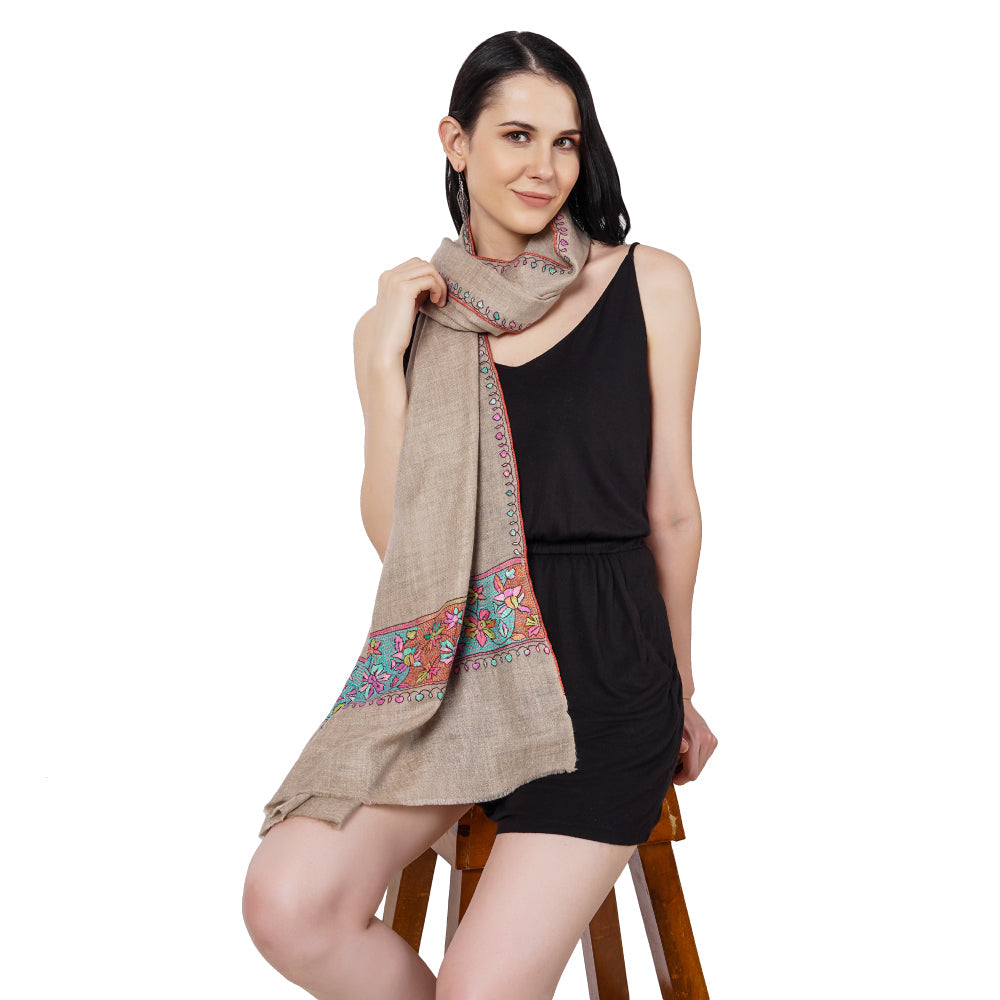
Border Sozni
Embroidery confined to the shawl's border (pallu) and selvedge edges — the central field left as plain handwoven Pashmina
3–8 weeks for a master artisan. Entry point of the sozni tradition — most widely available and accessible.
Scattered Field
Individual motifs scattered across the field in addition to border work — typically 30–50% surface embroidery
2–5 months. The motifs are more numerous but not touching — breathing room between embroidered elements.
Jali (Lattice)
A lattice or trellis structure embroidered across most of the field — motifs filling each cell of the lattice
5–10 months. The lattice structure demands high registration precision — any drift in the geometric grid is immediately visible.
Kalamkari (Full Field)
Dense embroidery covering 70–90% of the shawl surface — the plain weave visible only as the ground between closely packed motifs
8–18 months for a master artisan. The piece is as much embroidery as Pashmina — the cloth a substrate for an extended needle-drawn composition.
Jama (Complete Coverage)
Complete surface embroidery — no plain weave ground visible. Both sides finished to near-identical standard in the finest examples.
18 months to 3 years. The pinnacle of the sozni tradition. A completed jama shawl by a master artisan is among the most time-intensive luxury textiles produced anywhere on earth.
Sozni vs Kani — The Two Great Pashmina Decoration Traditions
Sozni and kani are the two great decoration traditions of Kashmir's Pashmina textiles, and comparing them clarifies what sozni's specific qualities are and why each remains irreplaceable in the tradition.
Kani weaving — described in detail in our article on the khaddi loom — integrates coloured threads into the fabric structure during weaving: the weaver switches between multiple coloured weft threads to create a tapestry-woven pattern simultaneously with the ground weave. A kani shawl's pattern is structurally part of the fabric itself — not applied to the surface but woven into it. Kani patterns are characteristically bolder, with harder colour edges and a structured geometry that reflects the interlocked tapestry weave; the reverse side of a kani shawl shows a different aspect of the same pattern from the front.
Sozni embroidery is applied after weaving — it is a layer placed on top of an already-completed cloth. Sozni patterns are characteristically more fluid and naturalistic than kani, because the needle can move in any direction on the fabric surface without the directional constraints that the warp-and-weft grid imposes on woven pattern. A sozni flower's petals can curve freely; a kani flower's petals step in the geometric increments the weave allows. Sozni shading — the gradual transition from one colour to another within a motif — is a fluid needle-drawing operation; kani shading is a technical feat of thread management in the weave.
✦ The Unique Achievement of Each Tradition
A master kani shawl achieves something that no other textile construction method can produce: a pattern that is structurally one with the cloth, reversible, with the precision of a woven grid applied to a naturalistic motif vocabulary. A master sozni shawl achieves something that weaving cannot: a drawn surface, fluid and free, with the shading and curvature of a painter's line applied to a cloth that retains the Pashmina's characteristic drape and weight beneath the embroidery's additional density. Both are irreplaceable. Neither is a lesser version of the other. Together they define what Pashmina can become when the craft communities of the Valley apply their full attention to it — and what Shahtoosh, with its structural prohibition on decoration, could never be.
What Shahtoosh Could Not Give — Why Embroidery Matters
The inability of Shahtoosh to carry sozni embroidery is not a minor limitation — it is a fundamental constraint on what the fiber could become as a cultural and artistic object. A luxury textile is not only a sensory experience; it is a site of human creativity, of artistic tradition, of the accumulated knowledge of craft communities that have refined their practice across generations. Shahtoosh's extreme fineness, which produced its extraordinary sensory qualities, simultaneously prevented it from becoming the substrate for that creative accumulation.
The finest Pashmina shawls in the world are not plain. They are the sozni-embroidered pieces that a single artisan spent twelve or eighteen months elaborating — the pieces in which the woven cloth is the beginning of a process rather than the end of it, the ground on which a complete artistic statement is made using tools and a design vocabulary that carry centuries of tradition behind every stitch.
"Shahtoosh was the finest thing the loom could make from the finest fiber the Himalayan plateau produced. Sozni-embroidered Pashmina is the finest thing a needle can add to what the loom has made. The two crafts serve different purposes — and only one of them was available to Shahtoosh. The other was always Pashmina's alone."
This matters not only as a craft distinction but as a quality argument: a buyer seeking the ultimate Kashmiri textile experience — the intersection of the finest handwoven cloth and the finest needle decoration — cannot find it in Shahtoosh, which was prohibited by its own fiber from receiving the decoration. They can find it only in Pashmina, where the sozni needle has been at work for centuries on exactly the kind of fine, handwoven ground that the tradition requires.
Shahtoosh was the finest thing a fiber could be.
Sozni-embroidered Pashmina is the finest thing a cloth can become.
One ends at the loom. The other begins there — and continues for a year or more in the hands of an artisan whose knowledge was centuries in the making.
Frequently Asked Questions
Sozni is the traditional needle embroidery of the Kashmir Valley — applied to completed handwoven Pashmina cloth by specialist artisans using an extremely fine straight needle to place flat stitches of silk or fine Pashmina thread onto the fabric surface. The sozni tradition encompasses a complete motif vocabulary — floral, paisley, chinar leaf, geometric — drawn from centuries of Kashmir's textile and garden culture. Sozni embroidery ranges in coverage from simple border work (3–8 weeks of work) to complete surface coverage on both sides of the shawl (the jama grade, which a master artisan may spend up to three years completing). It is one of the two great decoration traditions of Kashmir's Pashmina textile — the other being kani tapestry weaving, in which coloured threads are integrated into the fabric structure during weaving.
At 9–12 microns, Shahtoosh fiber has insufficient thread mass for the warp and weft to spring back after needle penetration — each stitch permanently displaces adjacent threads, creating visible texture irregularity in the fabric surface and structural weakness at the needle track. Pashmina at 12–16 microns has enough mass for the thread displacement to largely recover after stitching, allowing the fabric to absorb thousands of needle passages without structural compromise. This 3–4 micron difference opens the entire social embroidery tradition to Pashmina while permanently excluding Shahtoosh. It is one of the most significant craft-level differences between the two fibers — and one of the reasons that the finest Pashmina, embroidered by master sozni artisans, is a more complete artistic achievement than any Shahtoosh piece could be.
It depends entirely on the coverage grade. Border sozni (embroidery confined to the shawl's ends and selvedges) takes a master artisan 3–8 weeks. Scattered field embroidery (individual motifs across the field) takes 2–5 months. Dense field coverage takes 8–18 months. The highest grade — jama, or complete surface coverage on both sides — takes a master artisan between 18 months and three years. These figures represent the work of a single artisan working full-time; work shared between multiple artisans can reduce calendar time but changes the character of the piece, since each artisan brings their individual stitch to the work. The finest pieces are the work of one person, across one unbroken period, in one continuous artistic vision.
Several characteristics distinguish genuine hand sozni from machine or computer-embroidered imitations. Stitch direction: genuine sozni stitches follow the natural curves of each motif — stitches within a petal follow the petal's curve, rotating direction as the petal shape demands. Machine embroidery typically stitches in uniform parallel rows regardless of motif shape. Reverse side: genuine sozni shows a clean reverse with thread ends carefully anchored at short intervals — the reverse looks different from the front but is tidy. Machine embroidery shows a mechanical grid of locking stitches on the reverse. Slight imperfection: hand sozni has the imperceptible variation in stitch length and thread tension that is characteristic of human work — no two stitches are identical. Machine embroidery is perfectly uniform, which itself reads as inauthentic to a trained eye. GI-certified Kashmiri Pashmina with sozni embroidery carries documentation that covers the embroidery's production origin as well as the base cloth.
The craft that continues — and grows
Sozni-embroidered Pashmina —
what the needle can do with the finest legal fiber.
GI-certified handwoven Pashmina, embroidered by master sozni artisans in the Kashmir Valley. The fiber that the tradition chose — not because Shahtoosh was unavailable, but because Pashmina was the only canvas that could hold what the needle wanted to make. The craft that Shahtoosh's fineness permanently excluded. Yours to own, wear, and hand down.