
What a Shahtoosh Shawl Looks Like: Visual Characteristics Explained
Most accounts of Shahtoosh describe how it feels. Few describe how it looks. This guide covers the visual properties of genuine Shahtoosh — colour range, weave structure, drape profile, translucency, surface texture, and the specific visual cues sellers used to demonstrate it — alongside the honest answer to what visual inspection can and cannot tell you about any piece you encounter.
In This Article
- Overview — What Makes Shahtoosh Visually Distinctive
- Colour Range — The Shahtoosh Palette
- Weave Structure — What the Surface Looks Like Up Close
- Drape Profile — How It Looks in Motion and at Rest
- Translucency — The Light Test
- Dimensions and Weight — How a Full Piece Looks
- What Sellers Showed — The Visual Demonstrations
- Visual Comparison — Shahtoosh vs Genuine Pashmina
- What Visual Inspection Cannot Tell You
- Frequently Asked Questions
The visual experience of Shahtoosh is less extreme than its tactile experience — the qualities that made it sensationally different from other fine textiles were primarily experienced through touch rather than sight. To an untrained eye at normal viewing distance, a fine Shahtoosh shawl and a fine Pashmina shawl look very similar: both are plain woven, both are in natural or dyed colors, both have the characteristic fluid drape of fine animal fiber. The visual differences that exist between them require proximity and knowledge to detect — and even then, they are not diagnostic. This article describes what to look for and explains exactly what each visual characteristic does and does not tell you.
Overview — What Makes Shahtoosh Visually Distinctive
🖼️ General Appearance — A Shahtoosh Shawl at Rest
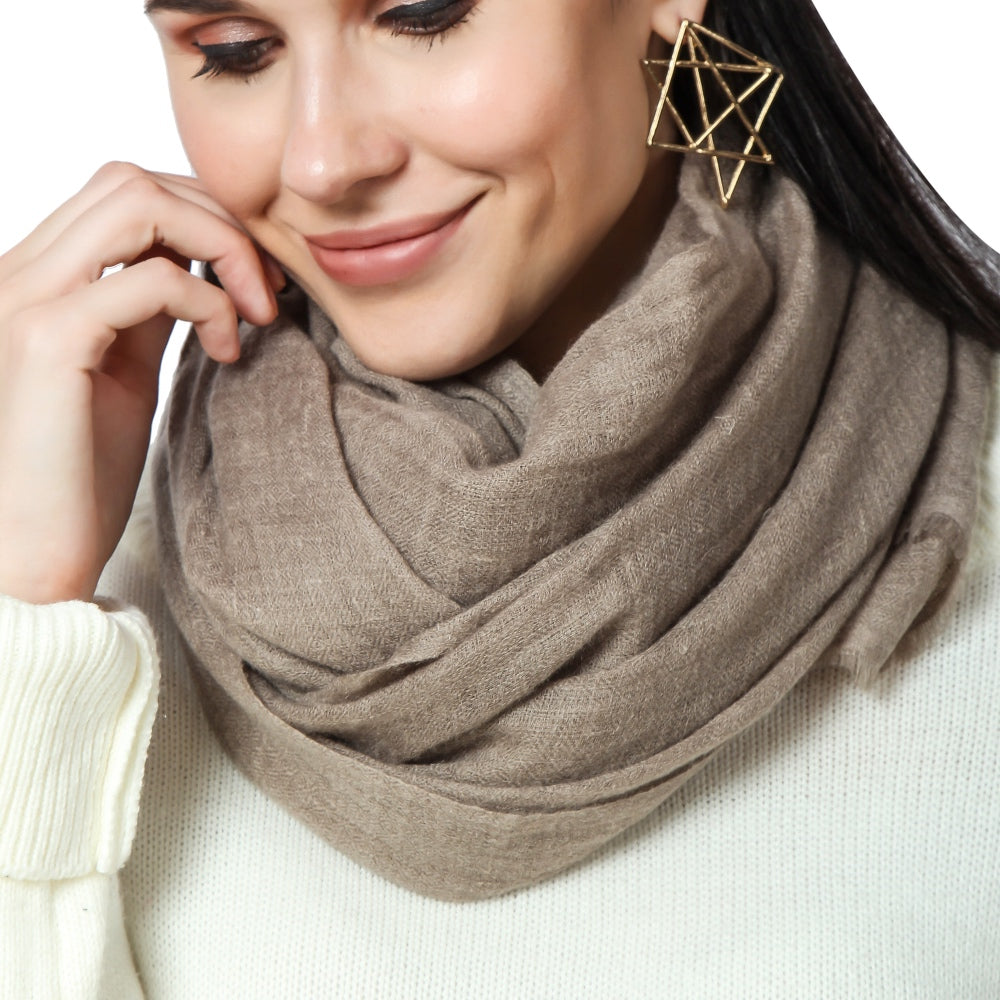
The first thing a viewer notices about a genuine Shahtoosh shawl is not a single dramatic visual property but an overall impression of extraordinary lightness and smoothness — a fabric that seems to occupy less visual space than its dimensions would suggest, that falls in unbroken continuous curves rather than holding any shape of its own, and whose surface has a uniform, almost reflective evenness without the slight texture variation that most woven cloth shows.
These visual properties are all consequences of the fiber's extreme fineness — 9–12 microns, producing a thread so fine that the weave structure itself is nearly invisible to the naked eye at normal viewing distance, and a fabric weight so low that the drape is dominated by gravity rather than by any structural stiffness in the cloth.
Colour Range — The Shahtoosh Palette
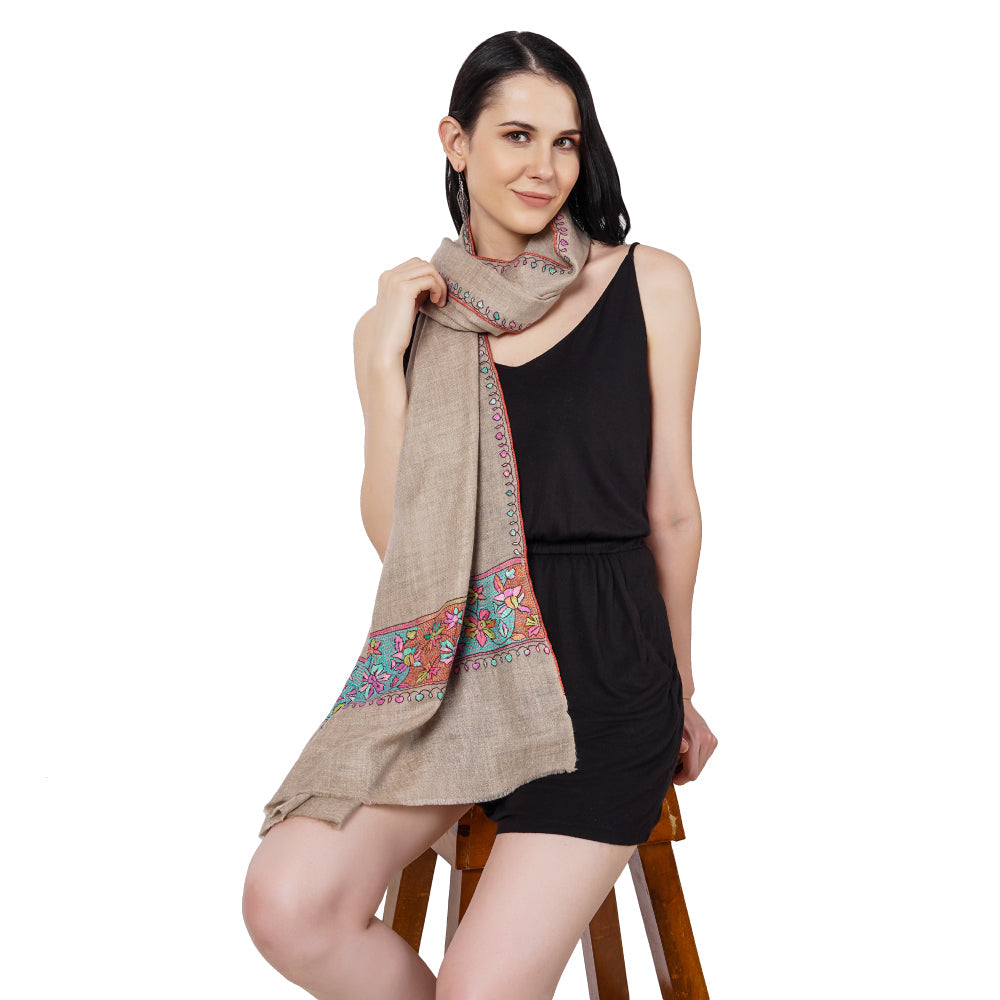
The chiru's natural fiber colour — a warm off-white to ivory, slightly yellower than the cool-white of some commercial wools. Undyed pieces in this colourway were among the most prized, as the natural fiber showed the weave's fineness without the slight colour variation that dyeing could introduce.
Most common in fine-quality pieces where the seller wanted to emphasise the fiber's natural properties.
A traditional Kashmir dyeing colour — warm yellow to gold tones achieved with natural or synthetic dyes on the fine fiber. The fine thread takes colour with exceptional evenness due to the high surface area relative to fiber mass, producing a more saturated and even tone than the same dye on a coarser fiber.
A classic colourway for pieces intended for the South Asian domestic luxury market.
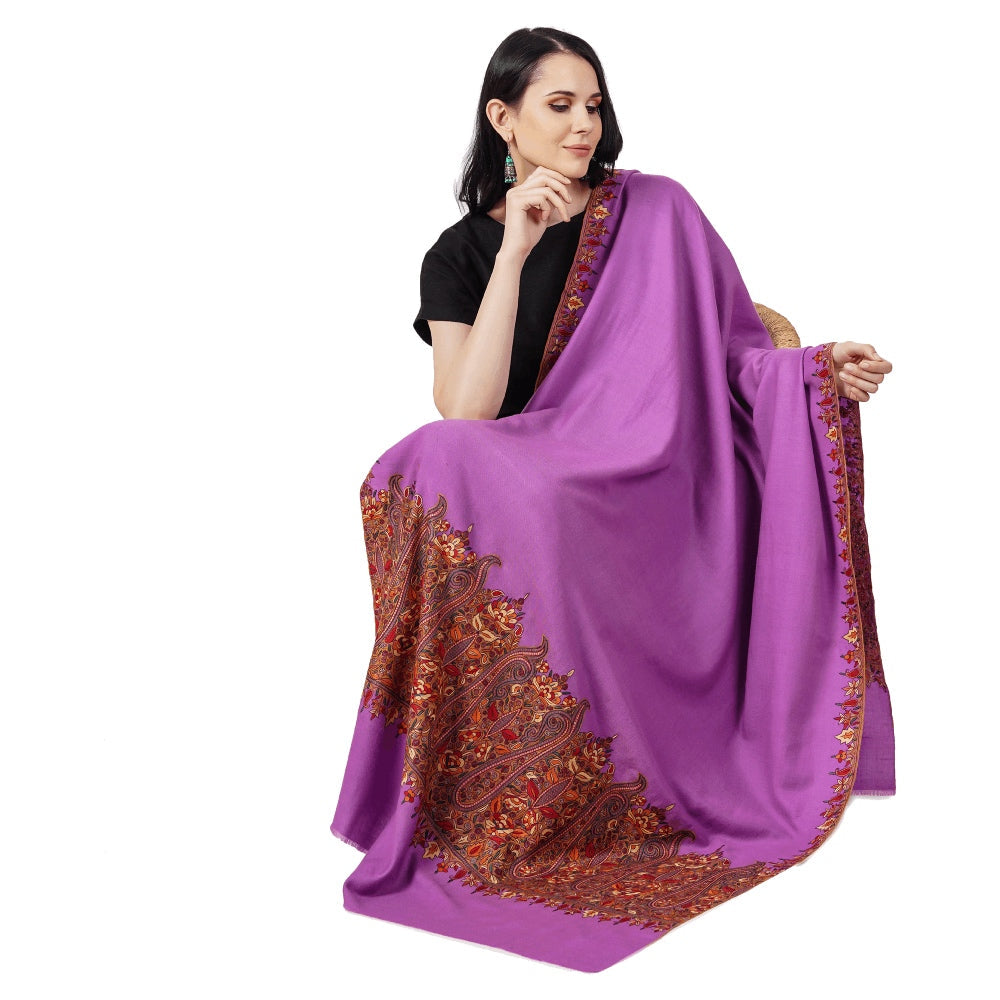
Deep red tones — crimson, wine, and burgundy — were among the most popular colourways for pieces sold into Western markets in the 1980s–1990s, where they read as luxury and warmth against winter clothing. The fine Shahtoosh fiber achieves deep even saturation in red tones that photographs well and photographs distinctively.
Heavily photographed in fashion press coverage of the period — the crimson Shahtoosh shawl became a visual signifier of the product category.
Deep blue tones — navy and midnight blue — were common in the export market for Western buyers who wanted a neutral luxury piece. Blue tones in fine animal fiber have a characteristic depth and evenness that is difficult to achieve in coarser yarns; in fine Shahtoosh, deep blues have a slightly luminous quality.
Popular for pieces intended as gifts — readable as both masculine and feminine in presentation.
Green tones — forest, bottle, and hunter green — completed the typical luxury colourway range for Western export. The fine fiber achieves richness in green tones without the slight yellow-green cast that some coarser fibers develop under certain dyeing conditions.
Less common than red and blue; appeared more in pieces aimed at the European market than the US or Japanese markets.
✦ Colour as a Visual Identifier — What It Does and Does Not Tell You
Colour is the least diagnostic visual characteristic for identifying Shahtoosh. Fine Pashmina is dyed in exactly the same colour range using the same dyeing methods, and the two fibers achieve similar saturation and evenness at equivalent quality levels. A colour you associate with Shahtoosh — crimson, navy, saffron — is equally achievable in fine Pashmina. Conversely, a colour that does not match the typical Shahtoosh palette does not rule out Shahtoosh — the fiber can be dyed any colour that standard protein fiber dyeing achieves. Colour tells you nothing diagnostically useful about whether a piece is Shahtoosh or Pashmina.
Weave Structure — What the Surface Looks Like Up Close
🔍 Weave Surface — Shahtoosh vs Pashmina at Close Viewing
The weave structure of genuine Shahtoosh is plain weave — the simplest interlacing of warp and weft threads, alternating over-under across the full width of the fabric. This is the same construction used for fine Pashmina. What differs is the thread count at which that structure is realised: Shahtoosh, woven from thread at 9–12 microns, achieves a higher thread count per centimetre than fine Pashmina woven from thread at 12–16 microns, producing a denser weave grid that is correspondingly harder to see with the naked eye.
At normal viewing distance — say, arm's length — neither the Shahtoosh weave grid nor the fine Pashmina weave grid is clearly visible. Both surfaces appear essentially smooth and uniform, with no discernible texture pattern. Moving closer — to the distance at which you might examine the fabric critically — the grid begins to become apparent in both, with the Shahtoosh grid remaining less visible than the Pashmina grid due to its higher density. A loupe (a jeweller's magnifying glass) makes the grid clearly visible in both; under a loupe, the Shahtoosh grid is notably finer than fine Pashmina but the difference requires comparing the two together to be reliably apparent.
Drape Profile — How It Looks in Motion and at Rest
🌊 Drape Comparison — Shahtoosh vs Fine Pashmina Falling from a Hand
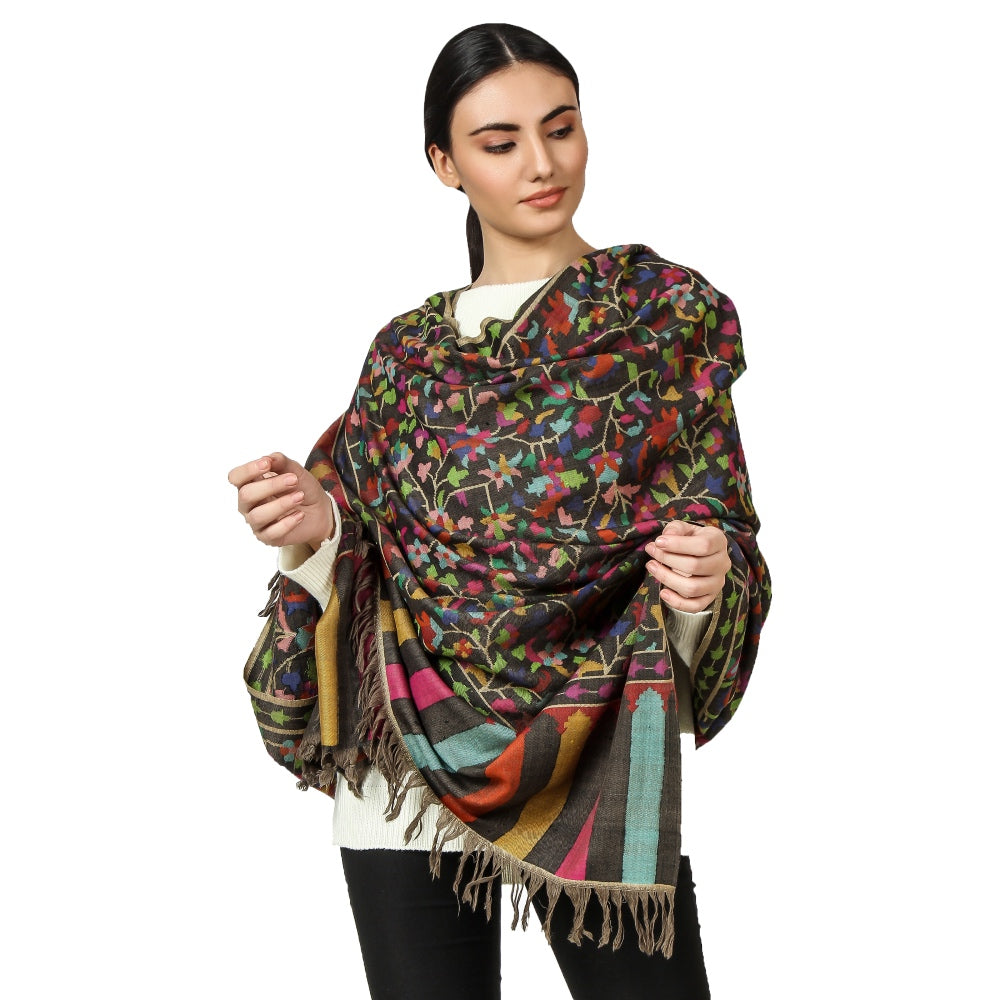
The drape difference between Shahtoosh and fine Pashmina is the most visually detectable distinction between the two — and it is still subtle. As documented in our sensory comparison article, drape is the dimension where experienced handlers most reliably distinguish the fibers. Visually, what this means is: when a Shahtoosh shawl is held from one corner and allowed to fall freely, the fabric descends in a single continuous curve with minimal variation in the falling width — it appears to fall as a liquid would, with almost no structural memory of its own. Fine Pashmina falls similarly but with fractionally more body — the falling fabric maintains a slightly wider width at the base, reflecting the marginally higher GSM.
Translucency — The Light Test
💡 Translucency — The Light Test Illustrated
When held up to a light source, a fine Shahtoosh shawl shows a degree of translucency — light passes through the fabric, creating a visible glow in the held area. This is the visual phenomenon that underlies the ring test: a fabric fine enough to be translucent is fine enough to collapse through a small ring. Fine Pashmina also shows translucency when held to light, but somewhat less than Shahtoosh at equivalent dimensions because the slightly higher GSM of Pashmina cloth blocks somewhat more light.
The critical point about translucency as a visual identifier: silk, modal, viscose, and fine cashmere all also show translucency when woven fine enough. Translucency is a property of low GSM plain-weave fabric, not a property specific to Shahtoosh. A translucent shawl is probably fine; it is not probably Shahtoosh.
Dimensions and Weight — How a Full Piece Looks
Standard Shahtoosh shawls produced for the commercial market during the trade's peak were typically produced in two primary formats:
- Full shawl: Approximately 190–210cm long × 90–110cm wide. At these dimensions in genuine Shahtoosh, weight typically 90–120 grams — shocking by its lightness when lifted, as the shawl appears large enough to weigh several hundred grams but registers as almost nothing in the hand.
- Stole / wrap: Approximately 190–210cm long × 65–75cm wide. Lighter still by dimension, but the weight reduction is perceptible compared to the full shawl in the same colourway and weave count.
The dimensions themselves are not diagnostic — fine Pashmina shawls are produced in the same range. What is distinctive is the weight-at-dimension ratio: a full Shahtoosh shawl at 200 × 100cm weighing 100 grams is lighter than most buyers expect, and lighter than equivalent fine Pashmina at the same dimensions by perhaps 20–30%.
What Sellers Showed — The Visual Demonstrations
🎭 The Seller's Visual Demonstration Sequence
The seller lifts the full shawl on one finger, demonstrating its minimal weight. The entire piece hangs from a single fingertip in a single fluid fall, visually confirming its lightness before the buyer touches it.
What it proves: The shawl is light — consistent with fine fiber at low GSM. Also consistent with fine Pashmina, silk, or a fine blend. Not diagnostic of species.
The seller draws the full shawl through a small finger ring or a specially prepared narrow ring, the fabric compressing into a stream no wider than the ring's diameter. The effect is visually dramatic — a large shawl apparently dissolving into nothing.
What it proves: The fabric is fine and lightweight enough to compress through the ring. Also consistent with silk, fine modal, viscose, and fine Pashmina. Not diagnostic of species. Documented in detail in our ring test debunking article.
The seller holds the shawl between the buyer and a light source, showing the fabric's translucency. The design, if any, becomes visible as a shadow-pattern through the fabric; a plain shawl shows a diffuse light passage.
What it proves: The fabric is translucent — confirming low GSM and fine weave. Also consistent with any fine plain-weave fabric at similar GSM. Not diagnostic of species.
The seller places the shawl against the buyer's cheek or the back of their hand, demonstrating the immediate warmth sensation and complete absence of any prickle or roughness.
What it proves: The fiber is below the prickle threshold and produces immediate warmth from the hollow-core structure. Also consistent with fine Pashmina. Not diagnostic of species.
⚠ The Visual Demonstration Problem
Every visual demonstration that the Shahtoosh trade used — the lift, the ring test, the light test, the warmth demonstration — proves properties of the fabric that are also present in fine Pashmina, fine silk, or fine synthetic blends. None of the demonstrations prove species identity. The demonstrations were visually dramatic and the properties they illustrated were genuine — the shawl really was light, really did pass through a ring, really was translucent, really was warm against bare skin. But genuine is not the same as diagnostic. A demonstration that is genuinely impressive and simultaneously completely uninformative about the most legally significant question — what species is this? — is not evidence of anything except the seller's skill at selecting demonstrations.
Visual Comparison — Shahtoosh vs Genuine Pashmina
Completely smooth surface — no visible weave grid, no texture, no pile. The surface has a slight sheen from the fine thread's reflectivity at scale. Colour is very even — no variation between selvedge and centre, no visible thread colour variation. Appears as a continuous field of colour with a slight luminosity.
Very smooth surface — the weave grid is not visible at arm's length but the fabric has a fractionally more present surface quality than Shahtoosh. Colour is equally even. The visual difference from Shahtoosh at arm's length is minimal — both read as extremely fine, plain, solid-colour cloth.
At arm's length: The two fibers are not reliably distinguishable by sight alone. Both present as smooth, even, fine cloth.
At close inspection, the weave grid becomes faintly apparent — more as a shimmer pattern than as individual threads. The thread itself is too fine to be individually visible to the naked eye. The surface appears completely even, with no variation in the reflective sheen across different areas of the fabric.
The weave grid is slightly more apparent at close inspection than in Shahtoosh — the individual threads are still very difficult to see with the naked eye but the grid structure creates a fractionally more perceptible surface pattern. An experienced handler can sometimes detect the difference at this distance, but it requires both fibers being present for comparison.
At close inspection: Experienced handlers may detect a difference in surface fineness. Most viewers cannot. Both fibers look extraordinarily fine at this distance.
What Visual Inspection Cannot Tell You
✗ What the Eye Cannot Determine — However Closely You Look
- Whether the fiber is from chiru or Changthangi goat — the visual properties overlap completely in the range where both fibers exist. No visual inspection, however expert, reliably distinguishes them without laboratory analysis.
- Whether a piece is genuine Shahtoosh or a very fine cashmere or Pashmina that was sold as Shahtoosh — many pieces sold as Shahtoosh were not. The seller's claim is not verifiable by looking at or handling the piece.
- Whether the ring test proves species — it proves fineness and low GSM, which multiple legal fibers share. A piece that passes the ring test may be Shahtoosh, Pashmina, silk, modal, or a fine blend.
- Legal status — the physical appearance of a textile reveals nothing about whether it is the product of an illegal supply chain. A Shahtoosh piece and a fine Pashmina piece look the same because they are the product of the same weaving tradition using structurally similar fibers.
- Whether a piece described as "vintage Shahtoosh" is actually Shahtoosh — most pieces so described have never been laboratory tested. The claim is as likely to reflect the seller's or original buyer's belief as it is to reflect the fiber's actual species identity.
The eye can tell you it is extraordinary. Only the laboratory can tell you what it is.
For every legal and practical purpose, the laboratory answer is the only one that matters.
Frequently Asked Questions
Genuine Shahtoosh was produced in the full range of colours that Kashmir textile dyeing achieves — from natural undyed ivory through deep jewel tones. The most common commercial colourways in the Western export market were natural ivory/cream (undyed), deep crimson, navy, and forest green. Saffron and warm gold tones were more common in pieces sold for the South Asian domestic market. There is no colour that is specific to Shahtoosh — fine Pashmina is produced in exactly the same colour range using the same dyeing methods, and the two fibers achieve similar colour depth and evenness at comparable quality levels.
Not reliably, even by experts. The visual properties of fine Shahtoosh and fine Pashmina — surface smoothness, colour depth, drape profile, translucency — overlap in the range where both fibers exist. Some experienced handlers claim to distinguish them by sight when both are present for comparison, primarily based on the Shahtoosh's marginally more fluid drape and fractionally less visible weave grid. Neither of these differences is reliable for species identification in any single piece. The only reliable method for distinguishing the species is laboratory fiber analysis — OFDA or SEM — which examines the microscopic scale pattern of the fiber cuticle, which differs between chiru and Changthangi goat at a level invisible to the naked eye.
The ring test demonstrates that the fabric is fine and lightweight enough to compress through a small ring — a property of any fine plain-weave fabric at low GSM. The visual drama of the demonstration (a large shawl passing through a ring no wider than a finger) is real: it is a genuinely impressive demonstration of the fabric's lightness and fineness. What it does not demonstrate is the species identity of the fiber, because fine Pashmina, fine silk, fine modal, and fine viscose will all pass through the same ring just as smoothly. The ring test, as a species identification method, has been definitively documented as non-diagnostic — detailed in our ring test article.
The selvedge edges (the woven edges parallel to the warp) of a genuine Shahtoosh shawl are typically left as the natural loom selvedge — the weft thread turning at the edge creates a neat, compact edge that is narrower than the body of the fabric and distinguishable from a cut edge. The end edges (perpendicular to the warp) are typically finished with a hand-rolled hem or a very fine stitched edge, as the cut warp threads at these edges require finishing to prevent fraying. In pieces that have end borders (embroidered or woven decorative bands at each end), the ends may be more elaborately finished. This edge treatment is the same for fine Pashmina shawls of equivalent quality — it is not diagnostic of Shahtoosh specifically.
The fiber that looks the same and is entirely different
Genuine Pashmina — looks extraordinary,
because it is extraordinary. And legal.
GI-certified Kashmiri Pashmina looks, at arm's length, like what Shahtoosh was sold as. Up close — and in a laboratory — it is documented, traceable, and from a living animal. The visual experience is essentially the same. Every other dimension is completely different.