
What GSM Is Best for a Cashmere Scarf?
Every other answer to this question gives you a vague range and calls it guidance. Here is the precise answer from inside the Pashmina supply chain: single ply should be 80 GSM. Double ply should be 120 GSM. These are not approximations — they are the specifications at which genuine Pashmina performs exactly as it should.
GSM — grams per square metre — is the most useful single number for evaluating a cashmere scarf, and the one that most buyers never think to ask about. It tells you more than price, more than fibre content claims, and more than the vague adjectives — "lightweight," "ultra-fine," "substantial" — that fill product descriptions without saying anything measurable.
GSM tells you how much fibre is actually in the fabric. And because in genuine Pashmina the fibre is doing the work — trapping air, providing warmth, creating drape — GSM is the number that determines whether a piece will perform the way it should or fall short of what it promises.
The problem is that most sources discussing cashmere GSM either avoid precise numbers or give ranges so wide they are useless. "100 to 300 GSM depending on weight" is not guidance. It is the absence of guidance dressed up as information.
Here is the precise answer, from direct sourcing experience inside the Kashmir supply chain: single ply genuine Pashmina should be 80 GSM. Double ply should be 120 GSM. These are not comfortable midpoints in a range. They are the specific weights at which the fibre count, the weave structure, and the warmth-to-weight ratio of genuine Pashmina are correctly calibrated — and everything either side of them is a compromise.
Single ply: 80 GSM. Double ply: 120 GSM. These are the numbers. Everything below is too thin. Everything significantly above is too heavy. The sweet spot is not a range — it is a number.
GSM — grams per square metre — is the standard textile measurement of fabric weight. Take a square of fabric one metre by one metre, weigh it in grams, and that number is the GSM. A higher GSM means more fibre per unit of fabric area — denser weave, more warmth, more structural presence. A lower GSM means less fibre per unit area — lighter, more breathable, more fluid drape.
For most textiles — cotton, linen, polyester — GSM tracks fairly directly with warmth and durability. Heavier means warmer and more robust. For genuine Pashmina, this relationship is more nuanced, because Pashmina achieves warmth through the hollow-core structure of each individual fibre rather than through sheer fibre mass. This means that a correctly specified Pashmina piece at 80 GSM provides warmth that a wool piece would need 250 GSM to match. More GSM in Pashmina does not simply mean more warmth — it means more fabric, more weight, and eventually a piece that has drifted away from the specific properties that make Pashmina exceptional in the first place.
GSM vs. Total Gram Weight — Understanding the Difference
GSM and total gram weight are related but distinct. A scarf measuring 70×200cm at 80 GSM has a total area of 1.4 square metres — giving it a total weight of approximately 112 grams. The same dimensions at 120 GSM would weigh approximately 168 grams. Both measurements matter: GSM tells you the fibre density of the fabric itself, while total weight tells you the practical heft of the finished piece in your hands. For a buyer evaluating a scarf, total weight is the more immediately intuitive number — but GSM is the more technically informative one, because it normalises for size and tells you what the fabric itself actually contains.
📐 The GSM Calculation for a Standard Pashwrap Scarf
Single ply scarf: 70cm × 200cm = 1.4m² × 80 GSM = 112g total weight
Double ply scarf: 70cm × 200cm = 1.4m² × 120 GSM = 168g total weight
These are the weights at which a correctly specified genuine Pashmina scarf should arrive. If a product claiming to be a 70×200cm Pashmina scarf weighs significantly less than 100g, the GSM is below the minimum threshold for structural integrity. If it weighs more than 200g, the GSM is above the range where Pashmina's hollow-core advantage is expressed most efficiently.
Here is every meaningful GSM range in the cashmere scarf market — what it contains, what it performs like, and whether it represents genuine Pashmina quality.
⚖️ Cashmere Scarf GSM Scale — From Too Thin to Too Heavy
The two highlighted rows — 80 GSM for single ply and 120 GSM for double ply — are the precise specifications at which genuine Pashmina's hollow-core warmth, drape, and structural integrity are correctly balanced. These numbers come from direct production experience in the Kashmir Valley supply chain, not from a range estimate.
Single ply and double ply refer to the number of yarn threads twisted together to form the weaving yarn. In single ply, each warp and weft thread is a single hand-spun strand. In double ply, two strands are twisted together before weaving, creating a thicker, denser yarn and a heavier, more structured fabric. The GSM difference — 80 versus 120 — is the direct consequence of this structural choice.
Light, fluid, three-season
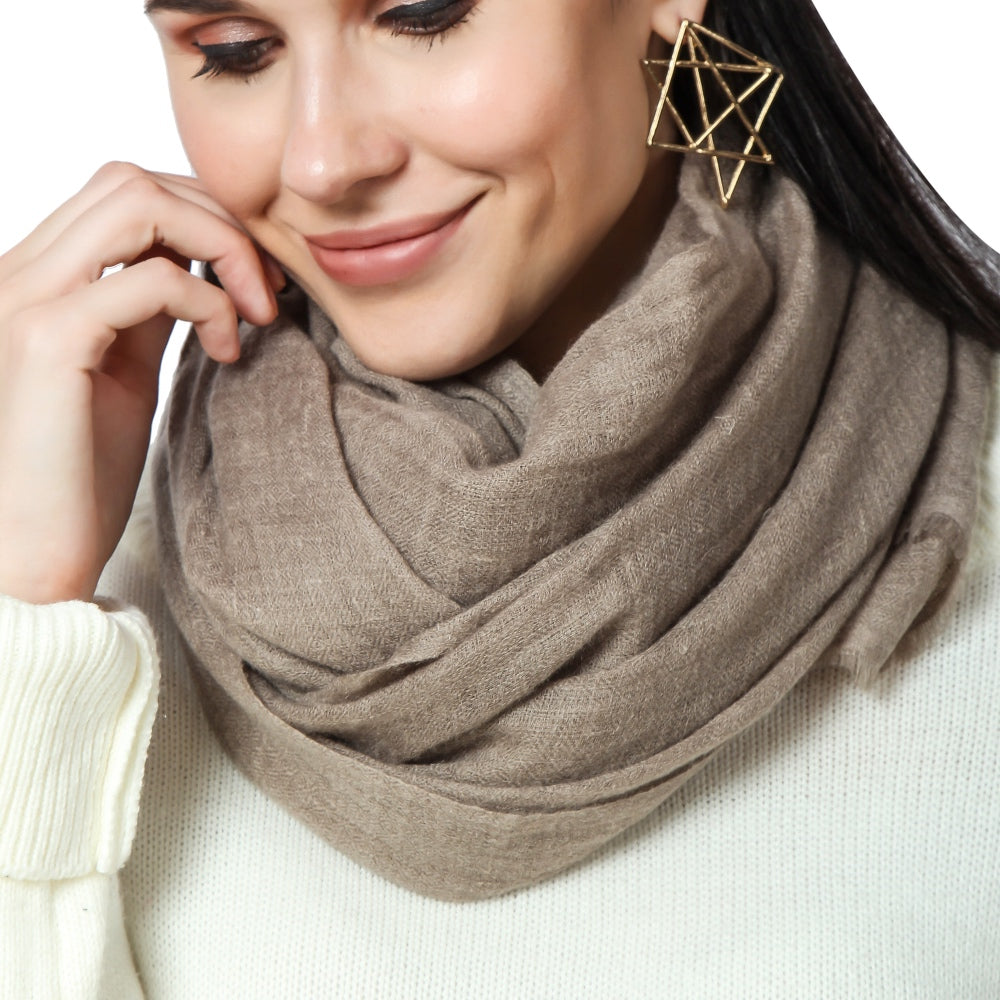
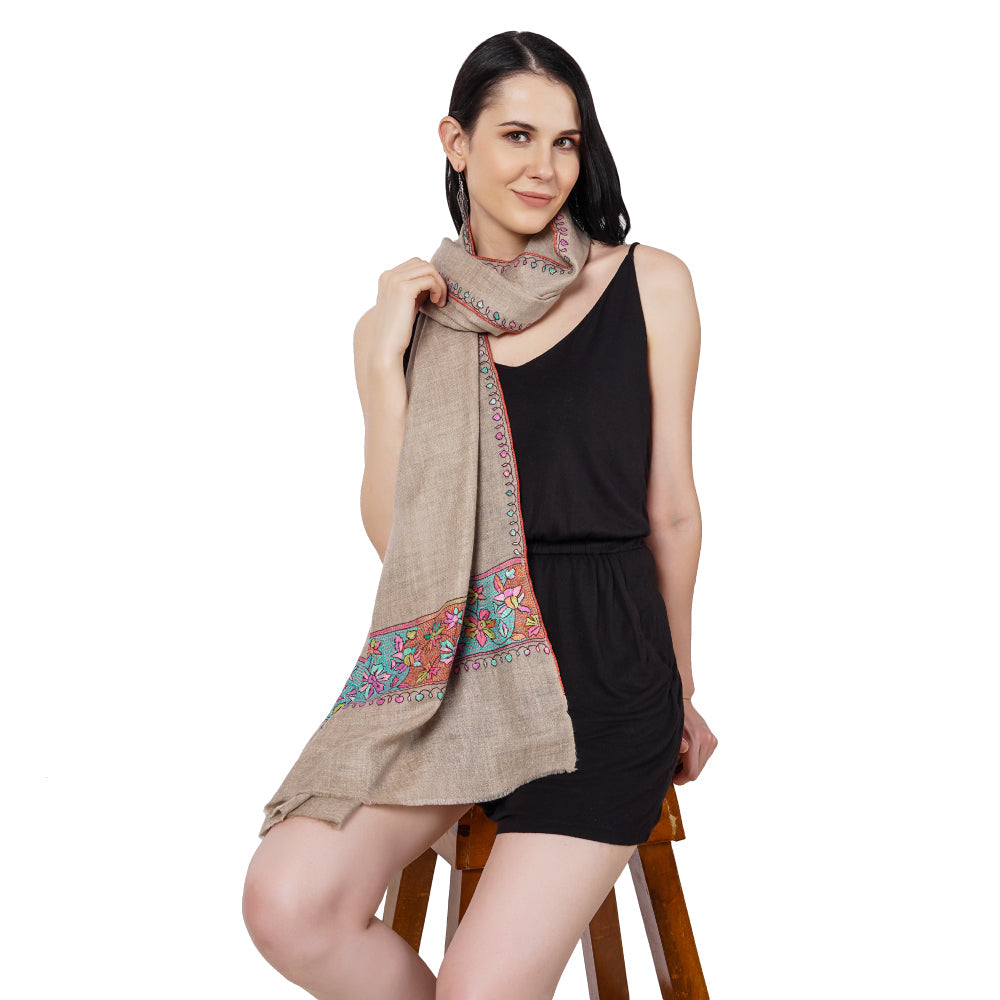
Single ply at 80 GSM is the authentic form of a Pashmina scarf — the weight at which the fibre's natural drape, hollow-core warmth, and fluid movement are most fully expressed. It is light enough for spring and autumn, warm enough for cool evenings, and fine enough that it folds to almost nothing in a bag or pocket. This is the GSM of a piece that gets reached for constantly because it does everything without being heavy.
Structured, substantial, winter-ready
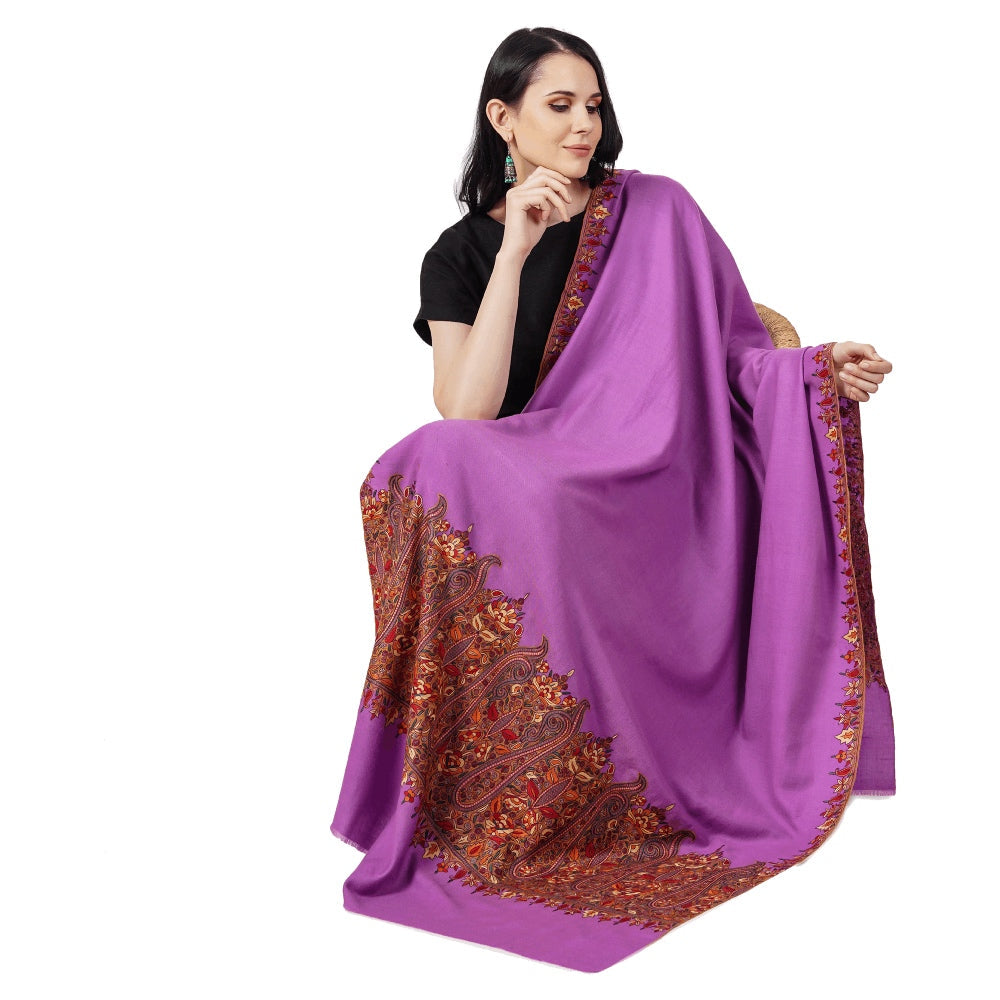
Double ply at 120 GSM is the winter specification — the weight at which two twisted strands of hand-spun Pashmina create a fabric with genuine structural presence, sustained warmth, and the kind of body that makes a scarf feel like a real cold-weather layer rather than a decorative addition. It is heavier and more structured than single ply, but still dramatically lighter than any wool alternative at comparable warmth. This is the GSM of a piece that earns its place in a serious winter wardrobe.
Single ply at 80 GSM is not a lesser version of double ply at 120 GSM. They are two different specifications for two different uses — both correct, both intentional, and both precisely calibrated to a specific performance outcome.
The Problem with Under 80 GSM
A single ply Pashmina scarf below 80 GSM has been under-woven. The warp and weft thread count is insufficient to create a fabric with the structural integrity that genuine Pashmina requires. What results is a piece that feels impressively light at point of purchase and begins to reveal its inadequacy in use: it pills faster because the fibre is less anchored in the weave, it loses its shape because the weave is too open to hold, and it feels insubstantial in a way that gives the impression of cheapness rather than fineness.
Under 80 GSM is also the range where fraudulent sellers operate most confidently. A very thin fabric is easier to produce cheaply — less fibre, lower material cost, faster weaving — and the lightness that results can be misrepresented as an indicator of exceptional fineness. It is not. Genuine fineness in Pashmina comes from 12–14 micron fibre diameter, not from an insufficient weave count. A piece that is thin because it contains too little fibre is not fine. It is sparse.
The Problem with Over 150 GSM for a Scarf
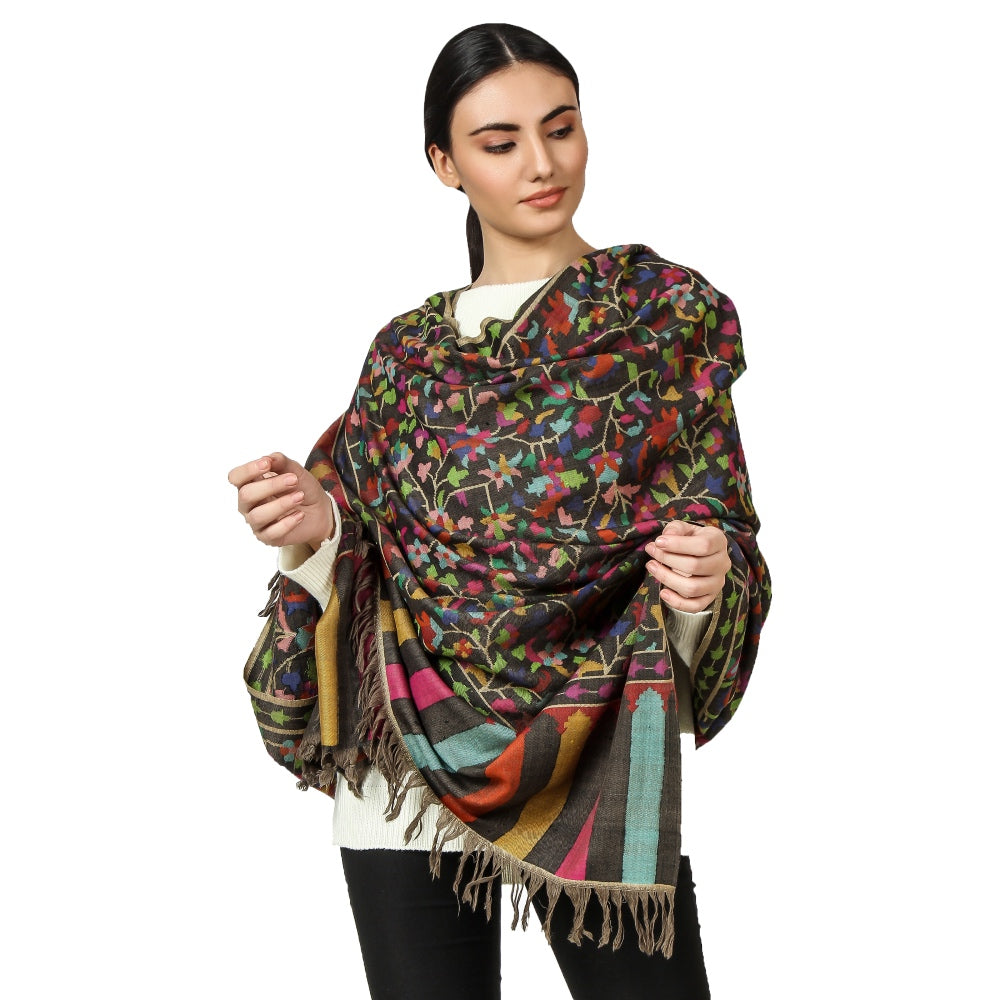
Above 150 GSM, a Pashmina piece transitions from scarf to shawl territory — and the performance characteristics shift accordingly. A scarf at 150+ GSM has enough fibre mass that warmth is being achieved partly through bulk rather than purely through hollow-core efficiency. It is heavier on the neck, less fluid in drape, and less versatile across temperature ranges. It is not a bad piece — it is the wrong specification for a scarf. Shawls, which provide shoulder and chest coverage rather than neck wrapping, benefit from higher GSM because the larger surface area justifies the additional fibre weight. For a neck scarf, 150+ GSM is more than the application requires.
⚠️ The GSM Fraud Pattern
Two common GSM-related frauds operate in opposite directions. The first is under-GSM fraud: selling a piece at 40–60 GSM as "ultra-lightweight luxury Pashmina" when it is in fact under-woven and structurally deficient. The second is over-GSM misrepresentation: selling a 200+ GSM wool or acrylic piece as "heavyweight premium cashmere" when the weight is not from fine hollow-core fibre but from cheap dense fiber that achieves bulk without quality. Both frauds exploit the fact that most buyers do not know what GSM to expect — which is precisely why knowing the correct numbers matters.
GSM is only useful as a buying tool if you can access the information. Here is how to use it at every stage of the purchasing process.
Ask the seller directly — before anything else
A transparent seller who knows their product will state the GSM without hesitation. "What is the GSM of this scarf?" is a specific, measurable question that requires a specific, measurable answer. A seller who responds with "it's very lightweight" or "it's our finest weight" without a number either does not know or does not want you to know. Both responses are informative — just not in the way they intend.
Calculate from total weight and dimensions
If a seller provides total weight and dimensions, you can calculate GSM yourself. Convert dimensions to metres, multiply to get area in square metres, then divide total weight in grams by area. A 70×200cm scarf weighing 112g: 0.7 × 2.0 = 1.4m² · 112g ÷ 1.4 = 80 GSM. A scarf of the same dimensions weighing 70g gives 50 GSM — below the structural threshold. A scarf weighing 168g gives 120 GSM — the double ply sweet spot.
Use the hold-up test as a physical proxy
Hold the fabric up between you and a light source. Genuine Pashmina at 80 GSM single ply is fine and slightly translucent in the way that high-quality woven fabric is — the light diffuses through it evenly without creating visible gaps in the weave. A fabric that shows distinct open gaps when held to the light is below 80 GSM and structurally deficient. A fabric that is completely opaque with no light transmission at all is likely above 120 GSM or made from a heavier fibre entirely.
Cross-reference with price
Correct GSM and correct pricing are correlated. A single ply 80 GSM genuine Pashmina scarf cannot be sold below $100 — the fibre, spinning, and weaving costs cannot be accommodated at that weight and that price. A product claiming 80 GSM genuine Pashmina at $30 is making a claim the economics cannot support. Either the GSM is wrong, the fibre claim is wrong, or both.
The Complete GSM Reference — At a Glance
| GSM | Ply | Total Weight (70×200cm) | Best Use | Verdict |
|---|---|---|---|---|
| Under 60 | — | Under 84g | Nothing | Structurally deficient — avoid |
| 60–75 | Single ply | 84–105g | Decorative / very mild spring | Below ideal — borderline |
| 80 | Single ply | ~112g | Spring · Autumn · Mild winter | ✓ Single ply sweet spot |
| 90–110 | Single or light double | 126–154g | All-season scarf | Good — versatile range |
| 120 | Double ply | ~168g | Autumn · Winter | ✓ Double ply sweet spot |
| 130–180 | Double ply / shawl | 182–252g | Winter shawl · Full coverage | Correct for shawls — heavy for scarves |
| 200+ | Not Pashmina scarf | 280g+ | Wool / heavy wrap territory | Not a Pashmina scarf specification |
The Answer — Simple, Specific, Unambiguous
What GSM is best for a cashmere scarf? Single ply: 80 GSM. Double ply: 120 GSM. These are the numbers at which genuine Pashmina — 12–14 micron Changthangi fibre, hand-spun, handwoven — performs exactly as it should. The hollow-core warmth is correctly expressed. The drape is correctly proportioned. The structural integrity is sufficient for decades of wear. And the weight-to-warmth ratio is at its most efficient point.
Below 80 GSM, a single ply scarf is under-woven and will not hold up. Above 150 GSM, a scarf has drifted into shawl territory and is heavier than the application requires. At 80 and 120 GSM respectively, a genuine Pashmina piece is exactly what it should be — nothing missing, nothing unnecessary, and nothing that a vague range would have told you.
To understand the fibre behind these specifications and why Pashmina at 12–14 microns outperforms all alternatives, read What Is the Difference Between Cashmere and Pashmina? To understand why a correctly specified Pashmina at these GSM numbers lasts decades, read Is a Cashmere Scarf Worth It? To understand how this GSM translates into winter performance, read Best Cashmere Scarf for Winter. To understand the honest price of a scarf at these specifications, read How Much Should a Real Cashmere Scarf Cost?
To find genuine Pashmina at the correct GSM specification — single ply and double ply — visit the Pashwrap collection.